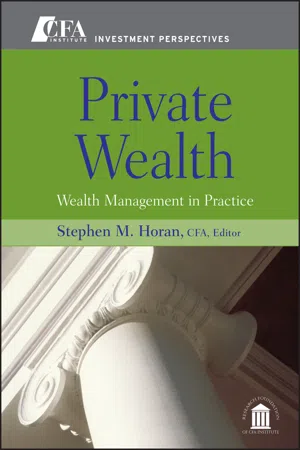
Managing the assets of high-net-worth individuals has become a core business specialty for investment and financial advisors worldwide. Keeping abreast of the latest research in this field is paramount. That's why Private Wealth, the inaugural offering in the CFA Institute Investment Perspectives series has been created. As a sister series to the globally successful CFA Institute Investment Series, CFA Institute and John Wiley are proud to offer this new collection. Private Wealth presents the latest information on lifecycle modeling, asset allocation, investment management for taxable private investors, and much more. Researched and written by leading academics and practitioners, including Roger Ibbotson of Yale University and Zvi Bodie of Boston University, this volume covers human capital and mortality risk in life cycle stages and proposes a life-cycle model for life transitions. It also addresses complex tax matters and provides details on customizing investment theory applications to the taxable investor. Finally, this reliable resource analyzes the use of tax-deferred investment accounts as a means for wealth accumulation and presents a useful framework for various tax environments.
- English
- ePUB (mobile friendly)
- Available on iOS & Android
eBook - ePub
PART I
LIFE-CYCLE INVESTING
CHAPTER 1
THE FUTURE OF RETIREMENT PLANNING
Robert C. Merton
The next generation of retirement products will provide the user-friendliness and simplicity of defined-benefit plans, but they will come in the form of increasingly sophisticated defined-contribution plans. The tools and technology needed to design such products are available in the marketplace and need only be adapted to retirement applications.a
With the move to defined-contribution plans, we, the financial services industry, are asking individuals to make complex financial management decisions that they have not had to make in the past and that, for the most part, they are not adequately prepared to make. In addition, I believe we are presenting these decisions in formats that make them difficult for individuals—even those who are generally well educated—to resolve.
I will begin this presentation with a few remarks about defined-benefit retirement plans, particularly how they went wrong and what we can learn from their flaws. I will then discuss defined-contribution plans, which have become the de facto alternative to defined-benefit plans. Unfortunately, traditional defined-contribution plans have a number of features that prevent them from being the long-term answer for employer-sponsored retirement plans. Thus, I will discuss a next-generation solution deriving from defined-contribution plans. Finally, I will discuss financial management technology and the tools available today that can be used to address and help solve the shortcomings of current retirement products.
DEFINED-BENEFIT RETIREMENT PLANS
Most expert observers agree that corporate defined-benefit (DB) plans are on their way out. The trend in that direction was emphasized in particular when IBM announced in early 2006 that it intended to close its defined-benefit plan to both existing and new employees. IBM isan employee-centric, financially strong company with an overfunded DB plan, and yet the DB plan is being shut down. Some observers say that defined-benefit plans have become too expensive for the corporations to maintain; others say they are too risky. I think the simplest explanation for what happened to defined-benefit plans is that they were mispriced, not three or five years ago but from the outset.
For example, assume that the liabilities in a defined-benefit pension plan have the equivalent duration of 10 years and a risk-free rate of 5 percent. Assume, too, that the plan used a blended expected return on the asset portfolio of 9 percent, not risk adjusted (with assets including risky securities). If liabilities that should have been discounted at 5 percent with a 10-year life span are instead discounted at 9 percent, the result is two-thirds of the present value. Thus, for every $1.00 of cost a corporation is expecting from a plan, the cost is actually $1.50.
If a corporation is negotiating with its employees and it offers what it mistakenly believes is $1.00 of benefits that are really worth $1.50, then employees are likely to choose the benefits offered over cash, even if they do not know the actual value of the benefits. As an analogy, consider a corporate automobile perk that allows employees to choose either a Toyota Camry or a Bentley. Which will they choose? Will the outcome be random? I do not think so. Even if they have no idea of the actual cost of each, most people are likely to pick the $300,000 Bentley over a $30,000 Camry, and just so with generous benefits versus cash compensation.
From the very beginning, providers and sponsors should have recognized that the accounting treatment of these plans was systematically underpricing the cost of benefits. Because of this underpricing, I can say with confidence that we will not go through a cycle that brings us back to defined-benefit plans, at least not to plans with such a pricing structure. Defined-benefit plans have some admirable features, and they may be used again, but we will not return to them with these benefits at this price.
Although defined-benefit plans have been underpriced from the beginning, the reason they are being shut down now rather than 10 years ago is path dependent. During the 1990s, the stock market was up 9 out of 10 years. Therefore, funding for such underpriced plans appeared not to be an issue. But the 2000-02 market crash combined with globally falling interest rates changed that unrealistic outlook, which is why the plans are being reconsidered now.
DEFINED-CONTRIBUTION RETIREMENT PLANS
The use of defined-contribution plans has become the default strategy following the decline in defined-benefit plans. Although defined-contribution plans solve the problem for the plan sponsor by (1) making costs predictable and (2) taking risk off the balance sheet, they place a tremendous burden of complex decision making on the user.
For example, assume the objective function is that employees hope to maintain the same standard of living in their retirement that they enjoyed in the latter part of their work lives. If that is the goal, then a defined-benefit type of payout is quite attractive. In a defined-contribution scenario, however, a 45-year-old will have contributions coming in for 20 years or more and a 35-year-old for 30 years prior to retirement, and each will need to decide the size of these contributions, as well as the types of investments to make with these funds, in order ultimately to provide the required standard of living at the age of 65.
Finding and executing a dynamic portfolio strategy to achieve such a goal is an extremely complex problem to solve, even for the best financial minds. Yet, through the use of defined-contribution plans, the financial services industry is, in effect, asking employees of all sorts—from brain surgeons, to teachers, to assembly line workers—to solve just such a problem. The situation is not unlike that of being a surgical patient who, while being wheeled into the operating room, has the surgeon lean down and say, “I can use anywhere from 7 to 17 sutures to close you up. Tell me whatever number you think is best, and that is what I will do.” Not only is that a frightening decision for a patient to be faced with, but it is one that most patients are, at best, poorly qualified to make.
The Next Generation of Retirement Planning
Let me turn to what I think might be a good next generation for defined-contribution plans. If we accept that one of the prospects that most frightens individuals is the possibility of outliving their assets, then the objective function of establishing a standard of living in retirement that approximates the standard of living individuals enjoyed in the latter part of their careers is an appropriate one. Furthermore, if we consider the behavior of most participants in defined-contribution plans, we realize that most people do not enjoy financial planning. After all, most participants do not change their contribution allocations after first establishing them. Therefore, considering individuals’ fear of outliving assets and their disinclination to do financial planning, how should the next generation of plans be designed?
First, if the objective function is an appropriate standard of living in retirement, then the plan should be a system that integrates health care, housing, and inflation-protected annuities for general consumption. Health and housing are substantial factors in the retiree’s standard of living that are not well tracked by the U.S. Consumer Price Index or by any other simple inflation index and should be treated as separate components in providing for an overall standard of living. Furthermore, in order to receive a real annuity at the time of retirement, individuals must expect to pay real prices. Thus, during the accumulation period, real mark-to-market prices should be used. But where do we find such mark-to-market prices? Well, we can approximate them. Insurers, in particular, have the expertise to develop them. What I suggest is that, rather than establishing arbitrary interest rates for the long run, plan developers should use actual market prices derived from actual annuities and mortality experience and mark them to market with respect to real interest rates and not to arbitrary projections. For example, if a plan is based on a 4 percent interest rate and the actual rate turns out to be 2 percent, then the retirees will not have the amount of money they had counted on.
In addition, plans need to be portable. They need to be protected against all credit risks, or at least against the credit risk of the employer. Plans also need a certain degree of robustness, and that robustness must be appropriate to the people who use them. Consider another analogy. If I am designing a Formula 1 race car, I can assume that it will be driven by a trained and experienced Formula 1 driver, so I can build in a high degree of precision because I know the car will not be misused in any way. But if I am designing a car that the rest of us drive every day, I have to be more concerned about robustness than a sophisticated level of precision. When designing a car for the rest of us, I have to assume that the owner will sometimes forget to change the oil or will sometimes bang the tires into the curb. I have to assume that it will be misused to some degree, so its design must be robust enough to withstand less than optimal behavior and yet still provide the intended outcomes. In applying this analogy to financial plan design, one probably should not assume that users will revise their savings rates in the optimal or recommended fashion.
Qualities of Plan Design: Simplicity and Constancy
What I have in mind is a defined-contribution plan that satisfies the goals of employers while also providing the outcomes of defined-benefit plans, which do such a good job of meeting the needs of retirees. Users should be given choices, but the choices should be ones that are meaningful to them, not the choices that are typically given today, such as what mixture of equities and debt to include in a portfolio. I do not think such choices are helpful for most people.
To use the automobile analogy again, we should be designing plans that let people make their decisions based on a car’s miles per gallon, a factor that makes sense to them, rather than an engine’s compression ratio, which is a degree of information that most people cannot use effectively. We need to design products that are based on questions that most people find reasonable, such as the following: What standard of living do you desire to have? What standard of living are you willing to accept? What contribution or savings rate are you willing or able to make? Such questions embed the trade-off between consumption during work life and consumption in retirement, and they make more sense to people than questions about asset allocation—or compression ratios.
Besides creating a simple design with only a handful of choices—but choices that are relevant—we need a design that does not change, at least in the way that users interact with it. An unchanging design leads to tools that people will be more likely to learn and use. In fact, a design that is unchanging is almost as important as a design that is simple.
For example, I have been driving for almost 50 years, and during that time the st...
Table of contents
- Title Page
- Copyright Page
- Foreword
- Introduction
- PART I - LIFE-CYCLE INVESTING
- PART II - INVESTMENT MANAGEMENT FOR TAXABLE PRIVATE CLIENTS
- PART III - TAX-EFFICIENT WEALTH ACCUMULATION
- PART IV - AFTER-TAX PERFORMANCE MEASUREMENT
- ABOUT THE CONTRIBUTORS
- INDEX
Trusted by 375,005 students
Access to over 1.5 million titles for a fair monthly price.
Study more efficiently using our study tools.
Frequently asked questions
Yes, you can cancel anytime from the Subscription tab in your account settings on the Perlego website. Your subscription will stay active until the end of your current billing period. Learn how to cancel your subscription
No, books cannot be downloaded as external files, such as PDFs, for use outside of Perlego. However, you can download books within the Perlego app for offline reading on mobile or tablet. Learn how to download books offline
Perlego offers two plans: Essential and Complete
- Essential is ideal for learners and professionals who enjoy exploring a wide range of subjects. Access the Essential Library with 800,000+ trusted titles and best-sellers across business, personal growth, and the humanities. Includes unlimited reading time and Standard Read Aloud voice.
- Complete: Perfect for advanced learners and researchers needing full, unrestricted access. Unlock 1.5M+ books across hundreds of subjects, including academic and specialized titles. The Complete Plan also includes advanced features like Premium Read Aloud and Research Assistant.
We are an online textbook subscription service, where you can get access to an entire online library for less than the price of a single book per month. With over 1.5 million books across 990+ topics, we’ve got you covered! Learn about our mission
Look out for the read-aloud symbol on your next book to see if you can listen to it. The read-aloud tool reads text aloud for you, highlighting the text as it is being read. You can pause it, speed it up and slow it down. Learn more about Read Aloud
Yes! You can use the Perlego app on both iOS and Android devices to read anytime, anywhere — even offline. Perfect for commutes or when you’re on the go.
Please note we cannot support devices running on iOS 13 and Android 7 or earlier. Learn more about using the app
Please note we cannot support devices running on iOS 13 and Android 7 or earlier. Learn more about using the app
Yes, you can access Private Wealth by Stephen M. Horan in PDF and/or ePUB format, as well as other popular books in Business & Finance. We have over 1.5 million books available in our catalogue for you to explore.