Arabic For Dummies
eBook - ePub

Arabic For Dummies

  1. English
  2. ePUB (mobile friendly)
  3. Available on iOS & Android
eBook - ePub

Arabic For Dummies

About this book

Regarded as one of the most difficult languages to learn for native English speakers by the U.S. State Department, Arabic is gaining both prominence and importance in America. Recent world events have brought more and more Americans and other English speakers into contact with Arabic-speaking populations, and governments and businesses are increasingly aware of the importance of basic Arabic language skills. Arabic for Dummies provides you with a painless and fun way to start communicating in Arabic.

Why should you learn Arabic? Well, besides the fact that over 200 million people in more than 22 nations use it to communicate, there are tons of reasons to get up to speed this 1, 400 year old language, including:

  • Nearly all of the Middle-East speaks Arabic or one of its dialects
  • Basic Arabic skills are extremely useful for anyone traveling to, doing business in, or serving in the Middle East
  • It is the language in which the Koran is written
  • There is a rich, centuries-old literary tradition in Arabic

Arabic For Dummies presents the language in the classic, laid-back For Dummies style. Taking a relaxed approach to this difficult language, it's packed with practice dialogues and communication tips that will have you talking the talk in no time. You'll get the scoop on:

  • The Arabic alphabet, pronunciation, basic grammar, and the rules of transliteration
  • The history of the language and information on classical Arabic and its dialects
  • How to make small talk and make yourself understood when dining, shopping, or traveling around town
  • How to communicate on the phone and in business conversations
  • Handy words and phrases for dealing with money, directions, hotels, transportation, and emergencies
  • Arabic culture and etiquette, including ten things you should never do in Arabic countries

The book also includes an Arabic-English dictionary, verb tables, and an audio CD with dialogues from the book to help you perfect your pronunciation. Written by a native Arabic speaker who helped start a year-round Arabic department at Middlebury College, Arabic For Dummies is just what you need to start making yourself understood in Arabic.

Note: CD-ROM/DVD and other supplementary materials are not included as part of eBook file.

Frequently asked questions

Yes, you can cancel anytime from the Subscription tab in your account settings on the Perlego website. Your subscription will stay active until the end of your current billing period. Learn how to cancel your subscription.
No, books cannot be downloaded as external files, such as PDFs, for use outside of Perlego. However, you can download books within the Perlego app for offline reading on mobile or tablet. Learn more here.
Perlego offers two plans: Essential and Complete
  • Essential is ideal for learners and professionals who enjoy exploring a wide range of subjects. Access the Essential Library with 800,000+ trusted titles and best-sellers across business, personal growth, and the humanities. Includes unlimited reading time and Standard Read Aloud voice.
  • Complete: Perfect for advanced learners and researchers needing full, unrestricted access. Unlock 1.4M+ books across hundreds of subjects, including academic and specialized titles. The Complete Plan also includes advanced features like Premium Read Aloud and Research Assistant.
Both plans are available with monthly, semester, or annual billing cycles.
We are an online textbook subscription service, where you can get access to an entire online library for less than the price of a single book per month. With over 1 million books across 1000+ topics, we’ve got you covered! Learn more here.
Look out for the read-aloud symbol on your next book to see if you can listen to it. The read-aloud tool reads text aloud for you, highlighting the text as it is being read. You can pause it, speed it up and slow it down. Learn more here.
Yes! You can use the Perlego app on both iOS or Android devices to read anytime, anywhere — even offline. Perfect for commutes or when you’re on the go.
Please note we cannot support devices running on iOS 13 and Android 7 or earlier. Learn more about using the app.
Yes, you can access Arabic For Dummies by Amine Bouchentouf in PDF and/or ePUB format, as well as other popular books in Languages & Linguistics & Languages. We have over one million books available in our catalogue for you to explore.

Information

Part I

Getting Started

In this part . . .
I introduce the Arabic script and present the 28 letters of the Arabic alphabet before explaining the difference between consonants and vowels, which have a very peculiar relationship in Arabic. In addition, in this part you get a detailed and thorough overview of Arabic grammatical and linguistic constructs. You find out how nouns, verbs, and adjectives interact with each other to create phrases and sentences. Finally, you discover some of the most basic forms of greetings and are introduced to basic words and phrases.
Chapter 1

You Already Know a Little Arabic

In This Chapter

bullet
Discovering English words that come from Arabic
bullet
Figuring out the Arabic alphabet
bullet
Sounding like a native speaker
m arHaba (mahr-hah-bah; welcome) to the wonderful world of Arabic! Arabic is the official language of over 20 countries and is spoken by more than 300 million people across the globe! It’s the language in which the Koran, the Holy Book in Islam, was revealed and written, and a large majority of the over 1.3 billion Muslims across the world study Arabic in order to read the Koran and to fulfill their religious duties. By speaking Arabic, you get access to people and places from Morocco to Indonesia. (For more on Arabic’s role in history, see the sidebar “Arabic’s historical importance.”)
In this chapter, I ease you into Arabic by showing you some familiar English words that trace their roots to Arabic. You discover the Arabic alphabet and its beautiful letters, and I give you tips on how to pronounce those letters so that you can sound like a native speaker! Part of exploring a new language is discovering a new culture and a new way of looking at things, so in this first chapter of Arabic For Dummies, you begin your discovery of Arabic and its unique characteristics.

Taking Stock of What’s Familiar

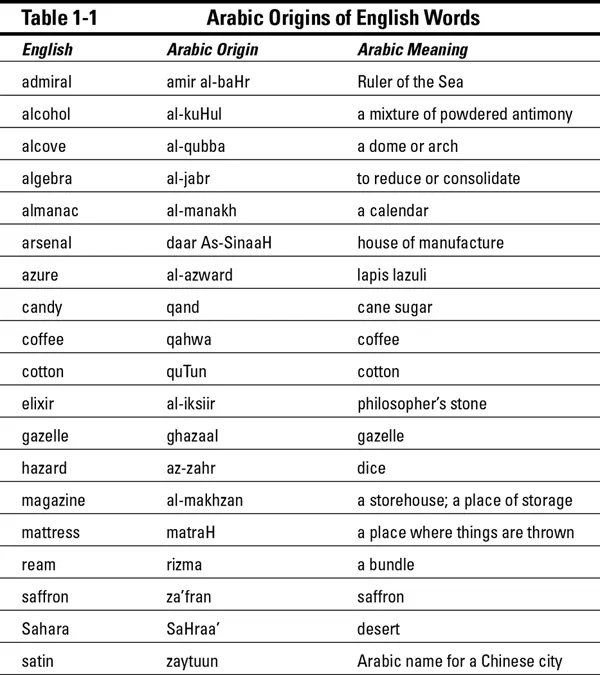
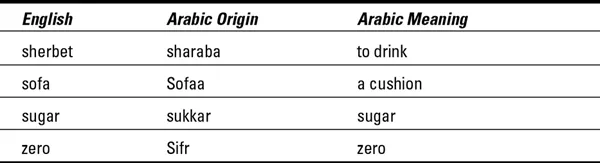
If English is your primary language, part of grasping a new lougha (loo-rah; language) is creating connections between the kalimaat (kah-lee-maht; words) of the lougha, in this case Arabic, and English. You may be surprised to hear that quite a few English words trace their origins to Arabic. For example, did you know that “magazine,” “candy,” and “coffee” are actually Arabic words? Table 1-1 lists some familiar English words with Arabic origins.

Arabic’s historical importance

During the Middle Ages, when Europe was plunged into the Dark Ages, Arab scholars and historians translated and preserved most of the works of the Greek scholars, thereby preserving some of the greatest intellectual achievements that are the cornerstone of Western civilization!
Table 1-1
Table 1-1
As you can see from the table, Arabic has had a major influence on the English language. Some English words such as “admiral” and “arsenal” have an indirect Arabic origin, whereas others, such as “coffee” and “cotton,” are exact matches! The influence runs the other way, too, especially when it comes to relatively contemporary terms. For example, the word tilifizyuun (tee-lee-fee-zee-yoon; television) comes straight from the word “television.” As is often the case with languages, Arabic and English tend to influence each other, and that’s what makes studying them so much fun!

Discovering the Arabic Alphabet

Unlike English and other Romance languages, you write and read Arabic from right to left. Like English, Arabic has both vowels and consonants, but the vowels in Arabic aren’t actual letters. Rather, Arabic vowels are symbols that you place on top of or below consonants to create certain sounds. As for consonants, Arabic has 28 different consonants, and each one is represented by a letter. In order to vocalize these letters, you place a vowel above or below the particular consonant. For example, when you put a fatHa, a vowel representing the “ah” sound, above the consonant representing the letter “b,” you get the sound “bah.” When you take the same consonant and use a kasra, which represents the “ee” sound, you get the sound “bee.”

All about vowels

Arabic has three main vowels. Luckily, they’re very simple to pronounce because they’re similar to English vowels. However, it’s important to realize that Arabic also has vowel derivatives that are as important as the main vowels. These vowel derivatives fall into three categories: double vowels, long vowels, and diphthongs. In this section, I walk you through all the different vowels, vowel derivatives, and vowel combinations.

Main vowels

The three main Arabic vowels are:
bullet
fatHah: The first main vowel in Arabic is called a fatHa (feht-hah). A fatHa is the equivalent of the short “a” in “hat” or “cat.” Occasionally, a fatHa also sounds like the short “e” in “bet” or “set.” Much like the other vowels, the way you pronounce a fatHa...

Table of contents

  1. Title
  2. Contents
  3. Introduction
  4. Part I : Getting Started
  5. Chapter 1: You Already Know a Little Arabic
  6. Chapter 2: The Nitty-Gritty: Basic Arabic Grammar
  7. Chapter 3: ‘as-salaamu ‘alaykum!: Greetings and Introductions
  8. Part II : Arabic in Action
  9. Chapter 4: Getting to Know You: Making Small Talk
  10. Chapter 5: This Is Delicious! Eating In and Dining Out
  11. Chapter 6: Going Shopping
  12. Chapter 7: Around Town
  13. Chapter 8: Enjoying Yourself: Recreation
  14. Chapter 9: Talking on the Phone
  15. Chapter 10: At the Office and Around the House
  16. Part III : Arabic on the Go
  17. Chapter 11: Money, Money, Money
  18. Chapter 12: Asking for Directions
  19. Chapter 13: Staying at a Hotel
  20. Chapter 14: Getting from Here to There: Transportation
  21. Chapter 15: Planning a Trip
  22. Chapter 16: Handling an Emergency
  23. Part IV : The Part of Tens
  24. Chapter 17: Ten Ways to Pick Up Arabic Quickly
  25. Chapter 18: Ten Things You Should Never Do in an Arab Country
  26. Chapter 19: Ten Favorite Arabic Expressions
  27. Chapter 20: Ten Great Arabic Proverbs
  28. Part V : Appendixes
  29. Appendix A: Verb Tables
  30. Arabic-English Mini-DictionaryEnglish-Arabic Mini-Dictionary
  31. Appendix C: Answer Key
  32. Appendix D: About the CD