Take the lead with sustainable package design solutions
The classic role of packaging is to "Protect, Inform, and Sell." Today, packaging must do all that—but with minimal eco-impact. Packaging Sustainability: Tools, Systems, and Strategies for Innovative Package Design is a comprehensive guide to thinking outside the box to create practical, cost-effective, and eco-responsible packaging.
With a broad range of contributions from pioneers of sustainability, Packaging Sustainability not only describes the concepts of sustainability but reveals the logic behind them, providing you with the tools to sift through and adapt to the ever changing barrage of materials, services, regulations, and mandates. The book:
Enables the designer to make smart, informed decisions at all points throughout the packaging design process
Offers a comprehensive overview of sustainable packaging design issues from leading practitioners, designers, engineers, marketers, psychologists, and ecologists
Describes materials and processes in current use and helps the reader understand how they interconnect
With solid information and actionable ideas, Packaging Sustainability gives you all the tools for maximizing a product's shelf impact—while minimizing its ecological footprint.
Minneapolis College of Art and Design Sustainable Design Certificate Program
With additional contributions from:
Caux Round Table, Ceres, Packaging Strategies, Sustainable Is Good
Pondering the Great Wall, 1986 Photo: W. Jedlička
The longest journey begins with a single step.
Lao-tzu (c 604–531 bce)
How do market forces shape the way we live, work, and even play? What are the economic lessons that can be drawn from nature? What is natural capital and how is it spent? How can we nurture the green thumb on the invisible hand? Today’s eco-leaders understand the interplay between producer and consumer, governments and people, stockholders and stakeholders, humans and the environment, and how all of these things interconnect and direct what and how we create.
Consumption and Renewal
The concept of birth > life > death is linear. It has a beginning, a middle, and an end. We view the things we surround ourselves with as having the same linear quality. Things are made, we use them, and then toss them away. But the reality is, there is no “away.” Products and their packages have a life after we use them, as garbage (landfill or incineration) or feeder stock for new objects (recycling or reuse reclamation). When objects are reborn (recycled or reclaimed) and put back into the system again, this becomes circular consumption and thus imitates nature: making, using, and remaking without limit. Imagine an upwardly spiraling system where we not only refresh what we take and use, but restore what we’ve previously destroyed through linear consumption. To get to this level we need to start reexamining not just how we do what we do, but why we do it.
Choices, Choices, Choices
Many examples of human impact on the environment abound in both recent and ancient history. The bestknown one is the fate of the Easter Islanders. This group, it has been suggested, drove themselves to extinction by their own excesses and severe lack of planning. As we consider the choices we make each day, think about too what must have been going through the mind of the Easter Islander who cut down the last tree, leaving his people no way to build, repair, or heat their homes, build or repair boats to fish (their main food source), or even get off the island. With a simple strike of his axe he sealed their collective fate.
We must hope in our lifetime, we will not be faced with this dilemma, but every choice we make each day adds or subtracts from the resources available to us tomorrow. Bad choices are accumulating like a death by a thousand cuts. Our salvation will come in much the same way, by regular people making everyday choices.
One of the most powerful avenues for impact we have is what and how we choose to consume. What we buy reveals a lot about how we frame our own impacts. Buying a perfect red apple vs. one that is kind of blemished but just as sweet and free of chemicals needed to attain that perfection, would be a great example.
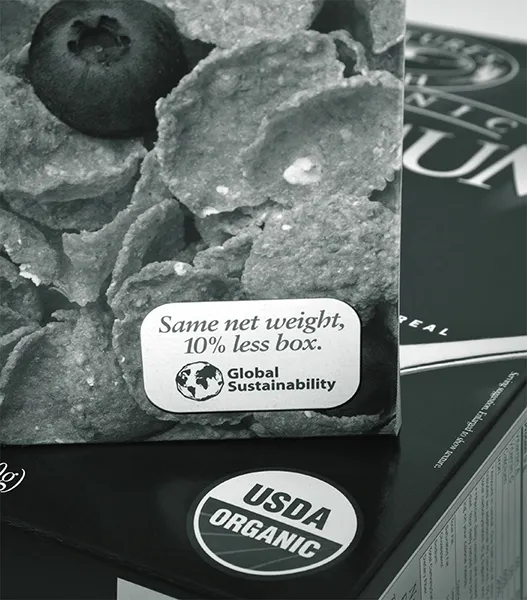
Heritage Flakes by Nature’s Path uses organic grains, and supports sustainable farming practices and biodiversity efforts. They also really understand their buyer.
Not only does the box illustrate an attractive product, plus key into potential buyers looking for more healthful choices and good taste, they also realize they needed to seal the deal by creating and talking about, their packaging reduction efforts. SAME NET WEIGHT, 10% LESS BOX is featured on the front. Finally, someone addressed one of the things that has been a nagging thorn in the consumer’s side since boxed cereal came on the scene over 100 years ago: how to fill the box and not leave such a huge space at the top. For most people, this is one of those packaged goods annoyances that just must be endured.
On the product’s side panel, Nature’s Path continues the discussion of packaging reduction by providing information regarding annual water savings (700,000 gallons), energy savings (500,000 kilowatts), and paperboard savings (about 1300 trees). These are serious and significant impacts all coming from what is in essence just a bit of air space. Now, along with information detailing nutrition and sustainable production practices, not only can the consumer make an educated decision about the food they eat, but about the impact of that choice. By connecting with the consumer on a deeper level, Nature’s Path has armed them with the information needed to know they do have a choice — and what instinctively seemed wrong, was indeed very wrong.
Nature’s Path: Right-Sized Cereal Box Same net product weight, 10% less box. This seemingly small redesign resulted in significant energy, water, and wood resource savings.
As we look at the decisions we make with regard to design, in order to achieve more than simply making things less bad, we have to provide the mechanism for the consumer to participate in the pursuit of good.
Like Nature’s Path, we need to consider all of our design choices as part of a greater contract with society. As product producers, we’re charged with nothing less than the health and safety of our fellow beings. Nowhere was this contract more brutally illustrated than in the case of the Tylenol murders in the early 1980s, which showed how easily our distribution system can be compromised.
At the time, Johnson & Johnson, the makers of Tylenol, were distributing their product using common and completely legal packaging technology for this product category. To their credit, Johnson & Johnson responded quickly and decisively. They not only pulled all of their products immediately from the store shelves, but became very proactive in the development of tamper-evident packaging — the norm across the pharmaceutical industry today.1
As product producers, we’re charged with nothing less than the health and safety of our fellow beings.
Underconsumption
It’s odd to think of not consuming enough, but this in fact is a very real problem. Malnutrition is a form of underconsumption (not having access to enough nourishment), and so is lack of education (not taking in or being allowed access to knowledge). One might also consider lack of research and the foresight it enables a type of underconsumption (not consuming enough time to make sure what you’re going to do will be smart in the long run). There are also systematic imbalances caused by underconsumption.
Deer overpopulation and subsequent overgrazing and habitat destruction are due to too few predators to help keep herds in harmony with the area that sustains them. This is a classic example of an imbalance caused by man’s interference. The deer herd’s health and their environment’s health suffers (too many deer for a given area to support), as the deer are underconsumed because the wolves that helped keep them in healthy balance were overconsumed (hunted to near extinction).
By being aggressive about keeping forests underconsumed by small fires, as had been the standard mode of forest management for the past century, too much underbrush is allowed to build up. What had been taken care of by nature’s renewal system, quickly becomes a devastating catastrophe resulting in complete ecosystem collapse. More progressive forest managers have found that working within nature’s plan allows their areas to remain healthier, more diverse, and better able to recover after disturbances.
As we begin to look at our products and behavior with an eye to restore what we’ve been taking out of our natural systems rather than create unstable monocultures for our convenience, looking for balance becomes key. We must look at things as a system and find ways of working to maintain all elements in harmony. Yet to do this, we need to not rush to find “the” solution: one that is convenient for us at the time, but completely ignores long-term impacts.
Overconsumption
Writer Dave Tilford tackled the idea of consumption in a 2000 Sierra Club article, “Sustainable Consumption: Why Consumption Matters”:
Our cars, houses, hamburgers, televisions, sneakers, newspapers and thousands upon thousands of other consumer items come to us via chains of production that stretch around the globe. Along the length of this chain we pull raw materials from the Earth in numbers that are too big, even, to conceptualize. Tremendous volumes of natural resources are displaced and ecosystems disrupted in the uncounted extraction processes that fuel modern human existence. Constructing highways or buildings, mining for gold, drilling for oil, harvesting crops and forest products all involve reshaping natural landscapes. Some of our activities involve minor changes to the landscape. Sometimes entire mountains are moved.2
An ecological footprint is defined as the amount of productive land area required to sustain one human being. As most of our planet’s surface is either under water or inhospitable, there are only 1.9 hectares (about 4 football fields) of productive area to support each person today (grow food, supply materials, clean our waste, and so on) but our collective ecological footprint is already 2.3 hectares. This means, given the whole of the human population’s needs, we would need 1.5 Earths to live sustainably. But this assumes all...
Table of contents
Cover
Contents
Title Page
Copyright page
Introduction
1 Taking the First Step
2 The Mechanics of Human Behavior
3 Marketing and Truth
4 Laws and Economics
5 Systems Thinking
6 Materials and Processes
7 Innovation Toolbox
Select Bibliography
Notes by Chapter
Index
End User License Agreement
Trusted by 375,005 students
Access to over 1.5 million titles for a fair monthly price.
Study more efficiently using our study tools.
Frequently asked questions
Yes, you can cancel anytime from the Subscription tab in your account settings on the Perlego website. Your subscription will stay active until the end of your current billing period. Learn how to cancel your subscription
No, books cannot be downloaded as external files, such as PDFs, for use outside of Perlego. However, you can download books within the Perlego app for offline reading on mobile or tablet. Learn how to download books offline
We are an online textbook subscription service, where you can get access to an entire online library for less than the price of a single book per month. With over 1.5 million books across 990+ topics, we’ve got you covered! Learn about our mission
Look out for the read-aloud symbol on your next book to see if you can listen to it. The read-aloud tool reads text aloud for you, highlighting the text as it is being read. You can pause it, speed it up and slow it down. Learn more about Read Aloud
Yes! You can use the Perlego app on both iOS and Android devices to read anytime, anywhere — even offline. Perfect for commutes or when you’re on the go. Please note we cannot support devices running on iOS 13 and Android 7 or earlier. Learn more about using the app
Yes, you can access Packaging Sustainability by Wendy Jedlicka in PDF and/or ePUB format, as well as other popular books in Design & Graphic Design. We have over 1.5 million books available in our catalogue for you to explore.