Boosting Self-Esteem For Dummies, UK Edition
eBook - ePub

Boosting Self-Esteem For Dummies, UK Edition

  1. English
  2. ePUB (mobile friendly)
  3. Available on iOS & Android
eBook - ePub

Boosting Self-Esteem For Dummies, UK Edition

About this book

Boosting Self-Esteem for Dummies

Learn to:

  • Leave behind negative modes of thinking

  • Understand the psychology of self-esteem

  • Use a variety of effective techniques to build self-esteem for a happier and healthier life

  • Give yourself a boost with cognitive behavioural therapy

Cognitive behavioural therapists

Rethink your self-image and be comfortable in your own skin

Fact: even individuals who radiate confidence on the outside can still have low self-esteem. Whether you're someone who puts on a front or a shy, retiring type who frets about what other people think, this practical guide can help you to conquer insecurities, get assertive and let your inner strength shine through. So what are you waiting for?

  • Understand the theories – get to grips with what self-esteem means and how it affects your outlook

  • Be honest with yourself – acknowledge your best bits (and your limitations) and identify the positive effects of your thoughts and actions

  • Discover boosting techniques – banish feelings of inadequacy by indulging in exercises and hobbies that exhilarate you

  • Give other people a break – understand when a compliment is a compliment and take criticism constructively

  • Go all-out – reassess your day-to-day priorities and map out what you really want from life

Open the book and find:

  • Strategies for getting to the bottom of the real you

  • Effective ways to record fluctuating moods and feelings

  • CBT techniques for stimulating self-encouragement

  • Advice on dealing with counter-productive comparisons

  • Guidance on tackling social phobias, body dysmorphia and eating disorders

  • Tips on maintaining self-discipline

  • How to foster better relationships at home and at work

Frequently asked questions

Yes, you can cancel anytime from the Subscription tab in your account settings on the Perlego website. Your subscription will stay active until the end of your current billing period. Learn how to cancel your subscription.
No, books cannot be downloaded as external files, such as PDFs, for use outside of Perlego. However, you can download books within the Perlego app for offline reading on mobile or tablet. Learn more here.
Perlego offers two plans: Essential and Complete
  • Essential is ideal for learners and professionals who enjoy exploring a wide range of subjects. Access the Essential Library with 800,000+ trusted titles and best-sellers across business, personal growth, and the humanities. Includes unlimited reading time and Standard Read Aloud voice.
  • Complete: Perfect for advanced learners and researchers needing full, unrestricted access. Unlock 1.4M+ books across hundreds of subjects, including academic and specialized titles. The Complete Plan also includes advanced features like Premium Read Aloud and Research Assistant.
Both plans are available with monthly, semester, or annual billing cycles.
We are an online textbook subscription service, where you can get access to an entire online library for less than the price of a single book per month. With over 1 million books across 1000+ topics, we’ve got you covered! Learn more here.
Look out for the read-aloud symbol on your next book to see if you can listen to it. The read-aloud tool reads text aloud for you, highlighting the text as it is being read. You can pause it, speed it up and slow it down. Learn more here.
Yes! You can use the Perlego app on both iOS or Android devices to read anytime, anywhere — even offline. Perfect for commutes or when you’re on the go.
Please note we cannot support devices running on iOS 13 and Android 7 or earlier. Learn more about using the app.
Yes, you can access Boosting Self-Esteem For Dummies, UK Edition by Rhena Branch,Rob Willson in PDF and/or ePUB format, as well as other popular books in Personal Development & Mental Health & Wellbeing. We have over one million books available in our catalogue for you to explore.

Information

Part I
Understanding Self-Esteem
741931-pp0101.eps
In this part . . .
You get a clear understanding of the nature of healthy self-esteem and how it differs from low self-esteem. We help you identify thoughts and ideas that can perpetuate feelings of low self-esteem and point you towards healthier ways of thinking about your self-worth. We also discuss some of the more common psychological problems associated with poor self-esteem and suggest strategies for tackling them.
Chapter 1
Explaining Self-Esteem
In This Chapter
arrow
Understanding the components of healthy self-esteem
arrow
Accepting yourself and others
arrow
Trusting your own judgement
Many people know that the opinion they have of themselves can be better. In our clinical practice, we see all sorts of different people from all walks of life battling with self-esteem issues. Difficulty appreciating personal worth is such a core issue that it can be said to apply legitimately to every single human being on the planet in one way or another and at one time or another. In fact, low self-esteem is such a commonly reported problem that we’ve written a whole book about defining healthy self-esteem and telling you how to get it.
Pause for a moment and think about your own definition of ‘self-esteem’. Maybe you think that having good self-esteem means being ever confident and happy. Or perhaps you link healthy self-esteem with success, wealth, achievement, attractiveness and popularity. If so, you aren’t alone. These qualities have an undeniable ‘feel good’ factor but they don’t necessarily guarantee healthy self-esteem.
Assuming that self-esteem is determined by external factors is a very common misconception. In this chapter (and to a greater extent in Chapter 2) we help you understand that true self-esteem is based on much more than confidence or success.
Remember.eps
Even the person who seems to have everything can be suffering with low self-esteem. Equally, a person with little wealth or obvious success can have very healthy self-esteem.
Defining Healthy Self-Esteem
Healthy self-esteem is having an enduring sense of yourself as a fundamentally valuable and worthwhile individual. This view translates into treating yourself with compassion and appreciation and not relying on outside opinions to think well of yourself.
Remember.eps
We use the term healthy self-esteem instead of high self-esteem because we want you to think of your worth as a constant, rather than as something that goes up and down depending on circumstance.
Some examples of what we mean by enduring healthy self-esteem:
check.png
Accepting yourself even when you’re faced with failure.
check.png
Liking who you are while simultaneously striving for personal development (have a gander at Chapters 8 and 14 for more details).
check.png
Thinking that you’re worthwhile and lovable even when a long-term relationship ends.
A lot of people also make the faulty assumption that having good self-esteem makes them impervious to a crisis of confidence or unpleasant feelings. Even if your self-esteem is very robust, you still experience times when your confidence wobbles in your ability to do certain things. Plus, you still experience negative emotions when bad things happen, no matter how healthy your self-esteem happens to be.
Considering common foundations for self-esteem
Very often people assume that their worth is based purely on what they can achieve or what the rest of the world approves of and is impressed by. However, important factors such as your personal values, character traits and unique personality are more accurate and healthy measures.
You may also believe that your level of self-esteem is determined entirely by the quality of your childhood relationships with your parents. Although this idea certainly contains some truth, it’s not the whole story. Many different types of experiences contribute to your understanding of yourself. Even individuals who have had very negative childhood experiences often manage to develop a robust sense of their own worth. So you’re not strictly at the mercy of your past (Chapter 10 is all about this topic).
Rejecting futile strategies for improvement
You may have tried many different strategies to elevate your self-esteem with limited or short-lived success. Common but often problematic strategies people use to try and raise their self-esteem include:
check.png
Driving themselves to improve their status...
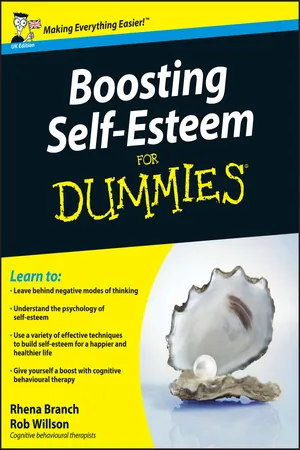
Table of contents

  1. Cover
  2. Table of Contents
  3. Title Page
  4. Introduction
  5. Part I: Understanding Self-Esteem
  6. Part II: Acknowledging That You're Okay As You Are
  7. Part III: Taking On New Techniques
  8. Part IV: Looking at the Ripple Effects of Low Self-Esteem
  9. Part V: Living Like You Mean It
  10. Part VI: The Part of Tens