eBook - ePub
Informal Learning
Rediscovering the Natural Pathways That Inspire Innovation and Performance
- English
- ePUB (mobile friendly)
- Available on iOS & Android
eBook - ePub
Informal Learning
Rediscovering the Natural Pathways That Inspire Innovation and Performance
About this book
Most learning on the job is informal. This book offers advice on how to support, nurture, and leverage informal learning and helps trainers to go beyond their typical classes and programs in order to widen and deepen heir reach. The author reminds us that we live in a new, radically different, constantly changing, and often distracting workplace. He guides us through the plethora of digital learning tools that workers are now accessing through their computers, PDAs, and cell phones.
1
OUT OF TIME
I AM OUT OF TIME. You bought the beta edition of this book. Things change so fast that all books are dated by the time they are published. Check the book Web site for extensions and updates (http://informl.com). Of course, the site is beta, too, but at least it is more recent. Nothing gets finished anymore. The world is moving too fast for closure. Our lives are in beta.
Everything is faster, more interconnected, and less predictable. Getting aligned with this new world is the road to profit and longevity for organizations, well-being and fulfillment for individuals. This book won’t give you the answers, but it will set you on the right path.
Two billion years ago, our ancestors were microbes; a half-billion years ago, fish; a hundred million years ago, something like mice; ten million years ago, arboreal apes; and a million years ago, proto-humans puzzling out the taming of fire. Our evolutionary lineage is marked by mastery of change. In our time, the pace is quickening.
CARL SAGAN
THE HYPERINFLATION OF TIME
When I was growing up in Hope, Arkansas, a ticket to the Saturday afternoon double feature cost fifteen cents. A Pepsi cost a nickel. Penny candy cost a penny. Motel 6 once charged six dollars a night. It’s not that everything in the old days was dirt cheap. Rather, the value of money has changed.
The same thing is now happening to time. More happens in a minute today than in one of your great-grandmother’s minutes. Not only is more and more activity packed into every minute, the rate of change itself is increasing. Measured by the atomic clock, the twenty-first century will contain a hundred years. Measured by how much will happen, in the twenty-first century, we will experience twenty thousand current years (Kurzweil, 2005).
A plot of the acceleration of time resembles a hockey stick. We have just left the blade and are shooting up the handle. We cannot keep driving into the future with the same old ox-cart; the wheels would fall off. The vehicle we ride into the future must be very responsive, for we are sure to encounter many surprises. There’s no map to what’s up ahead.
Everything flows. That’s life. Now everything flows faster. Survivors will be those who are most responsive to change. Unlearning obsolete routines is the secret of long life. Anything that is rigid is probably a vestige of earlier, slower times.
Time is all we have.
BARNABY CONRAD
TIME GUSHES FORWARD
When I was ten or eleven, Disney’s nature movie Living Desert provided my first experience of time-lapse photography. A seedling sprouted, grew, bloomed, and died in a couple of seconds on the screen. Withered green disks of cactus plumped up and grew little buds, and the buds miraculously turned into fat red prickly pears. Living things were always growing. I’d failed to notice that before because they changed too slowly for me to perceive.
Stopping time has fascinated me ever since, be it Eadward Muybridge’s photographs capturing a horse with all feet in the air or Harold Edgerton freezing a bullet in flight. Read Stewart Brand’s marvelous book How Buildings Learn (1994), and you realize that a fifteen-second animation of a century of New York’s Park Avenue would show buildings going up and coming down again and again, an immense railroad yard sinking beneath the earth, and mansions being replaced with gleaming skyscrapers, the scene morphing from cabin to brownstone to a Mies van der Rohe glass box.
Even the most permanent things are temporary when you shift to the long term and convert eons to seconds. A stream trickling across flat land carves the Grand Canyon. The floors of seas rise to form mountains. If dinosaurs get half an hour on screen, we humans get only a few seconds.
Three or four hundred years ago, a nanosecond in geological time, we adolescent humans convinced ourselves that we were the center of the universe, that we were in control, and that we could bend nature to our will. Descartes told us it was all in our heads. Newton explained how things moved (logically). Englishmen and Scots invented industry. Frederick Taylor told workers “You are not paid to think.” Hierarchy flourished.
Those days of certainty are over. We no longer control the universe (actually we never did). We are simply another thread in the fabric of life. A hundred years after Einstein, everything is beginning to feel relative. The watchmaker has left the stage. Uncertainty is the rule. We are all in this together.
NETWORK EFFECTS
Networks are growing faster than vines in the rain forest, reaching out, and encircling the earth. Denser connections yield faster throughput. The exponential growth of networks is the underlying reason that everything is speeding up.
Social networks, computer networks, communications networks, and any other network you can think up are constructed of nodes and connectors and nothing more. Each new node of a network increases the value of the overall network exponentially because the additional node connects to all the preexisting nodes. Connecting networks to other networks turbocharges their growth.
New linkages distribute information and power, breaking down organizational boundaries and fiefdoms. Networks subvert hierarchy. Perhaps it took longer than we expected, but people were right when they said the Net changes everything.
We are being propelled into this new century with no plan, no control, no brakes.
BILL JOY
Forty years ago, Intel cofounder Gordon Moore noted that the number of transistors on a chip doubled every year. Later, the rate slowed to doubling every eighteen months, and the exponential growth of computing power per dollar became known as Moore’s Law. Moore’s Law is why the laptop computer you bought not long ago is now selling for half what you paid for it.
Research has found that Moore’s Law applies to many areas besides computing. Examples are fields like DNA sequencing, gross domestic product, manufacturing output, e-commerce, educational expenditures, magnetic data storage, wireless data devices, Internet hosts, bandwidth, and miniaturization.
Inventor Ray Kurzweil (2005) plots what fifteen thinkers and reference works consider “the key events in biological and technological evolution from the Big Bang to the Internet” (p. 19). They’re taking place at a quicker and quicker pace. The speed of evolution itself is picking up. “Before the middle of this century, the growth rates of our technology—which will be indistinguishable from ourselves—will be so steep as to appear essentially vertical. . . . The growth rates will be . . . so extreme that the changes they bring about will appear to rupture the fabric of human history” (p. 30).
ON A HUMAN SCALE
It’s a safe bet that you don’t have as much time as you used to. Things used to be simple. People had plenty of time. Suddenly everything is complex, life is out of control, nobody has time, and most workers hate their jobs. The world has changed, and we humans have not kept up.
You don’t have to do the math to feel what’s going on. Compare your e-mail to a couple of years ago. Are you in control of the situation? Does the incessant arrival of more and more stress you out? What if you receive twice as many e-mails and voice mails next year? Or four times as many the year after that?
People are so overwhelmed with incoming messages that they have little time to cover new ground. You say your company wants innovation? How can people innovate when they hardly have time to get their regular jobs done?
Life is either a daring adventure or nothing.
HELEN KELLER
We all face a choice. The first option is to run faster and faster to keep up. A word of warning here: time management courses, self-improvement books, fancy calendars, personal digital assistants, spam filters, tickler files, discipline, and longer hours are not going to get you out of this one. At best they give you a temporary advantage. The second option is to get off the treadmill, admit that the world is not under your control, and embrace the chaos of change. That’s what the remainder of this book is about.
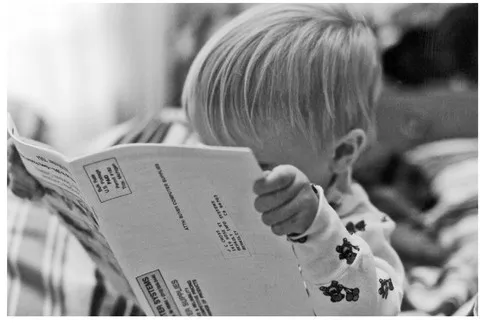
In Figure 1.1, my son, three years old in the photograph, is not reading the technology catalogue in his hands. (It’s upside down.) He is merely going through the motions. You may be in a similar state. If you are looking for an immediate quick fix to deep-seated organizational and personal issues without study and reflection, don’t waste any more time reading here. Thumb through these pages, pluck out a few nuggets, and keep up with your helterskelter schedule. There’s a complete summary in Appendix A.
FIGURE 1.1. Young Austin Cross, Going Through the Motions
To get the most out of this book, you must think outside of your comfort zone. You may find yourself nodding in agreement with many commonsense statements, only to reflect that adopting this approach wholesale will require a reversal of the corporate culture you are accustomed to. As Chairman Mao said, “You want to make an omelet, you break a few eggs.”
KEEPING UP
When the job environment changed only slowly, corporate learning involved acquiring the skills and know-how to do the job. Now corporate learning means keeping up with the new things you need to know to do the job, maybe even daily. The traditional barriers separating training, development, knowledge management, performance support, informal learning, mentoring, and knowing the latest news have become obstacles to performance. They are all one thing and for one purpose: performance.
Learning used to focus on what was in an individual’s head. The individual took the test, got the degree, or e...
Table of contents
- Praise
- About This Book
- About Pfeiffer
- Title Page
- Copyright Page
- PREFACE
- Acknowledgments
- Introduction
- Chapter 1 - OUT OF TIME
- Chapter 2 - A NATURAL WAY OF LEARNING
- Chapter 3 - SHOW ME THE MONEY
- Chapter 4 - EMERGENCE
- Chapter 5 - CONNECTING
- Chapter 6 - META-LEARNING
- Chapter 7 - LEARNERS
- Chapter 8 - ENVISIONING
- Chapter 9 - CONVERSATION
- Chapter 10 - COMMUNITIES
- Chapter 11 - UNBLENDED
- Chapter 12 - THE WEB
- Chapter 13 - GROKKING
- Chapter 14 - UNCONFERENCES
- Chapter 15 - JUST DO IT
- APPENDIX A: - INFORMAL LEARNING IN A NUTSHELL
- APPENDIX B: - WHERE DID THE 80 PERCENT COME FROM?
- APPENDIX C: - INSTITUTE FOR RESEARCH ON LEARNING
- GLOSSARY
- RESOURCES
- REFERENCES
- INDEX
- ABOUT THE AUTHOR
- Pfeiffer Publications Guide
Trusted by 375,005 students
Access to over 1.5 million titles for a fair monthly price.
Study more efficiently using our study tools.
Frequently asked questions
Yes, you can cancel anytime from the Subscription tab in your account settings on the Perlego website. Your subscription will stay active until the end of your current billing period. Learn how to cancel your subscription
No, books cannot be downloaded as external files, such as PDFs, for use outside of Perlego. However, you can download books within the Perlego app for offline reading on mobile or tablet. Learn how to download books offline
Perlego offers two plans: Essential and Complete
- Essential is ideal for learners and professionals who enjoy exploring a wide range of subjects. Access the Essential Library with 800,000+ trusted titles and best-sellers across business, personal growth, and the humanities. Includes unlimited reading time and Standard Read Aloud voice.
- Complete: Perfect for advanced learners and researchers needing full, unrestricted access. Unlock 1.5M+ books across hundreds of subjects, including academic and specialized titles. The Complete Plan also includes advanced features like Premium Read Aloud and Research Assistant.
We are an online textbook subscription service, where you can get access to an entire online library for less than the price of a single book per month. With over 1.5 million books across 990+ topics, we’ve got you covered! Learn about our mission
Look out for the read-aloud symbol on your next book to see if you can listen to it. The read-aloud tool reads text aloud for you, highlighting the text as it is being read. You can pause it, speed it up and slow it down. Learn more about Read Aloud
Yes! You can use the Perlego app on both iOS and Android devices to read anytime, anywhere — even offline. Perfect for commutes or when you’re on the go.
Please note we cannot support devices running on iOS 13 and Android 7 or earlier. Learn more about using the app
Please note we cannot support devices running on iOS 13 and Android 7 or earlier. Learn more about using the app
Yes, you can access Informal Learning by Jay Cross in PDF and/or ePUB format, as well as other popular books in Business & Human Resource Management. We have over 1.5 million books available in our catalogue for you to explore.