This book is a novel treatment of Operations Management. It takes a fresh insight to this increasingly important topic, exploring fundamental principles equally applicable to service and manufacturing situations. The book adapts a strategic stance by providing a framework for effective decision making and is aimed at practising managers who need to design working processes, manage change and make decisions within a strategic framework. The framework and supporting case vignettes allow the practitioner to grasp essential concepts quickly in a range of different operational contexts.
"Bamford and Forrester have done an excellent job in creating a concise, salient, and appealing approach - they have captured the essential elements of designing processes, products and work organizations; exploring approaches to operations planning and control; managing change through effective project management and technology transfer; and then managing quality and improvement strategies". —Professor Rob Handfield, Professor of Supply Chain Management, North Carolina State University, USA
"This is an excellent concise text that introduces students to all of the key areas - it's an invaluable aid for students in understanding all of the major aspects of operations and their importance to the success of businesses". —Professor Steve Brown, Professor of Management, University of Exeter Business School, University of Exeter, UK
"For today's or tomorrow's business leaders this text has well structured invaluable content ready for immediate adoption. Follow the guide, put it into practice, and the rewards will follow". —Mr Vernon Barker, Managing Director, First TransPennine Express, First Group Plc, UK
"This book combines technical theory 'book smarts' with real life experience 'street smarts' in a flowing read". —Mr Stephen Oliver, Vice President Marketing & Sales, Vicor Corporation, Boston, USA
The aim of any service, public sector or retail or industrial operation is to deliver goods and services of the quality, quantity, cost and availability that will satisfy the customers’ needs while at the same time making most effective use of resources. This can only be achieved by giving attention to the design of products, processes and work for employees, and through competent planning and control. This is what Operations Management is about. This book presents the fundamental principles of operations management in a novel and structured way that is appropriate to the needs of contemporary Operations Managers, and students in this field.
Operations management covers decision making in the organization, from top level management issues such as developing an operations strategy congruent with the company’s business and marketing strategies, to the immediate control of operations. It is, therefore, more than operational management. Each chapter develops an understanding of the theory and practice of key operational concepts to enable delivery of the strategy.
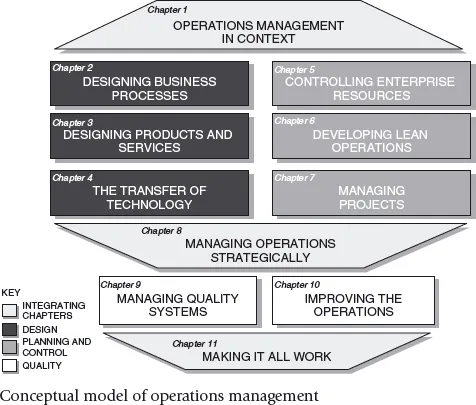
The book is structured in a unique manner, to better reflect the concerns of the contemporary Operations Manager in the twenty-first century. The book is based around the conceptual model of operations management.
The model centres upon the idea that operations management comprises three essential components:
Design of operations processes, products and services, and the work of individuals;
Planning and control of operations once designs are in place and operational; and
Ensuring quality of products and services produced and delivered, and (wherever possible) improving on these.
However these cannot be addressed in isolation. The essential element in effective operations management is the integration of these components. The book therefore contains three integrating chapters:
We need to understand operations management in context. What is its purpose in a business sense? And how and where does it relate to the other business functions.
How might we manage operations strategically? Design, planning and control activities must not be conducted totally independently of one another, so we need the means to coordinate our activities within a formulated operations strategy. We believe that operations strategy is best covered not at the start or end of the text (as you find in most other operations management books), but in the middle, after the principles of design and operations planning and control are well understood.
We need to consider the implementation of the principles contained in this book, so we need to look at making it all work in the final chapter. Implementation is identified by practitioners as the most critical activity, but is often overlooked or skimmed over in texts, so we address this head-on in this book.
The conceptual model offers a comprehensive and up-to-date view of the operations management function and it can be seen that we have integrated contemporary topics such as technology transfer, project management and lean operations (often discussed and also critical in business, but often overlooked in any depth within existing texts). But, before embarking on these topics, it is important that we fully grasp and comprehend what the practice of operations management comprises, and also where it has evolved from in an historical and theoretical context.
Basic principles of operations systems performance
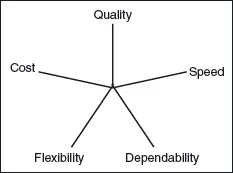
The task of the operations manager can be summarized at a basic level as converting a range of resource inputs, through the operations process, into a range of outputs in the form of products. However, the various elements that together make up this management function are diverse and complex in nature. The operations manager must have competencies in human resource management, strategic awareness, product knowledge, systems and organizational design and, at the operating level, of planning and control. Moreover, the task of the operations manager is often misunderstood and is often relegated to a reactive rather than a positive and proactive role within the organization. To indicate the importance of the operations function to the business it is useful to identify five key performance indicators for any operations system. These are quality, speed, dependability, flexibility and cost, where:
Quality reflects the extent to which operations are performed in line with specifications and/or satisfy the customer (i.e. getting things right);
Speed reflects how quickly and responsively we supply and deliver our products and services (i.e. doing things quickly);
Dependability indicates our reliability to the customer or recipient of the product or service (i.e. doing things consistently and on time);
Flexibility reflects our ability to adapt and respond to differing needs (i.e. being able to change what we do); and
Cost reflects the expense we have incurred in a financial sense to deliver the product and/or service to the recipient (i.e. doing things cheaply).
Figure 1.1 Five key performance indicators (KPIs)
In a simplistic sense, and in the ‘ideal world’, we might argue that an operation should seek to optimize all five of these performance objectives. If an operation delivers the best quality, in the fastest time, more reliably, in the most flexible way and at cheapest cost, it is inevitable that this operation would perform better and therefore more effectively than its competitors. However this is a panacea. As Hill (1993) originally, and others have since argued, operations management comprises a set of ‘trade-off’ decisions, whereby a decision to improve performance for one indicator often (though not always necessarily) results in a negative effect on another. Most obvious in this respect is cost. Often decisions to reduce cost can impact upon quality, speed, reliability and flexibility if improperly thought through. This book will, later, indicate where costs and other indicators might be simultaneously improved, but we need to recognize there are often constraints on what we might be able to achieve. And this indicates the second important factor of operations management: it is about managing constrained resources (human, physical and financial) which places limitations upon what we can achieve.
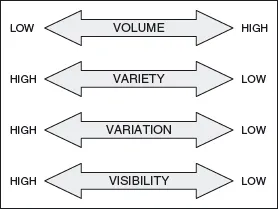
In the same way as the performance objectives above in Figure 1.1 can be used to compare and contrast different operations systems, so can the ‘four Vs’. Let’s investigate each of these individually, starting with volume. Figure 1.2 shows low volume on the left-side of the continuum and high volume on the right. Operations systems producing low volumes of products and services invariably result in: low repetition of tasks; operations performing a large proportion of the job (and perhaps the complete set of activities); less systemization; high unit costs. The opposite applies to high volume operations: greater repetition, a greater division of work, greater systemization and lower unit costs through economies of scale. The other three Vs run counter to volume, with ‘high’ on the left-side and ‘low’ on the right. This reflects the tendency for low volume operations systems to have high variety, high variation and frequently higher visibility. So high variety operations, those that produce a wide range of products and services, offer flexibility, are able to cope with and match customer needs and tend towards higher unit costs. Low variety operations, producing more standard products and services, have the opposite features. Variation reflects ability of the operations systems to flex and change, usually in response to the nature of demand (frequent and rapid changes on the left-side, very stable, unchanging demand on the right. High variation operations systems feature the ability to change capacity of output, anticipation, flexibility response and generally high unit costs. Finally visibility reflects the extent to which operations facilities and workers are physically seen or capable of being monitored by customers and clients, or whether they are out of sight and contact (back office type operations). High visibility operations feature short waiting tolerance, the need for customer contact skills, variety and responsiveness in service, and high unit cost.
Figure 1.2 Volume, variety, variation and visibility (the four Vs)
It has already been noted that the four Vs are arranged in Figure 1.2 so that volume has low on the left and a high on the right, whilst the others run opposite. This is for a reason. The features of operations systems occupying positions near the left-side of the continuum feature flexibility as a major concern: the ability to be flexible, to provide a flexible service. Whilst the right-side concurs with repeatability: the ability to economically produce products and services in high volume and at a relatively low unit cost. An example at this point serves to illustrate this.
Example 1
You have decided to take a vacation at an Island Resort. You wish to treat your nearest and dearest to a nice break in paradise; you want to be accommodated in a small house on stilts over ...
Table of contents
Cover Page
Title Page
Copyright Page
Contents
1: Operations Management in Context
2: Designing Business Processes
3: Designing Products and Services
4: The Transfer of Technology
5: Controlling Enterprise Resources
6: Developing Lean Operations
7: Managing Projects
8: Managing Operations Strategically
9: Managing Quality Systems
10: Improving the Operations
11: Making It All Work!
End User License Agreement
Trusted by 375,005 students
Access to over 1.5 million titles for a fair monthly price.
Study more efficiently using our study tools.
Frequently asked questions
Yes, you can cancel anytime from the Subscription tab in your account settings on the Perlego website. Your subscription will stay active until the end of your current billing period. Learn how to cancel your subscription
No, books cannot be downloaded as external files, such as PDFs, for use outside of Perlego. However, you can download books within the Perlego app for offline reading on mobile or tablet. Learn how to download books offline
Perlego offers two plans: Essential and Complete
Essential is ideal for learners and professionals who enjoy exploring a wide range of subjects. Access the Essential Library with 800,000+ trusted titles and best-sellers across business, personal growth, and the humanities. Includes unlimited reading time and Standard Read Aloud voice.
Complete: Perfect for advanced learners and researchers needing full, unrestricted access. Unlock 1.5M+ books across hundreds of subjects, including academic and specialized titles. The Complete Plan also includes advanced features like Premium Read Aloud and Research Assistant.
Both plans are available with monthly, semester, or annual billing cycles.
We are an online textbook subscription service, where you can get access to an entire online library for less than the price of a single book per month. With over 1.5 million books across 990+ topics, we’ve got you covered! Learn about our mission
Look out for the read-aloud symbol on your next book to see if you can listen to it. The read-aloud tool reads text aloud for you, highlighting the text as it is being read. You can pause it, speed it up and slow it down. Learn more about Read Aloud
Yes! You can use the Perlego app on both iOS and Android devices to read anytime, anywhere — even offline. Perfect for commutes or when you’re on the go. Please note we cannot support devices running on iOS 13 and Android 7 or earlier. Learn more about using the app
Yes, you can access Essential Guide to Operations Management by David Bamford,Paul Forrester in PDF and/or ePUB format, as well as other popular books in Business & Management. We have over 1.5 million books available in our catalogue for you to explore.