- Winner of CHOICE 2009 Outstanding Academic Title Award
- Focuses primarily on charges leveled by recent critics that belief in God is irrational and that its nature ferments violence
- Balances philosophical rigor and scholarly care with an engaging, accessible style
- Offers a direct response to the crop of recent anti-religion bestsellers currently generating considerable public discussion
- English
- ePUB (mobile friendly)
- Available on iOS & Android
eBook - ePub
About this book
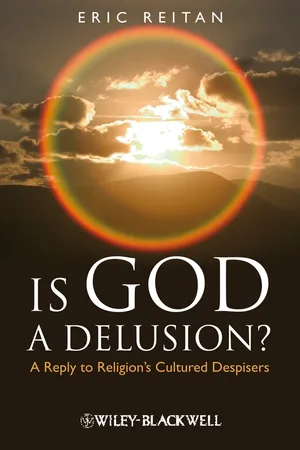
Is God a Delusion? addresses the philosophical underpinnings of the recent proliferation of popular books attacking religious beliefs.
Information
1
On Religion and Equivocation
In “Why I Am Not a Christian,” Bertrand Russell prefigures by about 80 years many of Richard Dawkins’ complaints about religion and theistic belief. After dispensing with (or so he thinks) the arguments for God’s existence, Russell launches into an attack on the character of Christ, focusing on Christ’s purported endorsement of the doctrine of hell. As Russell sees it, the doctrine “that hellfire is a punishment for sin . . . is a doctrine that put cruelty into the world and gave the world generations of cruel torture; and the Christ of the Gospels, if you can take him as his chroniclers represent Him, would certainly have to be considered partly responsible for that” (Russell 1961b, p. 594).
After impugning Christ’s character, he turns to the Christian religion which he claims “has been and still is the principal enemy of moral progress in the world” (p. 595). Then he brings religion as such under fire. “Religion,” he says, “is based primarily and mainly upon fear . . . fear of the mysterious, fear of defeat, fear of death. Fear is the parent of cruelty, and therefore it is no wonder if cruelty and religion have gone hand in hand” (p. 596). Finally, he turns his sights on God, saying that the concept of God “is a conception derived from the ancient Oriental despotisms. It is a conception quite unworthy of free men” (p. 597).
But what does Russell mean by “religion” here? What does he mean by “God”? Is religion in every sense “based on fear”? Is every conception of God “derived from the ancient Oriental despotisms”? For Russell, the concept of God is that of a terrible tyrant in the sky, dispensing arbitrary rules and ruthlessly punishing those who question his authority. The cowering masses, terrified of the world and its dangers, project their fears into the heavens, imagining this cosmic tyrant who, while deadly and capricious, can be appeased. Out of their efforts at appeasement, religion is born.
And when appeasement does no good (as it surely won’t, since its object is a fiction), there is the inevitable effort to place blame: we haven’t been good enough, or you haven’t been good enough. Those wicked Sodomites have brought God’s wrath upon us. It’s the fault of the infidels or the heretics. To appease God, we must defeat His enemies.
Gradually, perhaps, this attitude takes on an otherworldly dimension: The rewards for our efforts at appeasement will come in another life. And if we fail to defeat God’s enemies in this life, have no fear: they will roast in the next.
It’s no wonder, if this is Russell’s only image of religion, that he thinks of it as evil.1 It’s no wonder that, eighty years later, Russell’s spiritual protégé, Richard Dawkins, is on a righteous crusade to stamp out religion from the world.
But perhaps what Russell is describing is not the phenomenon of religion and the concept of God. After all, our language is messier than that. One word often refers, not just to one concept, but to a cluster of related ones. The philosopher Wittgenstein (1953) once suggested that many terms – such as the term “game” – extend over a range of phenomena that are related only by what he called “family resemblances” (p. 32, remark no. 67). My cousin looks nothing like my daughter. But my daughter looks like me, I look like my mother, my mother looks like her brother, and he looks like my cousin. We call both professional football and peek-a-boo “games”– even though it is hard to find anything they have in common – because they are connected by such “family resemblances.”
So it may be with both “religion” and “God.”2
The Meanings of “Religion”
When we use the term “religion,” we might mean a system of doctrines. Then again, we might mean a body of explanatory myths, or a social institution organized around shared beliefs and ritual practices, or the personal convictions of an individual, or a person’s sense of relatedness to the divine. Sometimes we treat it as synonymous with “comprehensive world-view” and other times as synonymous with “spirituality.”
Pretty much everyone would agree that the beliefs shared by most Southern Baptists, insofar as they are Southern Baptists, comprise a religion; and most would agree that the beliefs shared by biochemists, in their role as biochemists, do not. But while some people would be inclined to call secular humanism a religion, others would staunchly resist doing so.
The fact is, we use the term “religion” in a variety of ways. And this fact makes it difficult to talk precisely about religion, let alone attack it with valid objections. Whenever usage is so varied, there is a real danger that one will fall prey to what philosophers call equivocation – that is, the fallacy of using the same term in different senses in the course of a single argument or discussion, without noticing the shift.
This is the treacherous conceptual quagmire into which Bertrand Russell waded eighty years ago, and into which the new atheists slog cavalierly today. To his credit, Dawkins tries to define his terms. But he fails to do so with a philosopher’s care, and he is too swept up in his own rhetoric, the joyous excesses that make his attacks on religion so entertaining (at least to those who aren’t deeply offended by them). Sam Harris and Christopher Hitchens, by contrast, never define their terms, leaving it up to their readers to figure out what they are so fervently attacking when they attack “religion.”
To see more fully the conceptual challenges faced by anyone who wants to attack religion, consider some contrasting definitions. Paul Griffiths (1999), in his book Religious Reading, takes religion to be an account of things distinguished from other kinds of accounts by virtue of being comprehensive, unsurpassable, and central. For an account to be comprehensive, “it must seem to those who offer it that it takes into account everything, that nothing is left unaccounted for by it” (p. 7). An account is unsurpassable if it cannot be “replaced by or subsumed in a better account of what it accounts for” (p. 9). And to be central, an account “must seem to be directly relevant to what you take to be the central questions of your life, the questions around which your life is oriented” (p. 10).
Contrast this definition with the one offered by William James in The Varieties of Religious Experience(1914). James defines religion as “the feelings, acts, and experiences of individual men in their solitude so far as they apprehend themselves to stand in relation to whatever they may consider the divine” (p. 31). And he takes “the divine” to mean “only such a primal reality as the individual feels impelled to respond to solemnly and gravely, and neither by a curse nor a jest” (p. 38).
Again by way of contrast, consider the view of sociologist Emile Durkheim, who takes religion to be essentially a social phenomenon. For Durkheim, religion is a product of the “inter-social sentiments,” which are those that bond the individual to society by representing the individual as a member of a greater whole to whom he or she has binding obligations.3 Durkheim sees religion as “a form of custom, like law and morality,” that distinguishes itself from other customs in that “it asserts itself not only over conduct but also over conscience.”4 For Durkheim, the metaphysical speculations so typical of religious doctrine are merely instrumental and incidental: they function solely to achieve the effect of socializing the individual members of society, creating a conscientious allegiance to societal rules.
Or consider the theologian John Hick (1989a), who sees religious traditions, with their dogmas and practices, as attempts to orient religious practitioners towards an ultimate reality, a “noumenal Real” that transcends the grasp of human language and cognitive faculties. He takes it that human beings are alienated from “the Real” and from one another, at least in part because the Real is just too vast for us to grasp. All we can do is tell mythological stories, formulate metaphors, and devise ritual practices that connect us to it experientially. These stories, metaphors, and practices are supposed to move us away from our self-centered starting points, towards other-centeredness, and finally towards Reality-centeredness. The measure of a religion’s “truth,” for Hick, is not the literal truth of its teachings, since these are “about that which transcends the literal scope of human language” (p. 352). The measure of religious truth is, instead, its capacity to jar us out of our self-absorption and into a way of life shaped by a living connection with a Reality we cannot put into words.
So, which is it? Is religion a comprehensive and unsurpassable account of everything that matters to a person? If so, the naturalism of secular human-ists would qualify as their religion. Or is religion a private matter of how the individual relates subjectively to what is taken to be the fundamental reality? If so, the physicist’s awe and wonder at the vast beauty of the cosmos would be a religion. Or is religion a social construct, its metaphysical pronouncements (if any) an incidental by-product of its goal of creating loyalty, obedience, and cohesion among society’s members? If so, Marxist ideology would have been the religion of the former Soviet Union.5 Or is religion an attempt, through metaphors and ritual practices, to bring our lives into alignment with an inexpressible transcendent reality? If so, then most world religions would paradoxically be religions even as they reject the accuracy of Hick’s account (since they don’t typically take themselves to be engaged in merely metaphorical discourse).
The point, of course, is that “religion” is used in all these ways and more. Each account has justification in ordinary usage. And there is probably even greater diversity with respect to the cognate term, “religious.” Consider all the things we call “religious”: beliefs, stories, practices, ways of life, experiences, communities, persons, etc. When we call these things “religious,” do we always mean the same thing?
Of course not.
Einsteinian Religion and the Feeling of Piety
What this means is that if the new atheists want to say religion is evil, they need to tell us what sense of “religion” they have in mind. Likewise for “God.”
Do they?
Christopher Hitchens (2007) never even tries. But when we look at the details of his attack, we see an interesting trend. He claims, for example, that the faith of Dietrich Bonhoeffer, a Lutheran pastor who was executed for resisting the Nazis, was no real “religion” at all but “an admirable but nebulous humanism” (p. 7). When he refers to Bonhoeffer again, it is to point out that he risked and sacrificed “in accordance only with the dictates of conscience” rather than “on orders from any priesthood” (p. 241), implying that one is being religiously motivated only if one acts out of obedience to authorities of an organized religious hierarchy. That Bonhoeffer was part of a priesthood seems to miss his attention. The possibility that Bonhoeffer’s conscience might have been informed by his faith never enters Hitchens’ radar screen.
Concerning Martin Luther King, Jr., Hitchens claims that King was not a Christian in any “real” sense because he preached forgiveness of enemies and universal compassion rather than a rabid retributivism culminating in a doctrine of hell. The lynchpin of his case against the view that King was a real Christian is summarized in the following observation: “At no point did Dr. King . . . ever hint that those who injured and reviled him were to be threatened with any revenge or punishment, in this world or the next, save the consequences of their own brute selfishness and stupidity” (p. 176).
So, in Hitchens’ view, an ethic of love and forgiveness is less central to Christianity than the doctrine of hell. Someone who believes that “God is love” and claims to have experienced that love as a source of spiritual support can turn out, on Hitchens’ account, not to be a Christian in anything but a “nominal” sense. But while King was no true Christian, Hitchens treats Father Wenceslas Munyeshyaka, the Catholic priest in Rwanda who was charged with aiding the death squads and raping refugee Tutsi women, as channeling the true spirit of the Christian faith (pp. 191–2).
I would, of course, reverse these assessments. Anyone who, like Father Wenceslas Munyeshyaka, could call his mother a “cockroach” because she is Tutsi, strikes me as utterly divorced from religion even if he wears its trappings. I would argue, with Schleiermacher, that a deep connection to the essence of religion is rare compared to those who “juggle with its trappings,” and that this rare connection is most clearly represented in the lives of such people as Bonhoeffer and King.
But to say these things requires an account of what I mean by “religion.” Instead of offering his own account, Hitchens’ strategy seems to be this: if it is good, noble, or tends to inspire compassion, then it isn’t “religion.” It is “humanism” or something of the sort. With no clear definition to guide him, Hitchens is free to locate only what is cruel, callous, insipid, or banal in the camp of religion, while excluding anything that could reliably motivate the heroic moral action exemplified by Bonhoeffer and King. When “religion” is never defined, but in practice is treated so that only what is poisonous qualifies, it becomes trivially easy to conclude that “religion poisons everything.”
Do the other cultured despisers of religion do any better?
Consider Dawkins. In the first chapter of The God Delusion, Dawkins tries to distinguish “Einsteinian religion from supernatural religion” (p. 13). He stresses that it is only religion in the “supernatural” sense that he intends to attack. But his main purpose seems to be to deflate the pretensions of theists who want to quote Einstein as their ally.6 Perhaps because of this polemical aim, his account of the kind of religion he wants to attack is fatally underdeveloped.
Dawkins rightly points out that, when Einstein professed to be religious, he wasn’t referring to belief in a personal God but to the humility and “unbounded admiration” that thoughtful people feel when they contemplate the “magnificent structure” of the universe. At one point, Einstein expresses his understanding of religion this way:
The most beautiful and most profound experience is the sensation of the mystical. It is the sower of all true art and science. He to whom this emotion is a stranger, who can no longer wonder and stand rapt in awe, is as good as dead. To know that what is impenetrable to us really exists, manifesting itself as the highest wisdom and the most radiant beauty which our dull faculties can comprehend only in their primitive forms – this knowledge, this feeling is at the center of true religiousness. (F...
Table of contents
- Cover
- Title
- Copyright
- Introduction
- 1: On Religion and Equivocation
- 2: “The God Hypothesis” and the Concept of God
- 3: Divine Tyranny and the Goodness of God
- 4: Science, Transcendence, and Meaning
- 5: Philosophy and God’s Existence, Part I
- 6: Philosophy and God’s Existence, Part II
- 7: Religious Consciousness
- 8: The Substance of Things Hoped For
- 9: Evil and the Meaning of Life
- 10: The Root of All Evil?
- Notes
- References
- Index
Trusted by 375,005 students
Access to over 1.5 million titles for a fair monthly price.
Study more efficiently using our study tools.
Frequently asked questions
Yes, you can cancel anytime from the Subscription tab in your account settings on the Perlego website. Your subscription will stay active until the end of your current billing period. Learn how to cancel your subscription
No, books cannot be downloaded as external files, such as PDFs, for use outside of Perlego. However, you can download books within the Perlego app for offline reading on mobile or tablet. Learn how to download books offline
Perlego offers two plans: Essential and Complete
- Essential is ideal for learners and professionals who enjoy exploring a wide range of subjects. Access the Essential Library with 800,000+ trusted titles and best-sellers across business, personal growth, and the humanities. Includes unlimited reading time and Standard Read Aloud voice.
- Complete: Perfect for advanced learners and researchers needing full, unrestricted access. Unlock 1.5M+ books across hundreds of subjects, including academic and specialized titles. The Complete Plan also includes advanced features like Premium Read Aloud and Research Assistant.
We are an online textbook subscription service, where you can get access to an entire online library for less than the price of a single book per month. With over 1.5 million books across 990+ topics, we’ve got you covered! Learn about our mission
Look out for the read-aloud symbol on your next book to see if you can listen to it. The read-aloud tool reads text aloud for you, highlighting the text as it is being read. You can pause it, speed it up and slow it down. Learn more about Read Aloud
Yes! You can use the Perlego app on both iOS and Android devices to read anytime, anywhere — even offline. Perfect for commutes or when you’re on the go.
Please note we cannot support devices running on iOS 13 and Android 7 or earlier. Learn more about using the app
Please note we cannot support devices running on iOS 13 and Android 7 or earlier. Learn more about using the app
Yes, you can access Is God A Delusion? by Eric Reitan in PDF and/or ePUB format, as well as other popular books in Philosophy & Philosophy of Religion. We have over 1.5 million books available in our catalogue for you to explore.