eBook - ePub
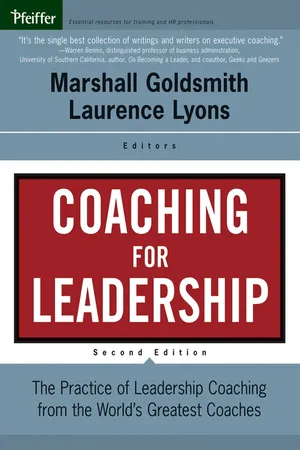
Coaching for Leadership
The Practice of Leadership Coaching from the World's Greatest Coaches
- English
- ePUB (mobile friendly)
- Available on iOS & Android
eBook - ePub
Coaching for Leadership
The Practice of Leadership Coaching from the World's Greatest Coaches
About this book
When it was published in 2000, Coaching for Leadership became an instant classic in the field of executive coaching. This second edition updates and expands on the original book and brings together the best executive coaches who offer a basic understanding of how coaching works, why it works, and how leaders can make the best use of the coaching process. This thoroughly revised edition reflects recent changes in coaching practices, includes well-researched best practices, and provides additional guidance and tools from the greatest leadership coaches from around the world. Each chapter in this important volume addresses a proven application, offers key principles of practice, and highlights critical learning points.
PART ONE
FOUNDATIONS OF COACHING
Personal success merely brings achievement. Helping others succeed confers genuine accomplishment.
Passion for “success through others”—the common aspiration of the consultant, counselor, and coach—is a source of synergy and a hallmark of leadership.
Only an accomplished leader leaves a social legacy. Having “made his mark” on the organization, he leaves behind talented people who will in turn make their mark into the future. For this to come about, the accomplished leader will have made time to pass on learning to others.
This idea was taught by Dick Beckhard whose motto—“we have a duty to pass on our learning”—was a deep source of inspiration for this book. The practice of leadership coaching has much to offer the person being coached. Inescapably, it offers the coach an opportunity to become accomplished as a leader.
CHAPTER ONE
THE ACCOMPLISHED LEADER
Laurence S. Lyons.
A leader becomes complete only after giving something back.
The Sheraton Hotel at Brussels airport is a short walk from the terminal building, making it a popular meeting place for the affluent traveler. Those adventurous enough to explore beyond the spacious restaurant level will find a secluded café frequented by the business jet-set. Chuck, a dapper fifty-something, confidently saunters in, immediately searching out a quiet corner. The plush atmosphere evokes a feeling of opulence and a sense of power. This is the life.
Chuck has arrived early, so finds time to reflect. Surely twenty-five years’ experience in the corporate world amply qualifies him for this imminent encounter. Chuck has worked in small businesses and in huge corporations. He was once a line manager responsible for a department of six-hundred people. He has done major tours of duty in operations, finance, and customer service. In one posting, Chuck served as a deputy regional manager. Chuck has experienced the thrills and spills of mergers from both sides. Chuck has lived the corporate life, and Chuck has survived.
Laurence S. Lyons Copyright © 2005. All Trademarks Acknowledged.
In his time, Chuck has come across many difficult situations and plenty of challenging people, each providing some new learning experience. An alumnus of the “hard knocks” school of management, he has acquired a sharp taste for reality. Chuck knows how much damage is done daily by organizational politics and mindless rules. He has seen great ideas get quashed, and under-spent budgets wastefully squandered at year-end. Chuck is mature now, and has learned how to play the corporate game. Chuck understands—and often correctly predicts—organizational outcomes that are completely counter-intuitive to the man in the street. Chuck speaks the language of management. Chuck is able to think as a leader. Chuck has much to offer; today he is ready to give something back, to pass on his learning.
Remembering that this will be his very first face-to-face meeting in his new role as an independent business coach, he opens his briefcase and again reads his notes....
Soon, Chuck is to meet Susan, a fast-track executive currently running the marketing department at a blue chip. In her early thirties, Susan has ambitions to work in public relations before moving to some more senior position, maybe one day to go onto the board. In their phone conversation last week, Susan told Chuck that she does not get on well with her boss and has recently been passed by for promotion. Susan suspects she is hitting a “glass ceiling.” Susan directs the work of fourteen marketing communications and program people, and seems to have only a vague idea about the work or personality of her peers.
A careful observer sitting in the lobby might notice Chuck lightly biting his bottom lip while contorting his eyebrows. He is now deep in thought: How do I start to make sense of Susan’s story? What do I really know about marketing or glass ceilings? What should we talk about? Where should I take this? What good can I do? And, more acutely: What damage might I do? As Chuck ponders these grave matters, he realizes that deep down he is just a tiny bit worried.
We’ll leave Chuck in suspended animation, anticipating Susan’s arrival at the hotel. Painting by numbers won’t effectively guide their conversation because Chuck does not know what gambit Susan might bring. Chuck’s strength lies in his ability to be responsive to Susan, to follow the needs of his client. To help him in this, Chuck needs general orientation, not specific advice. How should Chuck define the area of his work? How should he deal with his own lack of familiarity with some of Susan’s situations? How can Chuck play to his strengths? He does not realize it yet, but Chuck is in great shape. What he badly needs right now is a good theory.
A Clear Focus on Coaching
Now would make an excellent time for Chuck to focus his thoughts on what he is meant to be doing. In the conversation yet to take place, Chuck will follow Susan into many and varied topics. As coach, Chuck will at times touch on career planning; he may borrow techniques from personal counseling; he will sometimes processconsult. He will always bring his own experience and knowledge into the room. Yet at all times it is executive coaching that must remain at the forefront of his efforts. A commitment to coaching places Chuck’s work squarely within a learning context. The client is always an executive, so Chuck works exclusively within an organizational setting.
Executive coaching is about helping clients gain benefit from learning in an organizational setting. Ranging from the development of general personal skills, to helping Susan figure her way out of a tight corner, all that Chuck does as coach is in pursuit of that end. Chuck’s impact will be determined by his ability to transform organizational situations into realistic learning challenges matching the immediate needs of his client. Supremely importantly, How the client now thinks and How the client might think differently will be key components of that project.
Requisite Variety
Different people prefer different learning styles. This makes it extremely important for Chuck to offer Susan a choice of learning approach. As manager, Chuck himself may be able to get easily from A to C via B. As coach, his task is not to escort Susan to his intermediate comfort-point B; rather he should help Susan find her own path to C. Or, indeed, find an even better destination.
At work here is the systems concept of equifinality permitting a variety of personal styles, any of which may be applied to a given situation, to meet the same learning or business objective. Such choice is vital to ensure that each and every step in Susan’s learning program respects her personal values. It is only freedom of choice that allows Susan to remain true to herself. She must never feel that her quest to become a leader is forcing her to mimic a style that is distasteful to her, or make her adopt noxious behavior that she would recoil from seeing in others. Her ability to design her own authentic “Susan” style will bolster Susan’s feeling of comfort with herself and with her coaching program. She may at times test an unfamiliar tactic; while doing so she must never be asked to compromise her integrity of action.
At the root of designing such a learning strategy lies the coach’s ability to deeply understand “the organization,” how it works, and the different ways in which a client may survive, win, and prosper within it. Fortunately, this is an area where Chuck can claim to be something of an expert. Good coaches do more than point out an executive’s faults. They best help their clients by encouraging them to play to strengths. It is no different for Chuck, one of whose strengths is his expert understanding of organizational dynamics absorbed from his exposure to the corporate world. This is a skill he must leverage when making the transition from manager to executive coach.
Thinking Like a Theorist
An effective manager-turned-coach thinks like a theorist; acts like a researcher; never gives advice.
Theory can be that dry stuff found in textbooks. Alternatively a good theory inspires and stimulates action. Theory is capable of doing many useful things. It helps focus our attention on what is important when it encapsulates useful ways we have found in which to view our world. Theory can help get us quickly to the point. Theory helps us discover hidden connections; it helps us remember what otherwise we might forget. Theory may be the only thing we can cling to when we have little reliable data at hand. For coaches, who are behavioral practitioners in an imperfect world, a good theory is simply shorthand for good practice.
Theory truly comes alive when it helps practitioners tackle practical problems. While waiting for Susan in the freeze-frame action at the hotel, it is this more vibrant type of theory that Chuck definitely needs. Chuck may believe he is simply looking for some tested theory to help guide him along his new coaching path. Theories and models abound; simply collecting them is largely a sterile activity. Chuck adds value only when he helps his client. He will only start to do that and make real progress as a coach when he comes to understand that in his new job he has become a theorist. A theorist is someone who admits to not knowing and who is prepared to begin by making an informed guess as to cause and effect in a problem situation.
Learning by Theory
There are many parallels between Chuck’s work and that of a scientist. Both pick up the theorist’s work and conduct experiments in the real world from which learning results.
As a coach, Chuck must be clear about his role and know the boundaries of his work. He must be able to crystallize what he already knows and have the ability to transfer his insight. His deliverable will always be a learning opportunity. Of course, this is far from saying that Chuck will always have the right answers. Chuck’s perspective on a situation will never constitute more than a candidate hypothesis which may have to share the stage with several competitors. As always, the client must herself select between approaches and choose an appropriate way to learn. The best Chuck can hope to do is question and inform Susan based on his experience.
Chuck is concerned that some of Susan’s presenting issues seem to be outside his immediate experience. For one thing, he has never personally encountered a glass ceiling. The good news for Chuck in his conversations with Susan is that although he may come across subject matter with which he is totally unfamiliar, as a former manager he is well qualified to analyze what counts—the patterns of situations and relationships he is likely to find. Even better news for Chuck is that as he is now a coach not a manager, his role is all about learning systems: this positively prohibits him from giving any content advice. Shifting a gear into the theoretical level is just what Chuck needs to help keep him honest.
Chuck knows that very soon he will hear Susan’s story. He is preparing himself to draw out and organize Susan’s ideas. He considers for a moment the far-ranging scope that this conversation will likely have. During today’s little chat, Chuck must expect to exert considerable influence over the lives of Susan, those close to her, and others in and around the organization for which she works.
Chuck feels it important to shed any prejudices and false assumptions that may be in play—in his own mind, as well as in Susan’s. He feels a deep sense of listener responsibility and realizes that he will need to discipline himself in the way he chooses to receive Susan’s story. Chuck does not want to contaminate or judge that story. He will succeed by assuming a research style, or, in more familiar management terms—by conducting a friendly audit. Today, Chuck will say little, and instead concentrate his efforts on building rapport while simply listening to the music.
Susan’s Story
Susan has proven herself to be an exceptional marketing professional. Susan has the experience of growing and leading an excellent team. She has reached a career stage where the perceptions of her by peers in other functions have become critical to her advancement in the company. To be credible at her present level, it is important for Susan to express herself in terms of broader business ideas. To remain strong, Susan must demonstrate that she can think strategically and orchestrate the political dimensions of her role.
Susan’s regional boss wants to combine the marketing and public relations departments locally, and can see economies in doing so. But Susan works in a matrix organization in which her marketing boss wants to keep these functions separate. His logic for this is that PR audiences an...
Table of contents
- About This Book
- About Pfeiffer
- Title Page
- Copyright Page
- Foreword
- Dedication
- PREFACE TO THE SECOND EDITION
- PREFACE TO THE FIRST EDITION
- Acknowledgments
- ABOUT THE EDITORS
- PART ONE - FOUNDATIONS OF COACHING
- PART TWO - BUILDING BLOCKS
- PART THREE - LEADING CHANGE
- PART FOUR - APPLICATIONS
- Index
- Pfeiffer Publications Guide
Trusted by 375,005 students
Access to over 1.5 million titles for a fair monthly price.
Study more efficiently using our study tools.
Frequently asked questions
Yes, you can cancel anytime from the Subscription tab in your account settings on the Perlego website. Your subscription will stay active until the end of your current billing period. Learn how to cancel your subscription
No, books cannot be downloaded as external files, such as PDFs, for use outside of Perlego. However, you can download books within the Perlego app for offline reading on mobile or tablet. Learn how to download books offline
Perlego offers two plans: Essential and Complete
- Essential is ideal for learners and professionals who enjoy exploring a wide range of subjects. Access the Essential Library with 800,000+ trusted titles and best-sellers across business, personal growth, and the humanities. Includes unlimited reading time and Standard Read Aloud voice.
- Complete: Perfect for advanced learners and researchers needing full, unrestricted access. Unlock 1.5M+ books across hundreds of subjects, including academic and specialized titles. The Complete Plan also includes advanced features like Premium Read Aloud and Research Assistant.
We are an online textbook subscription service, where you can get access to an entire online library for less than the price of a single book per month. With over 1.5 million books across 990+ topics, we’ve got you covered! Learn about our mission
Look out for the read-aloud symbol on your next book to see if you can listen to it. The read-aloud tool reads text aloud for you, highlighting the text as it is being read. You can pause it, speed it up and slow it down. Learn more about Read Aloud
Yes! You can use the Perlego app on both iOS and Android devices to read anytime, anywhere — even offline. Perfect for commutes or when you’re on the go.
Please note we cannot support devices running on iOS 13 and Android 7 or earlier. Learn more about using the app
Please note we cannot support devices running on iOS 13 and Android 7 or earlier. Learn more about using the app
Yes, you can access Coaching for Leadership by Marshall Goldsmith, Laurence S. Lyons, Marshall Goldsmith,Laurence S. Lyons in PDF and/or ePUB format, as well as other popular books in Business & Human Resource Management. We have over 1.5 million books available in our catalogue for you to explore.