The Nobel Prize in Chemistry 2007 awarded to Gerhard Ertl for his groundbreaking studies in surface chemistry highlighted the importance of heterogeneous catalysis not only for modern chemical industry but also for environmental protection. Heterogeneous catalysis is seen as one of the key technologies which could solve the challenges associated with the increasing diversification of raw materials and energy sources. It is the decisive step in most chemical industry processes, a major method of reducing pollutant emissions from mobile sources and is present in fuel cells to produce electricity. The increasing power of computers over the last decades has led to modeling and numerical simulation becoming valuable tools in heterogeneous catalysis.
This book covers many aspects, from the state-of-the-art in modeling and simulations of heterogeneous catalytic reactions on a molecular level to heterogeneous catalytic reactions from an engineering perspective. This first book on the topic conveys expert knowledge from surface science to both chemists and engineers interested in heterogeneous catalysis. The well-known and international authors comprehensively present many aspects of the wide bridge between surface science and catalytic technologies, including DFT calculations, reaction dynamics on surfaces, Monte Carlo simulations, heterogeneous reaction rates, reactions in porous media, electro-catalytic reactions, technical reactors, and perspectives of chemical and automobile industry on modeling heterogeneous catalysis. The result is a one-stop reference for theoretical and physical chemists, catalysis researchers, materials scientists, chemical engineers, and chemists in industry who would like to broaden their horizon and get a substantial overview on the different aspects of modeling and simulation of heterogeneous catalytic reactions.
Modeling Catalytic Reactions on Surfaces with Density Functional Theory
John A. Keith, Josef Anton, Payam Kaghazchi, and Timo Jacob
1.1 Introduction
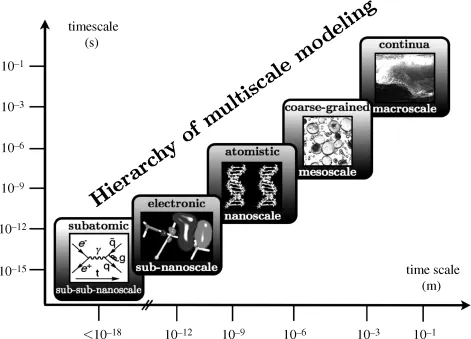
Predicting the reactivity of catalytic systems is a nontrivial process that usually requires knowledge about its geometric and electronic structure, properties determined by quantum mechanics (QM). Solving the Schrödinger equation1 is a nontrivial task even for small systems, and it becomes especially arduous when the system involves multiple phases as is the case in a surface reaction. Theoretical calculations nevertheless provide useful and important perspectives on chemical reactions that are not accessible through experimental observations alone. Figure 1.1 schematically shows the hierarchy of multiscale modeling, starting from the subatomic regime, over the electronic and atomistic regimes, to the meso- and finally the macroscale. Different theoretical methods have been established to address questions related to each regime (or timescale and length scale); however, realistic processes usually involve effects from all scales. In this chapter, we will focus on the electronic and atomistic regimes, which not only provide the basis for climbing up the hierarchy of multiscale modeling but also provide important mechanistic information on catalytic reactions.
Figure 1.1 Hierarchy of multiscale modeling of different time and length regimes.
Quantum chemistry is the application of QM to better understand chemical systems. In its purest form, QM calculations solve the Schrödinger equation, which provides the energy of a given configuration of nuclei and their electrons. There are two general approaches to do this. One way is to solve the energy given by the Schrödinger equation approximately using a nonclassical wavefunction. Another popular approach, density functional theory (DFT), uses the electronic density to evaluate the energy of a system via an approximate functional. Both approaches have their merits and provide a nonthermodynamical representation of the energy of a system of electrons.
This chapter gives an introductory overview of the essential concepts behind theoretical calculations of surface reactions, which we then apply to better understand one of the key features in energy conversion and fuel cell technology: the electrocatalytic oxygen reduction reaction (ORR). After describing the multibody problem in quantum mechanics, we will discuss the fundamentals behind wave function- and density-based methods used to solve this problem. We will then focus on density functional theory and its advantages and disadvantages in applications to catalysis. Section 1.2, the first part of this chapter, ends with brief technical details one has to grapple with when modeling surface reactions. This includes thermodynamic approximations and other considerations that extend calculated values from theoretical studies to be more comparable to experiment. Section 1.3, the second part of this chapter, shows an example how quantum mechanical DFT calculations can resolve mechanistic details of a rather complex surface reaction.
1.2 Theoretical Background
1.2.1 The Many-Body Problem
Many material properties of interest to physicists and chemists can be obtained by solving the many-body Schrödinger equation. In stationary, nonrelativistic terms it can be written as
(1.1)
where
is the Hamilton operator,
is the many-body wave function,
is the total energy of the system,
is the spin coordinate of electron
, and finally
and
are the spatial coordinates of electron i and nucleus
, respectively. The Hamiltonian for a system consisting of a set of nuclei and electrons ca...
Table of contents
Cover
Related Titles
Title Page
Copyright
Preface
List of Contributors
Chapter 1: Modeling Catalytic Reactions on Surfaces with Density Functional Theory
Chapter 2: Dynamics of Reactions at Surfaces
Chapter 3: First-Principles Kinetic Monte Carlo Simulations for Heterogeneous Catalysis: Concepts, Status, and Frontiers
Chapter 4: Modeling the Rate of Heterogeneous Reactions
Chapter 5: Modeling Reactions in Porous Media
Chapter 6: Modeling Porous Media Transport, Heterogeneous Thermal Chemistry, and Electrochemical Charge Transfer
Chapter 7: Evaluation of Models for Heterogeneous Catalysis
Chapter 8: Computational Fluid Dynamics of Catalytic Reactors
Chapter 9: Perspective of Industry on Modeling Catalysis
Chapter 10: Perspectives of the Automotive Industry on the Modeling of Exhaust Gas Aftertreatment Catalysts
Index
Trusted by 375,005 students
Access to over 1.5 million titles for a fair monthly price.
Study more efficiently using our study tools.
Frequently asked questions
Yes, you can cancel anytime from the Subscription tab in your account settings on the Perlego website. Your subscription will stay active until the end of your current billing period. Learn how to cancel your subscription
No, books cannot be downloaded as external files, such as PDFs, for use outside of Perlego. However, you can download books within the Perlego app for offline reading on mobile or tablet. Learn how to download books offline
Perlego offers two plans: Essential and Complete
Essential is ideal for learners and professionals who enjoy exploring a wide range of subjects. Access the Essential Library with 800,000+ trusted titles and best-sellers across business, personal growth, and the humanities. Includes unlimited reading time and Standard Read Aloud voice.
Complete: Perfect for advanced learners and researchers needing full, unrestricted access. Unlock 1.5M+ books across hundreds of subjects, including academic and specialized titles. The Complete Plan also includes advanced features like Premium Read Aloud and Research Assistant.
Both plans are available with monthly, semester, or annual billing cycles.
We are an online textbook subscription service, where you can get access to an entire online library for less than the price of a single book per month. With over 1.5 million books across 990+ topics, we’ve got you covered! Learn about our mission
Look out for the read-aloud symbol on your next book to see if you can listen to it. The read-aloud tool reads text aloud for you, highlighting the text as it is being read. You can pause it, speed it up and slow it down. Learn more about Read Aloud
Yes! You can use the Perlego app on both iOS and Android devices to read anytime, anywhere — even offline. Perfect for commutes or when you’re on the go. Please note we cannot support devices running on iOS 13 and Android 7 or earlier. Learn more about using the app
Yes, you can access Modeling and Simulation of Heterogeneous Catalytic Reactions by Olaf Deutschmann in PDF and/or ePUB format, as well as other popular books in Physical Sciences & Physical & Theoretical Chemistry. We have over 1.5 million books available in our catalogue for you to explore.