- Based on sixty in-depth interviews of free moving European citizens, and more than five years of ethnographic and documentary research, it uncovers the rarely studied human dimension of European integration
- Examines the mobility, lifestyle and career opportunities created by the borderless society of the European Union, as well as the barriers that still persist
- Analyses the new migration trends, challenges to the welfare state, and forms of urban cosmopolitanism linked to processes of European integration
eBook - ePub
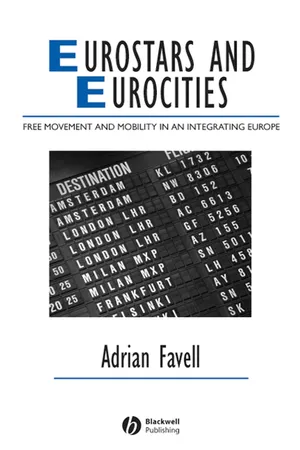
Eurostars and Eurocities
Free Movement and Mobility in an Integrating Europe
- English
- ePUB (mobile friendly)
- Available on iOS & Android
eBook - ePub
About this book
Eurostars and Eurocities: Free Movement and Mobility in an Integrating Europe examines intra-European Union migration in the cities of Amsterdam, London and Brussels.
Information
1
Freedom-Vrijheid-Liberte
Consider freedom of movement qua freedom. What is it? What is this new kind of freedom in Europe today? Here are a few examples.
You take a train. The station looks modern, the train fast. The two of you have been looking forward to this for a long time. The train departs, and rolls out through the city. You both laugh as local commuter trains overtake it. The announcements come in three languages – English, Dutch and French, with distinctive, slightly false accents. They are apologising for the delay. The train eventually enters a long tunnel, and suddenly it is travelling fast. When it comes out, the landscape is different, flashing by. Twice as fast. You arrive in the heart of a new city in less time than it would have taken to get out to the airport and pass through security in the first. You take another fast train. The cities and countries spin by in a blur, while you talk, station-to-station, trans-Europe express. The world outside is familiar, but strange. The new currency you hold can be used everywhere. You arrive in another new city. European modernity rises up around you ... You feel liberated. Eurostars.
You finish your undergraduate studies and decide to leave home. You throw all your things into a ruck sack, and say goodbye to your parents and home town – an affluent small city in the provinces of continental Europe. You take a cheap airplane, with a one-way ticket that flies you direct to a small, modern airport, miles out from the city. When you arrive in the big city – the capital of European finance and media – you find a job a couple of days later, making BLT sandwiches every morning for the biggest chain of lunchtime cafés. This is a means not an end. At nights you study English and follow courses for an MA in graphic design or business studies. You live in a damp £100-a-week dorm, with three other young Europeans. One of them works as a sandwich-board guy for the West End bargain computer shops, while his girlfriend is handing out leaflets for language schools round the corner. Someone else just got a job making coffee for the commuters on the trains. There are parties most nights, and you meet new friends every day ... You feel liberated. A free mover.
You finish work early and head down to the Irish pub near the international institutions to meet up and chat with friends of ten different nationalities. Everyone speaks English, but it’s a new continental version, no longer defined by the Queen of England or the BBC (which you still watch on cable), and certainly not the President of the United States. You love listening to all the different European accents, and charming hybrid grammatical inventions. Everyone seems to be enjoying the way you can step in and out of national identities in this place. Someone suggests a Greek restaurant, and the evening spills on into a lively salsa bar near the centre. Later, you wander the streets, before finding an underground night club in a bombed-out building, that serves up lemon vodka and hip hop, until 5 in the morning ... You feel liberated. A denationalized European.
You decide to quit your job with the company, and start afresh. Some friends abroad are offering you a chance to go it alone. You fly out to see them, and over a few beers, the deal is done. They agree to be your first clients. You set up the company, work out the red tape. There are no barriers to service provision here. Work conditions are good, and the business starts rolling in. It’s fun to be in a new city, a new country. There are tax breaks, and other associates who have cashed in the same way. The lifestyle is good, the quality of living even better. The city feels open, tolerant, and liberal. You are a foreigner, but your international connections bring in the work. You wonder why you never did this before. You feel liberated. A cross-national entrepreneur.
You retire from your job, and sell your home where you have both lived for thirty years. You put everything you own in a car and drive south. You leave your country. There are no passport controls, and the grass now grows over checkpoints that once marked out the military borders of nations. One country, then another. The weather improves, and the air gets warmer. You reach the ocean, and smell the olive trees. You arrive at your new whitewashed house, silhouetted against an azure sky. At the small town down the road you can collect your pension from your offshore account, arrange to see a doctor, or draw money on an international credit card. You eat and sleep well, and begin to forget the stresses of your old life, the cold damp mornings on the commuter train. You like your new life as citizens of nowhere. You feel liberated, sexy beasts. The new barbarians.
These are the stories to expect. Everyday lives, simple stories, banal even, but stories revealing trajectories nevertheless unique to this new Europe in the making. Freedom of movement of persons may just be the most remarkable achievement of the European Union, and its slow fifty-plus year progress towards integration, enlargement, and unity.
Individuals can now build lives – careers, networks, relationships, families – beyond the nation-state containers that once defined personal identity and personal history. This freedom of movement is not a global phenomenon; it is regionally defined, and specific to Europe. There is nothing else quite like it on the planet. If you are American, you cannot just move to London and get a job. If you are Australian, you still have to line up in the foreigners’ channel at the airport, fill out a landing card, and get your passport stamped. If you are Indian, you might be able to live permanently in Britain, even vote in the general election, but every time you travel abroad within Europe, you have to get a visa. These kinds of migration restrictions are still the norm in a world of nation-states, a world of national identities and bounded citizenships. This world certainly still exists, but something else exists within the integrating space of the European Union. European freedom of movement is a unique legal and political construction in the modern world, in which one has the right to move, travel, live, work, study, and retire without frontiers. In which any invocation of national boundary to restrict these opportunities for European foreigners is considered discrimination.
This distinctive new form of freedom, European freedom, deserves to be explored. How does one experience this freedom? Can one really live out and fulfil it? If so, where? Is it really freedom? What are its downsides? If you ask those who appear to be the most free, what do they say?
You Are Free
The train rolls into Centraal Station, Amsterdam. Natuurlijk. When you step off the train, here, you know you’ve arrived in Europe. You step over the junkies and out the hall, and there it is: perhaps the most well-known square mile of freedom in the Western world. Ahead, stretching up the waterside, lies the sordid strip up Damrak to Damplein: past sex museums and kebab shops, tacky stores selling souvenir dildos and clogs, boats crowded with sweaty tourists. Take a left, follow the smell, and you’re straight into the red light zone. You rub shoulders with leery stag weekend groups and naive frat boys, all in search of the rowdy coffee shops and supermarket-style brothels that make this place famous. Every few seconds, an edgy drug pusher catches your eye, whispering an inventory of mind altering substances as you pass by. This is everyone’s first idea of Amsterdam, the place where everything is permitted.
So let’s start here, as so many do. For instance, Ray from Ireland, who runs a successful transportation business in the city:
Soft drugs ... was my main knowledge of it. I hadn’t spent a huge amount of time on mainland Europe. All I really knew about Amsterdam was that it was small, everybody spoke English, they had a red light district, and you could smoke a joint without too much hassle – which nine years ago seemed [smiles] ... reasonably OK. For someone of my situation ... Being single [laughs].
This much is no different to the American frat boy’s idea of freedom, of course, with the red light zone in Amsterdam a must-do on any quick EURAIL tour of the continent. Only here, in old Amsterdam, the frat boys can kiss and hold hands, and nobody seems to mind. It’s only a start, but it feels good. Free. Ray, again:
The premise [here] is that you can do what you want as long as it doesn’t bother anybody else. If you want to wear a bikini on roller-skates going down the Herengracht that’s up to you. Try doing that in Dublin and you’re in a padded cell [laughs].
If you stay awhile, you learn to stop being a tourist, and start (trying) to be a resident. You get a job, look for a flat, and start taking part in city life. You realize that the red light zone and toleration towards soft drugs and sex work is only a part of how the place works. The city in fact offers much more appealing types of freedom. Susan, a young English woman, who works for a bank:
Amsterdam is so diverse, so many different cultures. It brings out the best in all worlds in some ways. What annoys me is people base their idea of Amsterdam on the red light district, which is absolutely the wrong thing to do. It’s not representative. Like Leidseplein, another big touristy area ... I can understand why they’re there, I’m sure that’s where we went when we visited the first time, but ... You kind of forget it’s there when you’ve been here awhile. When you live here ...
You start getting annoyed rather than flattered that the Dutch respond to you systematically in perfect, albeit strongly accented English. You start trying to take on board some of their distinctive habits: milk with bread and cheese for lunch; abusing pedestrians who get in your way in the cycle lane; joining clubs with strange mottos or initiation rites. As you get to know it, Amsterdam begins to feel less weird and unique, more like it’s the quintessential European city. Behind it, the Netherlands takes shape as the prototypical, model European society; if only because its contours are so clearly drawn, its self-contained social system so distinctive, so constructed, so vividly Dutch. It’s not the only way of being European, or even the most European, but it sure is European. Europe at its best, perhaps? A lot of the foreigners who move here think that when they arrive. Such as Valerio, from Italy, who works as a costume buyer for a theatre:
Let’s say when I was a student, everything was different. I was attending [expecting to find] people who had the same interests that I had ... It was a kind of fairy country.
What is this freedom that Amsterdam embodies? Is it just freedom from the state, the dream of anarchists everywhere? Spaces in society that escape the state’s penetrative gaze, its will to legislate and control, tell you what you should and shouldn’t do? Yes and no. For sure, Amsterdam outscores any city in Europe in terms of its liberal appeal. Its historical tradition of religious tolerance and asylum, and famously liberal attitudes, make it a magnet for all seeking a refuge from conservatism. American progressives, in particular, who despair about their own society, love it here. So is it in the coffee shop where we find freedom? In a haze of smoke? Or in legalized sex for money? Is that it? Not quite. The freedom here is, in fact, all legislated, regulated, controlled. These Dutch freedoms are organized spaces carved out of a society otherwise not so permissive in its attitudes. The Dutch even have a word for it: gedogen. To overlook, to ignore, to pretend it’s not there. There is a set place for everything.
But there is more to it than that. Amsterdam, Dutch society, does seems to embody some of the most open possibilities of progressive modernity. There are, for example, gay people in all levels of society. Guillaume, a French freelance journalist and activist, explains why this makes you feel free:
[When I arrived] many people were gay and it was not an issue. Like you have brown hair or black hair, it was nothing special. Wow! It felt very impressive ... In the gay life [here] half of the people are foreigners, and 50 percent of the reason they came here was to be free. They don’t come because it’s a gay city, that’s a mistake. They come because it’s non-homophobic, which is really not the same thing. They come here to be able to be normal. Here nobody cares. You are just human.
This city, like others, is seen as a refuge: from the provinces, from the intolerant, the xenophobic, the small-minded. From persecution. From ingrained tradition, hierarchy, privilege, thoughtless social reproduction. From other people’s norms. From where you’ve come from. As Guillaume stresses, it’s the place to be yourself, to be human. The freedom of experiencing cities like this also teaches you things. Ingrid is a Danish European Union fonctionnaire, nearing retirement after more than thirty years in Brussels, a city in which she feels completely at home:
I’m for opening, and the understanding of different people. Tolerance is a really important element in everyday life. If you don’t have tolerance you can’t live in peace with yourself. You learn that also in a city like Brussels ... In an international job, you see that people are very different. It’s fortunate to live and work in an environment like that.
This urban atmosphere in turn can be the key to one’s own well-being and happiness. Sandra, a Germanophone artist from Luxembourg, resident in London, puts it this way:
I love London. I think it’s a very beautiful city. I think the people [here] are very tolerant ... Once they accept you, they accept you the way you are. You can unfold your own creativity, whatever you want to do, without being criticized. When we lived in Germany – in Germany I’m a foreigner as well – the Germans are much more critical about everything. Here you can really be your own self. I never had the feeling of claustrophobia in London.
Within these quintessential international cities, there are local spaces where the intersection of cultures and diversity is even more intense. The easiest way to find them is to look for multi-ethnic gentrifying neighbourhoods, in which old locals, new ethnic minority immigrants, and a cosmopolitan sprinkling of foreign urban professionals intermix. Some have developed now into highly affluent areas, such as the Jordaan in Amsterdam, Islington in London, and Châtelain in Brussels. Others are still in development: De Pijp in Amsterdam, Shoreditch in London, Sint Katelijne in Brussels: exciting, protean places where the cosmopolitan brew of Eurocities best comes together in a specific locale.
London, Brussels, and other Eurocities share these dimensions, but Amsterdam might be thought of as emblematic. It helps us remember that freedom is a cultural thing too: it is, as John Stuart Mill would say, about lifestyles, diversity, and experimentation as much as anything else. Freedom must, of course, be economic and political too, as is more commonly stressed. Amsterdam, of course, is a free and open city – like London and Brussels – partly because of globalization and all that: of historical free trade, of its being a centre of global networks, of the flows and mobilities of the modern world in which it is a node. The freedom to move money and things across borders, as well as people. Amsterdam is a free society, like others, because liberal society has embraced the wisdom of giving people rights to do these things. A society in which transactions do not end at the borders of a nationstate. A society not embedded in the inertia of rooted national traditions, or singular cultures. A society built on the promise of some cosmopolitan future, not one based on ideas about the natural, national order of things.
In a sense, this is what the Dutch Enlightenment was all about. Creating a modern society, free from history, from nature, from the impossibility of an inverted land, in which the sea level is higher than the land on which the people live. As the Dutch never cease to remind you: this society, this city, is a man-made miracle. Rational, modernistic, organized down to the last brick, and thus emboldened in its defiance of nature. God might have made the world, but human hands and minds built the Netherlands. Amsterdam is a city built on stilts, with tall buildings sitting on soft mud and water, and oceans penned back behind dijks and the system of land-reclaimed polders. I remember my rapt discovery of the wonderful embossed diagram in the stadhuis, when you realize for the first time just how low Schiphol airport is relative to the city. It lies several meters below sea level. All of this, of course, was the fruit of the first golden age of globalization, the Dutch seventeenth century.
Amsterdam might then represent modernity – European modernity – at its best. Where freedom from tradition – from old Europe – is also freedom from where you came from, from how you were socialized. For those that move across the new Europe, this aspect of freedom is crucial: it is freedom from the nation-state, the most insidious and persistent source of identity in the modern world; the power of national culture to mould us in each other’s image, as citizens belong to this nationality, this culture, and no other. The way society disciplines our behaviour as a set of standardized, nationalized norms. For some, particularly young women, this might take the form of freedom from your family and their expectations. Anastasia is a young Greek woman, who chose Amsterdam for this reason:
There is a freedom here, a sort of a freedom we don’t have in Greece. They are not so attached to the family here. They don’t have to make such compromises. I don’t know a lot of Greeks here, because Greeks don’t move [abroad]. I felt free not to compromise on all this. You have to marry, you have to have kids, have to have things and make things, prove yourself, like having a good job, a nice husband, a good family. Everybody feels they can exercise control on you. You can go on a bus and the lady next to you can make remarks to you. Here, because I’m a foreigner, nobody cares what I’m doing.
Once you move away from home, your family, things change. You get a new deal. If you are Belgian, for example, London or Amsterdam might provide this. Saskia, who works in finance in London:
The thing is, my father is a quite well known figure in Belgium: the head of [a major nationalized company]. Belgium is a small country, you are always known as the daughter of someone else. If I’m at a wedding, I get asked, if I am connected [professionally] to him. It’s interesting that my sister is in Luxembourg, and I’m here [in London]. It’s nice to know that when you get a job it’s really what you do and not what your father did.
This is freedom from parochialism, from the old-boy network of home. If you are a German woman you might find what you are looking for in Amsterdam or London. Nina came to “relaxed, very laid back” Amsterdam to get away from working in a patriarchal German law firm. Freedom for her was symbolized by buying a little nutshell boat with her German partner, and being able to drink a bottle of wine out on the canals. If you are an English woman, the same thing might be found in Brussels. For example, Janet, a trade journalist. For her, it is the multinational quality of the place, that defines the space it allows her:
It’s because of the distinct lack of Belgian nationality, there isn’t a strong stamp. You can make a space [here]. In Paris, it would be harder,you would have more of a French [context] ... Brussels allows you that space to create your own life, that is semi-attached to the expat life, semi-attached to the Belgian life, kind of floating in-between.
Belgians describe going to the Netherlands in terms of escape from a conservative culture, or nationalist politics. Amsterdam feels like a liberation. But a Dutch person in Brussels can feel the same way about their relation to home. Joannet, who is working as a political consultant on Dutch-Belgian affairs in Brussels, puts it in terms of “quality of life”:
The one thing I like is that I have the feeling here of freedom. In the Netherlands, there are all these rules. They have this character thing where you always control what other people are doing. People are always giving their opinion, even if you don’t ask them. With the Dutch, if eating goose is in then it’s goose for everyone, if it’s too hot with the window open, then it’s too hot everywhere ... That goes for clothes, the movies you like, the books you read, what you do and what you don’t do generally in life ... I feel much happier here. I don’t have this idea that I should do something because its in or everyone is doing it.
The short move to Brussels enabled her to escape the national norms, and see her own country in a new light – something of great practical use in her daily work.
I get angry about Dutch issues. I’m not always proud to be Dutch. I went further away [from the Netherlands] but I got closer involved. It’s true I find it much easier to criticize the Netherlands now: whether it’s the political system, or our businesses, or the people, or a consumer organization, or how the house sale of my mum is h...
Table of contents
- Cover
- Series page
- Title page
- Copyright
- Series Editors’ Preface
- Preface
- 1: Freedom-Vrijheid-Liberte
- 2: New Amsterdam
- 3: London Calls
- 4: Brussels-Brussel-Bruxelles
- 5: Migration
- 6: Mobility (1)
- 7: Mobility (2)
- 8: Settlement
- 9: Integration (1)
- 10: Integration (2)
- 11: London Loves
- 12: Old Amsterdam
- 13: Anomie
- 14: Europa
- Postface
- Appendix 1: Summary of Interviews
- Appendix 2: A Note on Methodology
- Notes
- Bibliographical Essay
- Index of Interviewees
- Index
Trusted by 375,005 students
Access to over 1.5 million titles for a fair monthly price.
Study more efficiently using our study tools.
Frequently asked questions
Yes, you can cancel anytime from the Subscription tab in your account settings on the Perlego website. Your subscription will stay active until the end of your current billing period. Learn how to cancel your subscription
No, books cannot be downloaded as external files, such as PDFs, for use outside of Perlego. However, you can download books within the Perlego app for offline reading on mobile or tablet. Learn how to download books offline
Perlego offers two plans: Essential and Complete
- Essential is ideal for learners and professionals who enjoy exploring a wide range of subjects. Access the Essential Library with 800,000+ trusted titles and best-sellers across business, personal growth, and the humanities. Includes unlimited reading time and Standard Read Aloud voice.
- Complete: Perfect for advanced learners and researchers needing full, unrestricted access. Unlock 1.5M+ books across hundreds of subjects, including academic and specialized titles. The Complete Plan also includes advanced features like Premium Read Aloud and Research Assistant.
We are an online textbook subscription service, where you can get access to an entire online library for less than the price of a single book per month. With over 1.5 million books across 990+ topics, we’ve got you covered! Learn about our mission
Look out for the read-aloud symbol on your next book to see if you can listen to it. The read-aloud tool reads text aloud for you, highlighting the text as it is being read. You can pause it, speed it up and slow it down. Learn more about Read Aloud
Yes! You can use the Perlego app on both iOS and Android devices to read anytime, anywhere — even offline. Perfect for commutes or when you’re on the go.
Please note we cannot support devices running on iOS 13 and Android 7 or earlier. Learn more about using the app
Please note we cannot support devices running on iOS 13 and Android 7 or earlier. Learn more about using the app
Yes, you can access Eurostars and Eurocities by Adrian Favell in PDF and/or ePUB format, as well as other popular books in Ciencias sociales & Sociología urbana. We have over 1.5 million books available in our catalogue for you to explore.