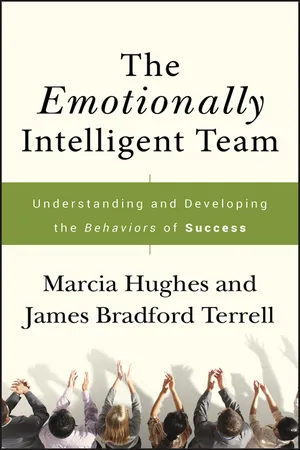
eBook - ePub
The Emotionally Intelligent Team
Understanding and Developing the Behaviors of Success
- English
- ePUB (mobile friendly)
- Available on iOS & Android
eBook - ePub
The Emotionally Intelligent Team
Understanding and Developing the Behaviors of Success
About this book
"Finally, a resource....guide...roadmap....to help team members and team leaders alike understand what it takes to function as a high performing team, how doing so can personally enrich your life, and why it's critical for organizations to function only in this way. The Emotionally Intelligent Team connects the dots between the task at hand, achieving and making a difference, and personal happiness. Imagine where humankind would be if every entity on the planet operated within a series of high performing teams. Marcia Hughes and James Terrell show us that it's possible!" Suzanne Kirk, SVP, Branch Service Center, Bank of the West "We value teams at Medtronic so we know that this book will be a powerful tool in understanding and developing successful team behaviors!" Michael Mihalczo, District Manager, Walter Cooper, District Manager, Medtronic CRDM "Marcia Hughes' and James Terrell's latest book, The Emotionally Intelligent Team, is a 'must read' for every school district, business and organization that wants to ensure high functioning and productive teams. Based on solid research, this easy-to-read book describes the seven social emotional skills necessary for effective teams, and includes practical strategies any team leader can use to develop and maintain an emotionally intelligent team. Marcia's and James' book has been of tremendous value to the work of the senior administrative team in our school district!" Linda Fabi, Director of Education, Waterloo Region District School Board "Marcia and James provide a good lens for the way people view others in a team environment. This insight, when combined with measuring ones own EQ through a test such as the Emotional Quotient inventory (EQ-i ), provides a powerful lever for improving team performance." Steven J. Stein, Ph.D., Founder and CEO of MHS, Co-author of the best seller The EQ Edge: Emotional Intelligence and Your Success and author of Make Your Workplace Great: The 7 Keys to an Emotionally Intelligent Organization "Discovering ways to strengthen teams in an organization can lead to impressive improvement in morale, engagement, productivity, and results. The Emotionally Intelligent Team will help any team take practical steps toward greater collaboration and effectiveness." Brian Twillman, EPA Training Officer Eileen Rogers, Global Director, Leadership Excellence Programs, Deloitte In this compelling book, authors Marcia Hughes and James Terrell offer practical information and a guide for businesses that want to draw on the power of the emotional competencies of their teams. They reveal how individuals, team members, and leaders can take the steps to become more emotionally intelligent team (ESI) members and show how to put in place the practices and exercises that will help any team grow in emotional intelligence. The book outlines the seven emotional competencies of teams.
Information
PART ONE
THE VALUE OF EMOTIONAL AND SOCIAL INTELLIGENCE FOR YOUR TEAM
CHAPTER ONE
WHY EMOTIONAL INTELLIGENCE IS SO VALUABLE FOR TEAMS
All the forces in the world are not as powerful as an idea whose time has come.
VICTOR HUGO
In a compelling Grey’s Anatomy vignette, Dr. Addison Shepherd, a renowned obstetrician, led multiple teams of doctors as she performed a C-section to deliver premature quintuplets. Highrisk pregnancy was putting it mildly, so teams of surgeons were lined up before the births. When it was time, pagers went off all over the hospital, in doctors’ homes, on the freeway, wherever the surgical teams were. Many complications were identified before the births. One baby had heart trouble, so Dr. Preston Burke, the heart specialist, was present with his team, whose members were ready to receive the baby immediately and begin what they hoped would be lifesaving work. One had a brain injury, so Dr. Derek Shepherd, the brain surgeon, and his team were ready to roll the minute the tiny infant was handed over. They all worked as a powerfully synchronous team. The whole Surgery Department worked on keeping those babies alive. It looked like most might make it; one didn’t.
As intern Meredith Grey was seeking to comfort the new mother, she had a revelation. She hurried to the babies, with the mother trailing her. Meredith picked up an infant who was failing to thrive and put her in the incubator with a sibling, snuggling them right up tight. She told the mother that twins were often put together in an incubator to promote survival: after all, they’d been close together for nine months, and they still needed each other.
Teams abound in this story—the parents, ready to take on and raise these blessed beings, and their siblings ready to welcome them home. The surgery department as a whole was a team at its best, and each specialist team in the Surgery Department was its own impressive team. The most profound team of all was the quintuplets, helping keep one another alive.
When someone you love is having surgery, you want the highestperforming team you can find. Nothing else matters to you but getting the best outcome. Though you may not realize it, you want more than state-of-the-art equipment, evidenced-based best practices, and the most highly trained and clinically competent surgical team you can access. You want a team that hums along like a well-oiled machine. You want a team that can handle pressure. You want a team that can adapt to a rapidly changing environment. You want a team that is abundantly resourceful and resilient. You want a team that is emotionally and socially intelligent.
It’s not just surgical teams that need to possess emotional and social intelligence (ESI); all the teams you’re on need it if they want to make it anywhere beyond mediocre performance in this global economy, where information travels at the speed of light. In fact, the entire world could use more of it! Almost every part of our daily experience is related to how well teams function. Whether a product is available online or on a shelf is contingent on a host of teams operating well. That backlog in the checkout line at the grocery store is related to team functionality. Getting projects completed on time and on budget, leading innovation in your industry, being perceived as an organizational thought leader, and offering top-notch products and services that meet the demands of your particular marketplace all come down to team functionality.
Fortunately, ESI is based on skills that any team can develop and refine. This creates an enormous opportunity to improve team functioning. No matter how well or poorly your team is operating, there’s more potential. There is no glass ceiling on team performance—the sky’s the limit!
SIGNIFICANT PERKS FOR TEAMS AND THEIR MEMBERS
A team that functions with healthy emotional and social intelligence experiences a multitude of benefits. Decades of work with organizations and teams repeatedly demonstrate that the relationships between team members affect everyone’s productivity and happiness. There’s an old saying that you may have heard: “If Mama ain’t happy, nobody’s happy.” Well, the same is true for team members: if one team member isn’t happy, everyone is negatively affected. A team with high ESI is happier all around. We make these observations based on our decades of work with teams and the organizational environments they live in. Furthermore, a growing body of research has demonstrated the value of ESI teams. These are some of the benefits:
• Individuals on the team are happier, more satisfied, more creative, and more productive.
• They enjoy working with their team, which reduces defensiveness, opens their thinking capacity, and facilitates creativity. In short, the creative grow even more creative. That’s powerful—more solutions drive more innovation!
• They persevere when tackling challenging tasks and complete them when other teams fail. Nothing breeds success like success.
• All of this yields better productivity. That’s money in the bank. Return on investment. Bang for the buck.
• For the individuals on such teams, these benefits result in improved emotional well-being and better odds that they’ll maintain a good work-life balance.
• The coworkers, friends, and families of people working on ESI teams get an added perk: they have more relaxed, playful, productive, and enjoyable relationships with that team member.
• Organizations also clearly benefit when individuals and teams are happier and more creative. Retention, engagement, and productivity all rise.
• Being happier is related to being healthier, which translates into tangential savings because fewer people call in sick and health insurance costs are mitigated.
• Humanity as a whole benefits when people work well together. Collaborative efforts achieve more efficient resource use and enhance communication, which reduces conflict and supports peace and well-being right here, where you and those you love live.
WHAT IS A TEAM?
On the news and in conversation, people are always referring to teams: teams of scientists, search and rescue teams, teams of engineers, sports teams, surgical teams, implementation teams, and the ever-popular “teams of experts.” Who knows if anyone is really talking about the same thing! The dictionary defines a team as “a number of persons associated together in work or activity,” such as a number of persons competing in sports or a group of workers completing a set of operations or “a group of specialists or scientists functioning as a collaborative unit.” That broad definition can be better understood when the concept of a team is broken down into key aspects. If your team can clearly define the functions listed here, you have a team. If not, you probably have a group or at best a partly dysfunctional team.
• Purpose. A team needs a purpose to exist. It can be stated as the problem to be solved or the result to be achieved. Reportedly, one of the best-selling personal books in recent years is The Purpose Driven Life by Rick Warren (2002). People crave purpose, and that’s true whether we’re looking at our personal or our professional lives. Teams have the same core need; they want to know that they are making a difference, that what they do matters in some way. That’s not possible without having a specific mission, a reason to be. The lack of a defined purpose is one of the most likely sources of team dysfunction.
• Productivity. A team needs feedback that is clear and useful and needs to know that the work it is doing contributes to the goals of the organization in a meaningful way. Pride comes from a sense of productivity, which is essential fuel for the next output. A team that feels that it never gets anything done or that the work it does is irrelevant will operate from a discouraged and disempowered space. That’s the start of a downward spiral. The discouragement spins the team downward, which eventually leads to poorer results, less creativity, increased disengagement, and higher turnover. There’s enough of that already. One of the highest costs organizations pay on health insurance claims is for depression.
• Numbers. Two or more people make up a team. Some people argue that a duo is simply a pair and not a team. However, it takes only two to tango, which is a passionate display of teamwork when danced well. In any situation in which individuals are called on to work together and solve problems, the skills and disciplines of collaboration are required, and you have the makings of a team.
• Longevity. There is no standard length of time for a team to exist; high-functioning teams last as long as they are needed and not a moment longer. Some teams come together for a very brief moment in time to perform a discrete task that is time-sensitive, and when the task is done, the team is disbanded. Such teams are referred to as just-in-time teams.
One of the ultimate just-in-time teams was born on April 13, 1970, when the number two oxygen tank exploded on Apollo 13, crippling the service module as it lost oxygen and electrical power. Over 200,000 nautical miles from Earth, the crew had to use the lunar module as a lifeboat for most of the flight. It was equipped to sustain two people for two days, yet there were three crew members who faced a four-day trip back to Earth, if they made it all.
The situation was dire. They had only ten hours’ worth of power available from the command module. The fuel had to be reserved for the approach and reentry to Earth’s atmosphere, and the module had the heat shield essential to keeping the astronauts safe during reentry.
It was an epic fight for survival in an extremely hostile environment. The spacecraft’s successful return to Earth was made possible by extraordinary teamwork and ingenuity, led by NASA’s chief flight director, Gene Kranz, whose motto was “Failure is not an option.” He assembled every available bit of talent he could find. Manufacturers of the main Apollo systems sent their top specialists immediately. Simulators, computer models, and experts were linked into a network and worked furiously to figure out a way to keep the astronauts alive and to get them home. It was an unprecedented display of tenacity, ingenuity, and perseverance, with rigorous attention to every tiny detail, that allowed them to prevail against all odds, just in time. Every single maneuver was tested in the simulators; every calculation was verified with computers.
Ultimately, Apollo 13 had the most accurate landing in the history of manned flight. The mission operations team and the astronauts were awarded the Presidential Medal of Freedom for their heroic actions.
Far less dramatic than the team that came together to prevent the Apollo 13 disaster, yet quite important in an organization’s daily life, are the typical senior teams found in most companies. These are composed of the top leaders in the organization and will likely exist as long as the organization exists, although the members of the team will change. As your teams develop more of their ESI skills, they are more likely to function with some of the same focus and commitment to success as the Apollo team or the daily success of an effective executive team.
• Accountability. This essential characteristic is closely linked with purpose and productivity. The team must be routinely held accountable. Although accountability is usually managed by a leader on the team or a manager at a higher organizational level, it can be done by the team itself, though that takes considerable commitment to the team’s purpose. Accountability functions to keep the team on target, committed to quality, and meeting its objectives. A team with no accountability is an amorphous group, acting more like a bunch of cells swimming around in a petri dish than a single organism. With accountability, you have the opportunity for a high-performing, productive, well-integrated team.
• Power. Power in a team is found in two primary forms—authority and influence. Authority is the direct ability to mandate action: it allows the leader to require deadlines, adjust project priorities, and hire and fire employees. Influence is much more subtle and when used with elegance is almost certain to be more effective. The dictionary defines influence as “producing an effect without apparent exertion of tangible force or direct exercise of command and often without deliberate effort or intent.” This is the most potent way to teach, guide, and coach people. It’s often the most effective way to move someone from no to yes. Effective use of authority and influence are primary tools in developing the seven skills of emotional and social intelligence in teams.
In assessing your team’s power, the questions to ask are who uses authority and influence and how well are those forms of power wielded. Ideally, the leader has direct power and uses it well. However, our experience has shown that there are many situations where an individual is appointed to lead a team but is given no direct power or authority. A team leader who doesn’t perform the personnel evaluations for the team members and has no ability to provide meaningful, concrete rewards or consequences for team behavior must be adept at using influence to propel the team to success.
WHAT IS EMOTIONAL AND SOCIAL INTELLIGENCE?
Simply put, emotional and social intelligence reflects the ability to recognize and manage your own emotions and to recognize and respond effectively to the emotions of others. It includes understanding your social community from the “big picture” point of view and the ability to direct change and to adapt to that change.
Emotional intelligence (EI) or emotional quotient (EQ) are terms used interchangeably, so you can interpret them as referring to the same concept. ESI adds the vital dimension of social intelligence, which the psychologist Edward Thorndike (1920) referred to as the ability to function successfully in interpersonal or social situations. Thorndike’s work in the 1920s has been built on by many in the EI world, especially Reuven Bar-On and Daniel Goleman.
Bar-On (2005) outlined the history of the development of ESI and helped define social intelligence when he wrote that “the early definitions of social intelligence influenced the way emotional intelligence was later conceptualized. Contemporary theorists like Peter Salovey and John Mayer originally viewed emotional intelligence as part of social intelligence (1990, p. 189), which suggests that both concepts are related and may, in all likelihood, represent interrelated components of the same construct” (p. 1).
While there are many definitions of emotional intelligence in circulation, we have found only one research-based approach that incorporates both emotional and social intelligence in a family of EQ measures. Reuven Bar-On, creator of the Emotional Quotient Inventory® (EQ-i) (1997), emphasizes that one must consider both emotional and social intelligence together. In a 2005 paper describing his model, Bar-On states that “emotional-social intelligence is a cross-section of interrelated emotional and social competencies, skills, and facilitators that determine how effectively we understand and express ourselves, understand others and relate with them, and cope with daily demands” (p. 3).
The fundamental tenets of ESI that influence the efficacy of teams are the following:
1. The ability to understand your own emotions—knowing what you feel and why you feel that way
2. The ability to use your emotions wisely, knowing how to manage and express them intentionally
3. The ability to understand and respect the emotions of others
4. The ability to respond to, influence, and interact with the emotions of others
These four components are always exercised in a social environment, which means that while they have a significant impact on individuals, the impact is even greater for teams. Hence these two additional tenets apply:
5. The ability to recognize that your emotions are applied in a social context, a complex system of relationships that requires sensitivity and tempered responses
6. The awareness that all ESI components come together to influence your ability to respond to and work with change, which is a constant dynamic in the environment
SHOULD WE MEASURE EMOTIONAL INTELLIGENCE?
One of the first choices when working with EI or ESI and your team is whether to use an assessment to measure emotional intelligence. Of course, teams are made up of individuals. There is value in assessing both individual ESI and team ESI. The t...
Table of contents
- Title Page
- Copyright Page
- Dedication
- Introduction
- PART ONE - THE VALUE OF EMOTIONAL AND SOCIAL INTELLIGENCE FOR YOUR TEAM
- PART TWO - THE SEVEN SKILLS OF A TEAM’S EMOTIONAL AND SOCIAL INTELLIGENCE
- PART THREE - RESULTS GAINED BY EMOTIONALLY AND SOCIALLY INTELLIGENT TEAMS
- CONCLUSION
- REFERENCES
- Acknowledgments
- ABOUT THE AUTHORS
- INDEX
Trusted by 375,005 students
Access to over 1.5 million titles for a fair monthly price.
Study more efficiently using our study tools.
Frequently asked questions
Yes, you can cancel anytime from the Subscription tab in your account settings on the Perlego website. Your subscription will stay active until the end of your current billing period. Learn how to cancel your subscription
No, books cannot be downloaded as external files, such as PDFs, for use outside of Perlego. However, you can download books within the Perlego app for offline reading on mobile or tablet. Learn how to download books offline
Perlego offers two plans: Essential and Complete
- Essential is ideal for learners and professionals who enjoy exploring a wide range of subjects. Access the Essential Library with 800,000+ trusted titles and best-sellers across business, personal growth, and the humanities. Includes unlimited reading time and Standard Read Aloud voice.
- Complete: Perfect for advanced learners and researchers needing full, unrestricted access. Unlock 1.5M+ books across hundreds of subjects, including academic and specialized titles. The Complete Plan also includes advanced features like Premium Read Aloud and Research Assistant.
We are an online textbook subscription service, where you can get access to an entire online library for less than the price of a single book per month. With over 1.5 million books across 990+ topics, we’ve got you covered! Learn about our mission
Look out for the read-aloud symbol on your next book to see if you can listen to it. The read-aloud tool reads text aloud for you, highlighting the text as it is being read. You can pause it, speed it up and slow it down. Learn more about Read Aloud
Yes! You can use the Perlego app on both iOS and Android devices to read anytime, anywhere — even offline. Perfect for commutes or when you’re on the go.
Please note we cannot support devices running on iOS 13 and Android 7 or earlier. Learn more about using the app
Please note we cannot support devices running on iOS 13 and Android 7 or earlier. Learn more about using the app
Yes, you can access The Emotionally Intelligent Team by Marcia Hughes,James Bradford Terrell in PDF and/or ePUB format, as well as other popular books in Business & Management. We have over 1.5 million books available in our catalogue for you to explore.