- English
- ePUB (mobile friendly)
- Available on iOS & Android
eBook - ePub
About this book
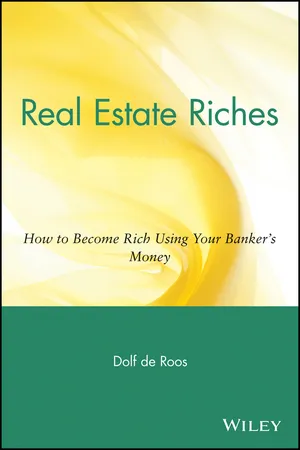
An all-time bestseller, Dolf de Roos?s classic Real Estate Riches shows you how to find great deals and make great profits in the real estate market. You?ll learn why real estate is such a reliable moneymaker and how to achieve the biggest return possible on your investment. Full of time-honored wisdom, proven tactics, and quick-and-easy tips, this book shows you how to find the best properties with the most potential, analyze deals, negotiate and submit offers, effectively manage properties, and dramatically increase the value of your real estate without spending much money. If you want to be your own boss and quit the nine-to-five life, Real Estate Riches shows you how.
Part One
Why Is Property So Good?
CHAPTER 1
FOUR MAGIC QUESTIONS
The purpose of this book is not so much to give you the “how-to” of real estate—although there will be plenty of how-to advice—but to make you sit bolt upright and exclaim: “Wow, I never realized real estate was this good!” The reason is that once you “get it,” once you understand why property is such a phenomenally lucrative and astoundingly simple investment vehicle, you will never be able to focus on a sitcom on television again without getting itchy feet, wondering whether the hour wasted watching the tube is costing you the Deal of the Decade. You will be itching to apply my how-to ideas (and those gleaned from other books and sources), and you will also want to invent your own and go out there and try them, modify them, and continually improve them.
I will show you that contrary to expectations and what we somehow seem to have been taught by our parents, relatives, schools, the mass media, and “experts,” it is possible to find a bargain property, or even many of them in a row. It is possible to buy properties using mostly or entirely other people’s money. It is possible to buy properties where the returns are 20 or 30 or 50 or 100 percent or more per annum. What’s more, all these things are easy.
When I tell people that property is not just as good as other investments, not just a little better, and not even just a lot better than other investments, but tens or even hundreds of times better than other investments, most people do not believe it.
So, let me in the next few pages show you why I think property is so much better.
Imagine you have a lump of money to invest. It does not matter whether you have $5,000, $10,000, $100,000, or $1 million, as the same principles apply in each case. So let’s assume that you have $100,000 cash to invest. Let’s also assume that you are considering investing your funds either in the stock market or in property. Finally, for the sake of simplicity, let’s ignore all brokerage fees and commissions.
I will simply pose four questions . . .
Question One
How many dollars’ worth of stock can you buy with $100,000 cash?
I often ask this question during seminars and am not infrequently met with a sea of blank faces, as if it were a trick question. It is not!
For most people, when you have $100,000 of cash to invest in the stock market, you can buy exactly $100,000 worth of stock.
Now I know some of you will protest that you can buy stocks on margin, but the reality is that investment houses will only let you do that with a very limited number of stocks, and then only for about 30 percent of the value of the stocks. What’s more, if the stocks go down in value, they will make a “margin call,” in other words, ordering you to pay a portion of the plummeted value so that your borrowing percentage is down to within their acceptable margins again. The truth is that for nearly all stock market investors, they put up the entire purchase price in cash.
So, in nearly all cases, your $100,000 cash will buy you exactly $100,000 worth of stock.
Let’s compare this with investing in real estate.
How many dollars’ worth of property can you buy with $100,000 cash?
Well, clearly, you could buy a $100,000 property. But you could also buy a $200,000 property, by taking out a mortgage for 50 percent of the property’s purchase price. You could also buy a $300,000 property by taking out a 66 percent mortgage. In fact, you could buy a $1 million property by taking out a 90 percent mortgage.
Now I know that for many of you the notion of buying $1 million worth of property with a mere $100,000 cash is way beyond your comfort zone, and into the fear territory of your minds. The figure of $1 million may be a bit daunting, and then you can’t help but think that if you have a $900,000 mortgage, how on earth are you going to pay the interest on that? After all, at a nominal 8 percent interest per annum, that would amount to $72,000 per year in interest, which may be more than you are presently earning!
The answer is that if you did buy a $1 million property with $100,000 cash, you would have an asset worth $1 million that would generate rental income for you. If you had bought wisely, then the rent would more than cover your expenses.
The point is that when you buy stocks, you generally have to put up the entire purchase price in cash. When you buy property, you generally have banks and other lending institutions falling over themselves to give you money.
People often challenge me on this claim that banks and financial institutions fall over themselves to lend you money to buy property. They often cite difficulties they have had with such institutions, and use examples of these difficulties to counter my argument.
They are totally missing the point. Anywhere in the world you can pick up a newspaper or magazine, look at television ads, or be confronted by huge billboards. You will never see advertisements saying things like: “Want to invest in diamonds, or antiques, or paintings, or precious metals, or stocks, or certificates of deposit (CDs), or mutual funds, or phone cards? Come and see us, and we will lend you the money to invest.” It sounds crazy, right? Yet these same newspapers and magazines and television channels and billboards continually run advertisements offering financing for property acquisitions.
Remember how when you buy a new (for you, anyway) car, you suddenly notice all the other cars of the same make and model on the road? Well, when you look out for advertisements of institutions looking to lend you money to buy property, you will suddenly see them all over the place. And then you will also notice the lack of ads offering financing for other investments.
There is another way of looking at it. Imagine going into the bank, and saying to your bank manager something like: “I want to invest in gold, and my neighbor says that platinum is a good investment, and my kids are really into phone cards and baseball cards, and my husband (or wife) collects antiques, and we want to buy more stocks and bonds, so will you please, Mr. Bank Manager, lend us the money to invest in these things?” Chances are he will laugh you out of his office. And yet if you were to ask that same bank manager for money to buy property, he will look at the situation with interest, as he is generally eager to lend money on property.
This tells you two things about property. First, it is still considered a safe and secure investment. As further proof of this, consider the interest rates charged on various loans. The interest rate charged on real estate loans is less than that charged on business loans, which in turn is less than that typically charged on credit card balances. Clearly, banks exact higher interest rates where the perceived risk is higher.
Second, the important thing to note from the observation that bank managers happily lend money on property (but almost nothing else) is that when you acquire property, you don’t even need most of the money required for the purchase! What a dream situation!
Think about this for a moment. Banks have the money (oodles of it!) but fortunately do not want to buy property (otherwise what would stop them from buying it all themselves?). And you want to buy property, but don’t have (all of) the money. What a great opportunity for synergy!
This brings us full circle: With $100,000 cash, you can generally buy $100,000 worth of stocks, whereas that same $100,000 cash can buy you $1 million worth of property.
The advantage of this leverage is self-evident. If both stocks and properties went up by, say, 10 percent, then your stocks would have gone to $110,000 (a profit of $10,000), meaning that you would have made a 10 percent return on your invested capital. Your property would similarly have gone from $1 million to $1.1 million (a profit of $100,000), meaning that you would have made 100 percent return on your invested capital.
Of course leverage works in both directions. If everything goes down by 10 percent, then the stockholder would only lose 10 percent of his invested capital, whereas the property investor would lose all of it. However, I will show in the next chapter why I am not overly concerned with this risk of a downturn.
Question Two
The moment you buy your $100,000 worth of stock using your $100,000 cash, how much is your stock worth?
If Question 1 (from a few pages back) as it relates to stocks draws blank stares during seminars, Question 2 creates discomfort, as most people seem to assume that this time it must really be a trick question. Once more it is not!
By definition, at any point in time, a stock is worth that price at which willing buyers and willing sellers agree to transact a parcel of shares. Even though there may be many tens of thousands of existing stockholders who could be either potential sellers or buyers, and an even larger body of people who could be potential buyers, all of whom may have wildly varying ideas as to what the stock is worth, the market is structured so that at any given time, there is only one valid market price for that stock. Any and all transactions are effected at that one same price until, through the forces of supply and demand, the one price moves to a different level. In other words, at any one time, there is one, and only one, market price for that stock.
Thus, the moment you buy $100,000 worth of stock using your $100,000 cash, it is worth exactly $100,000.
The moment you buy your $ 1 million property using your $100,000 cash and a mortgage of $900,000, how much is your property worth?
Answers to this question tend to be somewhat guarded, but from an audience there is generally a muted consensus that the property is worth $1 million the moment you buy it.
Well, let me just toss some ideas your way. . . .
Is it not possible that the property for which you just paid $1 million using your $100,000 cash and a mortgage of $900,000 is only worth $650,000, and that some fast-talking owner or agent talked you into paying too much for it? Is it not possible that you bought a lemon?
Of course it is! It happens all the time. Just as people can pay too much for a used car, only to find out later that there is the proverbial sawdust (or banana skin) in the gear box, and just as you can talk yourself into believing that a painting is a steal because you think it is a Rembrandt, only to discover later that it truly was stolen, or that it was a bad copy and therefore not worth 10 percent of what you paid, so too can you pay too much for a property.
By the same token, is it not possible that the property for which you just paid $1 million using your $100,000 cash and a mortgage of $900,000 is worth $1.5 million, and that some slow-thinking owner or agent let you get away with paying too little for it? Is it not possible that you bought a phenomenal bargain?
Of course it is! It happens all the time. Just as people will sell you a car incredibly cheaply because “we are leaving town tomorrow and just want to cross it off our list,” and just as you can get a painting for a song because the owners inherited it and never liked it in the first place and didn’t think it was worth much, and you then find out it is a master after all, so too can you get a property for what seems like a steal.
It happens every day of the week. In fact, it is much easier to buy a bargain than a lemon for the simple reason that even if you sign a contract (subject to finance) to buy a lemon, the bank will not lend you money on it, as the appraisal will reflect its true value and not the contract price. Bingo! An instant and invisible lemon-avoidance algorithm.
Now I know from experience that when I say “It happens all the time!” many people need more convincing. After all, they say, if it happens all the time, why has it never happened to me?
Well, the problem is that too many people think that if something sounds too good to be true, then it must be. If that is your belief, if that is what you have been brought up to think, then every time you come across something that sounds too good to be true (like a building worth $1.5 million that is on the market for $1 million), you will dismiss it as a hoax, as a con, or as a fiction of someone’s imagination, and you will move on to more “believable” deals.
Therefore, you will limit yourself to deals of mediocrity, to the plain vanilla, ordinary, so-so deals with little upside potential that most of the rest of the world languishes with.
Does this mean that all deals that sound phenomenal are in fact phenomenal? Of course not! But dismissing them out of hand merely because they sound good definitely means limiting yourself to those horrid deals of mediocrity.
Even if you accept that phenomenal deals may exist, you may still be wondering why anyone in their right mind would sell a building worth $1.5 million for a mere $1 million. There are too many reasons to list here, but let me give you some examples. . . .
The most common reason why properties are sold at way below their true value is, unfortunately, divorce. When people are blissfully m...
Table of contents
- Cover
- Contents
- Title
- Copyright
- Foreword
- Praise
- Acknowledgments
- Preface
- Part One: Why is Property So Good?
- Part Two: Okay! Show Me How to Do It!
- Part Three: Liftoff!
- Appendix: Other Books
- About the Author
- Index
Trusted by 375,005 students
Access to over 1.5 million titles for a fair monthly price.
Study more efficiently using our study tools.
Frequently asked questions
Yes, you can cancel anytime from the Subscription tab in your account settings on the Perlego website. Your subscription will stay active until the end of your current billing period. Learn how to cancel your subscription
No, books cannot be downloaded as external files, such as PDFs, for use outside of Perlego. However, you can download books within the Perlego app for offline reading on mobile or tablet. Learn how to download books offline
Perlego offers two plans: Essential and Complete
- Essential is ideal for learners and professionals who enjoy exploring a wide range of subjects. Access the Essential Library with 800,000+ trusted titles and best-sellers across business, personal growth, and the humanities. Includes unlimited reading time and Standard Read Aloud voice.
- Complete: Perfect for advanced learners and researchers needing full, unrestricted access. Unlock 1.5M+ books across hundreds of subjects, including academic and specialized titles. The Complete Plan also includes advanced features like Premium Read Aloud and Research Assistant.
We are an online textbook subscription service, where you can get access to an entire online library for less than the price of a single book per month. With over 1.5 million books across 990+ topics, we’ve got you covered! Learn about our mission
Look out for the read-aloud symbol on your next book to see if you can listen to it. The read-aloud tool reads text aloud for you, highlighting the text as it is being read. You can pause it, speed it up and slow it down. Learn more about Read Aloud
Yes! You can use the Perlego app on both iOS and Android devices to read anytime, anywhere — even offline. Perfect for commutes or when you’re on the go.
Please note we cannot support devices running on iOS 13 and Android 7 or earlier. Learn more about using the app
Please note we cannot support devices running on iOS 13 and Android 7 or earlier. Learn more about using the app
Yes, you can access Real Estate Riches by Dolf de Roos in PDF and/or ePUB format, as well as other popular books in Business & Real Estate. We have over 1.5 million books available in our catalogue for you to explore.