- English
- ePUB (mobile friendly)
- Available on iOS & Android
eBook - ePub
About this book
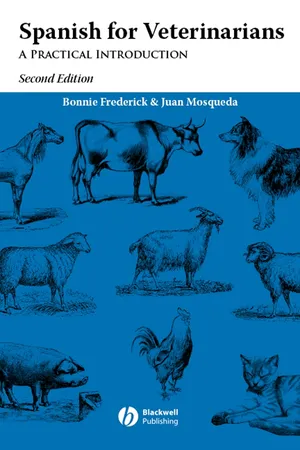
Spanish for Veterinarians, Second Edition, is designed to help you rapidly learn working Spanish for clinical conversations. Packed with the practical vocabulary information and conversational tools found in the first edition, the new edition now includes a new chapter on exotics and expanded information on the Spanish required for pre-consultation discussion. The pronunciation exercises, available online as audio files to help veterinary team members effectively and confidently use Spanish in their client communications, have also been revised and expanded. This new edition is a lively presentation of the Spanish that working vets increasingly need to know.
Information
CHAPTER 1
Getting Started
Pronunciation of Spanish
English speakers can breathe a sigh of relief: Unlike English, Spanish is logical and systematic in its pronunciation. There is only one silent letter, and all the other letters have only one major pronunciation. English speakers should focus first on the vowels.
Vowels
a as in father, otter, modern
e as in able, eight, paint
i as in easy, eat, machine
o as in old, rope, oats
u as in loop, moo, dude
Now try out the following words, saying them out loud and paying great attention to the vowels (don’t worry about anything else yet):
abomaso
abdomen
epidemia
enterovirus
insecto
inseminar
ovario
oviducto
uremia
ubre
Generally speaking, the vowels are more important in the Spanish language than in the English language, so you should practice them as much as possible.
Consonants
Consonants in Spanish are similar to those in English, with these exceptions:
- d is soft; it’s similar to these. When the d occurs between two vowels, it might even disappear in rapid speech; hablado can become hablao in some varieties of Spanish. Some practice words are: edad, nutrido, and ganado.
- h is silent. No matter how tempting it is, it is never pronounced. Some practice words are: heno, hormona, harina, and ahora.
- j is pronounced like the English happy. Some practice words are: jinete, conejo, and paja.
- ll is pronounced like the English yahoo. But in some dialects, such as those in Argentina, it’s pronounced like jello. Some practice words are: caballo, llano, and gallina.
- ñ is pronounced like the English canyon; the word in Spanish is cañón. Some practice words are: año, ordeño, and rapiña.
- qu is pronounced like the English kick, not quick; it doesn’t have the w sound as in English. Some practice words are: que, equino, and quiste.
- r inside a word has a little flip of the tongue as in the English words batter, bitter, or butter. Practice these words first to loosen up your tongue. Some practice words are: toro, terapia, and ubre.
- To pronounce rr or r at the beginning of a word, you must first practice purring like a cat or making a sound like a car revving up. The sound should be in your tongue (flapping like a flag in the wind) and not in your throat (no hacking please). As before, you should loosen your tongue. Some practice words are: perro, rabia, rumiante, and forraje. NOTE: The tongue muscles you use to make this revving sound are not commonly used in English, so yours are probably not accustomed to making this sound. If you notice that the sides of your tongue are a little sore, that means you’re practicing this sound properly, and those muscles are getting stronger.
- υ is pronounced like the English bed. A common spelling mistake among native Spanish speakers is to substitute b for v and vice versa. Some practice words are: vaca, virus, and veterinario.
- x is usually pronounced as it is in English; here is x in its usual ks form: toxina, examen, sexo, and ixodicida. But in certain words taken from the indigenous groups, x is more like the Spanish j. A practice word is México.
- z is pronounced like s in Latin America, but it is pronounced like th by many Spaniards. Some practice words to try both ways are: pezuña, lechuza, and enzima.
- c and g can be hard or soft, depending on what follows. C is hard like k when it is followed by a, o, or u. Some practice words are: caballo, cola, and curar. But it is soft like s when it is followed by i or e. Some practice words are: ciencia and cebra. Similarly, g is pronounced like English gargle when it’s followed by a, o, or u. Some practice words are: ganado, gallina, and gusano. Followed by e or i, the g becomes softened and is pronounced like English hello. Some practice words are gestante, ingesta, and agitado.
Which Syllable to Stress?
In Spanish there are three rules for syllable emphasis, that is, which syllable is pronounced stronger than the other parts of the word.
1. If a word ends in a vowel, s, or n, then the stress is on the next-to-last syllable. Some examples are: sangre, cuerno, abeja, razas, crecen, and dosis.
2. If a word ends in a consonant except s or n, the stress is on the last syllable. Some examples are: tumor, morbosidad, estar, and rural.
3. If a word doesn’t follow rule 1 or rule 2, then there’s a written accent mark. Some examples are: pájaro, gládula, ácaro, trébol, and mamífero.
Nouns and Plurals
Nouns are things or objects; in English, you can spot a noun because it can have the article “the” in front of it: the house, the barn, or the doctor. In Spanish, all nouns have gender; they are either masculine or feminine.
Feminine nouns often end in a, and their version of the article “the” is la: la vaca, la oveja, la pata, la cola, and la pipa.
Masculine nouns often end in o, and their version of the article “the” is el: el caballo, el perro, el calcio, and el rebaño. There are, however, exceptions, such as la mano or la radio.
Words that end in -itis, -osis, -ción, -dad, -tad, -tud, -ie, or -umbre are usually feminine. Some examples are la mastitis, la pediculosis, la inyección, la obesidad, la dificultad, la multitud, la serie, and la certidumbre.
The Spanish language also absorbed many Greek words. In Greek, a word ending in a is masculine. Some examples are: el síntoma, el edema, el sistema, el mapa, el problema, el programa, el linfoma, el enfisema, and el tema. Notice that most, though not all, of these words end in -ema.
Beyond these guidelines, you simply have to learn the gender of the noun when you learn the noun. As you study vocabulary, always learn the word with its article el or la. Notice, for example, that the following words both end in e, but they differ in gender: la sangre and el forraje.
When it comes to people and animals, there often are pairs of words showing the actual gender of the person or animal.
la especialista, el especialista; la veterinaria, el veterinario; la dueña, el dueño;
la gata, el gato; la coneja, el conejo; la perra, el perro
Articles and Plurals
As was previously discussed, the definite article “the” in English is equivalent to la or el in Spanish. The indefinite article “a” or “an” in English is equivalent to una (feminine) or un (masculine) in Spanish:
| la pluma (the feather) | una pluma (a feather) |
| el gusano (the worm) | un gusano (a worm) |
If the word ends in a vowel, just add s to make the nouns and articles plural because both have to match in both gender and number:
| las plumas (the feathers) | unas plumas (some feathers) |
| los gusanos (the worms) | unos gusanos (some worms) |
If the word ends in a consonant, add es to make the noun and article plural:
| el tumor (the tumor) | los tumores (the tumors) |
| la edad (the age) | las eda... |
Table of contents
- Cover
- Title
- copyright
- Preface
- Acknowledgments
- CHAPTER 1: Getting Started
- CHAPTER 2: The Body and How to Describe It
- CHAPTER 3: Verbs: Where the Action Is
- CHAPTER 4: Irregular Verbs
- CHAPTER 5: How Long Has the Cow Had a Fever?
- CHAPTER 6: The Past and Accidents
- CHAPTER 7: Telling People What to Do
- CHAPTER 8: Taking a Clinical History
- CHAPTER 9: The Diagnostic Exam
- CHAPTER 10: Cattle
- CHAPTER 11: Horses
- CHAPTER 12: Sheep and Goats
- CHAPTER 13: Swine
- CHAPTER 14: Dogs and Cats
- CHAPTER 15: Exotic Pets
- APPENDIX: Registration Forms
- Answer Key to Exercises
- Dictionary
Trusted by 375,005 students
Access to over 1.5 million titles for a fair monthly price.
Study more efficiently using our study tools.
Frequently asked questions
Yes, you can cancel anytime from the Subscription tab in your account settings on the Perlego website. Your subscription will stay active until the end of your current billing period. Learn how to cancel your subscription
No, books cannot be downloaded as external files, such as PDFs, for use outside of Perlego. However, you can download books within the Perlego app for offline reading on mobile or tablet. Learn how to download books offline
Perlego offers two plans: Essential and Complete
- Essential is ideal for learners and professionals who enjoy exploring a wide range of subjects. Access the Essential Library with 800,000+ trusted titles and best-sellers across business, personal growth, and the humanities. Includes unlimited reading time and Standard Read Aloud voice.
- Complete: Perfect for advanced learners and researchers needing full, unrestricted access. Unlock 1.5M+ books across hundreds of subjects, including academic and specialized titles. The Complete Plan also includes advanced features like Premium Read Aloud and Research Assistant.
We are an online textbook subscription service, where you can get access to an entire online library for less than the price of a single book per month. With over 1.5 million books across 990+ topics, we’ve got you covered! Learn about our mission
Look out for the read-aloud symbol on your next book to see if you can listen to it. The read-aloud tool reads text aloud for you, highlighting the text as it is being read. You can pause it, speed it up and slow it down. Learn more about Read Aloud
Yes! You can use the Perlego app on both iOS and Android devices to read anytime, anywhere — even offline. Perfect for commutes or when you’re on the go.
Please note we cannot support devices running on iOS 13 and Android 7 or earlier. Learn more about using the app
Please note we cannot support devices running on iOS 13 and Android 7 or earlier. Learn more about using the app
Yes, you can access Spanish for Veterinarians by Bonnie Frederick,Juan Mosqueda in PDF and/or ePUB format, as well as other popular books in Medicina & Medicina veterinaria. We have over 1.5 million books available in our catalogue for you to explore.