- English
- ePUB (mobile friendly)
- Available on iOS & Android
eBook - ePub
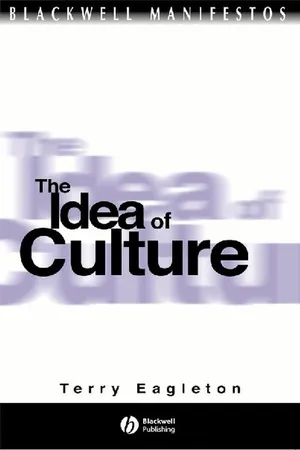
The Idea of Culture
About this book
Terry Eagleton's book, in this vital new series from Blackwell, focuses on discriminating different meanings of culture, as a way of introducing to the general reader the contemporary debates around it.
Information
1
Versions of Culture
‘Culture’ is said to be one of the two or three most complex words in the English language, and the term which is sometimes considered to be its opposite – nature – is commonly awarded the accolade of being the most complex of all. Yet though it is fashionable these days to see nature as a derivative of culture, culture, etymologically speaking, is a concept derived from nature. One of its original meanings is ‘husbandry’, or the tending of natural growth. The same is true of our words for law and justice, as well as of terms like ‘capital’, ‘stock’, ‘pecuniary’ and ‘sterling’. The word ‘coulter’, which is a cognate of ‘culture’, means the blade of a ploughshare. We derive our word for the finest of human activities from labour and agriculture, crops and cultivation. Francis Bacon writes of ‘the culture and manurance of minds’, in a suggestive hesitancy between dung and mental distinction. ‘Culture’ here means an activity, and it was a long time before the word came to denote an entity. Even then, it was probably not until Matthew Arnold that the word dropped such adjectives as ‘moral’ and ‘intellectual’ and came to be just ‘culture’, an abstraction in itself.
Etymologically speaking, then, the now-popular phrase ‘cultural materialism’ is something of a tautology. ‘Culture’ at first denoted a thoroughly material process, which was then metaphorically transposed to affairs of the spirit. The word thus charts within its semantic unfolding humanity’s own historic shift from rural to urban existence, pig-farming to Picasso, tilling the soil to splitting the atom. In Marxist parlance, it brings together both base and superstructure in a single notion. Perhaps behind the pleasure we are supposed to take in ‘cultivated’ people lurks a race-memory of drought and famine. But the semantic shift is also paradoxical: it is the urban dwellers who are ‘cultivated’, and those who actually live by tilling the soil who are not. Those who cultivate the land are less able to cultivate themselves. Agriculture leaves no leisure for culture.
The Latin root of the word ‘culture’ is colere, which can mean anything from cultivating and inhabiting to worshipping and protecting. Its meaning as ‘inhabit’ has evolved from the Latin colonus to the contemporary ‘colonialism’, so that titles like Culture and Colonialism are, once again, mildly tautological. But colere also ends up via the Latin cultus as the religious term ‘cult’, just as the idea of culture itself in the modern age comes to substitute itself for a fading sense of divinity and transcendence. Cultural truths – whether high art or the traditions of a people – are sometimes sacred ones, to be protected and revered. Culture, then, inherits the imposing mantle of religious authority, but also has uneasy affinities with occupation and invasion; and it is between these two poles, positive and negative, that the concept is currently pitched. It is one of those rare ideas which have been as integral to the political left as they are vital to the political right, and its social history is thus exceptionally tangled and ambivalent.
If the word ‘culture’ traces a momentous historical transition, it also encodes a number of key philosophical issues. Within this single term, questions of freedom and determinism, agency and endurance, change and identity, the given and the created, come dimly into focus. If culture means the active tending of natural growth, then it suggests a dialectic between the artificial and the natural, what we do to the world and what the world does to us. It is an epistemologically ‘realist’ notion, since it implies that there is a nature or raw material beyond ourselves; but it also has a ‘constructivist’ dimension, since this raw material must be worked up into humanly significant shape. So it is less a matter of deconstructing the opposition between culture and nature than of recognizing that the term ‘culture’ is already such a deconstruction.
In a further dialectical turn, the cultural means we use to transform nature are themselves derived from it. The point is made rather more poetically by Polixenes in Shakespeare’s The Winter’s Tale:
Yet nature is made better by no mean
But nature makes that mean; so over that art,
Which you say adds to nature, is an art
That nature makes … This is an art
Which does mend nature – change it rather, but
The art itself is nature.
But nature makes that mean; so over that art,
Which you say adds to nature, is an art
That nature makes … This is an art
Which does mend nature – change it rather, but
The art itself is nature.
(Act IV, sc. iv)
Nature produces culture which changes nature: it is a familiar motif of the so-called Last Comedies, which see culture as the medium of nature’s constant self-refashioning. If Ariel in The Tempest is all airy agency and Caliban all earthy inertia, a more dialectical interplay of culture and nature can be found in Gonzalo’s description of Ferdinand swimming from the wrecked ship:
Sir, he may live;
I saw him beat the surges under him,
And ride upon their backs; he trod the water,
Whose enmity he flung aside, and breasted
The surge most swoln that met him; his bold head
’Bove the contentious waves he kept, and oared
Himself with his good arms in lusty stroke
To th’ shore …
I saw him beat the surges under him,
And ride upon their backs; he trod the water,
Whose enmity he flung aside, and breasted
The surge most swoln that met him; his bold head
’Bove the contentious waves he kept, and oared
Himself with his good arms in lusty stroke
To th’ shore …
(Act II, sc. i)
Swimming is an apt image of the interplay in question, since the swimmer actively creates the current which sustains him, plying the waves so they may return to buoy him up. Thus Ferdinand ‘beats the surges’ only to ‘ride upon their backs’, treads, flings, breasts and oars an ocean which is by no means just pliable material but ‘contentious’, antagonistic, recalcitrant to human shaping. But it is just this resistance which allows him to act upon it. Nature itself produces the means of its own transcendence, rather as the Derridean ‘supplement’ is already contained by whatever it amplifies. As we shall see later, there is something oddly necessary about the gratuitous superabundance we call culture. If nature is always in some sense cultural, then cultures are built out of that ceaseless traffic with nature which we call labour. Cities are raised out of sand, wood, iron, stone, water and the like, and are thus quite as natural as rural idylls are cultural. The geographer David Harvey argues that there is nothing ‘unnatural’ about New York city, and doubts that tribal peoples can be said to be ‘closer to nature’ than the West.1 The word ‘manufacture’ originally means handicraft, and is thus ‘organic’, but comes over time to denote mechanical mass production, and so picks up a pejorative overtone of artifice, as in ‘manufacturing divisions where none exist’.
If culture originally means husbandry, it suggests both regulation and spontaneous growth. The cultural is what we can change, but the stuff to be altered has its own autonomous existence, which then lends it something of the recalcitrance of nature. But culture is also a matter of following rules, and this too involves an interplay of the regulated and unregulated. To follow a rule is not like obeying a physical law, since it involves a creative application of the rule in question. 2–4–6–8–10–30 may well represent a rule-bound sequence, just not the rule one most expects. And there can be no rules for applying rules, under pain of infinite regress. Without such open-endedness, rules would not be rules, rather as words would not be words; but this does not mean that any move whatsoever can count as following a rule. Rule-following is a matter neither of anarchy nor autocracy. Rules, like cultures, are neither sheerly random nor rigidly determined – which is to say that both involve the idea of freedom. Someone who was entirely absolved from cultural conventions would be no more free than someone who was their slave.
The idea of culture, then, signifies a double refusal: of organic determinism on the one hand, and of the autonomy of spirit on the other. It is a rebuff to both naturalism and idealism, insisting against the former that there is that within nature which exceeds and undoes it, and against idealism that even the most high-minded human agency has its humble roots in our biology and natural environment. The fact that culture (like nature in this respect) can be both a descriptive and evaluative term, meaning what has actually evolved as well as what ought to, is relevant to this refusal of both naturalism and idealism. If the concept sets its face against determinism, it is equally wary of voluntarism. Human beings are not mere products of their environs, but neither are those environs sheer clay for their arbitrary self-fashioning. If culture transfigures nature, it is a project to which nature sets rigorous limits. The very word ‘culture’ contains a tension between making and being made, rationality and spontaneity, which upbraids the disembodied intellect of the Enlightenment as much as it defies the cultural reductionism of so much contemporary thought. It even hints towards the political contrast between evolution and revolution – the former ‘organic’ and ‘spontaneous’, the latter artificial and voulu – and suggests how one might move beyond this stale antithesis too. The word oddly commingles growth and calculation, freedom and necessity, the idea of a conscious project but also of an unplannable surplus. And if this is true of the word, so is it of some of the activities it denotes. When Friedrich Nietzsche looked for a practice which might dismantle the opposition between freedom and determinism, it was to the experience of making art that he turned, which for the artist feels not only free and necessary, creative and constrained, but each of these in terms of the other, and so appears to press these rather tattered old polarities to the point of undecidability.
There is another sense in which culture as a word faces both ways. For it can also suggest a division within ourselves, between that part of us which cultivates and refines, and whatever within us constitutes the raw material for such refinement. Once culture is grasped as self-culture, it posits a duality between higher and lower faculties, will and desire, reason and passion, which it then instantly offers to overcome. Nature now is not just the stuff of the world, but the dangerously appetitive stuff of the self. Like culture, the word means both what is around us and inside us, and the disruptive drives within can easily be equated with anarchic forces without. Culture is thus a matter of self-overcoming as much as self-realization. If it celebrates the self, it also disciplines it, aesthetic and ascetic together. Human nature is not quite the same as a field of beetroot, but like a field it needs to be cultivated – so that as the word ‘culture’ shifts us from the natural to the spiritual, it also intimates an affinity between them. If we are cultural beings, we are also part of the nature on which we go to work. Indeed it is part of the point of the word ‘nature’ to remind us of the continuum between ourselves and our surroundings, just as the word ‘culture’ serves to highlight the difference.
In this process of self-shaping, action and passivity, the strenuously willed and the sheerly given, unite once more, this time in the same individuals. We resemble nature in that we, like it, are to be cuffed into shape, but we differ from it in that we can do this to ourselves, thus introducing into the world a degree of self-reflexivity to which the rest of nature cannot aspire. As self-cultivators, we are clay in our own hands, at once redeemer and unregenerate, priest and sinner in the same body. Left to its own devices, our reprobate nature will not spontaneously rise to the grace of culture; but neither can such grace be rudely forced upon it. It must rather cooperate with the innate tendencies of nature itself, in order to induce it to transcend itself. Like grace, culture must already represent a potential within human nature, if it is to stick. But the very need for culture suggests that there is something lacking in nature – that our capacity to rise to heights beyond those of our fellow natural creatures is necessary because our natural condition is also a good deal more ‘unnatural’ than that of our fellows. If there is a history and a politics concealed in the word ‘culture’, there is also a theology.
Cultivation, however, may not only be something we do to ourselves. It may also be something done to us, not least by the political state. For the state to flourish, it must inculcate in its citizens the proper sorts of spiritual disposition; and it is this which the idea of culture or Bildung signifies in a venerable tradition from Schiller to Matthew Arnold.2 In civil society, individuals live in a state of chronic antagonism, driven by opposing interests; but the state is that transcendent realm in which these divisions can be harmoniously reconciled. For this to happen, however, the state must already have been at work in civil society, soothing its rancour and refining its sensibilities; and this process is what we know as culture. Culture is a kind of ethical pedagogy which will fit us for political citizenship by liberating the ideal or collective self buried within each of us, a self which finds supreme representation in the universal realm of the state. Coleridge writes accordingly of the need to ground civilization in cultivation, ‘in the harmonious development of those qualities and faculties that characterise our humanity. We must be men in order to be citizens’.3 The state incarnates culture, which in turn embodies our common humanity.
To elevate culture over politics – to be men first and citizens later – means that politics must move within a deeper ethical dimension, drawing on the resources of Bildung and forming individuals into suitably well-tempered, responsible citizens. This is the rhetoric of the civics class, if a little more highly pitched. But since ‘humanity’ here means a community free of conflict, what is at stake is not just the priority of culture over politics, but over a particular kind of politics. Culture, or the state, are a sort of premature utopia, abolishing struggle at an imaginary level so that they need not resolve it at a political one. Nothing could be less politically innocent than a denigration of politics in the name of the human. Those who proclaim the need for a period of ethical incubation to prepare men and women for political citizenship include those who deny colonial peoples the right to self-government until they are ‘civilized’ enough to exercise it responsibly. They overlook the fact that by far the best preparation of political independence is political independence. Ironically, then, a case which moves from humanity to culture to politics betrays by its own political bias the fact that the real movement is the other way – that it is political interests which usually govern cultural ones, and in doing so define a particular version of humanity.
What culture does, then, is distil our common humanity from our sectarian political selves, redeeming the spirit from the senses, wresting the changeless from the temporal, and plucking unity from diversity. It signifies a kind of self-division as well as a self-healing, by which our fractious, sublunary selves are not abolished, but refined from within by a more ideal sort of humanity. The rift between state and civil society – between how the bourgeois citizen would like to represent himself and how he actually is – is preserved but also eroded. Culture is a form of universal subjectivity at work within each of us, just as the state is the presence of the universal within the particularist realm of civil society. As Friedrich Schiller puts it in his Letters on the Aesthetic Education of Man (1795):
Every individual human being, one may say, carries within him, potentially and prescriptively, an ideal man, the archetype of a human being, and it is his life’s task to be, through all his changing manifestations, in harmony with the unchanging unity of this ideal. This archetype, which is to be discerned more or less clearly in every individual, is represented by the State, the objective and, as it were, canonical form in which all the diversity of individual subjects strives to unite.4
In this tradition of thought, then, culture is neither dissociated from society nor wholly at one with it. If it is a critique of social life at one level, it is complicit with it at another. It has not yet set its face entirely against the actual, as it will as the English ‘Culture and Society’ lineage gradually unfurls. Indeed culture for Schiller is the very mechanism of what will later be called ‘hegemony’, moulding human subjects to the needs of a new kind of polity, remodelling them from the ground up into the docile, moderate, high-minded, peace-loving, uncontentious, disinterested agents of that political order. But to do this, culture must also act as a kind of immanent critique or deconstruction, occupying an unregenerate society from within to break down its resistance to the motions of the spirit. Later in the modern age, culture will become either Olympian wisdom or ideological weapon, a secluded form of social critique or a process locked all too deeply into the status quo. Here, at an earlier, more buoyant moment of that history, it is still possible to see culture as at once an ideal criticism and a real social force.
Raymond Williams has traced something of the complex history of the word ‘culture’, distinguishing three major modern senses of the word.5 From its etymological roots in rural labour, the word comes first to mean something like ‘civility’, and then in the eighteenth century becomes more or less synonymous with ‘civilization’, in the sense of a general process of intellectual, spiritual and material progress. As an idea, civilization significantly equates manners and morals: to be civilized includes not spitting on the carpet as well as not decapitating one’s prisoners of war. The very word implies a dubious correlation between mannerly conduct and ethical behaviour, which in England can also be found in the word ‘gentleman’. As a synonym of ‘civilization’, ‘culture’ belonged to the general spirit of Enlightenment, with its cult of secular, progressive self-development. Civilization was largely a French notion – then as now, the French were thought to have a monopoly on being civilized – and named both the gradual process of social refinement and the utopian telos towards which it was unfolding. But whereas the French ‘civilization’ typically included political, economic and technical life, the German ‘culture’ had a more narrowly religious, artistic and intellectual reference. It could also mean the intellectual refinement of a group or individual, rather than of society as a whole. ‘Civilization’ played down national differences, whereas ‘culture’ highlighted them. The tension between ‘culture’ and ‘civilization’ had much to do with the rivalry between Germany and France.6
Three things then happen to the notion around the turn of the nineteenth century. For one thing, it begins to veer from being a synonym of ‘civilization’ towards being its antonym. This is a rare enough semantic swerve, and one which captures a momentous historical one. Like ‘culture’, ‘civilization’ is part-descriptive, partnormative: it can either neutrally designate a form of life (‘Inca civilization’), or implicitly commend a life-form for its humanity, enlightenment and refinement. The adjectival form ‘civilized’ does this most obviously today. If civilization means the arts, urban living, civic politics, complex technologies and the like, and if this is considered an advance upon what went before, then ‘civilization’ is inseparably descriptive and normative. It means life as we know it, but also suggests that it is superior to barbarism. And if civilization is not only a stage of development in itself, but one which is constantly evolving within itself, then the word once more unifies fact and value. Any existing state of affairs implies a value-judgement, since it must logically be an improvement on what went before. Whatever is is not only right, but a great deal better than what was.
The trouble begins when the descriptive and normative aspects of the word ‘civilization’ start to fly apart. The term really belongs to the lexicon of a pre-industrial European middle class, redolent as it is of manners, refinement, politesse, an elegant ease of intercourse. It is thus both personal and social: cultivation is a matter of the harmoniou...
Table of contents
- Cover
- Contents
- Series Page
- Title Page
- Copyright Page
- Dedication
- 1 Versions of Culture
- 2 Culture in Crisis
- 3 Culture Wars
- 4 Culture and Nature
- 5 Towards a Common Culture
- Notes
- Index
Trusted by 375,005 students
Access to over 1.5 million titles for a fair monthly price.
Study more efficiently using our study tools.
Frequently asked questions
Yes, you can cancel anytime from the Subscription tab in your account settings on the Perlego website. Your subscription will stay active until the end of your current billing period. Learn how to cancel your subscription
No, books cannot be downloaded as external files, such as PDFs, for use outside of Perlego. However, you can download books within the Perlego app for offline reading on mobile or tablet. Learn how to download books offline
Perlego offers two plans: Essential and Complete
- Essential is ideal for learners and professionals who enjoy exploring a wide range of subjects. Access the Essential Library with 800,000+ trusted titles and best-sellers across business, personal growth, and the humanities. Includes unlimited reading time and Standard Read Aloud voice.
- Complete: Perfect for advanced learners and researchers needing full, unrestricted access. Unlock 1.5M+ books across hundreds of subjects, including academic and specialized titles. The Complete Plan also includes advanced features like Premium Read Aloud and Research Assistant.
We are an online textbook subscription service, where you can get access to an entire online library for less than the price of a single book per month. With over 1.5 million books across 990+ topics, we’ve got you covered! Learn about our mission
Look out for the read-aloud symbol on your next book to see if you can listen to it. The read-aloud tool reads text aloud for you, highlighting the text as it is being read. You can pause it, speed it up and slow it down. Learn more about Read Aloud
Yes! You can use the Perlego app on both iOS and Android devices to read anytime, anywhere — even offline. Perfect for commutes or when you’re on the go.
Please note we cannot support devices running on iOS 13 and Android 7 or earlier. Learn more about using the app
Please note we cannot support devices running on iOS 13 and Android 7 or earlier. Learn more about using the app
Yes, you can access The Idea of Culture by Terry Eagleton in PDF and/or ePUB format, as well as other popular books in Literature & Literary Criticism Theory. We have over 1.5 million books available in our catalogue for you to explore.