- English
- ePUB (mobile friendly)
- Available on iOS & Android
eBook - ePub
About this book
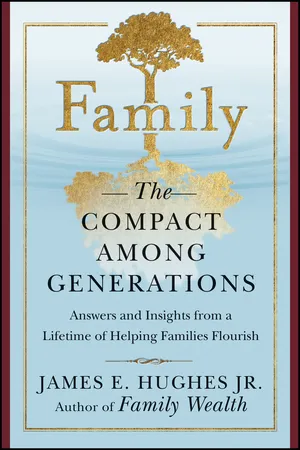
Why do some families thrive for generations? What accounts for the sad deterioration that others experience? This book takes families and the professionals who serve them beyond the now widely accepted practices offered in Family Wealth and offers a view of Hughes's panoramic insights into what makes families flourish and fail. It lays out the basis for the vision of family governance the author has been developing through his work and research. His advice addresses not only what to do but how to think about the complex issues of family governance, growth, and stability and the ongoing challenge of nurturing the happiness of each family member.
Information
PART ONE
Families of Affinity Their Nature and Practices
Chapter One
A Family of Affinity
By its dominant voices, its most unforgettable faces, and its chief acts of bravery does a generation recognize itself and history mark it.
—ERIC SEVAREID, American journalist
WHAT IS THIS thing we call “family” and what are its characteristics? I define a family as two or more people who by either genetic lineage or bonds of affinity consider themselves related to each other. The core of my philosophy is my belief that a family that sees itself as linked not only by blood but by affinity and acts from that philosophical base has the greatest chance of successfully enhancing the individual development and growth of its members and thus of dynamically preserving the family as a whole for at least five generations. Families who see themselves principally as linked by genetic lineage, or by blood, rarely if ever, in my experience, overcome the proverb.
Paradoxically, most families define themselves by blood alone and not also by affinity. Regardless of popular sentiment for such a definition, I have repeatedly found that a family that defines itself in this way closes its systems to new members from outside the family. These outsiders represent the new energy the family needs to overcome what it will lose by natural attrition. A family of affinity maintains open systems that welcome new members, giving the family a better chance of survival.
The Family and Its Functions
The function of the family is closely tied to the traits that characterize the human species. What characteristics capture how the human species is different from all others? First, we are defined by our gregariousness, our desire to be with others of our kind; second, as Dutch historian Johan Huizinga said, by our desire to play, our curiosity (Homo ludens); and third, by our desire to make tools (Homo faber). How are these characteristics manifested in a family?
Family is where our sense of gregariousness begins and is first worked out. Play within family is how we first learn and in many cases how we discover and define ourselves for the rest of our lives. Family is often the place we must leave in order to learn to individuate but to which we most want to return to tell the stories of our lives to those most willing to hear them. The parable of the prodigal son comes to mind. Our ability to make tools that manipulate our environment has led to our ability to survive and prosper within it. Family is often the place that spawns our creativity and offers us a laboratory for trying out new tools. It’s the place we find responses to new questions.
This definition of family puts the issues of the affinity of altruism and the selfishness of blood in direct opposition. It creates a dynamic competition of ideas between the sciences and the humanities, which can influence the family’s journey. That competition of ideas is between
a. the possibility that we are simply individual biological life forms, bundles of evolved genes, seeking selfishly to replicate ourselves, consciously or unconsciously, and
b. individuals of spirit, or consciousness, who seek to know ourselves through our interactions with other individuals likewise seeking to know themselves, all toward an enlightened self.
I believe that we are altruistic and that insofar as success as a family is concerned, altruism—the act of truly caring for another and acting generously toward that other—is likely to be a far more successful behavioral trait than is selfish genetic combat to survive. In my view, family founders who believe that their family’s differentness is worth preserving cannot begin with any view other than that altruism toward the spirit of each of their descendants and of all other sentient beings must govern all actions. Betting on a selfish goal of individual survival or, worse, on the biologically fallacious belief that one family’s DNA is superior to another’s will cause the family to lose the preservation race before it is very far along.
Defining Affinity
What are the connotations of the word affinity that make it so useful in my model description of a successful family? The Oxford English Dictionary offers many usages for this word. Let’s consider the definitions of this word that offer insight into its power in helping to define successful families.
1. Relationship by marriage as opposed to consanguinity, hence, collectively, relations by marriage. In these few words, we find the reality of family. Every family begins with two people, as all creation myths inform us. Certainly, in all general discussions of family, we link the concept to two people whom we see as its founders. Until very recently in human social history, these two people were always linked by some sort of marriage ritual, either a religious ceremony or the act of living together as a recognized couple for an extended period. Because such relationships are still the norm throughout the different cultures of the world, this is the form of family I will be describing throughout this book. Often today, even in single-sex families, two or more individuals who see themselves as founders seek a ritual to validate their union.
2. The spiritual relationship between sponsors and their godchild or between the sponsors themselves. In this definition, affinity can extend beyond blood or consanguinity and beyond relations by marriage. Bonds of emotion—defined as affinities—form between a sponsor and a child, and those affinities need not come from any genetic link. This form of affinity underlies the connections in successful tribes. Its powerful force of attraction and the tribe’s system of “seventh-generation thinking” reinforce this way of defining family relationships (see chapter 2).
3. Relationship or kinship generally between individuals or races; collectively, relations, kindred. This definition of affinity picks up where the second leaves off. Affinity describes relationships that we define as “kin.” These relations can be as broad as our relations with the races with whom we feel an affinity or as narrow as third cousins whom we rarely see.
4. Structural resemblance between different animals, plants, or minerals, suggesting modifications of one or (in the case of the two former) gradual differentiation from a common stock. This definition, taken from natural history, describes affinity in terms of our evolution as animals through the modification of our primary type. We have affinities as Homo sapiens to our original ancestors—the earliest members of the genus Homo—and to their ancestors from whom we split some 6 to 7 million years ago and to the evolving life form of our current species as it will inevitably evolve far into the future. All families as they evolve through their many successor generations reflect their affinity to their originators. When family members lose these links and their affinities cannot be traced, they are no longer families but rather only individual genetic realities.
5. Causal relationship or connection (as flowing the one from the other or having a common source) or such agreement or similarity of nature or character as might result from such relationship if it existed; family likeness. This definition captures the importance I attach to stories as the glue that creates a family’s affinity. Genetics can, through DNA testing, show to whom we are related. For most of us, our genetic lines are hidden. The telling of our oral histories, however, is the visible and auditory means by which we learn and experience in the present what links us by affinity to our past. Family stories are how we define the specific ideas as well as the values and practices flowing from them that characterize our sense of family, our differentness. We seek the connections and the sense of common family nature these stories offer. In them, we find our shared sense of our connections and the relationships they reflect and engender. These common sources help us to know our family’s differentness and recognize its affinity.
6. Voluntary social relationships, companionship, alliance, association. The word voluntary in this definition is a critical element in defining the concept of a family of affinity. Individual family members are linked as parts of a family system. All of these linkages to family, however, are in my view based on voluntary acts we make of conscious will or intuitive spirit to join in the social relationships of companionship, alliance, and association called family. These relationships are the social compacts that underlie the entities we call families. Members perceive that here, in a family where openness to the growth of the individual is reflected in its voluntary social compacts, they will receive the sustenance needed to achieve that growth. If members experience family life as a prison, then any hope for the growth of human and intellectual capital or for enlightenment is severely reduced.
The choice of where we seek community in which to do our life’s work of development of self is of extraordinary importance to the outcome. Seeking and finding communities of affinity is one of our greatest challenges. Families of affinity are defined by their openness to fostering individual dreams and growth; in so doing, they offer fertile possibilities for the successful undertaking of each family member’s most important work. That work is to find a calling and to achieve the greatest self-awareness and the full flourishing of spirit that follows. A family practicing affinity through fostering generative social compacts does work that is deeply beneficial to its preservation. Such a family enables exactly the kinds of enhancing relationships human beings seek and therefore it is more likely to gain and retain the members it needs for a successful long-term family journey.
7. A natural friendliness, liking, attractiveness, or an attraction drawing to anything. Here, affinity represents a positive attraction. The word offers the possibility of a system providing positive feedback for our endeavors. A “liking” is positive; it connotes feelings that are enjoyable. It suggests relations of profound joy and humor, virtues that encourage participation. A family that expresses friendliness to its members is “attractive;” it draws them in. The family serves as a place of community, where each individual’s journey can be accommodated. Perhaps a family can even become a place where members can express gratitude for others’ gifts to them; in this way, a member learns another side of altruism and experiences the comfortable giving up of self to help others that is so essential to the development of self. This positive feedback loop of giving self to gain self is the most essential process we can engage in to develop ourselves.
8. Chemical attraction: the tendency which certain elementary substances of compounds have to unite with other elements and form new compounds. Where can we find a better vision of a successful family dynamically preserving itself than in this definition? Elementary substances (individual family members) unite with other elements (all other members of a family of affinity) to form new compounds (forms of community that are new and “different”). In this definition, we discover the ecology of families: the hidden building blocks of family life organically combining from individual substances to form the new compounds needed for higher orders of family life. No individual disappears in a family of affinity but rather each contributes to the compound of community. Fortunately, even as the family expresses its common process, it also expresses its differentness.
Equally fascinating in the life of a family is to imagine the life forms to come that will grow out of the next set of “chemical attractions” as new members enter the process. Whether new members are born into the family or marry in or join by mutual attraction, each will contribute unique substances to that family. To recognize the necessity of welcoming those new substances into the energetic body of the family is to recognize the truth of how families meet new challenges to their essences, their affinities. Families that recognize through their rituals the positive energy they gain by accretion do well. Families that create out-laws out of their in-laws perform less well. No family attempting to evolve to the next level of complexity, and thus a higher order of existence, can do so successfully by relying only on the assets of those born into the family. After all, a family begins with two unique genetic signatures deciding to mate and, as with every evolving form of life, it needs all the positive energetic additions it can attract to find the necessary combinations of substances needed to successfully evolve to a higher order of itself.
As with all evolution, the addition of a new substance can lead to a mutation of the original substance that can kill it, so we cannot say that all evolved change through adaptation to new members will be positive for family growth. It won’t be. The strongest life forms succeed because they are better at defending themselves against such intruders than their competitors are. I believe that families of affinity, because of their characteristics as seekers of new connections and their awareness of the riches and rewards of those connections, carry within themselves the capacity to better adapt to the mutations caused by new life forms joining them and indeed can benefit from them.
9. A physical or spiritual attraction believed by some sects to exist between persons; sometimes applied concretely to the subjects or objects of the affinity. In this definition, the word affinity captures the family of man and its members’ attraction to each other. It defines that attraction in terms of the conscious, curious, playful Homo ludens we are. Affinity is associated with the longest-lived of all families: the religious, or spiritual, bodies we know as animism, Hinduism, Confucianism, Taoism, Buddhism, Stoicism, Shintoism, Judaism, Jainism, Zoroastrianism, Christianity, Islam, Sikhism, and secular humanism. Affinity, here, represents attraction based on physical and biochemical links that could describe the link the secular humanist feels to the species as a whole. In spiritual terms, affinity describes attractions based on common sets of beliefs leading to faith in a higher power. Likewise, it links those who believe that reason and intellect guide our actions to those who believe intuition and emotion guide those same actions (I am in the latter camp). What’s more, if we are willing, we can accept the teaching of modern physics that we are, as is the universe of which we are a part, pure energy. We may be linked physically and spiritually, but, most important, we are linked energetically as well.
As applied to a family, this definition takes affinity to its highest order. A family of affinity and its individual members can be seen as bits of energy linked by affinity to each other and to all other bits of energy in the universe. As I once heard Sri Swami Satchidananda, the founder of Integral Yoga, say, “All rivers [religions] lead to the same common ocean, so, I say, do all single elements of energy flow to the ocean of light to make up the energy of the universe.” A family that knows its members are all part of the common family of light encourages its members to see the innumerable number of linkages they share within the vastness of the universe and reminds them, whenever their egos need it, of how very small they are in the scheme of things. Ideally, it also encourages them in their search for self to seek out the wisdom of the philosophers, the sages, the prophets, the divines, the aesthetic voices of the arts, and the voices of reason in science to help them reach an enlightened understanding of how all families came to be and how they are evolving within the larger energetic realms of which they are a part.
“Seek, and ye shall find”: Ask the questions about the affinities that lead to the next generation of affinity. Seek the psychic, spiritual, and energetic linkages that come from paradox—what doesn’t seem to be, but is—to find out where the true affinities lie. Families of affinity are always asking questions, always creating, always discovering, always seeking to find the linkages between their past and present that provide hints to the secrets of their future. Families of affinity challenge the conventional while preserving thei...
Table of contents
- Praise
- Title Page
- Copyright Page
- Dedication
- PREFACE
- Acknowledgements
- Introduction
- PART ONE - Families of Affinity Their Nature and Practices
- PART TWO - Defining the Journey
- PART THREE - Principles of Family Governance
- PART FOUR - Family Leadership
- PART FIVE - Tools and Pathfinders
- EPILOGUE
- APPENDIX - Recommended Reading
- INDEX
- About Bloomberg
- About the Author
Trusted by 375,005 students
Access to over 1.5 million titles for a fair monthly price.
Study more efficiently using our study tools.
Frequently asked questions
Yes, you can cancel anytime from the Subscription tab in your account settings on the Perlego website. Your subscription will stay active until the end of your current billing period. Learn how to cancel your subscription
No, books cannot be downloaded as external files, such as PDFs, for use outside of Perlego. However, you can download books within the Perlego app for offline reading on mobile or tablet. Learn how to download books offline
Perlego offers two plans: Essential and Complete
- Essential is ideal for learners and professionals who enjoy exploring a wide range of subjects. Access the Essential Library with 800,000+ trusted titles and best-sellers across business, personal growth, and the humanities. Includes unlimited reading time and Standard Read Aloud voice.
- Complete: Perfect for advanced learners and researchers needing full, unrestricted access. Unlock 1.5M+ books across hundreds of subjects, including academic and specialized titles. The Complete Plan also includes advanced features like Premium Read Aloud and Research Assistant.
We are an online textbook subscription service, where you can get access to an entire online library for less than the price of a single book per month. With over 1.5 million books across 990+ topics, we’ve got you covered! Learn about our mission
Look out for the read-aloud symbol on your next book to see if you can listen to it. The read-aloud tool reads text aloud for you, highlighting the text as it is being read. You can pause it, speed it up and slow it down. Learn more about Read Aloud
Yes! You can use the Perlego app on both iOS and Android devices to read anytime, anywhere — even offline. Perfect for commutes or when you’re on the go.
Please note we cannot support devices running on iOS 13 and Android 7 or earlier. Learn more about using the app
Please note we cannot support devices running on iOS 13 and Android 7 or earlier. Learn more about using the app
Yes, you can access Family by James E. Hughes, Jr. in PDF and/or ePUB format, as well as other popular books in Business & Investments & Securities. We have over 1.5 million books available in our catalogue for you to explore.