eBook - ePub
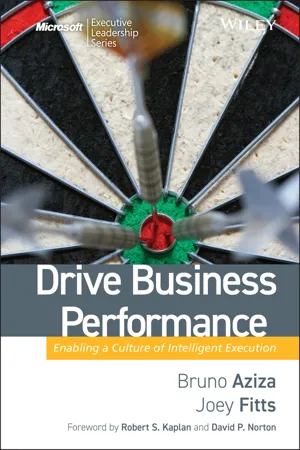
Drive Business Performance
Enabling a Culture of Intelligent Execution
- English
- ePUB (mobile friendly)
- Available on iOS & Android
eBook - ePub
About this book
This groundbreaking guide provides a deep understanding of how to achieve enterprise performance management objectives, backed up by first-hand accounts from Fortune 500 companies who are winning by building accountability, intelligence, and informed decision-making into their organizational DNA. Drive Business Performance explains the competitive advantage experienced by organizations that create and manage a "Culture of Performance."
1
The Six Stages of Performance Management
Give employees a large dose of discretion; provide them with the information they need to make wise decisions; and then hold them accountable for results.
—Gary Hamel, The Future of Management
WHY MANAGE PERFORMANCE?
Why do companies need to manage performance? For most organizations, it is crystal clear that they better figure out how to perform better if they want to better serve their customers, stay ahead of the competition, and meet shareholder demands.
Drivers for Performance Improvement
What are the catalysts for managing performance? Organizations often embark on a performance improvement initiative within one of the following scenarios:
• Leadership change. Often, performance improvement initiatives begin with a change in leadership. In case study after case study example in this book, this is a recurring theme—Energizer, Expedia, Fortis, Millipore, the Veteran’s Administration—all had new leaders come in with performance management as a priority. When a new leader takes over a division, business unit, or company, they have a green light to be bold in suggesting a performance improvement initiative. The authority and timing is right with a leadership change for performance optimization.
• Executive request—“top down.” Executives sometimes discover performance benefits achieved by other organizations and want to follow their path with a performance initiative within their own company or group.
We refer to this scenario as “scorecard envy,” when an executive sees the performance management capabilities other executives (inside or outside the company) have and wants these as well.
• Management best practice—“bottom-up.” This scenario is often the result of a zealous and persistent manager’s pioneering performance management results within a team or group, which get discovered and eventually are taken on to be institutionalized across the organization. As we shall see, this “internal guerilla marketing” as Laura Gibbons of Expedia refers to it, is necessary to get buy-in for performance management systems and processes even when executive support is present.
• Industry/sector awareness. In some industries, the management practices and systems are very consistent from company to company. When performance management becomes instantiated within a few of these organizations it is not uncommon for others in the industry to follow suit.
The public sector is a great example of this. Once a few government organizations adopt performance management practices, it soon proliferates across other segments of government.
There’s really a domino effect across the U.S. federal government for performance management adoption. Once the Balanced Scorecard was first adopted in the Army and the Department of Defense, it spread like wild fire.1
• Information technology (IT) driven: Sometimes the work of IT can help drive the proliferation of tools and applications, which start to effect broad change in how performance is managed. In these scenarios, the organization may view IT as strategic and take guidance on how technologies can improve performance thus having the initiative driven by IT. As IT shares technology capabilities without a business mandate, the “toys” are distributed and then the people discover how to play. This may result in a champion ultimately developing a best practice that bubbles up, and a more formal performance improvement initiative is started. This is not a common scenario, however, as at some point the push must come from the top down. Executive support is necessary for the performance management initiative to become a standard process or practice—to move from an initiative to the way the company does things across the enterprise.
• Regulations and public reporting: Regulations can also drive attention to performance management. Many public sector organizations are required to report performance against public metrics, such as the UN’s Millennium goals (as we shall discuss in the example of the Development Bank of Southern Africa). Public service organizations are often required to report their impact as well on metrics related to education, health, or safety.
In the private sector, compliance with financial reporting regulations such as Sarbanes Oxley and Basel II drive a focus on performance management. When the consequences are jail time for executives or fines if the organization is found to be out of compliance, it’s no wonder regulations are significant drivers for a more disciplined and transparent management approach.
These scenarios are typical catalysts for performance improvement. In addition to these structural drivers, there are also common business scenarios that compel organizations to better manage performance.
It should also be noted that performance management initiatives do not only occur when times are bad. Clearly, when performance is poor, the interest in performance improvement is increased. However, as professor and author Tom Davenport explains, you shouldn’t just manage performance when things are bad.
Motivation may be lower then (when things are going well), but when things do go bad, you need to know very quickly what the relationships are. So if you see that you are starting to have a problem with employee engagement, for example, you know from previous analysis that this is going to really affect your financial performance if you don’t do something about it very quickly. Or maybe you know there is a one year lag, so if we start with a customer royalty problem, it’s not going to affect this year’s performance but it is going to affect next year’s performance. You have to establish that under good times so you can address it quickly during bad.2
Good or Bad—You’re Making Decisions Today
The question really is not whether an organization will take steps to manage performance; it’s just a question of how serious they take performance and how well they’ll do it. Even without a formal performance management strategy and systems in place, organizations have some method, process, or habits they’ve developed to manage performance. Whether this is simply done via informal, status-update conversations, bonus-pay incentives, or a formal management-by-objectives method, these are all approaches to managing performance—it’s just the degree to which they are effective that varies.
So, when asked why performance management matters, we often ask in reply, “Why manage anything?”
Let’s start with a local business example for familiarity. Suppose you run a retail store and you are interested in making more money to grow your business, pay your people more, or maybe just so you can take a nice family vacation. How will you decide what promotion you are going to run to increase income for your store? This decision could be the difference between success and failure in achieving any of the above objectives.
Viewed differently, which organization would you rather have stock in—the retailer who makes up a promotion in 30 days’ time without any data to support the decision and hopes to get lucky? Or the retailer who, also within 30 days’ time, (1) segments the local retail market; (2) determines a targeted audience based on local retail market demographics, customer needs, and buying patterns; and (3) offers a promotion on merchandise of top buying interest to this community while also raising prices to increase profit margin on accessories and impulse merchandise? The answer seems obvious.
To believe in the benefits of performance management we assume a belief in the value of data driven decision making, a belief that well informed decisions typically yield better results than uninformed decisions. Thankfully, recent research indicates that “84% of senior executives believe high performing businesses make decisions based on evidence and facts rather than gut feel.”3
Organizations choose to manage performance for the same reason that organizations choose to have management structures—to provide a disciplined approach and accountability for running the business more effectively. The role of management is to align team efforts with corporate objectives and to be accountable for driving results of the team. Individual contributors are also responsible for individual results and utilize performance management systems to manage and report on this contribution as well. Across the entire enterprise, performance management, as with management itself, exists to help drive strategy execution, accountability, and performance.
Strategy Execution Is a Top Priority
The need and desire to improve performance is as clear as the competition’s logo, your own company’s ticker symbol or your last lost customer. The key reason why most companies around the world care about performance management is because they want to better execute their strategy.
Indeed, strategy execution is top of mind for global enterprises. In a recent study, the Conference Board asked 658 CEOs from multinational companies to prioritize their most pressing management challenges. “Consistent execution of strategy by top management” ranked first for organizations with revenues greater than $5 billion, and second for smaller organizations (behind “Sustained and steady top line growth”).4 Companies of all sizes seek to realize the benefits of their strategies through better strategy formulation, communication, and, ultimately, execution.
Executing on Strategy Is More Important than the Strategy Itself
It is often believed that it’s pure, genius strategy that wins the day. Many assume, “It’s the strategy that sets apart the envied market leader. Winning organizations must have great ideas and a novel approach that allows them to blaze a path to glory.”
However, we’ve learned that success hinges more on execution than a prize-winning strategy. Strategies hold potential, but delivering on the potential and contributing to organizational objectives depend on intelligent execution. While at first a controversial view, it is now more accepted to argue for tactical execution over high-level strategy alone. Before we review some of the research, following are some quotes that underscore the “execution” component of “strategy execution”:
Henry Ford
However beautiful the strategy, you should occasionally look at the results.
Winston Churchill
I saw that leaders placed too much emphasis on what some call high-level strategy, on intellectualizing and philosophizing, and not enough on implementation. People would agree on a project or initiative, and then nothing would come of it.
Larry Bossidy and Ram Charan,
Execution: The Discipline of Getting
Things Done
Execution: The Discipline of Getting
Things Done
Flawed decisions well implemented will bring more to the bottom line than the best decision that is not implemented.
Peter Schutz, former CEO, Porsche
Perhaps Mae West put it best of all, “An ounce of performance is worth pounds of promises.”
You’d Better Execute Better—Research Backs It Up
Fortune estimates that about 70% of companies can’t execute on strategy and that only 10% of organizations actually attain their strategic objectives. In the public sector, research by Barron’s indicates that out of nearly 800 federal programs studied only 15% achieved their goals.5
What’s the issue? Why is it so difficult to make strategy reality? A joint study by Renaissance Solutions, Inc., CFO magazine, and Business Intelligence helps describe the critical factors that account for failing to execute strategy across the organization:
• Awareness. 95% of the typical workforce does not understand the strategy.
• Finan...
Table of contents
- Title Page
- Copyright Page
- Dedication
- Foreword
- Foreword
- Preface
- Acknowledgements
- Chapter 1 - The Six Stages of Performance Management
- Chapter 2 - Managing Performance
- Chapter 3 - Monitor
- Chapter 4 - Analyze
- Chapter 5 - Plan
- Chapter 6 - Pull it All Together
- Index
Trusted by 375,005 students
Access to over 1.5 million titles for a fair monthly price.
Study more efficiently using our study tools.
Frequently asked questions
Yes, you can cancel anytime from the Subscription tab in your account settings on the Perlego website. Your subscription will stay active until the end of your current billing period. Learn how to cancel your subscription
No, books cannot be downloaded as external files, such as PDFs, for use outside of Perlego. However, you can download books within the Perlego app for offline reading on mobile or tablet. Learn how to download books offline
Perlego offers two plans: Essential and Complete
- Essential is ideal for learners and professionals who enjoy exploring a wide range of subjects. Access the Essential Library with 800,000+ trusted titles and best-sellers across business, personal growth, and the humanities. Includes unlimited reading time and Standard Read Aloud voice.
- Complete: Perfect for advanced learners and researchers needing full, unrestricted access. Unlock 1.5M+ books across hundreds of subjects, including academic and specialized titles. The Complete Plan also includes advanced features like Premium Read Aloud and Research Assistant.
We are an online textbook subscription service, where you can get access to an entire online library for less than the price of a single book per month. With over 1.5 million books across 990+ topics, we’ve got you covered! Learn about our mission
Look out for the read-aloud symbol on your next book to see if you can listen to it. The read-aloud tool reads text aloud for you, highlighting the text as it is being read. You can pause it, speed it up and slow it down. Learn more about Read Aloud
Yes! You can use the Perlego app on both iOS and Android devices to read anytime, anywhere — even offline. Perfect for commutes or when you’re on the go.
Please note we cannot support devices running on iOS 13 and Android 7 or earlier. Learn more about using the app
Please note we cannot support devices running on iOS 13 and Android 7 or earlier. Learn more about using the app
Yes, you can access Drive Business Performance by Bruno Aziza,Joey Fitts in PDF and/or ePUB format, as well as other popular books in Business & Business Strategy. We have over 1.5 million books available in our catalogue for you to explore.