- English
- ePUB (mobile friendly)
- Available on iOS & Android
eBook - ePub
About this book
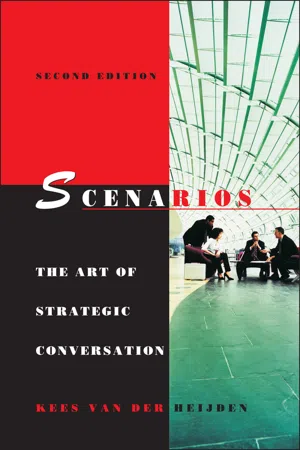
Scenario planning allows companies to move away from linear thinking and better understand external change. Eight years (and 30,000 copies) after publication Scenarios is still acknowledged as the definitive work in the field. Now, Kees van der Heijden brings his bestseller up to date, following up on his original case studies and adding significant new material. The Second Edition changes focus slightly by providing more in-depth analysis and application of the concept of the 'strategic conversation'. While maintaining the underlying rigour of the first edition, van der Heijden revisits the text to make it far more practical and accessible, and in doing so gives you the tools you need to set out and negotiate a successful future course for your organization in the face of significant uncertainty.
Part One
The Context
OVERVIEW
In this part we introduce scenario-based planning and consider it in the wider general management context. We will base this discussion on the premise that the ultimate purpose of the scenario planner is to create a more adaptable organisation, which first recognises change and uncertainty, and second uses it creatively to its advantage. Traditionally this has been the subject of a discipline known as ‘‘strategic management’’, and we review the various schools of thought that have developed over the years under this heading. We will argue that three main directions can be distinguished which tend to be put forward by protagonists as competing explanations of what happens in real-world organisations.
We will then develop a framework for integrating these schools of thought by means of the concept of organisations as learning organisms. We will move beyond the metaphor and develop a model for organisational learning, based on a general learning model suggested by David Kolb.
This unified theory of strategic management will put us in a position to discuss the contribution that scenario-based planning can make. We will argue that, properly institutionalised, the effect of scenario-based planning can be all-pervasive in an organisation’s ability to adapt and be successful in a continuously changing world.
Chapter One
1965 to 1990: Five Discoveries at Shell
Scenario-based planning has a long history. Its emergence in the organisational world is preceded by its use by the military in war games. It moved into the civil domain through the activities of the RAND Corporation during and after World War Two, and was subsequently developed by the Hudson Institute, created by Herman Kahn after he resigned from RAND. Kahn adopted the term ‘‘scenario’’, with its Hollywood association as a detailed outline of a future movie that was fictional, reinforcing his assertion that he did not make accurate predictions, but stories to explore. The Hollywood link was strengthened when director Stanley Kubrick used Khan as part of the model for his film character Dr Strangelove.
Kahn’s most quoted scenario publication was his book The Year 2000 published in 1967 (Kahn & Wiener 1967). From the late 1960s onwards scenario-based planning took off in the corporate world. Scenario analysis has evolved quite considerably since then. A short history of this evolution will help in understanding the basic principles involved.
Initially scenario analysis was essentially an extension of the traditional ‘‘predict-and-control’’ approach to planning, except that a single line forecast was replaced by a probabilistic assessment of alternative futures, leading to a ‘‘most likely’’ projection. This did not prove a fundamental advance over other forecasting approaches. By the end of the 1960s, the flaws in this approach were widely known. It is important to understand that the scenario-based planning process described in this book has at its core an entirely different central idea. This type of scenario-based planning relies not on probability but on causality. As such it appeals more to the intuitive needs of the typical decision makers in their search for enhanced understanding of the changing structures in society. Shell, one of the pioneers of scenario analysis, can probably claim to be one of the first and most consistent users of the methodology.
In Shell, interest in scenarios at a more conceptual level arose with the increasing failures of planning based on forecasts in the mid-1960s. Scenarios were initially introduced as a way to plan without having to predict things that everyone knew were unpredictable. Through Pierre Wack, who introduced scenarios in Shell, the early attempts were based on the Kahn philosophy. He suggested that planning must be based on the assumption that something is predictable. If the future is 100% uncertain planning is obviously a waste of time. The primary task therefore is to separate what is predictable from what is fundamentally uncertain. The predictable elements became known as the predetermined elements. The idea of the Kahn scenario approach was that predetermineds would be reflected in all scenarios in the same predictable way. Uncertainties, on the other hand, would be reflected through the different ways they play out in various different scenarios.
ROBUST DECISION MAKING
These multiple, but equally plausible, futures served the purpose of a test-bed for policies and plans. In Shell, an engineering dominated company, most big future-related decisions are project related. Each project is evaluated economically against a set of, say, two or three scenarios, so two or three performance outcomes are generated, one for each scenario. And a decision on whether to go ahead with the project is made on the basis of these multiple possible outcomes, instead of one go/no-go number. The aim is to develop projects that are likely to have positive returns under any of the scenarios. The scenarios as such are not the decision calculus indicating whether or not to go ahead with a project, they are a mechanism for producing information that is relevant to the decision. Decisions are never based on one scenario being more likely than another; project developers optimise simultaneously against a number of different futures which are all considered equally plausible, and treated with equal weight. In this way both the value and the downward potential of the project are assessed.
Similarly if a particular strategy or plan needs to be evaluated this is done against each scenario. This produces multiple outcome assessments, which are considered by the decision makers. Instead of one picture they look at, for example, three. After more than 35 years of scenario analysis top management in Shell would not want to make do with anything less. They are fully aware that if the quality of a strategic decision has been whittled down to one single indicator, important knowledge about the fundamental uncertainty in the project has been filtered out. In this way the first objective of scenario-based planning became the generation of projects and decisions that are more robust under a variety of alternative futures.
STRETCHING MENTAL MODELS LEADS TO DISCOVERIES
One of the early findings of the scenario planners was that the search for predetermined elements required them to consider driving forces in the business environment in some depth. The need to separate predetermineds from uncertainties requires a considerable degree of analysis of causal relationships.
The earliest examples of scenarios created by Wack’s team are a good example. The first item on the scenario agenda in the early 1970s was, not surprisingly, the price of oil. So planners had to consider what was predictable and what was fundamentally uncertain in the price of oil. That meant they had to examine what drives oil price, and, therefore, the whole question of supply and demand.
Interestingly, in those days the outlook for total demand worldwide was hardly problematic. It was regarded as predictable, growing around 6% every year. This had been a consistent pattern since World War Two and was not questioned. So attention turned to supply. To what extent was this predetermined or uncertain? This involved the question of where the supply would be coming from. Of course the Middle East loomed large in this.
Shell’s technical people had concluded that supply availability was predetermined, the resource in the ground was plentiful, and the necessary number of wells could be drilled. But Pierre Wack was not satisfied with that answer. He looked behind it, considering the people who have control over the reserves who would be making the actual production decisions. In the late 1960s these were still the major oil companies, but the producing governments had started to establish their sovereign authority. It was one of Pierre’s great contributions to the scenario process that he insisted on looking at the people behind decisions, not just at the technical or macro phenomena. The planners started to wonder whether it would make sense, from the point of view of the producing governments, to continue to supply the increasing quantities required by the oil consumers. They had to conclude that this was sufficiently uncertain to make it worth developing a new scenario. This scenario (one out of six initially) became known as the crisis scenario, in which producing countries would refuse to continue to increase production beyond what made sense from the perspective of their own cash needs.
When the oil crisis actually occurred in 1973 it became clear that the scenario analysis had put the company on a thinking track where traditional forecasting would never have taken it. Mental models had been stretched well beyond what traditional forecasting would have achieved. Forecasting produces answers, but scenario-based planning had made people ask the crucial questions. Scenario-based planning allowed the company to override the domination of the credible, popular but very wrong imagined future. As Shell’s managing director Andre Benard commented: ‘‘Experience has taught us that the scenario technique is much more conducive to forcing people to think about the future than the forecasting techniques we formerly used’’ (Benard 1980). Better quality thinking about the future became the second objective of scenario-based planning.
ENHANCING CORPORATE PERCEPTION
Not much later a third powerful effect was observed resulting from using scenario techniques in an institutional context: people who practised scenario-based planning found themselves interpreting information from the environment differently from others around them.
For example, against the background discussed earlier of a crisis scenario in the oil industry, the actions of a group of Shell executives stand out. This group recognised in developments taking place in the Middle East during 1973 some of the elements of the energy crisis scenario they had been discussing earlier. They interpreted persistent signals from that part of the world as an indication of the unfolding of the crisis scenario, and so they made a number of critical strategic decisions. The most important decision was a change in refining investment policies to allow for the possibility that the crisis scenario was in fact playing out. They interpreted the October 1973 events in the Middle East as the confirmation of the causal model in the scenario, on the basis of which they were able to quickly shift their investments. While most of the refining industry needed years to decide that something really fundamental had happened, Shell moved immediately, switching investments well ahead of their competitors. As a consequence of this industry inertia, refining capacity in the industry ran into considerable oversupply, with disastrous consequences for profitability. However, due to Shell’s early adaptation of alternative policies they suffered much less from overcapacity and outperformed the industry by a long margin. This later could be shown to have had a fundamental impact on the way the company as a whole came through the t...
Table of contents
- Cover
- Table of Contents
- Title
- Copyright
- Dedication
- Preface
- Part One: The Context
- Part Two: The Principles of Scenario-based Planning
- Part Three: The Practice of Scenario-based Planning
- Part Four: Institutionalising Scenario-based Planning
- Conclusion
- References
- Index
- End User License Agreement
Trusted by 375,005 students
Access to over 1.5 million titles for a fair monthly price.
Study more efficiently using our study tools.
Frequently asked questions
Yes, you can cancel anytime from the Subscription tab in your account settings on the Perlego website. Your subscription will stay active until the end of your current billing period. Learn how to cancel your subscription
No, books cannot be downloaded as external files, such as PDFs, for use outside of Perlego. However, you can download books within the Perlego app for offline reading on mobile or tablet. Learn how to download books offline
Perlego offers two plans: Essential and Complete
- Essential is ideal for learners and professionals who enjoy exploring a wide range of subjects. Access the Essential Library with 800,000+ trusted titles and best-sellers across business, personal growth, and the humanities. Includes unlimited reading time and Standard Read Aloud voice.
- Complete: Perfect for advanced learners and researchers needing full, unrestricted access. Unlock 1.5M+ books across hundreds of subjects, including academic and specialized titles. The Complete Plan also includes advanced features like Premium Read Aloud and Research Assistant.
We are an online textbook subscription service, where you can get access to an entire online library for less than the price of a single book per month. With over 1.5 million books across 990+ topics, we’ve got you covered! Learn about our mission
Look out for the read-aloud symbol on your next book to see if you can listen to it. The read-aloud tool reads text aloud for you, highlighting the text as it is being read. You can pause it, speed it up and slow it down. Learn more about Read Aloud
Yes! You can use the Perlego app on both iOS and Android devices to read anytime, anywhere — even offline. Perfect for commutes or when you’re on the go.
Please note we cannot support devices running on iOS 13 and Android 7 or earlier. Learn more about using the app
Please note we cannot support devices running on iOS 13 and Android 7 or earlier. Learn more about using the app
Yes, you can access Scenarios by Kees van der Heijden in PDF and/or ePUB format, as well as other popular books in Business & Decision Making. We have over 1.5 million books available in our catalogue for you to explore.