- explores the work histories, motivation, leadership styles, mentors, and family backgrounds of a diverse assortment of top-level women
- includes the case studies of the President of Old Navy/Gap, the Chairman of Deloitte and Touche, the VP of IBM operations, a Supreme Court Judge in China, President of Legislative Council in Hong Kong, several university presidents, and more
- weighs the positive effects of multiple roles and positive and negative work-life spill over
- discusses strategies for success (e.g., scaling back, juggling), the need for social support, and the importance of cultural context
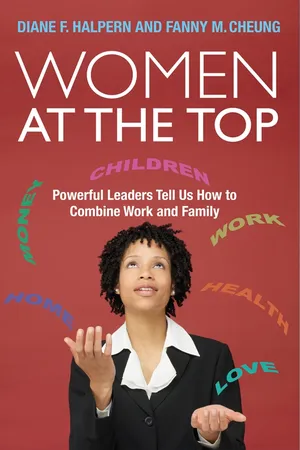
eBook - ePub
Women at the Top
Powerful Leaders Tell Us How to Combine Work and Family
- English
- ePUB (mobile friendly)
- Available on iOS & Android
eBook - ePub
Women at the Top
Powerful Leaders Tell Us How to Combine Work and Family
About this book
Using case studies of top-level women and research in the field, Women at the Top breaks new ground and offers new insight into how women can create dually-successful lives.
Information
Chapter 1
For Women at the Top:
How’s the Weather up There?
How’s the Weather up There?
“I remember my days on Wall Street when women would go out of their way to behave like a man. They would argue loudly in meetings, just like the men, and I would watch and think that women have a different way of doing business, and it doesn’t have to be the man’s way. I remember when women executives would boast proudly about not spending any time at home. One woman told me that she went back to work two days after she gave birth. I thought that was so stupid and unnecessary. Why would anyone want to do that? Of course, Wall Street is male-dominated, but the women who worked there didn’t help either; they basically played along with the rules of the game that were laid down by men. There are so many misconceptions about how women should behave if they want to be as competitive as men. It is a misconception for young women to think: ‘I can’t get married, I can’t have children because then I will lose my competitiveness.’ That is just wrong. So much of women’s growth comes from being a mother and a wife …. The way for women to lead is as equals with men and to work in the professional world in their own womanly style.”
These are the reflections of Zhang Xin, who was recognized by the World Economic Forum as a “world global leader” for her work as Chairman and Co-CEO of SOHO China, Ltd., an innovative real estate firm. She is one of the 62 powerful women leaders whom we interviewed for this book. Each rose to the top of her profession while she was “married with children,” or, in a few cases, provided elder care or had other family caregiving responsibilities. These powerful women reveal personal insights into the rarefied atmosphere of “life at the top.” How do women with family care responsibilities make it over multiple hurdles to get to the top of their profession and then go home every night to change diapers and read bedtime stories? What can the rest of us learn as we gaze upward into the world of top-level decision makers, politicians, law makers, chiefs of police, university presidents, and CEOs for major manufacturing corporations, to name a few positions these women occupy?
We have two very different stories to tell about women’s leadership around the world and, depending on your attitudes toward women in leadership positions, the news is very good or very bad. Let’s get one contemporary myth out of the way. Despite the endless blogging and newspaper headlines, women are not “opting out” of the work-force to stay home with their babies. The workforce participation rate of mothers in the United States has dropped by 2 percent since its peak in 2000, but as economist Boushey (2005) demonstrated, there was a similar drop in employment for women without children and all men, which was caused by a general recession from 2001 to 2004. Women, including those who are mothers, are in the workforce to stay. Many prefer to work fewer hours, some will take temporary stop-outs, and almost everyone wants more flexibility in how they work. Not surprisingly, the best educated women are most likely to be working; they invested years of education in preparing for employment, and they have the most to lose in terms of salary and status when they stop out. The best educated are also getting married later, having fewer children, and, consistent with this trend, may be divorcing at lower rates, which could be due to the fact that they are marrying later and hence have fewer years when divorce is possible.
The good news is that women are enjoying phenomenal advances and success in some areas. They now make up almost half of the workforce in the US (46 percent; US Census Bureau, 2007, August 9), China (45 percent; People’s Daily Online, 2007, May 18), and Hong Kong (42 percent; Census and Statistics Department, 2007), which are the three societies we focus on in this book, although we include interesting facts from other countries in every chapter. The data on employment are comparable for other industrialized countries. Women are getting more education than ever before; they comprise the majority of undergraduate college enrollments in two of these societies and all other industrialized countries in the world (57 percent in the US, US Census Bureau, 2007; 44 percent in China, Department of Population, Social, Science, and Technology, 2004; 54 percent in Hong Kong, Census and Statistics Department, 2007). Another way of thinking about the phenomenal advantage women now have in college enrollments is to highlight the growing gap between women and men in the US. Among women in the US between 25 and 34 years old, 33 percent have completed college compared to 29 percent of men (US Department of Education, 2005). The cumulative effect of this sizable difference in college graduation rates is very large. As might be expected from women’s higher educational achievement, there will be increasingly more women than men in mid-level management positions, creating an overflowing “pipeline” ready for advancement to top-level executive positions.
Now for the bad news. Despite women’s success in education and mid-level management, few women make it to the “O” level – CEO, CFO, CIO, CTO – in the corporate world or comparable top levels in noncorporate settings, such as the highest levels of political office, or top rungs of the academic ladder. In the US, women hold more than 50 percent of all management and professional positions, but only 2 percent of Fortune 500, and 2 percent of Fortune 1000 CEOs are women (CNNMoney.com, 2006, April 17). Comparable data from the Financial Times Stock Exchange 250 (FTSE 250; Singh & Vinnicombe, 2006) show that 2.8 percent of CEOs for the top 250 companies listed on the London Stock Exchange are women. In the European Union (EU), which actively promotes gender mainstreaming, only 3 percent of the large EU enterprises have women as CEOs; women make up 10 percent of the governing boards of top listed companies, and 32 percent of the managers (European Commission, 2006). Of course, there are variations among the EU countries, with the Scandinavian countries leading in the proportion of women in decision-making positions, and Italy and Luxemburg at the bottom of the list.
It has been a half-century since the start of the women’s movement, and women have only moved closer to the half-way mark in the corporate world and other organizations; most are stuck in middle management. Women in China and Hong Kong are still far from that half-way mark. In China, women make up 16.8 percent of the heads of government departments and the Communist Party, social organizations, enterprises, and institutions (Department of Population, Social, Science, and Technology, 2004). In Hong Kong, women constitute 29.1 percent of persons employed as managers and administrators (Census and Statistics Department, 2007), but few make it to the top level. However, with the trend of more women obtaining higher education in these societies, they will be following in the similar footsteps of the American women.
A bevy of commentators have suggested that women are better suited for the “New Economy,” with its emphasis on communication and interpersonal skills and the rapid loss of jobs in manufacturing, agriculture, and most jobs where physical strength is an asset. Although this may seem like a logical conclusion, there are very few women who have made it to the top leadership positions.
Statistics showing that the most talented women are stalled at midlevel positions are repeated in every career path we examined. A recent survey by the National Association of Women in Law Firms (2006) in the US found that while women account for close to half of all associates (45 percent of beginning level attorneys), they account for only 16 percent of the top-level partners, or about one in six. These numbers get even smaller when you look at managing partners, where the percentage of women is 5 percent. The disparities between women and men in the legal profession are not just a matter of waiting until there is a sufficiently large pool of talented women with the experience to move into partner-level positions, because large numbers of women have been graduating from law schools in the US since the late 1960s. The scarcity of women at the top is not a pipeline problem.
Why are there so few women at the top of the leading organizations or running law firms or heading other major institutions, given the large numbers that are stalled at middle management? An important clue can be found by taking a closer look at the women who have made it into the rarefied atmosphere of life at the top. It is even more disheartening to find that among the small percentage of high-level executives who are women, almost half do not have children. According to a report from the US Census Bureau (2004), the more money a woman makes, the less likely she is to ever have children, with close to half of all women in the US with salaries greater than $100,000 without children. Similar data are found for women who achieve at the highest faculty ranks at research universities, where there have been extensive and eye-opening analyses of the academic success of women with children. Only one-third of all women who began their job at research universities without children ever become a mother, and among those who attain tenure, they are twice as likely to be single 12 years after obtaining their doctorate than their male counterparts (Mason & Goulden, 2004). A McKinsey and Company survey (2007) of middle and senior managers around the world showed that 54 percent of the women were childless, compared to 29 percent of the men; 33 percent of the women managers were single, compared to 18 percent of the men. Hewlett (2002) showed that in America, 49 percent of the “best paid” women in the 41 to 55 age range and making over $100,000 per year are childless, compared to 19 percent of the men. The double-standard is alive and well in the workplace. The presence of children signals stability and responsibility for men, who are assumed to be better workers because of their role as breadwinners. The identical situation for women has the opposite effect. The choice for highly successful women has been clear: you can choose either a baby or a briefcase.
But, what about those women who refused to make a choice and have succeeded at the top of their profession with children and other family care responsibilities? What can we learn from these women who are leading dually successful lives, with happy, thriving families and occupational success at the highest levels? To answer this question, we interviewed 62 women at the top of their profession, with about equal numbers from China, Hong Kong, and the United States. Their ages ranged from mid-forties to early eighties, with the majority in their fifties and sixties. These high-achieving women had all been married and, in most cases, were also mothers or, in a few cases, had some other highly-involved caregiving responsibility, such as caring for a sibling with disabilities or ailing parents. They occupied a wide range of top-level positions including Chairman of Deloitte LLB, President of Old Navy/Gap, Managing Director of China Light & Power, several university presidents, chief of police, Vice-President of IBM Greater China Operations, president of a television station, cabinet member, presidential adviser, state legislator, Supreme Court justice and deputy chairperson of the standing committee of the National People’s Congress in China, and President of the Legislative Council and head of the civil service in Hong Kong. The American leaders include white, African-American, and Chinese-American women, several of whom are listed in Forbes magazine’s (for multiple years) 100 Most Influential Women in the World. A listing of the women we interviewed, with a brief biography for each, can be found in the Appendix. This cross-cultural group of women leaders helps us to understand the issues women face in a more diverse and global context.
The interviews were conducted as part of a project entitled “Work–Family Balance for Women in Chinese and US Societies: Implications for Enhancing Women Leadership” for which one of the authors (Fanny) received funding as a participant of the 2004 Fulbright New Century Scholars (NCS) Program. The interviews focused on the decisions that Chinese and American women leaders made about their work and family roles, on the strategies they adopted at different stages to address these competing forces, and on the cultural meaning of work–family balance for these women, as well as on their leader-ship styles.
To ensure diversity of background, we included women leaders from different sectors, including government, politics, business, and the professions. The sample of women leaders was not intended to be representative. To start with, they are not the typical women in the population; they are also not typical of women leaders as few top women leaders are married and have children. Instead, access to top women leaders with family responsibilities who would consent to the interview was the key consideration. We relied on networking for the access.
Fanny conducted all the interviews personally, in the cities in which the women leaders resided, or, in a few cases, during their visits to Hong Kong. The in-depth interview was based on an outline that had been sent previously to the interviewees. Although an outline was provided, the interview was unstructured to allow the interviewees to elaborate on themes that were important to them. We only spoke to the women personally, not any of their family members. Other than a few who requested anonymity, most of the interviewees consented to the use of their identifying information for research purposes.
Mommy Track versus Career Track
The Mommy Track was first offered as an alternative to the Fast Track by Felice Schwartz in an article she wrote for Harvard Business Review in 1989. In that article, she suggested that corporations and other employers offer an alternative career track for women who wanted either to slow down their pace at work or to step out of the world of work for a while to spend more time with their children. Schwartz never used the term “mommy track,” but it was used repeatedly in the media frenzy that followed her publication and the term stuck because it succinctly summarized a polarizing concept in the contentious debates about women and work. The alternative and admittedly slower-paced career track Schwartz proposed was intended as a way of retaining talented women who might otherwise leave high-pressure jobs when childcare responsibilities were added to an already overly full day. Schwartz was pilloried by the popular media as being opposed to women’s advancement.
The idea that giving birth meant career-death generated emotional responses from all parts of the work–family spectrum. In fact, Schwartz was arguing that corporations, law firms, and other major employers of highly talented women were losing their investment by not providing ways to help women with primary childcare responsibilities succeed at work. Today, we find this sort of thinking in the establishment of what are commonly known as family-friendly work policies. These are policies that are designed to provide more flexibility and more control to individual workers so that they can manage the dual demands of family and work. These organizational policies coupled with tax incentives are well established in the Scandinavian countries, which set high standards in gender equality. Depending on the nature of the position, options may include the opportunity for part-time employment, including reductions in the number of days worked so that parents can be at home when their children have school holidays, flexible start and stop work schedules, job sharing, telecommuting, and almost any combination of alterations in the standard nine to five workday, which in reality can be a standard 8 a.m. to 10 p.m. workday in high-pressure jobs.
One reason why there was such an outcry of condemnation for the idea of a mommy track was that it would be utilized mostly by women, and thus created a second-class citizenship for women in the workplace. It also created an organizational category for women based on assumptions about their ability to remain on the fast track while toting babies and carrying the bulk of the responsibility for care of the home. The concern was, and still is, that the mommy track creates a second-class ghetto for women, and even the most ambitious women who have no intention of reducing or rearranging their work hours will be damaged by being automatically categorized as someone who will never be a high achiever.
With the advantage of hindsight, it seems that both points of view on the establishment of work conditions that help working mothers stay in the workplace are correct. Providing more flexible ways of allowing employees to do their work is good for business and can relieve stress for employees with children or others to care for, but it can also have negative effects on the career trajectories for the employees who use them. There are, of course, other ways to help families combine work and family, but these other ways involve a redefinition of many of our societal roles and rules, and societal changes are much more difficult than changing work policies or passing legislation to protect the rights of employees who are also caregivers. Real reform involves changing the normative roles of mother and father so that both are equally responsible for the family and the home they share. It involves removing the stigma from the users of family-friendly work policies, and arranging the nature of work so that anyone who steps off the fast track is not penalized with lower hourly pay, less desirable work assignments, little chance for advancement, and no way to rejoin their fast-track peers when they are ready to re-enter full-time employment. Real change also requires community support for working families and valuing caregivers. We are a long way from real change, but we are moving in that direction.
The biggest problem with workplace solutions to managing work and family is that they carry an implicit assumption that motherhood is incompatible with life in the executive suite. The opposite assumption is made for men, who are perceived as more responsible when they have children. The default assumptions are that mothers will be less committed as workers and have more absences from work than fathers. While many parents may want more time to catch their breath while also toting strollers and perhaps pushing wheelchairs, not everyone does. The powerful leaders we interviewed make it clear that it is possible to have a highly demanding career and a happy family. We have heard people say that it is not possible to do...
Table of contents
- Cover
- Title page
- Copyright page
- Preface
- Chapter 1: For Women at the Top: How’s the Weather up There?
- Chapter 2: Learning from Mothers, Mentors, and Others
- Chapter 3: Saving and Spending Time
- Chapter 4: Happy Homemaker, Happy Marriage: The Female Executive Edition
- Chapter 5: Cherished Children: Tales of Guilt and Pride
- Chapter 6: Work–Family Spillover: From Conflict to Harmony
- Chapter 7: Culture Counts: Leading as the World Changes
- Chapter 8: Leading as Women: Styles, Obstacles, and Perceptions
- Chapter 9: How to Lead a Dually Successful Life
- References
- Appendix: Biography of the Women Leaders
- Index
Trusted by 375,005 students
Access to over 1.5 million titles for a fair monthly price.
Study more efficiently using our study tools.
Frequently asked questions
Yes, you can cancel anytime from the Subscription tab in your account settings on the Perlego website. Your subscription will stay active until the end of your current billing period. Learn how to cancel your subscription
No, books cannot be downloaded as external files, such as PDFs, for use outside of Perlego. However, you can download books within the Perlego app for offline reading on mobile or tablet. Learn how to download books offline
Perlego offers two plans: Essential and Complete
- Essential is ideal for learners and professionals who enjoy exploring a wide range of subjects. Access the Essential Library with 800,000+ trusted titles and best-sellers across business, personal growth, and the humanities. Includes unlimited reading time and Standard Read Aloud voice.
- Complete: Perfect for advanced learners and researchers needing full, unrestricted access. Unlock 1.5M+ books across hundreds of subjects, including academic and specialized titles. The Complete Plan also includes advanced features like Premium Read Aloud and Research Assistant.
We are an online textbook subscription service, where you can get access to an entire online library for less than the price of a single book per month. With over 1.5 million books across 990+ topics, we’ve got you covered! Learn about our mission
Look out for the read-aloud symbol on your next book to see if you can listen to it. The read-aloud tool reads text aloud for you, highlighting the text as it is being read. You can pause it, speed it up and slow it down. Learn more about Read Aloud
Yes! You can use the Perlego app on both iOS and Android devices to read anytime, anywhere — even offline. Perfect for commutes or when you’re on the go.
Please note we cannot support devices running on iOS 13 and Android 7 or earlier. Learn more about using the app
Please note we cannot support devices running on iOS 13 and Android 7 or earlier. Learn more about using the app
Yes, you can access Women at the Top by Diane F. Halpern,Fanny M. Cheung,Fanny Cheung in PDF and/or ePUB format, as well as other popular books in Psychology & Human Sexuality in Psychology. We have over 1.5 million books available in our catalogue for you to explore.