Since the previous edition of the book, the number and type of organisations that apply communicative strategies to foster change and development in agriculture and resource management has become much more varied and this book is aimed at those who use communication to facilitate change in agriculture and resource management. Communication for Rural Innovation is essential reading for process facilitators, communication division personnel, knowledge managers, training officers, consultants, policy makers, extension specialists and managers of agricultural extension or research organisations. The book can also be used as an advanced introduction into issues of communicative intervention at BSc or MSc level.
- English
- ePUB (mobile friendly)
- Available on iOS & Android
eBook - ePub
About this book
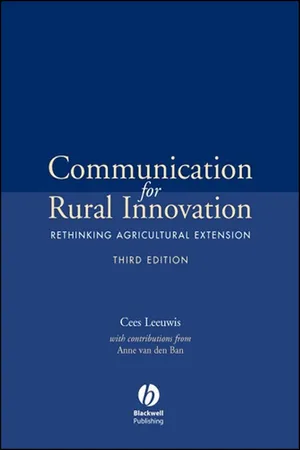
This important book is the re-titled third edition of the extremely well received and widely used Agricultural Extension (van den Ban & Hawkins, 1988, 1996). Building on the previous editions, Communication for Rural Innovation maintains and adapts the insights and conceptual models of value today, while reflecting many new ideas, angles and modes of thinking concerning how agricultural extension is taught and carried through today.
Information
PART 1
Rethinking extension
In the first four chapters of this book we set out to put into context the concept and societal role of what was previously labelled ‘agricultural extension’. In Chapter 1 we outline the main challenges that agriculture is facing today and the implications this has for communicative intervention practice. This is followed by a discussion of the changing ideas regarding agricultural extension at the conceptual level (Chapter 2). We explain the evolution of the concept of ‘extension’ into the notion of ‘communication for innovation’. The political and ethical dimensions of communication for innovation are discussed in Chapter 3, while two basic approaches to communicative intervention (the instrumental and the interactive approach) are discussed Chapter 4. In the subsequent chapters of this book we will further explore the details and implications of changing views on agricultural extension.
1
Introduction
As the problems and challenges faced by agricultural sectors change over time, we will have to adapt our ideas about the role and meaning of ‘agricultural extension’. In this introductory chapter we outline some of the challenges that agricultural extension is facing, and point to the need to reinvent agricultural extension as a professional practice. The final section of this chapter provides a more detailed overview of the set-up and contents of the book.
1.1 Challenges for agricultural extension practice
The challenges to agricultural extension in the early 21st century derive, on the one hand, from the challenges that farmers and agriculture face in view of their ever-changing social and natural environment, and, on the other hand, from the changes that emerge within extension organisations themselves in connection with, for example, new funding arrangements, developments in extension theory, and the emergence of new computer-based communication technologies. Different people may have different ideas about what is a challenge for agricultural sectors and/or extension. Thus, the challenges we present are neither complete nor an absolute truth; they are open for debate. Moreover, challenges can often be associated with threats. Our use of the word ‘challenge’ is deliberate, because we feel it is often more productive to deal with problems and threats in a pro-active way, rather than to run away from them or go into a defensive mode.
1.1.1 Challenges for farmers and agriculture at large
Some of the challenges that face today’s agriculture have been with us for a long time, while others have arisen more recently. We will briefly discuss them more or less in order of age.
Food production, food security and intensification
Although the overall world food situation has improved, there are still 800 million people who are chronically undernourished (Zijp, 1998). Improving food security is a challenge which is not simply about producing more food, as many of the causes of food insecurity relate to insufficient access to available food, insufficient economic development outside agriculture, bad governance, detrimental trade relations, debt crisis, inadequate functioning of agricultural institutions, etc. (see Koning et al., 2002). Nevertheless, sufficient food production remains an important condition for alleviating food insecurity. Moreover, the demand for food is likely to increase significantly in the near future, as the world population is still growing, and also since higher incomes in many countries result in greater food consumption. Much of the increased food production will have to be realised on land that is already under cultivation, as the availability of new land suitable for agricultural production is limited. Similarly, the scope for expanding irrigated agriculture is constrained due to increased competition for water.
This means that intensification will have to be realised in diverse and risk-prone rain-fed areas, for which available Green Revolution technologies have proved to be largely ill-suited in technical and/or social-organisational terms (Chambers & Gildyal, 1985; Lipton, 1989; Reijntjes et al., 1999). This failure of Green Revolution technologies indicates that agriculture may have to look for routes of ‘intensification’ other than through the intensive use of external inputs (chemical fertilisers, high yielding varieties, pesticides, machinery, etc.) in mono-cropping systems (Reijntjes et al., 1999). We may, for example, look for forms of ‘intensification’ that are labour intensive and make use of more complex cropping systems, based on locally adapted knowledge (Van der Ploeg, 1999). It is important, however, to realise that we have learned from the past that no generally applicable agricultural development model exists. What is important is that agricultural systems are flexibly adapted to their environment, and this does not coincide with dogmatic views of what agriculture should look like. In any case, increasing agricultural production through the development and stimulation of technical and/or organisational innovations remains an important concern for agriculture and agricultural extension.
Poverty alleviation, income generation and future prospects
According to estimations by the World Bank (World Bank, 1997; Zijp, 1998) there are some 1000 million economically active people worldwide whose livelihood depends at least in part on subsistence and/or commercial farming. The majority of these have incomes of less than one US dollar a day. For the improvement of their livelihood these people depend directly or indirectly on agricultural development – directly, in the sense that agricultural development may allow them to have a higher income from farming, and indirectly since agricultural development is widely regarded as an important trigger and condition for non-agricultural economic growth (IFAD, 2001; Koning et al., 2002). Contributing to agricultural development, therefore, remains an important challenge. From the perspective of poverty alleviation too, farming that relies on high external input does not seem to be the most feasible development model for many of the rural poor, as it is notoriously difficult for them to acquire necessary inputs.
A problem with many forms of agricultural development is that they usually imply that the same amount of produce can be produced with fewer people, which means that levels of employment in agriculture tend to come under pressure (see also Chapter 3 and Van den Ban, 2002). Where no alternatives exist outside agriculture, greater prosperity for some may mean increased poverty for others. Where prosperity in cities is growing and access to markets in other countries improving (see below), this effect may be ameliorated by possibilities for small farmers to venture into new high value-added and labour intensive agricultural products such as fruit, vegetables, flowers and processed food. However, such products are often more risky than staple food crops, and frequently require specialised knowledge and skills. Moreover, marketing channels are usually not readily available, while international competition can be fierce. Nevertheless, it can be worth exploring and supporting such options, not least to maintain labour and income opportunities in agriculture.
At the same time, it is perhaps significant to note that many of the rural poor see little future in agriculture (Farrington et al., 2002), and would like to see their children get a good education and not become farmers. In some regions agriculture is increasingly looked upon as a ‘last resort’ activity (e.g. Khamis, 1998), i.e. as something one does if everything else fails. With this cultural outlook on agriculture it will be difficult to meet any of the challenges mentioned in this chapter because few may be willing to make a real investment, and many capable people may prefer to leave the sector. Thus, an additional challenge for agricultural sectors may in some cases be to improve its own credibility and image as a promising and valuable economic sector.
Sustainability, ecosystems and natural resource management
Across the world, agriculture has been criticised sharply for its detrimental effects on the natural environment and the world ecology at large. Soil degradation, erosion, water pollution, excessive use of chemicals, waste of water, decreasing ground water tables, destruction of natural habitats for wildlife, and limited animal welfare are just a few of the concerns raised by environmentalists, ecologists, nature conservationists and the public at large. This had led to a call for agriculture to become less exploitative and more ‘sustainable’, which means that agriculture will have to be carried out to make the best use of available natural resources and inputs, and regenerate conditions for future production (e.g. soil fertility, resilience of the ecosystem, water availability). There are different schools of thought on the precise technical, social, economic and ethical criteria and characteristics that should be used to assess and describe the ‘sustainability’ of agriculture. For some, sustainable agriculture means agriculture with low external input, while others argue that this kind of agriculture is unsustainable since it requires a large increase in cultivated area, and that the use of fertilisers and high-tech machinery can also be sustainable. Various labels have been coined, such as integrated agriculture, ecological agriculture, organic agriculture, biological agriculture, permaculture, precision agriculture, etc. Regardless of one’s convictions, sustainable agriculture and natural resource management represent important challenges for primary agriculture, agro-industries and service institutions.
As several authors have pointed out (e.g. Berkes & Folke, 1998; Röling & Wagemakers, 1998) ‘sustainability’ cannot just be looked at in biophysical or ecological terms, because the state of ‘hard systems’ depends crucially on interactions between multiple human beings (i.e. on the ‘soft system’). The hydrological state in a water catchment area, for example, cannot be understood properly in hydrological terms only, i.e. without taking into account the practices of various water users. This is because hydrological processes and their outcomes are shaped and influenced by the way farmers irrigate their land, use stream banks, make wells, plough their land, manage contours, choose crops, etc. This in turn depends partly on wider social–organisational circumstances, such as water laws and regulations, the way markets for different agricultural products are organised, population pressure, the functioning of agricultural service institutions, etc. Thus, when one wishes to improve, from a sustainability point of view, the management of water in a catchment area, one will essentially have to foster new agreements, modes of co-ordination and/or forms of organisation among farmers themselves, and between farmers and other societal stakeholders, including other water users (e.g. industries, urban communities).
The example on water catchment management indicates that the management of natural resources often transcends community and regional boundaries. It is argued by many that some of the environmental problems faced by the world (e.g. climate change, water shortage) can only be solved if co-ordination is achieved on a transnational or even global level. And to further complicate the matter, it is sub-optimal – at least from an ecological perspective – to manage the use of different natural resources (e.g. water, biodiversity, energy, etc.) separately, because ecological cycles are closely intertwined. Even if local or regional stakeholders in agriculture are often not in the position to foster co-ordination at such a scale and level of complexity, global ecological issues may well have local and regional implications for farmers and others if one accepts the motto ‘think globally, act locally’.
At the local level, then, an additional challenge is posed by the experience that sustainable agriculture requires different types of agricultural knowledge from that previously developed by research institutes and disseminated by extension organisations (Röling & Van de Fliert, 1994; Röling & Jiggins, 1998). When we limit ourselves to ‘agro-technical’ knowledge, three issues arise. Although there may be disagreement over the precise meaning of the term ‘sustainable’, it is self-evident that such types of agriculture require farmers to manage and co-ordinate ecological processes and cycles carefully. In crop-protection, for example, it is no longer sufficient merely to apply a number of preventive sprayings according to a standard recipe. Instead, a balance must be maintained between pests and their natural predators, and keeping the ecosystems in which the latter exist. The management of this kind of balance requires that farmers have a good insight into complex ecological processes and interconnections, and at the same time that they can anticipate the inherent unpredictability of such systems (Holling, 1985, 1995).
A second feature that seems to be important is that, especially with low external input, sustainable agrarian practices will probably need to be more varied than conventional practices. The crop rotations of biological farmers, for example, involve a greater number of crops, and a certain amount of integration with stock grazing would seem an obvious step. This relative ‘de-specialisation’ means that farmers need to be conversant with a broad spectrum of knowledge. Lastly, ecological processes and situations are by nature locally specific since important differences can exist within individual regions or even individual fields. Awareness of the local situation is therefore essential. In short, the nature of the requisite knowledge could be described as complex, diverse and local. Much of this knowledge is not readily available and needs to be developed and/or adapted ‘on the spot’ with close co-operation between farmers, researchers and extensionists.
In summary, it can be argued that, if agricultural branches are to become more sustainable, farmers and other stakeholders will – more than in the past – have to take into account and link inherently complex knowledge regarding both global and local processes and circumstances. The emergence of new practices and forms of co-ordination depends in essence on joint learning and negotiation between stakeholders (Daniels & Walker, 1996). As discussed in section 1.1.2, this may require different forms of extension practice from the modes of operation we have seen in the past.
Globalisation and market liberalisation
Due to huge changes in communication and transport technologies, the exchange of goods, people and ideas has become much easier and more widespread than before. Even the most remote rural areas often have numerous direct or indirect connections with the wider world economy. Moreover, under the influence of World Trade Organisation (WTO) agreements, and World Bank and International Monetary Fund (IMF) policies, as well as national policies, this world economy becomes increasingly organised according to the principles of the ‘free market’. Many economists regard the free market as the most efficient means to allocate scarce resources. And even where – according to neo-classical economic theory itself – the conditions for such a market to operate effectively are not provided (e.g. perfect competition and perfect information), we witness attempts being made to create a free market and/or to create appropriate conditions for it. Although one can legitimately question the effectiveness, morality, political implications and cultural connotations of the current free market ideology, we cannot ignore the consequences for agriculture, especially non-subsistence. The emerging world market provides both constraints and opportunities for agriculture. The gradual removal of trade barriers and agricultural protection systems may allow producers in, for example, Africa to venture into new products (e.g. flowers, labour-intensive crops) that can be exported to industrialised countries, but it may also effectively wipe out agricultural branches (e.g. maize or milk production for local markets) where products can be imported more cheaply.
In connection with this, it is worrying that huge differences exist in labour productivity between industrialised and non-industrialised countries, and that these differences are increasing rather than decreasing. According to the World Bank (2000), many industrialised countries have a labour productivity in agriculture that is 50 to 100 times higher than non-industrialised countries. Of course, there are also enormous differences in costs (e.g. in terms of land, equipment, inputs, etc.), and the quality of the World Bank data may well be contested, but the threat is real that important agricultural products may increasingly be produced more cheaply in industrialised countries. In addition, these countries spend over 70 times as much on income support for their own farmers than on development assistance (IFAD, 2001). This restricts the opportunities for non-industrialised countries to export their agricultural products. In this regard, market liberalisation is rhetoric, not reality. Where and when market liberalisation progresses, regions will have to increasingly adapt their market-oriented agricultural systems according to their competitive potential vis-à-vis other regions of the world. This implies that there is an increased need to use and collect information on opportunities and consumer demands elsewhere in the world, and on the developments that take place in competing regions. If, alternatively, regions wish to escape from the pressures of the world market, they will have to deliberately maintain and/or establish protection and/or non-market arrangements (e.g. in the form of contracts, family or tribal networks, joint ventures, etc.) between agricultural producers, processing companies and consumers. This too provides important challenges, as it tends to run counter to the dominant economic regime. In any case, as farmers are often relatively weakly represented in debates on world market arrangements, a final challenge here may be to stimulate and strengthen new forms of farmer organisation at various levels (local, national and international) in order to have a greater leverage vis-à-vis other market parties.
Multi-functional agriculture
In connection with the societal debates on environmental issues and sustainability, it has been realised that agriculture has, or can have, many more functions than producing food and non-food plant or animal products. Farmers may or may not ‘produce’ clean air, a beautiful landscape, biodiversity, attractive space for recreation, clean water, a healthy soil, animal welfare. In other words, there can be many things that farmers ‘produce’ for which they are not directly rewarded in financial terms. Of course, it is in the interest of farmers themselves to maintain a healthy soil and clean water, and several governments have introduced laws and licensing systems to prevent environmental degradation. Thus, some of these ‘products’ can be regarded as something that farmers need to deliver ‘free of charge’. However, when farmers are functioning in a liberalised world market, it cannot be taken for granted that they preserve the landscape, maintain recreational spaces and improve animal welfare if their immediate competitors elsewhere in the world are not required to take such often production-limiting measures as well. Mainly in rich industrial societies where citizens would like farmers to maintain such landscape, recreational and/or natural values, we see the introduction of new arrangements (e.g. a nature conservation contract, certified value-added marketing chains for ‘nature friendly’ food) through which farmers can be rewarded financially for the provision of non-agricultural functions. Even apart from an ecological merit, such reward systems for ‘multi-functional agriculture’ are in some countries rapidly becoming an economic prerequisite for the survival of the agricultural sector.
The Netherlands, for example, is a small and densely populated country, in which space, nature and land are extremely scarce. Although agriculture, in the narrow sense, is technically advanced and highly productive, it is increasingly becoming non-viable since the costs for acquiring or even inheriting land and production rights are much higher than in nearby surrounding countries (e.g. Eastern Europe), while the same is true for variable costs such as labour. Thus, in order to make agriculture survive, government bodies and farmers are looking for new value-added products, including non-agricultural ones such as recreational services, nature conservation and even agro-health care services. Hence, developing suitable arrangements for multi-functional agriculture is a challenge that an increasing number of regions in the world will have to face in view of ecological and/or economic pressures. This challenge includes the need for the agricultural sector to establish effective communication and co-operation with other actors in society, such as one-issue action groups and non-agricultural sectors. As we have learned in the Netherlands this is not always easy, as some of these parties have come to look upon each other as ‘enemies’ with competing interests in a ‘struggle’ over land-use (e.g. Aarts & Van Woerkum, 1999).
Agrarian reform
In different parts of the world we witness different types of agrarian reform. In many industrialised countries farm sizes have steadily increased while the numbers of farms has dropped significantly. This trend was facilitated by technological developments and agro-economic policies, and seems to continue in view of market liberalisation and efforts to reduce over-production. In the former communist countries of Eastern Europe very large co-operative and state farms are being divided into smaller landholdings, with former workers becoming farm managers. In parts of Southern Africa too large commercial farms are being redistributed into smaller farms for people with insufficient land, or new ownership arra...
Table of contents
- Cover
- Contents
- Title Page
- Copyright
- Preface
- The CTZ
- Part 1: Rethinking extension
- Part 2: The relations between human practice, knowledge and communication
- Part 3: Innovation as a process of network building, social learning and negotiation
- Part 4: Media, methods and process management
- Part 5: Organisational and interorganisational issues
- Part 6: Epilogue
- References
- Index
Trusted by 375,005 students
Access to over 1.5 million titles for a fair monthly price.
Study more efficiently using our study tools.
Frequently asked questions
Yes, you can cancel anytime from the Subscription tab in your account settings on the Perlego website. Your subscription will stay active until the end of your current billing period. Learn how to cancel your subscription
No, books cannot be downloaded as external files, such as PDFs, for use outside of Perlego. However, you can download books within the Perlego app for offline reading on mobile or tablet. Learn how to download books offline
Perlego offers two plans: Essential and Complete
- Essential is ideal for learners and professionals who enjoy exploring a wide range of subjects. Access the Essential Library with 800,000+ trusted titles and best-sellers across business, personal growth, and the humanities. Includes unlimited reading time and Standard Read Aloud voice.
- Complete: Perfect for advanced learners and researchers needing full, unrestricted access. Unlock 1.5M+ books across hundreds of subjects, including academic and specialized titles. The Complete Plan also includes advanced features like Premium Read Aloud and Research Assistant.
We are an online textbook subscription service, where you can get access to an entire online library for less than the price of a single book per month. With over 1.5 million books across 990+ topics, we’ve got you covered! Learn about our mission
Look out for the read-aloud symbol on your next book to see if you can listen to it. The read-aloud tool reads text aloud for you, highlighting the text as it is being read. You can pause it, speed it up and slow it down. Learn more about Read Aloud
Yes! You can use the Perlego app on both iOS and Android devices to read anytime, anywhere — even offline. Perfect for commutes or when you’re on the go.
Please note we cannot support devices running on iOS 13 and Android 7 or earlier. Learn more about using the app
Please note we cannot support devices running on iOS 13 and Android 7 or earlier. Learn more about using the app
Yes, you can access Communication for Rural Innovation by Cees Leeuwis in PDF and/or ePUB format, as well as other popular books in Technology & Engineering & Agriculture. We have over 1.5 million books available in our catalogue for you to explore.