- English
- ePUB (mobile friendly)
- Available on iOS & Android
eBook - ePub
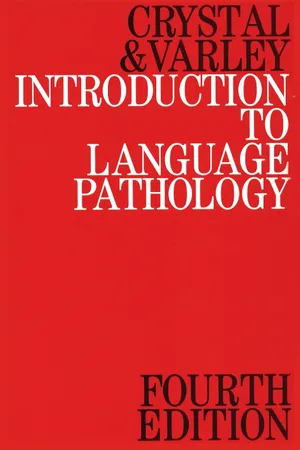
Introduction to Language Pathology
About this book
This new edition includes the introduction of the WHO distinctions between impairment, disability and handicap; an increased focus on information processing approaches to language disorders, and the introduction of revision questions as well as tutorial activities at the end of every chapter to support student learning.
Information
Chapter 1
The Scope of the Subject
What’s in a name? That which we call a rose
By any other name would smell as sweet
By any other name would smell as sweet
(Romeo and Juliet, II. ii)
A Question of Terminology
It is an unfortunate irony that the subject which professes to deal with the difficulties and disorders of language should itself be in difficulties over its name. But such is the case, even though there is little real dispute as to what this subject of study actually consists of. The kinds of things that go on in speech clinics in Canada and the United States of America, under the supervision of people called ‘speech and language pathologists’, are very much the same as those that go on in the United Kingdom under the supervision of people called ‘speech and language therapists’, or in Australia under the supervision of people called ‘speech pathologists’. Likewise, in continental Europe, labels vary, but the job remains largely the same: in France one is an ‘orthophonist’; in Belgium and Germany, a ‘logopaedist’; in the Czech Republic, a ‘phonia-trist’ … What, then, is the job that all these people do?
All these people are professionals, trained to investigate and treat abnormal manifestations of communication, from whatever cause, in children and adults. The skills involved are many, and take three or four years of training to acquire. A rather fuller description is provided by the American Speech-Language-Hearing Association (the body that, in the USA, issues certificates of clinical competence to those who graduate from training programmes). They state that clinicians:
work to prevent speech, voice, language, communication, swallowing and related disabilities. They screen, identify, assess, diagnose, refer, and provide treatment and intervention … to persons of all ages with, or at risk for speech, voice, language, communication, swallowing and related disabilities. They counsel individuals with these disorders, as well as their families, caregivers, and other service providers. (1996 formulation)
In a similar vein, Communicating Quality (1996), a document produced by the Royal College of Speech and Language Therapists in Britain, identifies key areas of the clinician’s responsibility. These include specific statements of the speech and language therapist’s role in the prevention of speech and language difficulties and in the assessment and treatment of communication disorders when they occur.
There is, it would seem, considerable agreement about what these professionals are doing – enough, at least, to suggest that a single name for the subject would not be a problem. Why is this not so?
Speech, Language and Communication
There are (in 1998) 17 universities across Britain and Ireland, offering a total of 21 undergraduate and master’s-level training courses in speech and language therapy. These 21 courses offer a bewildering array of course titles and, even ignoring minor differences between titles, there are 11 different titles on offer. This is particularly remarkable when one considers that most academic disciplines show agreement on their name: one goes to a university to read psychology; French; linguistics; philosophy – so why the extraordinary proliferation of discipline labels within speech and language therapy? The situation would be remarkable indeed if there was no overlap between the 11 variants of course title. Fortunately the situation is not quite so confusing. Of the 21 courses, 13 include ‘speech’ within the title, eight include ‘language’ and four include ‘communication’. A further variation on course name concerns how speech/language/communication are suffixed: ‘therapy’ appears in seven course labels, ‘pathology’ in a further 10, and ‘clinical sciences’ or ‘studies’ in eight. The first task in understanding the debate regarding the name of the subject is, accordingly, to differentiate between the terms ‘speech’, ‘language’ and ‘communication’.
There is, to some degree, a hierarchical relation between the three terms: speech is a manifestation of language, and, in turn, language is a component – and a very important component – of human communication. ‘Communication disorder’ is often used as a superordinate term, encompassing both speech and language disabilities, and other disabilities too. There are difficulties, however, in the use of superordinate terms in that their meanings are inevitably rather broad. Those courses whose titles include ‘communication’ prefix the term with ‘human’ or ‘clinical’. This is because ‘communication’ has a breadth of meaning that allows it to apply to non-human systems of communication, including animal signalling systems, but also to human artefacts such as computer and telephone systems.
The term ‘speech’ is one that is included within the job title of the North American, Australian and British professions. Speech is an acoustic or sound signal, produced by the combined action of various components of the vocal apparatus: the lungs, the larynx (or voice box), and various structures within the mouth (such as the tongue and lips). The movements of these structures result in vibration of air, and so an acoustic signal. However, speech is more than just a vibration in the air. After all, the lungs, larynx and oral structures perform other movements which result in an acoustic output – for example, yawning, sneezing or coughing – but these would not be regarded as speech. Speech has the characteristic that it encodes a linguistic message. It has a complex structure: the sounds of speech combine to form words, words combine to form sentences, and both words and sentences carry meaning.
We are already into the territory of the next term – ‘language’. Speech is the realization of language via an acoustic modality or channel, but other modalities are available through which we can send or receive linguistic messages. Instead of sending a message via speech, we can choose to write something down. The choice of whether to use speech or writing in sending messages depends on which is likely to be the more appropriate in a particular situation. Where the recipient of the message is remote in space or time, writing may be the more effective. When we need a permanent record of the message, it is again best to ‘have it in writing’. Where constraints of this kind do not operate, we will use speech. In addition to sending messages, we receive messages. Acoustic-speech messages are heard and then understood (auditory or speech comprehension). Written messages are read and then understood (reading comprehension).
Table 1.1. Modalities of language use
| Auditory/Vocal | Visual/Graphic | |
| Message receiving | Listening | Reading |
| Message sending | Speaking | Writing |
We have now identified four modalities through which linguistic messages can be sent or received and these are summarized in Table 1.1. The speech/auditory channel is often referred to as the ‘primary’ channel. This is because it is the language channel we acquire first, and often with no explicit instruction. In contrast, reading and writing are learned later and through formal instruction at school. The ‘secondary’ status of the reading/writing channel is also indicated by the observation that, while all human cultures have spoken languages, many languages have never been written down, and even within supposedly literate cultures there are many adults who are unable to read. Recent estimates within the UK, for example, suggest that levels of illiteracy are increasing, with 5 to 10% of school-leavers failing to attain functional or useful levels of reading ability.
In addition to the ‘usual’ auditory/vocal and visual channels for sending and receiving linguistic messages, other compensatory channels are available in the event of damage to the above modes. Braille reading, for example, allows the blind to ‘read via a tactile route instead of the usual visual route. Sign language permits the deaf to send and receive messages via a visual/gestural route, so by-passing problematic auditory/vocal processing.
Messages carried by all these modalities, whether primary or secondary or special modalities, have certain common characteristics. In particular, they have a complex hierarchical structure: units combine to form a unit at a higher level (e.g. sounds/letters form words, words form phrases and sentences). Also, the units and their combinations carry meaning. Language in all its modalities is a symbolic system: words represent or ‘stand for’ other entities. These can be concrete entities such as ‘dogs’, ‘daffodils’ or ‘dictionaries’, or abstract constructs such as ‘honesty’ or ‘intelligence’.
The final term we need to define is ‘communication’. This is a superordinate term which can encompass both speech and language. Communication is the sending and receiving of messages. It refers to any message, not just the highly structured symbolic messages of language. A sneeze might tell you that I had a cold or maybe suffered from hayfever, but it is not a hierarchically structured or symbolic linguistic message. The study of patterned human communication, in all its modes, is known as semiotics. The ways in which humans communicate outside language are many and various. Patterns of eye contact, the posture adopted, and the amount of space or touching which takes place between individuals will send different messages. The facial expression and eye contact accompanying a linguistic message may entirely alter the message that is conveyed. The term ‘non-verbal communication’ (NVC) subsumes all these visual and tactile features of interaction.
We often see popular expressions such as ‘the language of gesture’, the ‘language of the face’, or ‘body language’ However, in the light of the distinctions we have made between the terms ‘language’ and ‘communication’, these must be seen as metaphorical extensions of the term ‘language’. They are not literally ‘language’, it is argued, because there are crucial qualitative differences between what goes on in speech/writing and what goes on in facial expressions/gestures, etc.1 Two criteria have been proposed as critical. The first is to point to the major difference in productivity between spoken language and gestural communication. Productivity refers to the creative capacity of language users to produce and understand an indefinitely large number of words and sentences. Words in spoken language are continually being invented and dying out. Fresh combinations of words are continually being produced and understood. It is probable that most, perhaps all, of the sentences in this book are new sentences to you, i.e. sentences that you have not read or heard before; and yet, because you have learnt the rules of the English ‘language’, you are able to decode these fresh combinations and arrive at their meaning. By contrast, gestural communication lacks productivity. Gestures are not continually being invented and dying out. Fresh combinations of gestures are not continually being produced. There is in fact a very limited range of gestures you can make using your hands, posture, face and so on; and similarly, a very limited set of meanings that can be communicated in this way. Webster’s Third New International Dictionary contains over half a million words. A ‘dictionary’ of body language would find it difficult to accumulate more than several hundred contrasts.
The second main difference between spoken language and gestural communication is in their internal organizations, or structures. The former displays what has been called duality of structure; the latter does not. Duality of structure refers to the way language is organized in terms of two abstract levels. At one level, as has already been suggested, language can be seen as a sequence of units, or segments, which lack meaning. Segments such as p, t, e, etc. do not have any meaning in themselves. However, when they are put together into certain sequences, and we look at the larger units so formed, then suddenly meaning is found: pet. At this second, higher level of analysis, language has meaning. It is this capacity, to produce meaningful units out of meaningless segments, which identifies a behaviour as being a language. By contrast, normal gestural communication lacks duality of structure. In addition, the minimal units of body ‘language’ are meaningful: the closing of one eye, the raising of one eyebrow, the clenching of a fist.2 Moreover, if a sequence of gestures is used – say, a wink followed by a shrug of the shoulders – there is a clear and direct relationship between the units in sequence and the units in isolation: the ‘meaning’ of the wink, and of the shrug, is preserved, which again suggests the lack of any real duality of structure.
Distinctions between speech, language and communication, as we shall see later, are useful in differentiating between different types of communicative handicap. We have already said that ‘communication’ can be used as a superordinate term, which can encompass both speech and language disabilities, and we shall be using the term in this way later in this chapter. Patients with a hoarse and croaky voice will have particular difficulties making themselves audible in a noisy environment, and so their difficulty in speaking will result in reduced communicative efficiency. In the same way, individuals who have a language disability – for instance, difficulty in finding an appropriate word and placing that word within a sentence – will be less effective communicators, as they are likely to experience considerable difficulty in conveying their thoughts, ideas and feelings. ‘Communication disorder’ then can subsume speech and language handicap, but it can also include a disability that is distinct from speech or language. A young adult with Down’s syndrome, who exuberantly greets total strangers with a hug, might be viewed as exhibiting inappropriate non-verbal behaviour. In this instance, we have a communicative/interactional problem that is independent of speech or language.
The Name of a Profession
Now that we have made these distinctions between the terms ‘speech’, ‘language’ and ‘communication’, we can examine the debate that has taken place in the British profession regarding its name. The debate, which began in 1973, was finally resolved in 1991 when the profession changed its name from ‘speech therapy’ to ‘speech and language therapy’. Therapists in some districts have carried the change further and labelled themselves ‘communication therapists’. A wholesale change of name of a profession inevitably causes a degree of confusion, but when, in addition to change at a national level, there are regional variants of name, the potential for confusing the patients who receive the therapy service and the professionals who work alongside the speech and language/communication therapist is immense.
Prior to 1991, the British profession was named simply ‘speech therapy’. What are the implications of this term, and the associated term ‘speech therapist’, which have caused so much controversy over the last 30 years? There were two main objections to these labels. First, the profession does a great deal more than deal solely with speech. When there is a breakdown in a person’s communicative abilities, it is often the case that much more than speech is affected. Other modes of communication can be involved, such as listening, reading, writing or signing. And even within speech, as we have seen, there is far more involved than the surface sounds. Beneath the surface lies a world of grammar and meaning, and this may also contribute to someone’s problems in communication. Accordingly, therapists who were working with children with poor understanding of language, or who were introducing a gestural communication system to patients who had difficulties in controlling the movements of their tongue, or who were working with patients who had suffered a stroke to regain their writing abilities, found it incongruous to be called ‘speech’ therapists. ‘Speech’ was viewed as too restricting. Such people preferred instead to talk about ‘speech and language’ therapy or ‘communication’ therapy.
But if ‘speech’ caused problems, the term ‘therapy’ caused even more difficulty. This term is used in relation to a broad spectrum of activities, such as in ‘beauty therapy’ and ‘aromatherapy’, which are unrelated to its original sense of medical treatment. Many of these skills do not involve professional training of any kind, and those that do are often not comparable to the specialized academic training which speech and language therapists receive. As a consequence, many speech and language therapists feared that, if they continued to be referred to as ‘therapists’, their status would be misunderstood, or would be diminished in the eyes of the other professionals with whom they work. A particularly misleading implication, in their view, was that the term suggested that their only function was treatment, neglecting their role in assessment and prevention of disabilities. These fears were not entirely well-founded, as the medical notion of therapeutics is an extremely broad one, subsuming all aspects of patient management (including surgical, pharmacological and psychotherapeutic). If this notion was felt to summarize well what physicians did, the analogous use of the term in the context of language disability might not be as misleading as was feared.
As an alternative to ‘therapist’, consideration was given to the term ‘pathologist’, which is used throughout North America and Australia. ‘Pathology’ is a medical term, falling within a tradition where it is rigorously defined. One medical dictionary (Blakiston’s) defines it as ‘a branch of biological science which deals with the nature of disease, through study of its causes, its process, and its effects, together with the associated alterations of structure and function’. There are two central features of this definition for our purposes: it refers to ‘disease’, and this in turn refers to a disturbance of normal structure and function. In view of the fact that many of the conditions which speech-language clinicians treat are medical in origin, the result of disease, this alignment of their profession with the clinical word seems eminently sensible. On the other hand, by no means all of the conditions which are treated in a speech and language clinic are medical in origin, in any clear sense. Patients may have an apparently normal physical structure and function. Voice disorders may occur despite normal vocal apparatus (see further p. 199). The ENT (ear, nose and throat) department of the hospital to which a patient is referred may not be able to find anything physically wrong – no detectable pathology, in other words. Does it then make sense for this patient to be sent to the speech and language clinic and immediately have the disability placed under the heading of speech or language ‘pathology? Thanks to an extension of the meaning of the term ‘pathology’ in the past 100 years, this should no longer be a problem. The word has been extended to the study not only of disease but also of abnormal mental and moral conditions, according to the Oxford English Dictionary, since at least the 1840s. More recently, its sense of ‘deviation from any assumed normal state’ has become increasingly current, and the term ‘speech-language pathology’ falls within this development. Certainly in the USA, where there are more practitioners of this subject than in any other country, the designation ‘speech-language pathologist’ is the accepted norm.
With objections from within the profession to both components of the label ‘speech therapist’, in 1973 the British College of Speech Therapists held a poll of its membership to determine whether an alternative name might be found. The membership was asked to choose between 21 alternative names that had been proposed, the majority of which (13) were variants on the terms speech/language/communication and therapist/pathologist/specialist/practitioner. Not surprisingly, faced with so many alternatives, the results were inconclusive. No one label received an overwhelming majority. In fact, none of the alternatives received as many votes as ‘speech therapist’! Accordingly, a further vote took place (in 1974), the seven names receiving the largest number of votes in the earlier ballot being short-listed. But again, no decision was reached – indeed, only a small proportion of the membership voted the second time. The College concluded at the time that the name should be unchanged. But the matter was not dropped. Five years later, the question was raised again, further votes were taken, and the issue was finally reduced to a single choice: ‘speech pathologist’ versus ‘speech therapist’. The vote produced a two-to-one majority in favour of ‘speech therapist’. But the issue still did not rest. In 1983, a further ballot was held and the profession continued to vote to retain the name ‘speech therapist’. Finally, in 1990, the fifth ballot on the issue, two-thirds of the profession voted to change the name of the profession to ‘speech and language therapy’. Whether the issue is finally resolved is open to question in the face of regional variants of name such as ‘communication therapy’.
Lest this should be thought to be a peculiarly British obsession, it should be pointed out that a similar concern has often been expressed in other countries where this profession is practised. At present there is also a need to consider the merits of consistency throughout Europe -particularly in these days of the European Union – and throughout the English-speaking world. Nor is the terminological question trivial. The issues involved are those of professional identity and status, academic orientation, and intellectual, clinical and financial rewards.
The terminological issues which have caused such difficulties for clinicians in selecting a label that adequately names their profession also dogged the choice of the title for this book. It is called ‘Introduction to Language Pathology’ for a number of reasons. ‘Language’ is included within the title as it is a major facet of human communication and also because the concept of ‘speech’ is encompassed within it. The broader term ‘communication’ does not appear within the title because with ...
Table of contents
- Cover
- Contents
- Title Page
- Copyright
- Preface to the Fourth Edition
- Preface to the Third Edition
- Preface to the Second Edition
- Preface to the First Edition
- Acknowledgements
- Chapter 1: The Scope of the Subject
- Chapter 2: Approaches to Language Disability
- Chapter 3: The Communication Chain
- Chapter 4: The Physical Basis of the Communication Chain
- Chapter 5: The Classification of Linguistic Pathologies
- Chapter 6: Assessment and Treatment of Communication Disorders
- Further Reading
- Author Index
- Subject Index
Trusted by 375,005 students
Access to over 1.5 million titles for a fair monthly price.
Study more efficiently using our study tools.
Frequently asked questions
Yes, you can cancel anytime from the Subscription tab in your account settings on the Perlego website. Your subscription will stay active until the end of your current billing period. Learn how to cancel your subscription
No, books cannot be downloaded as external files, such as PDFs, for use outside of Perlego. However, you can download books within the Perlego app for offline reading on mobile or tablet. Learn how to download books offline
Perlego offers two plans: Essential and Complete
- Essential is ideal for learners and professionals who enjoy exploring a wide range of subjects. Access the Essential Library with 800,000+ trusted titles and best-sellers across business, personal growth, and the humanities. Includes unlimited reading time and Standard Read Aloud voice.
- Complete: Perfect for advanced learners and researchers needing full, unrestricted access. Unlock 1.5M+ books across hundreds of subjects, including academic and specialized titles. The Complete Plan also includes advanced features like Premium Read Aloud and Research Assistant.
We are an online textbook subscription service, where you can get access to an entire online library for less than the price of a single book per month. With over 1.5 million books across 990+ topics, we’ve got you covered! Learn about our mission
Look out for the read-aloud symbol on your next book to see if you can listen to it. The read-aloud tool reads text aloud for you, highlighting the text as it is being read. You can pause it, speed it up and slow it down. Learn more about Read Aloud
Yes! You can use the Perlego app on both iOS and Android devices to read anytime, anywhere — even offline. Perfect for commutes or when you’re on the go.
Please note we cannot support devices running on iOS 13 and Android 7 or earlier. Learn more about using the app
Please note we cannot support devices running on iOS 13 and Android 7 or earlier. Learn more about using the app
Yes, you can access Introduction to Language Pathology by David Crystal,Rosemary Varley in PDF and/or ePUB format, as well as other popular books in Languages & Linguistics & Linguistics. We have over 1.5 million books available in our catalogue for you to explore.