eBook - ePub
About this book
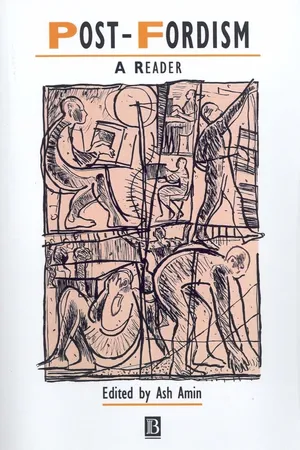
Part analysis of contemporary change and part vision of the future, post-Fordism lends its name to a set of challenging, essential and controversial debates over the nature of capitalism's newest age. This book provides a superb introduction to these debates and their far-reaching implications, and includes key texts by post-Fordism's major theorists and commentators.
Information
1
Post-Fordism: Models, Fantasies and Phantoms of Transition
INTRODUCTION
These appear to be times of bewildering transformation and change in the structure and organization of modern Western economy and society. It seems that capitalism is at a crossroads in its historical development signalling the emergence of forces – technological, market, social and institutional – that will be very different from those which dominated the economy after the Second World War. Though not uncontroversial, there is an emerging consensus in the social sciences that the period since the mid-1970s represents a transition from one distinct phase of capitalist development to a new phase. Thus, there is a sense that these are times of epoch-making transformation in the very forces which drive, stabilize and reproduce the capitalist world. Terms such as ‘structural crisis’, ‘transformation’ and ‘transition’ have become common descriptors of the present, while new epithets such as ‘post-Fordist’, ‘post-industrial’, ‘post-modern’, ‘fifth Kondratiev’ and ‘post-collective’ have been coined by the academic prophets of our times to describe the emerging new age of capitalism.
One observer, Ernest Sternberg (1993), lists no fewer than eight potential new ages. The first is the information age, which will generate wealth through the exercise of knowledge, trade in information activities and the potentialities for information technology. The second is the age of post-modernity, which will extend the frontier of consumerism into all areas of social and private life, including aesthetics, art, leisure, recreation and pleasure. Third, Sternberg refers to the age of global interdependence, to convey a sense of the pervasive globalization of production, finance, distribution and trade within the contemporary economy, a process which increasingly bestraddles and shapes local and national fortunes. The fourth trend identified is a new mercantilism, which Sternberg describes as an age in which national coalitions (industry-government-labour) will seek to develop strategic technological advantage as a basis for national prosperity. Fifth is a new age of corporate control, in which global corporations and banks will exercise systemic power over markets, firms and states; shaping consumption patterns in every corner of the world and run by a new global class of executives and professionals living in select world cities. The sixth age is the age of ‘flexible specialization’, characterized by new principles in production, including specialist units of production, decentralized management and versatile technologies and workforces, to satisfy increasingly volatile markets. Seventh is the age of new social movements working to ‘humanize’ the new capitalism and to negotiate for a ‘social economy’ which might incorporate the rights of minorities and women as well as guarantee ecological sensitivity, economic security and basic human needs. It will contrast with the social movements of the passing age, said to be organized around lines of class and nationality, and often in the name of anti-capitalist and anti-establishment goals. Finally, Sternberg identifies the rise of an age of fundamentalist rejection in many parts of the world of the technocracy and consumerism of the new information age, in defence of territorial or ethnic identities rooted in pre-enlightenment religious or communitarian traditions and values.
Which of these purported new ages will consolidate or combine into the next millenium remains an open and vexed issue. Equally contested is the issue of whether the emerging new trends represent a radical break with the past or a refinement or modification of old trends. New or not, it seems indisputable that the salience of so many of the icons of the age of mass industrialization and mass consumerism appears to be diminishing. Under threat in the West appears to be the centrality of large industrial complexes, blue-collar work, full employment, centralized bureaucracies of management, mass markets for cheap standardized goods, the welfare state, mass political parties and the centrality of the national state as a unit of organization. While, of course, each individual trend is open to dispute, taken together they make it difficult to avoid a sense that an old way of doing things might be disappearing or becoming reorganized.
The ‘post-Fordist’ debate concerns the nature and direction of such epoch-making change. It is a debate about the putative transition from one dominant phase of capitalist development in the post-war period to another thirty to fifty year cycle of development based upon very different economic, societal and political norms. It seeks to identify the driving forces in each historical phase and, through this process, to elaborate how these forces constitute a paradigm or system capable of securing relative economic stability over the long term. Different positions within the debate each accept that history can be periodized into distinct phases, guided by a coherent frame of dominant principles, but giving way to a period of uncertainty and transition during which the elements of a new paradigm may develop and mature.
Such a theorization of historical evolution and change is not unchallenged, which is one reason why the literature on post-Fordism must be considered as a debate rather than an achieved or universally accepted theory of transition. Indeed, the entire project of periodizing capitalist history has been criticized in particular from within a Marxist tradition which stresses the dialectical and evolutionary nature of historical change. Critics of the post-Fordist literature, many of them gathered around the Conference of Socialist Economists in Britain and its journal Capital and Class, tend to reject the debate for its functionalist or systemic theorization of the historical process, preferring instead an approach which stresses the non path-dependent, contested and open nature of change in class societies (Rustin, 1989; Clarke, 1990; Bonefeld and Holloway, 1991; Pollert, 1991; Psychopedis, 1991). They also criticize the idea of absolute turning points, ‘rules of transition’ and clear breaks between distinct phases or stages of development, preferring instead a more evolutionary interpretation of change which stresses a mixture of continuity and change from one period to another (Meegan, 1988; Hyman, 1991; – Lovering, 1991; Bonefeld, 1993). Reliance on sharp distinctions between phases has been criticized for falling prey, in its worst applications, to a logic of binary contrasts between, say, rigid or collective ‘old times’ and flexible or individualistic ‘new times’ (Williams et al., 1987; Sayer, 1989; Thrift, 1989; Sayer and Walker, 1992). It is claimed that such a logic produces overviews based on arbitrarily derived guiding principles and universal claims based on partial truths, thus denying the key aspect of history as a complex and heterogeneous process of many determinations (Gertler, 1988, 1992; Amin and Robins, 1990; Graham, 1992).
But use of the term ‘debate’ is appropriate in another, ‘internal’, sense since the meaning and application of the term ‘post-Fordism’ is disputed among those within the debate. Arguments exist over the nature of the passing age, the origins of its crisis, the bearers of change and the shape of things to come. It would be an error to think of the post-Fordist debate as variants of one position. Yet there is a perception among observers of the debate that the perspectives within it, with the passing of time, are becoming strands of one broad theorization of change (Amin and Robins, 1990; Graham, 1992) or cohabitants within one approach (Dankbaar, 1992; Elam, chapter 2 in this reader; and to a lesser extent, Boyer, 1988a).
Such a perception has been reinforced by the more popular accounts of transition which draw eclectically from a diverse body of thought to synthesize a new age under the banner of ‘post-Fordism’. One example is the work of a group of British intellectuals and activists associated with the magazine Marxism Today, which ceased to publish in 1991 (Hall and Jacques, 1989). Through its search for an explanation of Thatcherism rooted in irreversible and deep-rooted changes within modern industrial society, this group draws selectively from the literature to articulate a blend of post-Fordist times:
A shift to the new ‘information technologies’; more flexible, decentralised forms of labour process and work organisation; decline of the old manufacturing base and the growth of the ‘sunrise’, computer-based industries; the hiving off or contracting out of functions and services; a greater emphasis on choice and product differentiation, on marketing, packaging and design, on the ‘targetting’ of consumers by lifestyle, taste, and culture rather than by categories of social class; a decline in the proportion of the skilled, male, manual working class, the rise of the service and white-collar classes and the ‘feminization’ of the work force; an economy dominated by multinationals, with their new international division of labour and their greater autonomy from nation state control; and the ‘globalisation’ of the new financial markets, linked by the communications revolution. (Hall, 1988, p. 24)
This version of ‘new times’ does not stop at the economy, but also identifies new cultural patterns: ‘Post-Fordism is also associated with broader social and cultural changes. For example, greater fragmentation and pluralism, the weakening of older collective solidarities and block identities and the emergence of new identities associated with greater work flexibility, the maximisation of individual choices through personal consumption’ (Hall, 1988, p. 24).
The Marxism Today version of post-Fordism is brave enough to prophesize the future, to use the term to encapsulate a totality of change and to discard Fordism as an exhausted age characterized by the opposite of all the post-Fordist features described above. Its audacity has been matched by the depth of criticism it has attracted. Some have attacked its theory and method, dismissing its structuralism, lack of conceptual rigour, eclecticism, holism and inescapable futurology (Pollert, 1988; Hirst and Zeitlin, 1991). Others within the Left have criticized it for: reading off political strategies from structural changes; overstressing the subjective, individual and aesthetic nature of the future; painting a romantically rosy picture of society and culture in the new times; and embracing a politics which, in conjuring away existing social and political conflicts, plays into the hands of the New Right and its social constituency (Meiskins Wood, 1989; Rustin, 1989; Sivanandan, 1990).
In many senses, dispute over the politics of the future lies at the heart of the post-Fordist debate. An underlying theme is the search for a political project which is more democratic, more egalitarian and more humane than neo-liberal Conservatism. On this question the debate represents competing political alternatives, ranging from a defence of traditional class, race and gender politics, through to a desire for ‘yeoman democracy’ (Piore and Sabel, 1984) or new alliances between diverse social forces including ecologists, the labour movement and the voluntary sector.
The perspective taken in this book, therefore, is that the post-Fordist debate is a confrontation of diverse viewpoints, a heterogeneity of positions which draw on different concepts to say different things about past, present and future. These positions offer different explanations and conjure up different fantasies and phantoms. They also operate at different levels of analysis, from production and industrial organization to the macroeconomy, culture and politics.
The aim of this book is to reflect and represent the diversity and difference of perspective within the debate. The next part of the chapter outlines the broad arguments of three theories of transition which have come to dominate the debate, while the second part of the chapter, reflecting the sections of the book, focuses on the major themes covered within the debate (the macroeconomy, industrial organization, policy and politics, culture and lifestyles). In a field of inquiry which has produced a vast literature, no single book can do full justice to the breadth or depth of the debate. This reader has selected some of the seminal contributions of the past decade and new ones in order to provide broad coverage of the debate. In addition, though the book seeks to represent the main areas in social science involved in the debate (political economy, geography, industrial and urban sociology, political science) the focus of the book is inflected towards the uneven geography of post-Fordism (e.g. industrial geography, urban sociology).
THREE TRANSITION MODELS
It is commonly accepted that three theoretical positions lie at the heart of the post-Fordist debate. These are the regulation approach, the flexible specialization approach and the neo-Schumpeterian approach. All three offer a developed theoretical framework to substantiate and explain the claim that an era of mass production (or Fordism) is under challenge, and portends to give way to a new set of organizational principles if a new long wave of economic growth is to be secured and sustained.
Other cognate theorizations of transition also exist, and could be brought more centrally into the debate than they have been thus far. For example, in the United States, a group of radical economists including David Gordon, Sam Bowles and Herb Gintis has developed the concept of ‘social structure of accumulation’ to offer an analytical framework which is close to regulation theory, but which places a premium on the role of state and class politics in explaining the transition (see Dankbaar, 1992, for a summary and a comparison with other post-Fordist approaches). Another approach, in which the analysis extends into the social and cultural sphere, derives from the work of two British sociologists, Scott Lash and John Urry (1987, 1993), who distinguish between a passing era of ‘organized’ capitalism and a new, flexible, era of ‘disorganized’ capitalism (see Hirst and Zeitlin, 1991, who place Lash and Urry squarely into the debate). A third position, inspired by the work of the Marxist geographer David Harvey, refers to the transition from Fordism to ‘flexible accumulation’, to signal the rise of flexible labour markets and flexible geographies of production (Harvey, 1987, 1989a, 1991; Harvey and Scott, 1988). Yet another approach, but with a narrower focus than the latter two, draws upon the idea of ‘new production concepts’ (Kern and Schumann, 1987) to argue that in the arena of work, advanced technology is encouraging a new age of worker-employer cooperation and worker involvement; a new industrial democracy reversing the Fordist interpretation of workers as a restraint in production (see Tomaney, chapter 5 in this reader; Hyman, 1991; Dankbaar, 1992).
There is no space here to consider these approaches but they merit further attention, not only for their intrinsic merit, but also because their particular inflections on change confirm that what comes after Fordism may well be an open matter. Like other reviews of post-Fordist theories (Elam, chapter 2 in this reader; Boyer, 1991; Hirst and Zeitlin, 1991; Hyman, 1991; Nielsen, 1991; Webber, 1991; Dankbaar, 1992; Jessop, 1992a), the discussion below focuses on the three approaches most closely associated with the debate.
The regulation approach
The regulation approach was pioneered in France in the 1970s, and refined in the 1980s, by political economists attempting to explain the dynamics of long-term cycles of economic stability and change (Aglietta, 1979; Coriat, 1979; André and Delorme, 1982; Lipietz, 1985, 1987; Boyer, 1986; Mistral, 1986). The approach has had a huge international impact and has emerged as a major theorization of the patterns of post-war economic growth until the mid 1970s and of its crisis thereafter. Its diffusion as an approach, inevitably, has resulted in considerable internal differentiation (Jessop, 1992a, for instance, identifies seven regulationist schools), and a broadening of the base of heterodox economic theories it draws upon (from Marxian value theory to Keynesian macroeconomic ideas). There is a large body of literature on the regulation approach, including summaries and reviews (see, for example, Boyer, 1986; Noel, 1987; Dunford, 1990; Hirst and Zeitlin, 1991; Nielsen, 1991; Jessop, 1992a). The summary that follows consequently seeks to provide only a crystallized account of core concepts and arguments, in order to make sense of it in relation to the other theories of transition (see chapter 2 by Elam for a fuller critical evaluation).
The aim of the early French regulationists was to develop a theoretical framework which could encapsulate and explain the paradox within capitalism between its inherent tendency towards instability, crisis and change, and its ability to coalesce and stabilize around a set of institutions, rules and norms which serve to secure a relatively long period of economic stability. This conceptual effort was underpinned by the observation that the stagnation of growth in the world economy after the mid-1970s amounted to much more than a cyclical lull, symbolizing a generalized crisis of the institutional forms that had come to guide the post-war world economy.
The project was thus to identify the structures, principles and mechanisms which underpinned the passing regime, to explain its internal contradictions and to speculate on future possibilities for growth. For the regulationists, it was important to think of a phase or regime as a ‘partial, temporary and unstable result of embedded social practices rather than the pre-determined outcome of quasi-natural economic laws’ (Jessop, 1992b, p. 26). Thus, while it wished to acknowledge that rules drive a system, it rejected the notion that such rules should be pre-given, immutable or pre-figurative of a future development path. Accordingly, its theorization of economic development and change claimed to give as much regard to historical processes as to the basic rules of the capitalist economy.
In order to articulate and explain the systemic coherence of individual phases of capitalist development, regulation theory draws on a number of key concepts which identify the core mechanisms at work. Two key concepts are ‘regime of accumulation’ and ‘mode of regulation’. The regime of accumulation refers to a ‘set of regularities at the level of the whole economy, enabling a more or less coherent process of capital accumulation’ (Nielsen, 1991, p. 22). It includes norms pertaining to the organization of production and work (the labour process), relationships and forms of exchange between branches of the economy, common rules of industrial and commercial management, principles of income sharing between wages, profits and taxes, norms of consumption and patterns of demand in the marketplace, and other aspects of the macroeconomy. The mode of regulation (or similar terms – see chapters 3, 8 and 9 in this reader) refers to ‘the institutional ensemble (laws, agreements, etc.) and the complex of cultural habits and norms which secures capitalist reproduction as such. It consists of a set of ‘formad or informal “rules” that codify the main social relationships’ (Nielsen, 1991, p. 22). It therefore refers to institutions and conventions which ‘regulate’ and reproduce a given accumulation regime through application across a wide range of areas, including the law, state policy, political practices, industriad codes, governance philosophies, rules of negotiation and bargaining, cultures of consumption and social expectations.
Nielsen (1991) refers to three other concepts deployed varyingly within the regulation school either to specify further the two main concepts or to identify other forces of ‘systemic cohesion’. One is the concept of ‘dominant industrial paradigm’ or ‘labour process’ (Coriat, 1979), which refers to patterns of industrial and work organization, and includes the nature of technologies, management rules, division of tasks, industrial relations and wage relations. The second concept is ‘mode of development’, used by Lipietz (1988) in particular to denote the total pattern of development within an economy, based on the industrial paradigm, regime of accumulation and mode of regulation. The third concept is ‘mode of societalization’, or ‘societal paradigm’ adopted by Jessop (1992a) and Lipietz (chapter 11, this volume) as well as the German exponents of the regulation school (e.g. Esser and Hirsch, chapter 3, this volume; Hirsch, 1991). This concept refers to a series of political compromises, social alliances and hegemonic processes of domination which feed into a pattern of mass integration and social cohesion, thus serving to underwrite and stabilize a given development path.
It is with these five major concepts that the regulation approach has sought to periodize capitalist development, explain relative stability and systemic coherence, and interpret structural crisis (as the breakdown of the norms captured by the five concepts). The passing age, with its heyday in the 1950s and 1960s, has been named ‘Fordism’, a term coined to reflect loosely the pioneering mass production methods and rules of management applied by Henry Ford in his car factories in America during the 1920s and 1930s. Fordism is summarized as the age of ‘intensive accumulation’ with ‘monopolistic regulation’ of the economy. Although the term is applied at separate levels of analysis (industrial paradigm, regime of accumulation, mode of regulation, mode of societalization), it is its usage to synthesize a macrosystem which makes the regulation approach most interesting and distinctive from the two other theories of transition.
The driving force of Fordist ‘intensive accumulation’ is claimed to be the mass production dynamic, pioneered by the United States and reliant upon the intensification of work, the detailed division of tasks and mechanization to raise productivity, and various forms of ‘monopolistic’ regulation to maintain this dynamic. Jessop (1991, pp. 136–7) succinctly summarizes the central features of this dynamic:
Fordism itself can be analysed on four levels. As a distinctive type of labour process [or industrial paradigm], it involves mass production based on moving assembly-line techniques operated with the semi-skilled labour of the mass worker. Not all branches nor workers will be directly involved in mass production in a Fordist economy, of course: the important point is that mass production is the main sour...
Table of contents
- Cover
- Series
- Title page
- Copyright
- Contributors
- Acknowledgements
- 1: Post-Fordism: Models, Fantasies and Phantoms of Transition
- Part I: New Macroeconomic Designs
- Part II: New Sociologies and Geographies of Industrial Organization
- Part III: Policy and Politics Beyond Fordism
- Part IV: Post-Fordist City Lives and Lifestyles
- Index
Trusted by 375,005 students
Access to over 1.5 million titles for a fair monthly price.
Study more efficiently using our study tools.
Frequently asked questions
Yes, you can cancel anytime from the Subscription tab in your account settings on the Perlego website. Your subscription will stay active until the end of your current billing period. Learn how to cancel your subscription
No, books cannot be downloaded as external files, such as PDFs, for use outside of Perlego. However, you can download books within the Perlego app for offline reading on mobile or tablet. Learn how to download books offline
Perlego offers two plans: Essential and Complete
- Essential is ideal for learners and professionals who enjoy exploring a wide range of subjects. Access the Essential Library with 800,000+ trusted titles and best-sellers across business, personal growth, and the humanities. Includes unlimited reading time and Standard Read Aloud voice.
- Complete: Perfect for advanced learners and researchers needing full, unrestricted access. Unlock 1.5M+ books across hundreds of subjects, including academic and specialized titles. The Complete Plan also includes advanced features like Premium Read Aloud and Research Assistant.
We are an online textbook subscription service, where you can get access to an entire online library for less than the price of a single book per month. With over 1.5 million books across 990+ topics, we’ve got you covered! Learn about our mission
Look out for the read-aloud symbol on your next book to see if you can listen to it. The read-aloud tool reads text aloud for you, highlighting the text as it is being read. You can pause it, speed it up and slow it down. Learn more about Read Aloud
Yes! You can use the Perlego app on both iOS and Android devices to read anytime, anywhere — even offline. Perfect for commutes or when you’re on the go.
Please note we cannot support devices running on iOS 13 and Android 7 or earlier. Learn more about using the app
Please note we cannot support devices running on iOS 13 and Android 7 or earlier. Learn more about using the app
Yes, you can access Post-Fordism by Ash Amin in PDF and/or ePUB format, as well as other popular books in Social Sciences & Sociology. We have over 1.5 million books available in our catalogue for you to explore.