Performance measurement and attribution are key tools in informing investment decisions and strategies. Performance measurement is the quality control of the investment decision process, enabling money managers to calculate return, understand the behaviour of a portfolio of assets, communicate with clients and determine how performance can be improved.
Focusing on the practical use and calculation of performance returns rather than the academic background, Practical Portfolio Performance Measurement and Attribution provides a clear guide to the role and implications of these methods in today's financial environment, enabling readers to apply their knowledge with immediate effect.
Fully updated from the first edition, this book covers key new developments such as fixed income attribution, attribution of derivative instruments and alternative investment strategies, leverage and short positions, risk-adjusted performance measures for hedge funds plus updates on presentation standards. The book covers the mathematical aspects of the topic in an accessible and practical way, making this book an essential reference for anyone involved in asset management.
- English
- ePUB (mobile friendly)
- Available on iOS & Android
eBook - ePub
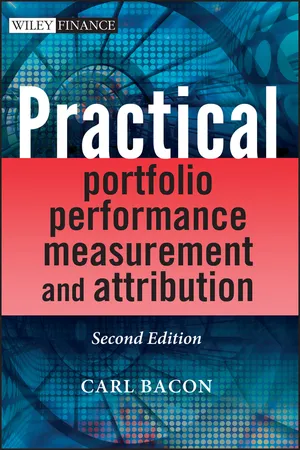
Practical Portfolio Performance Measurement and Attribution
1
Introduction
The more precisely the position is determined, the less precisely the momentum is known in this instant, and vice versa.
Heisenberg (1901-1976) The Uncertainty Principle (1927)
Lord Acton (1834-1902)
WHY MEASURE PORTFOLIO PERFORMANCE?
Whether we manage our own investment assets or choose to hire others to manage the assets on our behalf we are keen to know “how well” our collection or portfolio of assets is performing.
The process of adding value via benchmarking, asset allocation, security analysis, portfolio construction, and executing transactions is collectively described as the investment decision process. The measurement of portfolio performance should be part of the investment decision process, not external to it.
Clearly, there are many stakeholders in the investment decision process; this book focuses on the investors or owners of capital and the firms managing their assets (asset managers or individual portfolio managers). Other stakeholders in the investment decision process include independent consultants tasked with providing advice to clients, custodians, independent performance measurers and audit firms.
Portfolio performance measurement answers the three basic questions central to the relationship between asset managers and the owners of capital:
1. What is the return on their assets?
2. Why has the portfolio performed that way?
3. How can we improve performance?
Portfolio performance measurement is the quality control of the investment decision process providing the necessary information to enable asset managers and clients to assess exactly how the money has been invested and the results of the process. The US Bank Administration Institute (BAI, 1968) laid down the foundations of the performance measurement process as early as 1968. The main conclusions of their study hold true today:
1. Performance measurement returns should be based on asset values measured at market value not at cost.
2. Returns should be “total” returns, that is, they should include both income and changes in market value (realised and unrealised capital appreciation).
3. Returns should be time-weighted.
4. Measurement should include risk as well as return.
THE PERFORMANCE MEASUREMENT PROCESS
Performance measurement is essentially a three-stage process:
1. Measurement:
Calculation of returns, benchmarks and peer groups Distribution of information
2. Attribution:
Return attribution
Risk analysis (ex post and ex ante)
3. Evaluation:
Feedback
Control
THE PURPOSE OF THIS BOOK
The writing of any book is inevitably a selfish activity, denying precious time from family who suffer in silence but also work colleagues and friends driven by the belief that you have something to contribute in your chosen subject.
The motivation to write the first edition was simply to provide the book I most wanted to read as a performance analyst which did not exist at the time.
The vocabulary and methodologies used by performance analysts worldwide are extremely varied and complex. Despite the development and global success of performance measurement standards there are considerable differences in terminology, methodology and attitude to performance measurement throughout the world.
The main aims of the first edition were:
1. Provide a reference of the available methodologies and to hopefully provide some consistency in their definition.
2. Promote the role of performance measurers.
3. Provide some insights into the tools available to performance measurers.
4. Share my practical experience.
Since the first edition I’m pleased to say the CFA Institute have launched the CIPM designation which further reinforces the role of performance measurement and is a major step in developing performance measurement as a professional activity. I can certainly recommend the CIPM course of study and I’m delighted to have successfully achieved the CIPM designation. The CIPM curriculum has also to some degree influenced the content of this second edition.
With practical examples this book should meet the needs of performance analysts, portfolio managers, senior management within asset management firms, custodians, verifiers and the ultimate clients. I’m particularly pleased that this second edition includes a CD including many of the practical examples used throughout the book.
ROLE OF PERFORMANCE MEASURERS
Performance measurement is a key function in an asset management firm, it deserves better than to be grouped with the back office. Performance measurers provide real added value, with feedback into the investment decision process and analysis of structural issues. Since their role is to understand in full, make transparent and communicate the sources of return within portfolios they are often the only independent source equipped to understand the performance of all the portfolios and strategies operating within the asset management firm.
Performance measurers are in effect alternative risk controllers able to protect the firm from rogue managers and the unfortunate impact of failing to meet client expectations.
BOOK STRUCTURE
The chapters of this book are structured in the same order as the performance measurement process itself, namely:
Chapter 2 Calculation of portfolio returns
Chapter 3 Comparison against an appropriate benchmark
Chapter 4 Proper assessment of the reward received for the risk taken
Chapters 5 to 10 Attribution of the sources of excess return
Chapter 5 Fundamentals of attribution
Chapter 6 Multi-currency attribution
Chapter 7 Fixed income attribution
Chapter 8 Multi-period attribution
Chapter 9 Attribution issues
Chapter 10 Attribution for derivatives
Chapter 11 Presentation and communicating the results
Inevitably, due to time constraints the first edition was not complete; the second edition affords me the opportunity to make substantial additions and improvements.
In Chapter 2 the “what” of performance measurement is introduced describing the many forms of return calculation including the relative merits of each method together with calculation examples.
Performance returns in isolation add little value; we must compare these returns against a suitable benchmark. Chapter 3 discusses the merits of good and bad benchmarks and examines the detailed calculation of commercial and customised indexes. I’ve added a section on random portfolios, some additional remarks, a few benchmark statistics and extended the section on performance fees.
Chapter 4 is substantially enhanced to include risk measures for hedge funds in an attempt to catalogue all the available risk measures used by performance analysts including suggestions for consistent definition were such definitions are lacking.
The original Chapter 5 in the first edition was perhaps too long. Attribution is a broad subject; Chapter 5 is now focused on the fundamentals of attribution, principally the Brinson model and its adaptation to arithmetic and geometric approaches.
Chapter 6 focuses on multi-currency attribution, including the important work of Karnosky and Singer plus a detailed description of geometric multi-currency attribution.
Chapter 7 is largely new material focusing on fixed income attribution. Since the investment decision process of fixed income managers is fundamentally different the unadjusted Brinson model is not appropriate.
Attribution analysis is useful for analysing performance not only for the most recent period but also for the longer-term requiring the linking of multi-period attribution results. The issues of multi-period attribution are discussed in Chapter 8.
Chapter 9 is new material covering a variety of technical attribution issues including security-level analysis, off benchmark investments, and balanced and multi-level attribution.
Chapter 10 is also new material covering the measurement and attribution of derivative instruments and attribution for various alternative asset strategies such as market neutral and 130:30 funds.
Finally, in Chapter 11 we turn to the presentation of performance and consider the global development of performance presentation standards. The second edition is updated for the latest version of the GIPS standards published in 2006.
2
The Mathematics of Portfolio Return
Mathematics is the gate and key of the sciences.... Neglect of mathematics works injury to all knowledge, since he who is ignorant of it cannot know the other sciences or the things of this world.
Roger Bacon, Doctor Mirabilis, Opus Majus (1214-1294)
Robert Helibroner (1919-2005)
SIMPLE RETURN
In measuring the performance of a “portfolio” or collection of investment assets we are concerned with the increase or decrease in the value of those assets over a specific time period, in other words the change in “w...
Table of contents
- Title Page
- Copyright Page
- Dedication
- Acknowledgements
- Chapter 1 - Introduction
- Chapter 2 - The Mathematics of Portfolio Return
- Chapter 3 - Benchmarks
- Chapter 4 - Risk
- Chapter 5 - Performance Attribution
- Chapter 6 - Multi-currency Attribution
- Chapter 7 - Fixed Income Attribution
- Chapter 8 - Multi-period Attribution
- Chapter 9 - Further Attribution Issues
- Chapter 10 - Performance Measurement for Derivatives
- Chapter 11 - Performance Presentation Standards
- Appendix A - Simple Attribution
- Appendix B - Multi-currency Attribution Methodology
- Appendix C - EIPC Guidance for Users of Attribution Analysis
- Appendix D - European Investment Performance Committee – Guidance on ...
- Appendix E - The Global Investment Performance Standards
- Appendix F - Guidance Statement on Composite Definition
- Appendix G - Sample Global Investment Performance Standards Presentation
- Appendix H - Calculation Methodology Guidance Statement
- Appendix I - Definition of Firm Guidance Statement
- Appendix J - Treatment of Carve-outs Guidance Statement
- Appendix K - Significant Cash Flow Guidance Statement
- Appendix L - Guidance Statement on Performance Record Portability
- Appendix M - Guidance Statement on the Use of Supplemental Information
- Appendix N - Guidance Statement on Recordkeeping Requirements of the GIPS Standards
- Appendix O - Useful Websites
- Bibliography
- Index
Trusted by 375,005 students
Access to over 1.5 million titles for a fair monthly price.
Study more efficiently using our study tools.
Frequently asked questions
Yes, you can cancel anytime from the Subscription tab in your account settings on the Perlego website. Your subscription will stay active until the end of your current billing period. Learn how to cancel your subscription
No, books cannot be downloaded as external files, such as PDFs, for use outside of Perlego. However, you can download books within the Perlego app for offline reading on mobile or tablet. Learn how to download books offline
Perlego offers two plans: Essential and Complete
- Essential is ideal for learners and professionals who enjoy exploring a wide range of subjects. Access the Essential Library with 800,000+ trusted titles and best-sellers across business, personal growth, and the humanities. Includes unlimited reading time and Standard Read Aloud voice.
- Complete: Perfect for advanced learners and researchers needing full, unrestricted access. Unlock 1.5M+ books across hundreds of subjects, including academic and specialized titles. The Complete Plan also includes advanced features like Premium Read Aloud and Research Assistant.
We are an online textbook subscription service, where you can get access to an entire online library for less than the price of a single book per month. With over 1.5 million books across 990+ topics, we’ve got you covered! Learn about our mission
Look out for the read-aloud symbol on your next book to see if you can listen to it. The read-aloud tool reads text aloud for you, highlighting the text as it is being read. You can pause it, speed it up and slow it down. Learn more about Read Aloud
Yes! You can use the Perlego app on both iOS and Android devices to read anytime, anywhere — even offline. Perfect for commutes or when you’re on the go.
Please note we cannot support devices running on iOS 13 and Android 7 or earlier. Learn more about using the app
Please note we cannot support devices running on iOS 13 and Android 7 or earlier. Learn more about using the app
Yes, you can access Practical Portfolio Performance Measurement and Attribution by Carl R. Bacon in PDF and/or ePUB format, as well as other popular books in Business & Finance. We have over 1.5 million books available in our catalogue for you to explore.