- Shows how secularism can answer the problem of religious terrorism
- Provides new perspectives on how religious minorities can be integrated into liberal democracies
- Reveals how secularism has gained a new political and moral significance.
- Also examines such topics as atheism, religious criticism and free speech
- English
- ePUB (mobile friendly)
- Available on iOS & Android
eBook - ePub
About this book
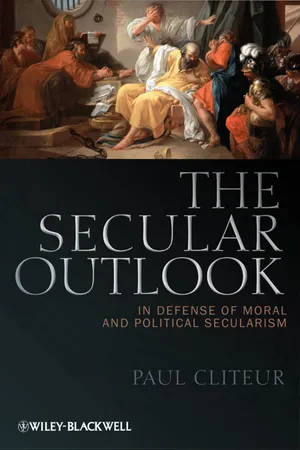
The Secular Outlook: In Defense of Moral and Political Secularism shows how people can live together and overcome the challenge of religious terrorism by adopting a "secular outlook" on life and politics.
Information
1 Atheism, Agnosticism, and Theism
Non-Religious Ethics is at a very early stage. We cannot yet predict whether, as in Mathematics, we will all reach agreement. Since we cannot know how Ethics will develop, it is not irrational to have high hopes.
(Derek Parfit, 1984)1
He has told you, O man, what is good; and what does the Lord require of you but to do justice, and to love kindness, and to walk humbly with your God?
(Micah 6:8)
Let us start with what people most often associate with “the secular outlook.” If with anything at all, they associate it with atheism. But what is atheism? Sometimes atheism is presented as a coherent worldview, encompassing all the other traditions supposedly associated with the secular outlook. On this basis the Christian theologian and physicist Alister McGrath (1953– ) writes: “Atheism is the religion of the autonomous and rational human being, who believes that reason is able to uncover and express the deepest truths of the universe, from the mechanics of the rising sun to the nature and final destiny of humanity.”2 The first thing that strikes us is that atheism is presented here as a “religion.” A second point that is remarkable is that McGrath depicts as “atheism” beliefs that most people would associate with “rationalism.” In clarifying his definition the author even introduces other elements, such as optimism. Atheism, so McGrath writes, “was a powerful, self-confident, and aggressive worldview. Possessed of a boundless confidence, it proclaimed that the world could be fully understood and subsequently mastered.”3 Often these definitions seem animated by an aversion to the denial of God. This also seems true in the case of McGrath. McGrath wrote a history of atheism based on a claim that its significance was declining.
A similar thesis is defended by the prolific Catholic historian Paul Johnson (1928– ). “Atheism as a positive set of beliefs, including a code of moral behavior, has failed to flourish,” Johnson writes.4 It may be that fewer and fewer people in Western countries practice religion, Johnson tells us, but the number of those prepared to state their disbelief in God openly and specifically is extremely small. There is only a small minority that does that, whose numbers are probably no greater today than in the time of Percy Bysshe Shelley (1792–1822), who was expelled from Oxford University for his atheism. Shelley’s Queen Mab: A Philosophical Poem (1813) was a forceful attack on organized religion. It takes the form of a dream-vision allegory in which the fairy Queen Mab takes the mortal maiden Ianthe on an extraterrestrial excursion in order to show her the past, present, and future states of the human world. According to Shelley, the past is irrational. It is the record of one mistake after another. The present is irreversibly corrupted by kings, priests, and statesmen. But the future will be a supremely glorious affair.5 Several atheistic passages were removed from the first edition, but they were restored in the second. The poem’s publisher, Edward Moxon (1801–1858), was prosecuted and convicted of blasphemous libel. In the 1820s the British intellectual and bookseller Richard Carlile (1790–1843) issued a new edition of the poem.
That the development of atheism is still at the same stage as Shelley left it at the beginning of the nineteenth century, as Paul Johnson contended in 1996, is not very convincing given the vast quantity of literature that has appeared on atheism recently. But maybe this has to do with the fact that it is far from clear what Johnson means when he uses the term “atheism.”
More attention is given to this matter in monographs explicitly devoted to the subject. According to Julian Baggini (1968– ) atheism is “extremely simple to define,” because “it is the belief that there is no God or gods.”6
In other definitions atheism is contrasted with theism. Robin Le Poidevin (1962– ) writes: “An atheist is one who denies the existence of a personal, transcendent creator of the universe rather than one who simply lives life without reference to such a being. A theist is one who asserts the existence of such a creator. Any discussion of atheism, then, is necessarily a discussion of theism.”7 So, in contrast to Baggini, Le Poidevin asserts that atheism is related to a specific concept of god: god as a personal and transcendent creator of the universe. According to Le Poidevin, atheism also implies a conscious and explicit position in the sense that simply living a life without God is not sufficient to call someone an “atheist.”
We find the same contrast between theism and atheism in Daniel Harbour who writes: “Atheism is the plausible and probably correct belief that God does not exist. Opposed to atheism, there is theism, the implausible and probably incorrect view that God does exist.”8
Atheism is generally considered to be an integral part of the tradition of the secular outlook. In what follows I will delineate what seems to me a defensible approach to atheism. Nevertheless, as I will try to show, few people approach atheism the way I do. Atheism has negative overtones. That does not make it necessarily untrue, of course, but the forces united against atheism as a creed, voiced by McGrath, Johnson, and many other detractors, are so formidable, and the misunderstandings about atheism so widespread, that it seems advisable to be somewhat cautious in using the term. In any case one should not identify the secular outlook entirely with atheism.9 It would surely be wrong to say that if atheism goes, the secular outlook goes. That, at least, will be my conclusion. Secularism is not atheism. Most atheists are secularists.10 Not all secularists are atheists. Atheism is about the existence of God. Secularism is about the role of religion in public life and about the way we should legitimize our moral commitments. But let us start with a defensible approach to atheism.
The Alpha Privative
I recommend the terminology used by Le Poidevin and Harbour. Atheism is a-theism. So: “a,” hyphen, “theism.” An atheist is someone who does not subscribe to the central tenets of theism. The “a” is an alpha privative, it denies what follows. So an atheist denies what a theist tries to assert. Someone who is a-religious is simply what it says: not religious. It is not the case that by denying a religion you, by some magic trick, invent a religion of your own: the religion of irreligious or a-religious people. Atheism is no more a religion than not playing chess is a hobby. Perhaps this sounds like a commonplace, nevertheless it is necessary to state it. Atheists are often considered to be driven by a religious impulse: the religious impulse to deny religion. Denying religion is in itself a religion, it is said. As a matter of fact, we have seen this with McGrath. I consider this form of reasoning to be a strange rhetorical trick.
Because atheism is the denial of theism, every tract on atheism should also address the question “what is theism?” Theism is the same as – monotheism, which is the more current term. Theists are adherents of one of the three theistic religions: Judaism, Christianity and Islam. Theists believe in one god. That makes the word “monotheism,” strictly speaking, a pleonasm. But theism is more than belief in one god; it also requires a conception of a specific god. God, according to theists, is good. And not only “good” in the sense you and I can be good, but perfectly good. Someone who identifies God with evil (“the supreme evil, God”), as the great Victorian poet Algernon Charles Swinburne (1837–1909) did,11 cannot be a theist. The god of Jews, Christians and Muslims is eo ipso good.
Goodness is not the only attribute of the theistic god. He is eternal, the creator of the universe, almighty, transcendent, omniscient, holy, and personal. Western theology has tried to reflect on those characteristics and construe a concept of God that is consistent (I will elaborate on these attributes in the first section of Chapter 4, Pope Benedict XVI on the Apostles’ Creed).12
Atheism and Liberal Concepts of God
Theism as outlined above is something different from religious belief in general. So atheism in the sense outlined here is not opposed to religion as such. Atheism is concerned with one specific concept of god: the theistic god. The theistic god has a name and this is written with a capital: God.13 At face value it may be strange to limit atheism so that it is opposed only to the theistic concept of god and not to all the other gods that have been venerated by man. Buddhists or Hindus subscribe to polytheistic apprehensions of the divine. Should not they be included in the atheist rejection of the divine, as they are in Baggini’s definition of atheism, mentioned above? I think not and I will now spell out my reasons for using the narrow definition.
The best way to make my position clear is by means of an example. There are people who are in awe of, or even venerate, vague and wide dimensions of reality that they identify as “the totally other” (das ganz Andere).14 Or who refer to a particular mystical experience.15 There are people and theologians who claim to worship “the absolute” or “ultimate reality” or the “unsearchable region out of which all phenomena spring.”16 C.S. Lewis (1898–1963), who was not particularly fond of this approach, called it “Christianity-and-water.”17 Take the theologian Paul Tillich (1886–1965). In his book Dynamics of Faith (1958) Tillich tells us: “The fundamental symbol of our ultimate concern is God.”18 Here God is not a person, not a father, not a creator, but a symbol. You cannot pray to a symbol, so it would seem. A symbol does not lead the Jewish people through the desert. A symbol does not reveal the Ten Commandments to Moses on Mount Sinai, and symbols do not have sons to be sent to the earth to atone for our sins. The concept of God advocated by Tillich is completely different from the one that theistic religions proclaim. Should an atheist also be opposed to (or deny) the reality of such symbols? My answer is “no.”
Another theologian, J.A.T. Robinson (1919–1983), in his book Honest to God (1963) criticizes the conception of God as a supernatural being “out there” or the “old man in the sky.” God, so Robinson proclaims is, by definition, “ultimate reality.” Robinson adds that it is meaningless to ask whether God exists. The only question we can fruitfully pose is: what does that ultimate reality look like?19
We also find ideas like those of Robinson and Tillich in the work of the German theologian and philosopher of religion Rudolf Otto (1869–1937)20 and Friedrich Daniel Ernst Schleiermacher (1768–1834).21 I will not be concerned with conceptions of the divine as advocated by those liberal theologians (although Schleiermacher’s hermeneutics will be discussed in Chapter 4). Why not?
First: a possible discussion with Robinson and Tillich would probably not deal with theism or atheism but with logic, methodology, or the philosophy of science. The discussion would focus on the question of whether it is fruitful to discuss such vague concepts as “ultimate reality.” What is “reality”? Is the love for my daughter “reality” or “a reality”? Is the dream I had last night part of “reality”? These are all difficult problems that have to be solved first if one is to discuss whether God is “reality” (or “a reality”). And what characteristics should reality have if it is to be “ultimate”? And what justification do we have for identifying such vague concepts with “God”? Would not that be a kind of verbal inflation? Is what Tillich and Robinson do, not to present a kind of sophisticated atheism?22 Philosopher Paul Kurtz (1925– ) coined the word “igtheism” to denote what he thinks underlies the theism of many theologians. The prefix “ig” is derived from the word ignorant. Kurtz argues that when theologians speak in woolly abstractions about the “ground of being” they are really employing murky language as a dodge to cover up our ignorance of how the universe actually operates.23
Suppose someone is so completely immersed in fishing that his “ultimate concern” lies in his ...
Table of contents
- Cover
- Table of Contents
- Half Title Page
- Title page
- Copyright page
- Acknowledgments
- Introduction: The Secular Outlook
- 1 Atheism, Agnosticism, and Theism
- 2 Freethought I: Criticism of Religion
- 3 Freethought II: Freedom of Expression
- 4 Moral and Political Secularism
- Selected Reading
- Index
Trusted by 375,005 students
Access to over 1.5 million titles for a fair monthly price.
Study more efficiently using our study tools.
Frequently asked questions
Yes, you can cancel anytime from the Subscription tab in your account settings on the Perlego website. Your subscription will stay active until the end of your current billing period. Learn how to cancel your subscription
No, books cannot be downloaded as external files, such as PDFs, for use outside of Perlego. However, you can download books within the Perlego app for offline reading on mobile or tablet. Learn how to download books offline
Perlego offers two plans: Essential and Complete
- Essential is ideal for learners and professionals who enjoy exploring a wide range of subjects. Access the Essential Library with 800,000+ trusted titles and best-sellers across business, personal growth, and the humanities. Includes unlimited reading time and Standard Read Aloud voice.
- Complete: Perfect for advanced learners and researchers needing full, unrestricted access. Unlock 1.5M+ books across hundreds of subjects, including academic and specialized titles. The Complete Plan also includes advanced features like Premium Read Aloud and Research Assistant.
We are an online textbook subscription service, where you can get access to an entire online library for less than the price of a single book per month. With over 1.5 million books across 990+ topics, we’ve got you covered! Learn about our mission
Look out for the read-aloud symbol on your next book to see if you can listen to it. The read-aloud tool reads text aloud for you, highlighting the text as it is being read. You can pause it, speed it up and slow it down. Learn more about Read Aloud
Yes! You can use the Perlego app on both iOS and Android devices to read anytime, anywhere — even offline. Perfect for commutes or when you’re on the go.
Please note we cannot support devices running on iOS 13 and Android 7 or earlier. Learn more about using the app
Please note we cannot support devices running on iOS 13 and Android 7 or earlier. Learn more about using the app
Yes, you can access The Secular Outlook by Paul Cliteur in PDF and/or ePUB format, as well as other popular books in Philosophy & Philosophy History & Theory. We have over 1.5 million books available in our catalogue for you to explore.