This title is designed to provide a clear and comprehensive overview of tribology. The book introduces the notion of a surface in tribology where a solid surface is described from topographical, structural, mechanical, and energetic perspectives. It also describes the principal techniques used to characterize and analyze surfaces. The title then discusses what may be called the fundamentals of tribology by introducing and describing the concepts of adhesion, friction, wear, and lubrication. The book focuses on the materials used in tribology, introducing the major classes of materials used, either in their bulk states or as coatings, including both protective layers and other coatings used for decorative purposes. Of especial importance to the tribology community are sections that provide the latest information on Nanotribology, Wear, Lubrication, and Wear-Corrosion: Tribocorrosion and Erosion-Corrosion.

- English
- ePUB (mobile friendly)
- Available on iOS & Android
eBook - ePub
Materials and Surface Engineering in Tribology
About this book
Information
Chapter 1
Surfaces
1.1. Introduction
The surface of a solid delimits its volume and defines the region where interactions with its environment occur.
When considering the structure of a crystalline material, the surface corresponds to a discontinuity in the periodic arrangement of atoms. The number of nearest neighbors (8 for a body-centered cubic lattice, 12 for a hexagonal close-packed or face-centered cubic lattice) is reduced for surface atoms, so that their vibrational states, inter-atomic separations and associated electronic states are very different from those of atoms within the solid’s interior [BOI 87] (see Figure 1.1).
Figure 1.1. Centered cubic lattice showing the number of nearest neighbors for an atom: a) within a solid; b) on its surface
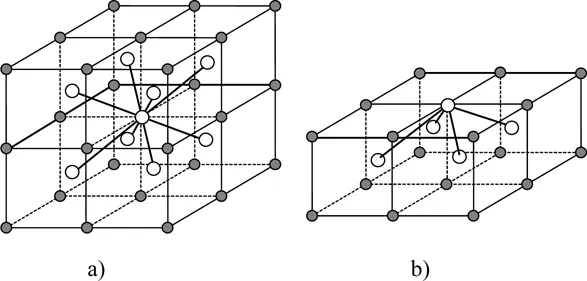
This difference between surface atoms and volume (or bulk) atoms allows us to introduce the notions of an ideal surface and a realistic surface. An ideal surface is defined only in terms of the topmost atomic layers spanning a dimension of only several nanometers, whereas a realistic surface describes a region that extends further below the outer surface, down to depths of several microns to several tens of microns. The mechanical, physicochemical and structural properties of this region differ noticeably from those of the material’s volume as well as those of the ideal surface [PERR 87].
Because surface atoms possess a lower number of nearest neighbors, they are involved in a smaller number of bonds and thus experience an asymmetric force field. Indeed, these atoms interact only with other surface atoms and atoms situated within the solid’s interior. This results in a certain number of dangling bonds, directed towards the exterior of the solid, which allow the solid to interact with its environment through the establishment of bonds aiming to re-establish the surface atoms’ equilibrium.
The number of dangling bonds and the nature of their interactions with atoms or molecules in the environment depend on the surface atom coordination and therefore its crystallographic orientation. Each crystallographic plane (each grain in a polycrystalline material) will therefore possess a specific reactivity and physicochemical and mechanical properties different from those of other planes. Passivation and gas adsorption kinetics, speed of corrosion, hardness, Young’s modulus, surface energy and electron work function are all amongst the properties that depend on the surface in this way [BERA 83, OUD 73].
1.2. The surface state
A surface can be characterized by its mechanical, physicochemical, topographic or structural properties. The combination of these characteristics defines what we refer to as the surface state.
1.2.1. Structural state of a surface
During shaping or machining processes, the contact between a surface and a machining tool considerably modifies the crystalline structure of the superficial surface layers through mechanical and thermal stresses.
Figure 1.2 shows the cross-section of a surface presenting different zones or layers:
(i) The first zone is a contamination zone consisting of a layer of adsorbed gases such as water vapor, hydrocarbons and other atmospheric pollutants. This surface layer extends to a depth of a few nanometers.
(ii) The second zone is made up of products arising from the interaction with the environment and generally consists of oxides whose composition depends both on the base metal and the environment.
(iii) The third zone corresponds to a material structure that has been significantly “work-hardened” and where the crystalline matrix is essentially destroyed. This layer, often referred to as the Beilby layer, extends to a depth of about one micron.
(iv) The fourth zone is one which has been mechanically deformed from the accumulation of residual stresses. Its thickness ranges from several microns to several tens of microns.
(v) The fifth zone corresponds to the unmodified structure of the original material.
Figure 1.2. Visual ...
Table of contents
- Cover
- Title Page
- Copyright
- Dedication
- Foreword
- Preface
- Chapter 1: Surfaces
- Chapter 2: Tribology
- Chapter 3: Materials for Tribology
- Bibliography
- Index
Trusted by 375,005 students
Access to over 1.5 million titles for a fair monthly price.
Study more efficiently using our study tools.
Frequently asked questions
Yes, you can cancel anytime from the Subscription tab in your account settings on the Perlego website. Your subscription will stay active until the end of your current billing period. Learn how to cancel your subscription
No, books cannot be downloaded as external files, such as PDFs, for use outside of Perlego. However, you can download books within the Perlego app for offline reading on mobile or tablet. Learn how to download books offline
Perlego offers two plans: Essential and Complete
- Essential is ideal for learners and professionals who enjoy exploring a wide range of subjects. Access the Essential Library with 800,000+ trusted titles and best-sellers across business, personal growth, and the humanities. Includes unlimited reading time and Standard Read Aloud voice.
- Complete: Perfect for advanced learners and researchers needing full, unrestricted access. Unlock 1.5M+ books across hundreds of subjects, including academic and specialized titles. The Complete Plan also includes advanced features like Premium Read Aloud and Research Assistant.
We are an online textbook subscription service, where you can get access to an entire online library for less than the price of a single book per month. With over 1.5 million books across 990+ topics, we’ve got you covered! Learn about our mission
Look out for the read-aloud symbol on your next book to see if you can listen to it. The read-aloud tool reads text aloud for you, highlighting the text as it is being read. You can pause it, speed it up and slow it down. Learn more about Read Aloud
Yes! You can use the Perlego app on both iOS and Android devices to read anytime, anywhere — even offline. Perfect for commutes or when you’re on the go.
Please note we cannot support devices running on iOS 13 and Android 7 or earlier. Learn more about using the app
Please note we cannot support devices running on iOS 13 and Android 7 or earlier. Learn more about using the app
Yes, you can access Materials and Surface Engineering in Tribology by Jamal Takadoum in PDF and/or ePUB format, as well as other popular books in Technology & Engineering & Materials Science. We have over 1.5 million books available in our catalogue for you to explore.