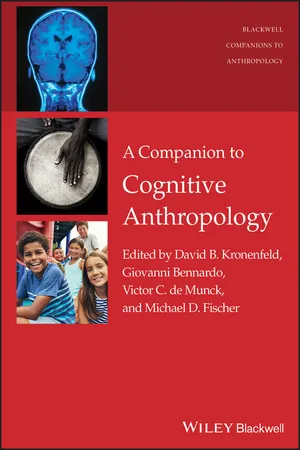
This new Companion traces the development of cognitive anthropology from its beginnings in the late 1950s to the present, and evaluates future directions of research in the field. In 29 contributions from leading anthropologists, there is an overview of cognitive and cultural structures, insights into how cognition works in everyday life and interacts with culture, and examples of contemporary research. A Companion to Cognitive Anthropology is essential for anyone interested in the questions of how culture shapes cognitive processes.
eBook - ePub
A Companion to Cognitive Anthropology
- English
- ePUB (mobile friendly)
- Available on iOS & Android
eBook - ePub
A Companion to Cognitive Anthropology
About this book
Information
PART I
History of Cognitive Anthropology; Nature and Types of Cultural Knowledge Structures
History of Cognitive Anthropology; Nature and Types of Cultural Knowledge Structures
CHAPTER 1
A History of Cognitive Anthropology
A History of Cognitive Anthropology
Cognitive anthropology as a distinct area of inquiry is a relatively recent one, dating from the early 1960s. Antecedents exist, of course, even from the beginnings of anthropology in the mid-19th century, but focal questions on mental constructs and their underlying principles have appeared systematically only during the past 50 or so years. Aspects of the early history relevant to cognitive anthropology will be traced below, but some introductory comments are in order. An initial concern is to locate cognitive anthropology within the discipline of anthropology.
INTRODUCTION
Although cognitive anthropology is typically seen as one of the sub-fields of cultural anthropology, that placement has always been problematic. There are two related issues. One is the identification of cognitive anthropology as psychology. While there is a Society for Psychological Anthropology section of the American Anthropological Association, it is relatively small, reflecting the general disinterest or even antipathy of many cultural anthropologists to the discipline of psychology. There are historical grounds for those sentiments. In the late 19th century, anthropology was struggling to become an academic discipline in its own right, which meant independence from an already established psychology. Anthropology needed a perspective or orientation definitive of the discipline and differentiating it from psychology. The concept of culture emerged to play that role. It became the key concept of the discipline, and many, but certainly not all, anthropologists continue to see it in that way.
In addition to competition for departmental independence, anthropologists in the late 19th century were opposed to psychological theory as it was then practiced. Psychologists tended to view the mind as consisting of innate properties. Levels and types of mental activity were to be explained, through reductionism, as properties of the brain. By contrast, anthropologists saw knowledge as cultural, as socially based, and as mutable. From the beginnings of the discipline, cultural anthropologists were opposed to reductionism, opting instead for radical relativity and for societies with unique sets of traits, to be described ethnographically. The perspective came to be known as historical particularism. While that perspective is no longer in vogue, at least in those terms, opposition to reductionism has remained, and in fact appears to have become more steadfast.
Cognitive anthropologists have also been concerned with accurate ethnographic description, but in addition they have sought principles that underlie behavior. A search for underlying order within kinship systems has been a prime example. Cognitive anthropology is, in fact, reductionist in the sense that observable behavioral phenomena are recognized as expressions of more basic and fundamental underlying organizational order and principles. Differences in perspective between cultural anthropologists and cognitive anthropologists still center on reductionism, but that difference is emblematic of a broader academic issue, humanities versus science. Anthropologists sometimes claim that anthropology is both a humanity and a science (a classic statement is by Wolf 1964), but the two approaches are not equally weighted and valued within the discipline. A good argument can be made that, in terms of number of practitioners and dominant theoretical perspectives, anthropology has always been much more a humanistic than a scientific discipline. Historical factors drive much of the character of the discipline, especially through the idea that ethnography must be qualitative, but cultural relativism plays an even more significant role. At issue is how ethnographic data are to be interpreted, as will be discussed below. The pursuit of explanatory principles in cognitive anthropology differentiates it from cultural anthropology.
The place of cognitive anthropology within the discipline of anthropology, then, has been and remains problematic. The “fit” within cultural anthropology is forced, at best. Given its history and problem of “disciplinary place,” it is perhaps not surprising that claims are sometimes heard that cognitive anthropology is moribund or even dead. An aim of the discussion here will be to present the counterclaim that cognitive anthropology is alive and well and that its place within anthropology lies within scientific anthropology, not within fine gradations of cultural anthropology.
A BRIEF HISTORY OF THE CULTURE CONCEPT: COGNITIVE FROM THE OUTSET
Given that cognition has not been a central topic of inquiry in anthropology, it is perhaps ironic that the first anthropological definition of culture was fundamentally cognitive. That definition was provided by E. B. Tylor, the first academic anthropologist, who was engaged in an intellectual competition for several decades in the 19th century to account for the “place” among humankind of recently “discovered” people of Africa, Asia, and the Americas (1865, 1871). Rather than viewing the people as sinners degraded from a state of grace, he argued that they had not advanced as far comparatively as European folk toward civilization. The concept of culture was a centerpiece of his argument. Culture, in his view, was an intellectual capacity of humankind, a capacity that allowed all people to become more advanced, eventually to civilization. Tylor’s definition of culture was the predominant view of culture for several decades in the early history of anthropology: “Culture … is that complex whole which includes knowledge, belief, art, law, morals, custom, and any other capabilities and habits acquired by man as a member of society” (1871:1). The operant concept is “capabilities,” referring to the ability of people to acquire and produce knowledge, beliefs, etc. In contemporary terms, ability would include cognition.
Concerns with definitions of culture reappeared in the 1930s. Cognitive capacity continued to be a central aspect of definitions, expressed typically as “ideas” or “knowledge.” In an effort to bring clarity to the abundance of definitions, two leading anthropologists of the time, Alfred Kroeber and Clyde Kluckhohn, produced a book based on extant definitions (1952). They identified 164 complete definitions and 300 partial ones, which they collapsed into a synthetic definition. The definition was too complex and cumbersome to be very useful (Marvin Harris [1968:10] referred to it as a theory), but it is noteworthy that their proposal contained the statement “the essential core of culture consists of traditional (i.e., historically derived and selected) ideas and especially their attached values” (1952:357). As was the case for Tylor, knowledge was at the core. The book, incidentally, provides an excellent and detailed discussion of the history of the culture concept during the 18th and 19th centuries.
Not until 1957 did a definition of culture appear that was intended to support research toward cognitive ends, provided by Ward Goodenough. Anthropology at the time was heavily influenced by structural linguistics, which was often seen as the most scientific of the sub-fields within anthropology. Goodenough saw the structural and taxonomic approaches in linguistics as applicable to cultural phenomena and proposed a definition of culture accordingly: “A society’s culture consists of whatever one has to know or believe in order to operate in a manner acceptable to its members, and do so in any role that they accept for any one of themselves” (1957:167). The definition placed culture squarely within knowledge and belief systems but without an iteration of kinds of knowledge or their application. The intent was to encourage anthropologists to produce classification and nomenclature systems to replace the simple iteration of traits. His definition required discovery procedures to identify domains and their content, organization, and underlying features.
THE EMERGENCE OF COGNITIVE ANTHROPOLOGY
The decade of the 1960s was one of change in the linguistic sciences. Linguistics was revolutionized by the work of Noam Chomsky (1965), who redirected linguistic theory from surface descriptions to an underlying, generative, and transformational basis. Sociolinguistics began to be developed as a new sub-field of linguistics and linguistic anthropology (Gumperz and Hymes 1964, 1972; Labov 1972; Blount 1974), searching for social and cultural factors that structured discourse. At the same time, taxonomic linguistic principles were being applied innovatively in anthropology. The intellectual center of the new perspective was at Stanford University, developed in the early 1960s by Kim Romney, Roy D’Andrade, Charles Frake, and their students, including Brent Berlin, David Kronenfeld, and Naomi Quinn, among others. A second locus later in the 1960s was at the University of California at Berkeley, led by Brent Berlin and Paul Kay. The theoretical perspective was first labeled as “ethnoscience,” the study of the ways in which domains of knowledge in traditional societies were distinguished and organized. In time, a number of other labels were applied, including “ethnosemantics,” “componential analysis,” “lexical semantic analysis,” and eventually “ethnographic semantics.” A research procedure was established, in which the anthropologist began with a domain such as kinship or color, then elicited exhaustively the terms for the types of objects (kin types, color types) within the domain, followed by an analysis of the components (semantic features) from which the objects are uniquely constructed. Lastly, the psychological reality of the analysis could be demonstrated, through feedback from the folk whose domain was under description. Descriptions of the procedure can be found in the now classic articles by Frake (1962), “The Ethnographic Study of Cognitive Systems” and Conklin (1962), “Lexicographical Treatment of Folk Taxonomies.”
A particular interest within ethnographic semantics, perhaps not surprisingly, was in kinship. Kinterms and their determinants has been a dominant theme in anthropology, since L. H. Morgan’s monumental work in 1871, to G. P. Murdock’s lineage-based account (1949) and sociological approaches in British social anthropology (Radcliffe-Brown and Forde 1950). To touch on only two prominent areas of inquiry within ethnographic semantics, Floyd Lounsbury proposed a formal procedure for kinship analysis (1964b), “The Structural Analysis of Kinship Semantics,” and he also carried out a reanalysis of Crow and Omaha kinship systems (1964a), “A Formal Account of the Crow- and Omaha-Type Kinship Terminologies,” showing how generational skewing rules clarified some of the terminological challenges of the two systems. In each system, some kinterms are applied to individuals (kin types) in generational levels both above and below ego, a seeming anomaly in kinship systems.
The second arena of lexical semantic analyses of kinship was in a series of publications on American English kinship, providing different outcomes and sharp intellectual debates about relevance. The first publication was by Wallace and Atkins (1960), “The Meaning of Kinship Terms,” in which a componential paradigm was presented as evidence of the psychological relevance of the terminological system. Their publication was followed, however, by a publication by Romney and D’Andrade (1964), “Cognitive Aspects of English Kin Terms,” presenting a different analysis and an argument for its psychological validity, based on the typological representation of the results and on a series of confirmatory tests given to native speakers. A second discussion on American English kinship was between Ward Goodenough (1965), “Yankee Kinship Terminology: A Problem in Componential Analysis,” and David Schneider (1965), “American Kin Terms and Terms for Kinsmen: A Critique of Goodenough’s Componential Analysis of Yankee Kinship Terminology.” Schneider’s criticism was essentially against the formalism of componential analysis, bringing to bear various types of sociological and psychological variables external to a domain-based analysis.
Each of the two sets of discussions is important in the history of cognitive anthropology for the focus of analytic attention to the psychological reality of the native speakers who utilize the terminological systems. Accurate representation of informant knowledge continued to be a central concern in subsequent research, including major advances in color terminology at the end of the decade and in later developments in ethnobiology. The paper by Schneider is important on different grounds, as it illustrates the types of criticisms that cultural anthropologists tended to make of lexical semantic analysis. Critics argued that the research was focused much too narrowly on single or isolated domains, thereby missing even broader traditional domain based knowledge (see Burling 1964), much less the larger picture and broader concerns of cultural anthropology (Geertz 1973). The core of the latter type of criticism was that formal analysis could never provide overarching cultural descriptions of individual societies of the types expected in information-rich ethnographies. Formal analysis was perceived by critics as too narrow and piecemeal for holistic ethnographic descriptions. The response of cognitive anthropologists was that their method of representing informant knowledge was more principled and thus more accurate, in contrast to impressionistic, non-replicable ethnography.
There were three signal publications in the 1960s. A special publication in 1964 of the American Anthropologist, entitled “Transcultural Studies in Cognition,” edited by A. Kimball Romney and Roy Goodwin D’Andrade, contained papers on linguistic, anthropological, and psychological approaches to cognition, reflecting the cross-field nature of the field from the outset. The first reader, Cognitive Anthropology, edited by Stephen A. Tyler (1969), included many of the classic papers in the emergence of cognitive anthropology. Basic Color Terms (1969), was based on the groundbreaking work by Brent Berlin and Paul Kay on color terminology. Their work spawned interest in color terms that continues to the present, and their research helped to usher in prototype theory cognitive anthropology. In 1972 Harold Conklin published a topically arranged bibliography with over 5,000 entries in eight sections, including kinship, ethnobotany, ethnozoology, ethnomedicine, orientation, color, and sensation.
By the 1970s, however, cognitive anthropology had moved away from componential analysis, mainly from their ...
Table of contents
- Cover
- Contents
- Halftitle page
- Series page
- Title page
- Copyright
- Notes on Contributors
- Acknowledgments
- Introduction
- PART I History of Cognitive Anthropology; Nature and Types of Cultural Knowledge Structures
- PART II Methodologies
- PART III Cognitive Structures of Cultural Domains
- PART IV Cognitive Anthropology and Other Disciplines
- PART V Some Examples of Contemporary Research
- Afterword: One Cognitive View of Culture
- Index
Trusted by 375,005 students
Access to over 1.5 million titles for a fair monthly price.
Study more efficiently using our study tools.
Frequently asked questions
Yes, you can cancel anytime from the Subscription tab in your account settings on the Perlego website. Your subscription will stay active until the end of your current billing period. Learn how to cancel your subscription
No, books cannot be downloaded as external files, such as PDFs, for use outside of Perlego. However, you can download books within the Perlego app for offline reading on mobile or tablet. Learn how to download books offline
Perlego offers two plans: Essential and Complete
- Essential is ideal for learners and professionals who enjoy exploring a wide range of subjects. Access the Essential Library with 800,000+ trusted titles and best-sellers across business, personal growth, and the humanities. Includes unlimited reading time and Standard Read Aloud voice.
- Complete: Perfect for advanced learners and researchers needing full, unrestricted access. Unlock 1.5M+ books across hundreds of subjects, including academic and specialized titles. The Complete Plan also includes advanced features like Premium Read Aloud and Research Assistant.
We are an online textbook subscription service, where you can get access to an entire online library for less than the price of a single book per month. With over 1.5 million books across 990+ topics, we’ve got you covered! Learn about our mission
Look out for the read-aloud symbol on your next book to see if you can listen to it. The read-aloud tool reads text aloud for you, highlighting the text as it is being read. You can pause it, speed it up and slow it down. Learn more about Read Aloud
Yes! You can use the Perlego app on both iOS and Android devices to read anytime, anywhere — even offline. Perfect for commutes or when you’re on the go.
Please note we cannot support devices running on iOS 13 and Android 7 or earlier. Learn more about using the app
Please note we cannot support devices running on iOS 13 and Android 7 or earlier. Learn more about using the app
Yes, you can access A Companion to Cognitive Anthropology by David B. Kronenfeld, Giovanni Bennardo, Victor C. de Munck, Michael D. Fischer, David B. Kronenfeld,Giovanni Bennardo,Victor C. de Munck,Michael D. Fischer in PDF and/or ePUB format, as well as other popular books in Social Sciences & Cultural & Social Anthropology. We have over 1.5 million books available in our catalogue for you to explore.