- Features a succinct biography of the life and times of a fascinating figure in Mexico's revolutionary past
- Represents the most analytical and up-to-date study of caudillo/military strongman rule
- Sheds new light on the networks and discourse practices that support rulers such as the Castros in Cuba and Hugo Chávez in Venezuela, and the emergence of modern Mexico
- Offers new insights into the role of leadership, the nature of revolution, and the complex forces that helped shape modern Mexico
- English
- ePUB (mobile friendly)
- Available on iOS & Android
eBook - ePub
About this book
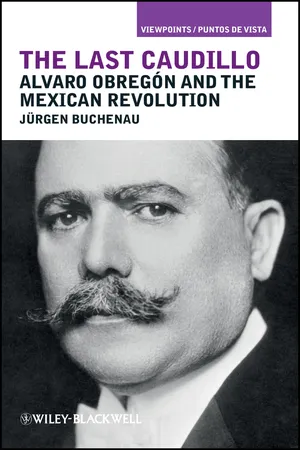
The Last Caudillo presents a brief biography of the life and times of General Alvaro Obregón, along with new insights into the Mexican Revolution and authoritarian rule in Latin America.
Information
1
The Background of the Last Caudillo
Mexico is not a republic, but a military Díazpotism.
Charles Flandrau (1908)
Obregón’s career developed in two different contexts, and both of these contexts are important in understanding his role in the Mexican Revolution. In the first place, Obregón grew up in a somewhat contradictory political context—a system marked by both authoritarian political practices and the inability of governments at the national and state levels to enforce their decisions on a recalcitrant and diverse population. Second, his upbringing in distant Sonora, an arid state that borders the United States, instilled in him the political culture of the northwest. This culture and society differed in crucial ways from those of central and southern Mexico.
Since the beginning of recorded time, the area we know today as “Mexico” has featured struggles between strong central rulers and regional chieftains with considerable autonomy. The rugged, mountainous terrain has always made political centralization difficult. Such was the case in the Mexica Empire under Emperor Moctezuma; and likewise, the authoritarian methods of the Spanish Crown, in what it called the Viceroyalty of New Spain, faced stiff local resistance. The political system of the viceroyalty imposed centralizing features that would survive all the way to Obregón’s era: a top-down pattern in all levels of governance; no clear separation of powers; and the appointment rather than democratic election of many regional and local leaders. The king appointed a Spanish-born viceroy to rule in his stead, held in check by a group, the audiencia, with executive, legislative, and judicial powers. At the regional and local levels, the viceroy named corregidores (regents) although larger towns featured elected cabildos (town councils). After the Bourbon Reforms of the late 1700s, the king also sent intendants as a means of enforcing his power. In practice, strong regional loyalties and chiefs remained throughout the colonial period, and subalterns often did not carry out the orders coming from their superiors. Throughout the colonial period, the Spanish authorities struggled to subdue local and regional rebellions, and they never controlled the vast northwestern frontier—including present-day Sonora—much at all.1
By the Wars of Independence (1810–1821), France’s Napoleon Bonaparte provided a new blueprint for central rule not only for Europe, but also for Latin America. Napoleon’s armies overran a checkerboard of local sovereignties in central Europe by means of a brilliant military strategy and a dedicated volunteer army devoted to service of the French nation. Not surprisingly, contemporary artists represented the Venezuelan Simón Bolívar, the Argentine José de San Martín, and the Mexican Agustín de Iturbide as citizens-emperors, scions of Napoleon. In many ways, these liberators constituted the first wave of caudillos in Latin America: self-anointed military heroes who commanded by virtue of their network of clients.2
Of these leaders, Iturbide established the most direct bridge to Napoleon by means of his coronation as Agustín I, Constitutional Emperor of Mexico, on July 21, 1822. Unlike the other Spanish American independence leaders, who established republican forms of government, Iturbide became a monarch, just like Napoleon. However, this monarchy was short-lived. Iturbide’s empire was vast, stretching from California east to the Louisiana border and south to Costa Rica. Moreover, Iturbide’s sudden exaltation went to his head. He ennobled members of his immediate family and ordered their birthdays to be celebrated as national holidays. Petitioners who wished to see him needed to kneel before him and kiss his hand. Thus, an uprising ousted Iturbide in March 1823. After a year in exile, he returned home, only to be arrested and executed by firing squad just two years after his proclamation as emperor.3
From Santa Anna to Díaz
Iturbide’s brief reign highlighted several important characteristics that would endure until Obregón’s days. Most importantly, his dissolution of parliament indicated the supremacy of the executive branch over the legislative one, as well as the arbitrary use of power. Iturbide’s self-aggrandizement pointed the way to the forging of personality cults that would prove a crucial aspect of authoritarian political rule. Finally, his fall at the hands of his former lieutenants set a pattern for violent changes of government. Until 1920, the year of Obregón’s election, most presidents would come to power via a coup d’état. Two leaders in particular—Antonio López de Santa Anna and Porfirio Díaz—left important legacies for Obregón’s career.
Santa Anna belonged to a new generation that came to power in the chaotic decades following the wars of independence. Historian John Lynch calls this group “primitive caudillos:” leaders who ruled over unstable nations with stagnating economies by personal fiat.4 This generation also comprised other classical cases of caudillo rule such as Argentina’s Juan Manuel de Rosas and Venezuela’s José Antonio Páez. These leaders had entered the wars as rank-and-file but worked themselves up to important positions by the time the conflicts ended. Hence, they were next in line when the original independence heroes fell from grace. Rosas helped spread the purview of the independence movement beyond the capital region of Buenos Aires by organizing a regiment of the famed cowboys, the gauchos. As a champion of the gauchos, he remained the dominant figure of the region until his fall in 1853. Páez joined Bolívar’s 1810 insurrection at the age of twenty. He commanded the pro-independence army in Venezuela while Bolívar was helping spearhead the liberation of Peru; and in 1830, he declared Venezuela’s independence from Gran Colombia. Páez and Rosas represented themselves as the embodiment of their nations, yet they depended on personal alliances with hacienda owners, the military, the high clergy, and indigenous leaders. Their power remained limited by the absence of political stability, the persistence of local and regional challenges to central authority, and the existence of a minimal national government without the means to make its authority respected.5
Mexico’s quintessential caudillo, Santa Anna was born in Jalapa, Veracruz, in 1794 into a middle-class creole family. He was a master at sensing the shifting of political winds. After entering the army at the age of sixteen, he served with the Crown’s forces until 1821, distinguishing himself by his ruthless persecution of the pro-independence guerrilla. When he sensed that the tide had turned in favor of independence, he proclaimed his adherence to Iturbide’s Plan of Iguala. As opposition against Iturbide mounted, Santa Anna declared the “Plan de Casa Mata,” the successful call for the emperor’s overthrow. Thereafter, he became the most important military figure of the early republic, and the master of an extensive patron-client network centered on his home base in Veracruz. He took center stage in the most important military confrontations of the first thirty years of independent Mexico, which featured wars with Spain, France, and the United States and the formation of two rival political blocs: the Centralists and the Federalists. Sometimes, he helped the nation pull together; at other times, his ambitions constituted a singularly disruptive force. In 1829, he led a successful campaign against Spain’s attempt to reconquer its former colony. In 1832, he helped the Federalists to power, and he served a brief first stint as president from May 16 to June 3, 1833. Within a few months, Santa Anna regretted his alliance and helped the Centralists regain power under his second presidency. However, he enjoyed his role as a savior who rode in on his horse whenever the nation appeared in need, more so than he relished the authority vested in the presidential chair. In 1836, another such opportunity came when Santa Anna led Mexican troops to fight the effort of Texas settlers to obtain their independence from Mexico. However, the following year, the Texans dealt him a devastating defeat at San Jacinto.6
Soon thereafter, Santa Anna bounced back, thanks in part to a lost limb that became a political spectacle just as Obregón’s would a century later. In 1838, a French fleet blockaded the port of Veracruz in order to exact payment of claims held by French citizens. On November 27, at his hacienda near the city, Santa Anna heard the distant rumblings of cannon that accompanied the French attack on the fortress of San Juan de Ulúa. He mounted his white horse to meet the invaders. As the Mexican armies forced the French to return to their ships, a cannonball severed his left leg below the knee. The mutilated caudillo again became a national hero, and he sought to exploit his sacrifice. On September 27, 1842, he gave his leg a state burial, complete with an urn, a mausoleum, and a twelve-gun salute.7
However, such a spectacle could not instill lasting allegiance to a caudillo. Upon a successful coup d’état against Santa Anna in 1844, the victorious rebels removed the leg from its mausoleum and waved it around during their procession. In Santa Anna’s own words: “A member of my body, lost in the service to my country, dragged from the funeral urn, broken into bits to be made sport of in such a barbaric manner. … In that moment of grief and frenzy, I decided to leave my native country … for all time.”8 Of course, within a short time, the caudillo returned despite this nefarious mistreatment of his leg. He weaved in and out of power throughout the next nine years, which included defeat in the US-Mexican War (1846–1848). The traumatic defeat formalized the US annexation of Texas and the transfer of a total of one-half of the Mexican territory to the United States. Santa Anna played an unsavory role in the Gadsden Purchase of 1853, which transferred southern Sonora to the United States. According to some sources, 600,000 dollars ended up in his own pocket.9 This transaction earned him the moniker of vendepatria, or seller of the fatherland. Not surprisingly, official Mexican historical memory has treated Santa Anna as a villain.
It was no coincidence that another caudillo, Juan N. Alvarez, spearheaded the rebellion that finally toppled Santa Anna for good. Just as Santa Anna took advantage of his regional base on the Gulf Coast, so Alvarez enjoyed a privileged position as the commander of the Pacific port of Acapulco. By the time his supporters pronounced the Plan of Ayutla on March 1, 1854, Alvarez had dominated southern Mexico for more than three decades. The program called for Santa Anna’s removal due to his corruption, referencing in particular the dastardly act of selling off a part of the nation. The new caudillo found the presidency unappealing and returned to his hacienda after a few months in office. Alvarez’s parting words would later find a prominent imitator in Obregón, both in their emphasis on his humble origins and in their denigration of political office: “I entered the presidency as a poor man, and I leave it as a poor man, with the satisfaction that I do not have to bear the censure of the public because I was dedicated from an early age to personal labor, to work the plow to support my family, without the need for public offices where others enrich themselves by outrages to those in misery.”10
Alvarez’s brief tenure paved the way for the ascendancy of the Liberal party and its most famous exponent, Benito Juárez, an attorney of Zapotec origins from the southern state of Oaxaca. Led by Juárez, the Liberals opposed caudillo politics and favored the installation of a genuine representative democracy. They also called for an end to all privileges enjoyed by the Catholic Church, the aristocracy, and the army, groups that enjoyed the protection of special courts. They viewed the Church, especially, as an obstacle to progress and advocated lay education, civil marriages, and the expropriation of its wealth, which included more than half of the nation’s arable land. The Liberals wished to turn Mexico into a nation of yeoman farmers who produced enough food to export it to the burgeoning populations of western Europe. In 1857, Juárez became president, and the Liberals codified these ideas in a constitution that remained the law of the land until 1917.11
Juárez’s government could not establish effective control, however, before encountering stiff resistance from the Church and the Conservative Party. The Conservatives used the Liberal campaign against the Church as a rallying cry that resonated particularly with deeply religious indigenous communities. They could also count on the support of ranchers and hacendados who stood to lose by a reorganization of agricultural land. And, of course, they knew that they could depend on the allegiance of many of the Santannista strongmen, as well as other local leaders dissatisfied with the central government. In 1858, the Conservatives ousted Juárez. The Liberals triumphed following three years of war, only to be driven from power again in 1862 by French invasion forces sent by Emperor Napoleon III. The emperor harbored the dream of establishing a Caribbean dominion. In 1864, he installed the Habsburg prince Maximilian on the throne of a restored Mexican empire.
Maximilian’s style of leadership differed from that of a caudillo as much as anyone could imagine. The Austrian fashioned himself as a kind-hearted conciliator who could heal old divisions and solve Mexico’s problems in a few short years. He surrounded himself with a circle of educated advisors, the so-called imperialistas, to aid him in the formulation of policy.12 The emperor attempted to endear himself to the Liberals by refusing to roll back the Reform Laws; unfortunately, that step alienated the Conservatives without winning him any Liberal friends. Similarly, he made history by decreeing the end of debt peonage, only to find out that he had added the landowners to his already considerable list of enemies. Therefore, the goal of reconciliation eluded an emperor who served as a pawn of Napoleon’s ambitions, and who owed his throne to French arms. Worse yet, the blond, blue-eyed Austrian aristocrat who had grown up in the palaces of Europe remained an utter outsider. Finally, Maximilian held deeply romantic visions of indigenous Mexicans. In his view, he alone was destined to save that population from ruin and exploitation. Consider the following quote of a French military officer: “When … the burden of his job seemed too heavy, His Majesty would go on a little trip. Amidst the ovations of the poor, morose Indians, he found relief and pleasure, as he considered himself adored by his subjects.”13 Maximilian’s failures gave the Liberals a chance to reinvent themselves as patriots, and they went on the offensive. Faced with this threat, the emperor panicked and swore the Liberals a war to the death. As the Liberals waged a guerrilla campaign, a fateful decree promised death to all rebel officers captured by the government.
Not surprisingly, the decree angered the Liberals, who first chased out the French and then returned to power in June 1867. They gave the emperor a dose of his own medicine, executing him and two of his closest Mexican allies. When Juárez returned to the presidency, he knew that his faction had triumphed through military conquest rather than the superiority of the Liberal program. He also embraced repressive tactics in order to deal with rebellions and banditry. For example, he established a roving police force, the rurales, a corps made up primarily ...
Table of contents
- Cover
- Half title page
- Series page
- Title page
- Copyright page
- Dedication
- List of Illustrations
- Preface
- Acknowledgments
- Introduction
- 1 The Background of the Last Caudillo
- 2 An Improvised Leader, 1880–1913
- 3 Chaos and Triumph, 1913–1916
- 4 The Path to Power, 1916–1920
- 5 The President, 1920–1924
- 6 The Last Caudillo, 1924–1928
- 7 The Unquiet Grave
- Bibliography
- Index
Trusted by 375,005 students
Access to over 1.5 million titles for a fair monthly price.
Study more efficiently using our study tools.
Frequently asked questions
Yes, you can cancel anytime from the Subscription tab in your account settings on the Perlego website. Your subscription will stay active until the end of your current billing period. Learn how to cancel your subscription
No, books cannot be downloaded as external files, such as PDFs, for use outside of Perlego. However, you can download books within the Perlego app for offline reading on mobile or tablet. Learn how to download books offline
Perlego offers two plans: Essential and Complete
- Essential is ideal for learners and professionals who enjoy exploring a wide range of subjects. Access the Essential Library with 800,000+ trusted titles and best-sellers across business, personal growth, and the humanities. Includes unlimited reading time and Standard Read Aloud voice.
- Complete: Perfect for advanced learners and researchers needing full, unrestricted access. Unlock 1.5M+ books across hundreds of subjects, including academic and specialized titles. The Complete Plan also includes advanced features like Premium Read Aloud and Research Assistant.
We are an online textbook subscription service, where you can get access to an entire online library for less than the price of a single book per month. With over 1.5 million books across 990+ topics, we’ve got you covered! Learn about our mission
Look out for the read-aloud symbol on your next book to see if you can listen to it. The read-aloud tool reads text aloud for you, highlighting the text as it is being read. You can pause it, speed it up and slow it down. Learn more about Read Aloud
Yes! You can use the Perlego app on both iOS and Android devices to read anytime, anywhere — even offline. Perfect for commutes or when you’re on the go.
Please note we cannot support devices running on iOS 13 and Android 7 or earlier. Learn more about using the app
Please note we cannot support devices running on iOS 13 and Android 7 or earlier. Learn more about using the app
Yes, you can access The Last Caudillo by Jürgen Buchenau in PDF and/or ePUB format, as well as other popular books in History & Latin American & Caribbean History. We have over 1.5 million books available in our catalogue for you to explore.