![]()
chapter ONE
What Coaching Can Bring to Your Role
We define coaching as a process that supports individuals to make more conscious decisions and to take new action. It helps them to identify and build on their strengths and internal resources and moves them forward from where they are to where they want or need to be. Coaching supports reflection, awareness, communication, and accountability.
We receive countless requests from nonprofit managers seeking support in managing staff. The requests usually look something like this:
• This person is doing a good job, but how can I get her to step into a larger position of leadership?
• My staff members are asking for more feedback on their work. Some of them say they don’t know where they stand. What can I do about this?
• How can I delegate better when I don’t have time and it’s easier to do it myself?
• I need to have a difficult conversation with someone I manage. What do I do?
• Our organization is flat and doesn’t have a lot of career paths available. What is the best way to provide professional development for staff so I can keep them engaged?
• I’ m feeling that I need to do everything for this person. How can I help her to stop asking me what to do and take on more accountability so I can get to my own work?
We hear many more questions, but these are some of the highlights. And these are merely the presenting issues. When we dig deeper, we find that nonprofit managers are really struggling with some fundamental skills. They are spending a great deal of their time telling staff what to do so they can get back to their own work (the traditional working manager role), but they are spending very little time helping their staff to learn and grow on the job. As a result, they become frustrated because their staff aren’t doing anything different.
A central task of leadership is learning to support the growth of others.
—Stephen Preskill and Stephen Brookfield, 2009, p. 61
What we believe has been missing from the equation is coaching. Although working with an external, one-on-one coach has its benefits (see Chapter Seven for more information on this type of coaching), we’ve seen how bringing coaching skills into an organization can have a much greater impact on staff commitment and the achievement of organizational goals.
According to a study by BlessingWhite, the relationship between a manager and staff is the most critical and reliable option for building strong organizations. “To achieve results and to keep employees engaged, coaching is a practice that requires relatively little investment, is infinitely adaptable, and is inherently personalized” (BlessingWhite, 2008, p. 3). Ongoing coaching is technically a part of any manager’s role, but it has yet to be embraced as much as it could be in the sector due to lack of exposure and training.
In this chapter, we discuss
• What a coaching manager does differently
• Using the coaching approach to manage others
• What coaching is not
• How coaching differs from other ways of developing staff
• Opportunities to coach
• An example of coaching (a scenario)
• The specific approach we’ll be using
WHAT A COACHING MANAGER DOES DIFFERENTLY
Coaching is unlocking a person’s
potential to maximize their own performance.
It is helping them to learn rather than
teaching them.
—John Whitmore, 2002
Managers who use the coaching approach with their staff help them to develop their thinking, find new possibilities, and grow their abilities. These managers support others to learn on the job. Here are some key ways these managers approach leading others:
• They provide a space for reflecting and learning.
• They engage others to solve their own problems or reach their own solutions.
• They identify and build on an individual’s internal resources and strengths.
• They use coaching to create accountability.
• They use coaching to support adult learning and the development of others.
Many nonprofit managers we’ve worked with say they initially thought coaching meant sitting around talking and never really getting any work done. But in our nonprofit work, the focus is on action and results: How many clients did we serve? Did we complete the program on time? How much money have we raised? Nonprofit managers are often so busy they tend to focus on doing.To them, coaching can seem a waste of time. Or they may think coaching is about telling and showing people what to do, as a sports coach does on the field. Though getting results is important, and telling people what to do has its place, all this doing and telling can easily lead to the trap of focusing instantly on problem solving or giving quick advice so people will get back to work and do more, more, more. But more doing doesn’t always mean better outcomes. Managers who use the coaching approach find they attain better results in the long run.
Coaching creates an opening in communication that being directive does not. It invites conversation, problem solving, and a realization on the part of those being coached that they are active participants in the process. The people I supervise ultimately become more self-sufficient. They come to rely on their own judgment and become less dependent on me. They also pass along the skills they learn to the people they supervise. It has contributed to my confidence as a supervisor.
—Pat Swartz, program manager, Girls Inc. of Alameda County
Coaching Managers Support Reflection and Learning
Though we are all here to get the job done, most of us need to learn and grow along the way. A basic assumption of adult learning is that adults have a great deal of life experience and learn best when they can be in dialogue with a person and reflect about that experience. In this way, they will learn new knowledge, skills, or attitudes (Knowles, Holton, and Swanson, 2005).
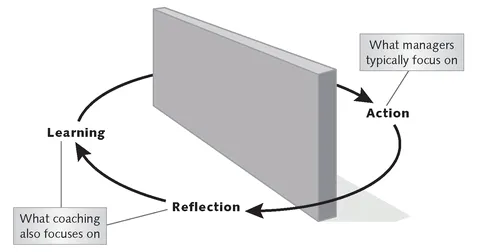
Remember the example we shared in the introduction about Michael, the development director who thought his meeting with the funder was dismal? He needed to reflect on the action he had just taken. He knew he could do something more or better, but he couldn’t figure it out alone. A coaching manager would ask him questions like, “What worked?” “What didn’t work?” “What would you do differently next time?” As a coaching manager, you would support him to reflect and to think. From reflection, new realizations are born and learning happens. Learning leads to more successful actions, such as making more time for the next meeting, getting to know the funder, or practicing the presentation with a colleague. This type of critical reflection can also reinforce what Michael did well and may want to do more of. When he knows what he does well and why he does it, he will be operating from a place of greater self-awareness. This process of using reflection-based awareness and learning to lead to new and better actions is called action learning, and it is graphically represented in Figure 1.1.
More often than not, managers tend to focus exclusively on the action part of this process. That’s because all of us are more concerned with results than with what led to those results. When managers focus exclusively on results, they miss opportunities to support the learning and development of the individuals they manage. This focus cuts them off from the reflection and learning process. A coaching approach supports the whole action learning process, not just action. According to Peter Senge, author of The Fifth Discipline(2006), adults learn best from each other. They do this by reflecting on how they address problems, question assumptions, and receive feedback. Grantmakers for Effective Organizations similarly acknowledges these characteristics as best practices for identifying successful leaders: “[Successful leadership development] embraces an ‘action learning ’ or ‘learning-by-doing’ focus, supporting and creating opportunities for participants to apply acquired knowledge and skills to real challenges facing their organizations” (Enright, 2006, p. 3). When you use the coaching approach, you provide the space and support for reflection and learning to happen.
Figure 1.1 The Action Learning Process
Source: Adapted from Finger and Asun, 2001, p. 40.
Coaching Managers Encourage Others to Solve Their Own Problems
“Coaching provides conditions that are ideal for adult problem solving and learning. In the midst of continual change and development, people rarely struggle because they lack some key piece of information or some precise procedure from a course or a book. Rather, they often get stuck in how they think and feel about themselves or their situations” (McNamara, 2001, p. 68).
Reeling in my natural desire to solve my coworkers’ problems or offer advice helped me to identify the strengths of my team members, each of whom problem solves in her or his own unique and effective way. I do not have superior problem-solving skills, merely a different methodology. As a leader, it is my responsibility to bring out the best in my team members, not to create carbon copies of myself.
—Michael Dismuke, property supervisor, Eden Housing Management, Inc.
Coaching assumes that the individual being coached does not need to be given all the answers. In other words, when you use the coaching approach you assume the “person with the problem is the expert on the problem” (McNamara, 2001, p. 2) and simply needs support to find her or his own answers. Leadership coach and author David Rock (2006) stresses this point, emphasizing that the best leaders bring out the best performance in others: “They improve their employees’ thinking—literally improving the way their brains process information—without telling anyone what to do. Improving thinking is one of the fastest ways to improve performance” (p. xv).
When a staff member comes into your office with a goal or a problem on an especially busy day, you may think, What’s the fastest way to get her out of my office so I can get back to work?Or perhaps you think, Oh goody, a distraction! Let me solve this for her.In either case, as you read this, you may think it would be a whole lot easier just to solve her problem or give her some advice. Saves time, doesn’t it? If you think this way, you are not alone. Lots of people operate like this. It’s so easy to focus on problems and problem solving. In fact, it’s natural. As David Rock (2006) points out, neurological research verifies this fix-it mentality. Our brains love to find associations, connections, and links between bits of information. When we do this, our brains give off alpha waves, which have been found to correlate with the release of the neurotransmitter serotonin, a chemical that increases relaxation and eases pain. In other words, it feels good...