eBook - ePub
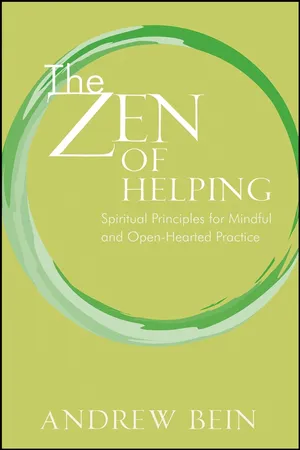
The Zen of Helping
Spiritual Principles for Mindful and Open-Hearted Practice
- English
- ePUB (mobile friendly)
- Available on iOS & Android
eBook - ePub
About this book
Bring compassion, self-awareness, radical acceptance, practitioner presence, and caring to the relationships you have with you patients by utilizing the advice in The Zen of Helping: Spiritual Principles for Mindful and Open-Hearted Practice. As a mental health professional, you will appreciate the vivid metaphors, case examples, personal anecdotes, quotes and poems in this book and use them as a spiritual foundation for your professional practice. Connect Zen Buddhism with your human service and address issues like dealing with your own responses to your client's trauma and pain.
Information
Chapter One
A SPIRITUAL HELPING FRAMEWORK FOR OUR CLIENTS AND OURSELVES
Beyond Spiritual Neutrality
—Seung Sahn
Not everything that counts can be counted. Not everything that can be counted counts.
—Albert Einstein
Zen is about being intimate with what is. As we enter helping relationships with real people, what could be more important? We offer them our authentic presence, our hearts, and our willingness to muck around in their pain and fear as well as in their successes and failures. As helping practitioners, we project the reality that we are on a sacred journey with our clients. We are profoundly fortunate to experience a connection with people in spite of the truth that we rarely know what we are doing. This vision of practice is simple but it is not easy to realize.
Conventional training in the helping fields increasingly reflects a different vision about helping, which we refer to here as a story about practice. Practitioners and scholars who are advocates of evidence-based practice, for example, like the elements of this following story quite a bit: (a) results from studies are enormously helpful in determining what to do with clients; (b) once we can reduce a client’s complex reality into a more user-friendly diagnosis or problem statement we are better equipped to be helpful; (c) helping practitioners often are ignorant regarding the true value of research or they are too numbers-phobic, intuition-reliant, or irresponsible to base their work upon research findings.
Sometimes we use a fancy word for story and call it a paradigm. Nevertheless, no matter how much some people worship chi-squares and t-tests or believe in the importance of citing multitudes of prior scholars who have said similar things, it is the author’s own story about the value of different helping orientations that determines the kind of human service or therapy book that is written.
This book represents a departure from most books and emphasizes principles that tell a different story about the essence of helping practice. These principles are rooted not only in Zen, but also in real-life case examples and personal anecdotes that illustrate the principles’ meaning, relevance, and application. At the end of this chapter, I make some suggestions on how to engage with this book. The book’s core practice principles are outlined next, followed by a discussion connecting helping practice with practitioner self-care:
Spiritual Principles of Helping
• The main ground of helping and professional practice is uncertainty and not knowing. Although theory and knowledge of the other may be helpful, it often interferes with our direct perception and engagement with clients.
• We are best able to serve our clients if our hearts remain open to them, we act in a compassionate manner, and we love them. The Zen metaphor "strong back, soft front" reminds us that our work also involves the area below our neck, and that our open-heartedness flourishes when we are stable and clear and the relationship has structure.
• We view our encounters with clients as personal opportunities for being alive and fully present in the moment. Our moment-to-moment self-awareness and presence is a precious and vital asset for clients. Self-awareness is not about self-obsession regarding performance; thus, we are not distracted while we pay attention to the world of self and other. Effectiveness with clients and practitioner self-care are interrelated.
• As we increasingly trust the present moment, our responses emerge from deep wisdom rather than fight-or-flight reactions or superficial attempts at grasping for certainty.
• Radical acceptance of what is—in the form of our clients’ lives, agency, or community conditions as well as our own responses, moods, or thoughts—provides a base of transformation and change. Although the term may seem to imply otherwise, radical acceptance is not about rolling over in the face of oppression.
• Bearing witness is the manner in which we deal with our clients’ trauma and our own trauma. It involves our willingness to enter uncertainty and listen deeply, our nonattachment to outcome, and our ability to hold the client’s pain without being overwhelmed. Bearing witness to social realities provides a foundation for engaging and acting with communities.
• We are intimately connected with our clients and communities. We tune into our essential nonseparateness in a manner that is spiritual. This nonseparateness means that my client’s narrative is my own and were it not for some circumstances or biological or social conditions, I could easily be in the client’s chair, and she could be in mine. We fully embrace that we, as practitioners, are no better than our clients.
• We see through the limited thinking that portrays many issues as dualities. The Middle Way allows us to simultaneously embrace DSM concepts and the strengths perspective without being attached to either one. (No DSM axe to grind here; I have two DSM-labeled children.) We are playful amidst the paradox of our nonseparateness or boundlessness with clients on the one hand, and the boundaries that we operate from in the relative world on the other. We do not contrive intellectual arguments that demonize one apparent polarity while extolling the virtues of the other (except for my few jabs at evidence-based practice).
• Caring for clients is rarely talked about in social work, counseling, and psychology, yet clients consistently identify practitioner caring as a curative factor. We focus on the nature and depth of our caring, which involves our genuine curiosity regarding who our clients are and how they live. As we move through diverse environments, we let our clients teach us valuable life lessons and inspire us through their courage and perseverance. We enter these environments with few preconceptions and a love of the unknown.
• We persistently take risks. We develop mindfulness regarding our fears or periods of low energy and witness them with detachment. We act with a warrior’s commitment to the truth and to being genuinely helpful. As we risk and advocate, we are mindful of fostering peaceful, collaborative relationships using "right speech." We develop the courage to confront and to examine our own armor.
• We focus on our own mental, spiritual, and physical health. We embrace our failures and recognize that failure is inevitable within our lives and in our work with clients. Our joy, calmness, and authenticity are precious resources for our clients. We maintain equanimity while we are with clients and while we are away from clients.
• We use our breath to nourish our strong back and soft front. We stay centered and do not become attached or overly enamored with any story about the nature of helping practice—including this story!
SPIRITUAL PRACTICE AND SELF-CARE
As we learn, practice, and embody the principles found throughout the book, we tap into previously underutilized personal resources in the service of our clients. We notice that we are less distracted during our sessions. We start to listen to clients with our hearts as well as our heads and our responses emerge less from flight-or-fight reactions, judgments, and dispassionate, label-based interventions. We begin to allow ourselves to care about our clients, to be inspired by their stories, and come face to face with their pain and the reality that we mutually toil in the unknown.
We proceed in this exploration grounded in Zen thought that emphasizes "each moment’s sacramental quality" (Austin, 1998, p. 12). Thus, we do everything that we can in order to come into each moment fully. We increasingly experience sitting down with a client, family, or group as a sacred event that we are most fortunate to be part of. Our presence is founded on our radical acceptance of the feelings, thoughts, and circumstances that arise in our lives, our clients’ lives, and the moment-to-moment experience that unfolds as we sit together.
This journey is a spiritual one in that it calls on us to go beyond what is apparent or what can easily be reduced and described in a book. The particular flavor of this journey in Zen is often simple. Our calm, open-hearted, sincere, and mindful approach while engaging with or attending to the smallest act allows us to touch the deepest level of truth—what some may label as the divine or God. As a metaphor, we notice that atomic and subatomic structures have the same patterns of orbit, movement, space, and unpredictability as the cosmos. As we perceive the reality of atoms, molecules, and quarks, we perceive the reality of stars, planets, and the universe. In a similar manner, our mindful, compassionate connection with one client in an office links us with all human beings in the world.
It is no small act, then, to enter a helping encounter for it becomes our opportunity to "awaken to the fundamental unity with that eternal universe, right under our noses" (Austin, 1998, p. 12). This book will serve as your under-the-nose guide.
Under your nose, just within an office or client living room is the client-practitioner gestalt right in the middle of the universe. How do you bring yourself to this encounter? How do you work with what is really happening—including everything that is happening within you? How do you cultivate the deepest levels of acceptance for your client and what do you do when serious judgments arise? What is deep listening and stillness? Are they "things" you admonish yourself to do? What role do your breath and posture play? How do you confront when you care and how do you make use of diagnostic labels when you want to transcend them? What happens when your own energy is low, when you experience failure, or you come face-to-face with difficult trauma? What is the reason you are doing this work and how do you manifest your sense of calling or purpose in your day-to-day interactions with clients and colleagues?
We grapple with these questions in order to provide the best possible service for our clients and we commit to a spiritual orientation because we understand that our clients need more from us than technique- or diagnosis-driven approaches. Although relationship factors are at least twice as important in determining outcomes as intervention choice or counseling technique (Duncan, Miller, & Sparks, 2004), conventional helping paradigms view the relationship as setting the table for doing the real work—assessing the client and settling on an intervention. In social work education, for example, this emphasis is manifested through the worshipping of the biopsychosocial assignment. Students, sometimes during three separate levels of practice classes—Bachelor’s, first year Master’s and second year Master’s—write long assessments regarding the biological, psychological, and social or ecological factors that may have some bearing on their clients’ lives. Once the biopsychosocial Holy Grail is complete, a plan for intervention is written that is often only remotely connected to all the information gathering that came before it.
Typically, little if any student self-reflection occurs around the spiritually oriented questions posed earlier. What judgments arise while in the presence of the client? How distracted or present is the student helper? How much has a sense of caring been cultivated in the course of the relationship? In what manner has the client inspired the student and has the student been able to communicate this? The biopsychosocial exercise reinforces the notion that we the practitioners "work on" the clients in a similar manner that an auto mechanic works on a car. With the interjection of the concept of counter-transference, we do acknowledge that we may bring some of our own dirty baggage (or dirty car parts) to the encounter that requires us to proceed with caution. However, we lack depth in investigating how our internal life can make a profound difference for our clients.
The spiritual principles in this book address the practitioner’s internal life. Although they were developed with the "eyes on the prize"—practitioner effectiveness with clients—they inevitably address practitioner health and self-care. One group of students who were guinea pigs for much of the book’s content commented that experiencing, investigating, and learning about self-care was a major outcome. Although not framed specifically in this manner, the book’s emphasis on: (a) awareness of internal life; (b) use of breath to facilitate calmness and mindfulness presence; (c) cultivation of radical acceptance of self, other, and context; (d) celebrating the capacity for caring for others and, in general, invoking our heart within our work; (e) appreciating the balance between a strong back (container and structure for work) and soft front (compassionate heart); (f) facing trauma and difficulty without the customary and sometimes unhelpful responses of denial; and (g) maintaining a warrior’s mentality blazed a trail for practitioner self-compassion, self-awareness, and self-care.
This trail was uniquely connected to practitioner practice—as one might expect in Zen. There were some discussions about self-care in the form of personal retreat time and mindful breathing exercises, but much of it was oriented toward integrating self-care with the in-session work with clients.
UNIVERSAL APPLICATION FOR ALL TRADITIONS
People from many religious backgrounds, traditions, and degrees of formality as well as varying levels of faith or belief in God (from 0 to 100) found a home within these pages. The principles presented within are pragmatic rather than dogmatic and readers are able to apply their sense of spirituality to the concepts in the book. For example, a field of radical acceptance for some people is read as a field of Jesus’ love. Zen’s emphasis on encounters and interactions as sacred and linked to the "bigger picture" is similar to the slogan "what would Jesus do" for waking us up to the importance of our acts. People from Jewish, Shamanic, Muslim, and secular humanist roots embrace the book’s specific lessons and orientation. A brief introduction to Buddhism and Zen can be found in the Appendix.
HOW TO ENGAGE WITH THIS BOOK
"Zen mind is not Zen mind" was the first sentence of the opening quote. What a ridiculous and truly delightful thing to say. The idea here is not to try to grab onto what Zen is. Tightly holding onto a view or concept interferes with our ability to connect with the world as it is.
You are not asked to let go of any spiritual practices or religious views that you have. Zen thought is compatible with the world’s spiritual and religious traditions. Zen is more about practices that align us with being awake, alive, psychologically healthy, and intimate with the world than it is about adopting a set of beliefs. If something in this book does not work for you, throw it out with glee.
"Throwing away Zen mind is correct Zen mind" is another sentence within the quote. The Zen tradition is full of playful paradoxes. On the one hand, the playfulness suggests we not take it too seriously, especially when we are exhorted to throw away our notions about Zen. On the other hand, the message within may be quite profound. We learn to hold both sides of this paradox—a lesson that has profound practice implications, as we will see in Chapter 7.
This book is a call to the heart and, ultimately, to the real world of practice. Examples are drawn from my experiences with highly diverse practitioners and clients who have been mandated, semi-voluntary, or voluntary. Because the principles are fluid, they will come alive as you become intimate with the book’s content. A beginner’s mind (Suzuki, 1970) is valuable. Too much confidence about material within may interfere with needed humility and make you think that you know more than you actually do.
Finally, the process of opening your heart to the book is parallel to opening your heart with your clients. The terrain is not linear and we are invited to rejoice in the surprise, the paradox, and the ambiguity. Just as we sometimes learn powerful lessons from watching a movie, reading a novel, or listening to a poem, the attempt here is to engage you in a nonconventional way. I wish to warn you, however, that explorations regarding practitioner presence, open-heartedness, nondualistic thinking, and client-practitioner connectedness are sometimes viewed as "nonprofessional." You may decide that it is safer to read this book in the privacy of your own home.
Enjoy the ride!
Chapter Two
SITTING WITH CLIENTS ON UNCERTAIN GROUND: STRONG BACK, SOFT FRONT
Beyond Evidence-Based Practice
no need to grasp or push away.
Present with each moment,
the whole of you, body, mind
and soul, opens to receive.
—Danna Faulds
This book is a little different from most social work, counseling, or psychotherapy books because it begins with the premise that we do not truly know who our client is or what we are doing when we engage in practice. No matter how many books we have read, no matter how many similar clients we have seen, no matter how much we think that we can relate to the client’s life, no matter how closely we have listened to "the problem," no matter how many standardized instruments we have utilized, our story about the client sitting across from us, to a large extent, represents our projections or fantasies. We can categorize the client according to his or her race/ethnicity, mental illness diagnosis, presenting problems, strengths, substance use, behavioral transgressions, or milestone events or traumas; yet the environment of practitioner uncertain...
Table of contents
- Praise
- Title Page
- Copyright Page
- Foreword
- FOREWORD
- PREFACE
- Acknowledgements
- Chapter One - A SPIRITUAL HELPING FRAMEWORK FOR OUR CLIENTS AND OURSELVES
- Chapter Two - SITTING WITH CLIENTS ON UNCERTAIN GROUND: STRONG BACK, SOFT FRONT
- Chapter Three - RADICAL ACCEPTANCE OF CLIENTS, CONTEXT, AND SELF
- Chapter Four - MINDFULNESS: STEADYING THE MIND AND BEING PRESENT
- Chapter Five - CURIOSITY, COMPASSIONATE CARING, AND INSPIRATION
- Chapter Six - BEARING WITNESS TO TRAUMA AND PAIN
- Chapter Seven - THE MIDDLE WAY: EMBRACING CONTRADICTION AND PARADOX
- Chapter Eight - HAVING THE CONVERSATION: MAKING SPACE FOR CLIENT SPIRITUALITY
- Chapter Nine - DEALING WITH FAILURE
- Chapter Ten - SWIMMING UPSTREAM WITH A WARRIOR’S HEART
- ABOUT THE AUTHOR
- Appendix - BRIEF INTRODUCTION TO BUDDHISM AND ZEN
- REFERENCES
- INDEX
Trusted by 375,005 students
Access to over 1.5 million titles for a fair monthly price.
Study more efficiently using our study tools.
Frequently asked questions
Yes, you can cancel anytime from the Subscription tab in your account settings on the Perlego website. Your subscription will stay active until the end of your current billing period. Learn how to cancel your subscription
No, books cannot be downloaded as external files, such as PDFs, for use outside of Perlego. However, you can download books within the Perlego app for offline reading on mobile or tablet. Learn how to download books offline
Perlego offers two plans: Essential and Complete
- Essential is ideal for learners and professionals who enjoy exploring a wide range of subjects. Access the Essential Library with 800,000+ trusted titles and best-sellers across business, personal growth, and the humanities. Includes unlimited reading time and Standard Read Aloud voice.
- Complete: Perfect for advanced learners and researchers needing full, unrestricted access. Unlock 1.5M+ books across hundreds of subjects, including academic and specialized titles. The Complete Plan also includes advanced features like Premium Read Aloud and Research Assistant.
We are an online textbook subscription service, where you can get access to an entire online library for less than the price of a single book per month. With over 1.5 million books across 990+ topics, we’ve got you covered! Learn about our mission
Look out for the read-aloud symbol on your next book to see if you can listen to it. The read-aloud tool reads text aloud for you, highlighting the text as it is being read. You can pause it, speed it up and slow it down. Learn more about Read Aloud
Yes! You can use the Perlego app on both iOS and Android devices to read anytime, anywhere — even offline. Perfect for commutes or when you’re on the go.
Please note we cannot support devices running on iOS 13 and Android 7 or earlier. Learn more about using the app
Please note we cannot support devices running on iOS 13 and Android 7 or earlier. Learn more about using the app
Yes, you can access The Zen of Helping by Andrew Bein in PDF and/or ePUB format, as well as other popular books in Psychology & Psychotherapy. We have over 1.5 million books available in our catalogue for you to explore.