- English
- ePUB (mobile friendly)
- Available on iOS & Android
eBook - ePub
About this book
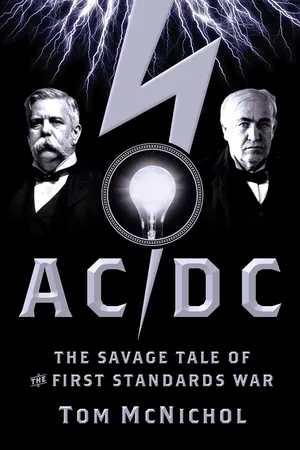
AC/DC tells the little-known story of how Thomas Edison wrongly bet in the fierce war between supporters of alternating current and direct current. The savagery of this electrical battle can hardly be imagined today. The showdown between AC and DC began as a rather straightforward conflict between technical standards, a battle of competing methods to deliver essentially the same product, electricity. But the skirmish soon metastasized into something bigger and darker. In the AC/DC battle, the worst aspects of human nature somehow got caught up in the wires; a silent, deadly flow of arrogance, vanity, and cruelty. Following the path of least resistance, the war of currents soon settled around that most primal of human emotions: fear. AC/DC serves as an object lesson in bad business strategy and poor decision making. Edison's inability to see his mistake was a key factor in his loss of control over the ?operating system? for his future inventions?not to mention the company he founded, General Electric.
Information
1
FIRST SPARKS
The story of electricity begins with a bang, the biggest of them all. The unimaginably enormous event that created the universe nearly 14 billion years ago gave birth to matter, energy, and time itself. The Big Bang was not an explosion in space but of space itself, a cataclysm occurring everywhere at once. In the milliseconds following the Big Bang, matter was formed from elementary particles, some of which carried a positive or negative charge. Electricity was born the moment these charged particles took form.
All matter in the universe contains electricity, the opposing charges that bind atoms together. Even human beings are awash in it; the central nervous system is a vast neuroelectrical network that transmits electrical impulses across nerve endings to the body’s muscles and organs.
However, electricity, like the face of the Creator, is normally hidden from view. Most matter contains a balance of positive and negative charges, a stalemated tug-of-war that prevents electricity from manifesting itself. Only when these charges are out of balance do electrons move to restore the equilibrium, allowing electricity to show its face.
Electrical current is the flow of negatively charged electrons from one place to another in order to restore the natural balance of charge. It would take untold years and thousands of lives before humans learned to harness that flow and make those unseen charged particles do their bidding. Even then, electricity remained shrouded in mystery, an eccentric, invisible force with powers that seemed to come from another world.
Electricity first showed itself on earth as lightning, and as such, may have provided the original spark for life. Cosmologists believe that lightning may have provided some of the energy that transformed simple elements such as carbon, hydrogen, oxygen, and nitrogen into amino acids, the more complex molecular chains that are the building blocks of life.
Billions of years ago, the primordial surface of the earth was subjected to almost constant lightning strikes. Lightning is discharged when charged particles in the clouds separate; the lower portion of the cloud becomes negatively charged, producing an enormous electrical difference between it and the positively charged ground. The imbalance is discharged as a spark: lightning. A lightning bolt is a bundle of heat and energy, hotter than the surface of the sun and carrying an electrical force of more than a billion volts.
Lightning may have not only sparked organic life but also preserved plant life during crucial evolutionary choke points when fuel supplies ran low. During the Archaean age two billion years ago, carbon dioxide levels fell dramatically, drying up the supply of nitrates, which are essential for plant growth. Lightning is believed to have helped produce additional nitrates in the atmosphere, allowing plants to survive through this period. When plants began to flourish again, more oxygen was produced, making the earth increasingly suitable for animals, and later, humans. In many ways, we are the products of lightning, the sons and daughters of electricity.
The first humans knew nothing of lightning’s creative power, only its terrible capacity for destruction. A jagged bolt from the heavens could incinerate someone in midstride, instantly turning a human being into a charred corpse. It was not the sort of power to be taken lightly. It would take millennia for humans to learn how to shield themselves from lightning, and longer still to learn its lifegiving power. Lightning strikes sparked fires, which in time were controlled and put to use to cook food, provide warmth, and ward off dangerous animals.
The first creatures to put electricity to work were Homo habilis, or “Handy Man,” the Stone Age humans that inhabited Africa about 1.8 million years ago. Handy Man, it turns out, wasn’t all that handy. He hadn’t yet worked out how to make fire; instead he waited for lightning to strike a bush or tree, and then carefully tended the flame. When it was time for the tribe to move to another location, Handy Man took lit branches along to start a new fire, or simply waited for lightning to strike again somewhere else.
For Homo sapiens, lightning and electricity would likewise be a luminous mystery. Around 600 B.C., the Greeks discovered that amber, a soft golden gem formed from fossilized tree sap, behaved oddly when rubbed by a piece of fur: the stone attracted pieces of straw or hair. Sometimes, the amber would even emit a spark, a miniature lightning bolt. The science behind this strange effect would remain a mystery for more than two thousand years, but the Greeks had discovered static electricity. As we now know, the fur transferred negatively charged electrons to the amber, giving it an imbalanced charge, which in turn attracted the straw. The phenomenon would later give electricity its name: elecktron is the Greek word for amber.
Even as humans struggled to understand electricity, the subject continued to be clouded by superstition. Thales of Miletus, an early Greek philosopher and mathematician, interpreted the curious properties of amber as evidence that objects were alive and possessed immortal souls. Greek mythology explained electricity by associating lightning with Zeus, the supreme god, who threw bolts of lightning down from the heavens to vent his anger at enemies below. Virgil’s Aeneid recounts the tale of Ajax, who, boasting of his own power, defied lightning to strike him down. Such a dare amounted to nothing less than shaking his fist in the face of the gods, and led to a predictably unhappy ending. In short order, Ajax was felled by an expertly aimed lightning bolt from the sky.
Lightning was so fearsome that many cultures sought to ascribe meaning to what seemed like a wantonly destructive power. The Etruscans and Romans believed that lightning was not simply a weapon of the gods but a message from them. The Etruscans were particularly keen observers of lightning, dividing the sky into sixteen sections in order to determine the significance of a bolt. Lightning moving from west to north was considered disastrous, while lightning to the left hand of the observer was thought to be fortunate. The Etruscans even compiled a sacred book about the art of interpreting lightning strikes, and laid out their towns in accordance with signs gleaned from the heavens.
In Roman times, objects or places struck by lightning were considered holy. Roman temples often were erected at these sites, where the gods were worshipped in an attempt to appease them. A man struck by lightning who lived to tell the tale was considered someone especially favored by the gods. In most cases, however, lightning was utterly destructive. A thunderbolt, the Roman poet Lucretius wrote, “can split towers asunder, overturn houses, tear out beams and rafters, move monuments of men, struck down and shattered, rob human beings of life, and slaughter cattle.”
Lightning mythology readily spread to other cultures—the phenomenon was clearly something that demanded explanation. The Vikings believed lightning was caused by Thor striking a hammer on an anvil as he rode his chariot across the sky. In Africa, Bantu tribesmen worshipped the bird-god Umpundulo, who directed lightning. Medicine men were sent into storms to bid Umpundulo to strike far away from a village, a practice that continues to this day in parts of Africa. The Book of Job places lightning in the hands of a wrathful God: “He fills his hands with lightning and commands it to strike its mark.” The Koran states that lightning, which is directed by Allah, can be a force for both creation and destruction: “He it is who shows you the lightning causing fear and hope.”
Native American tribes were particularly attuned to lightning’s dual nature, its power to kill and to give birth. Native tribes saw with remarkable clarity the inherent duality of electricity centuries before Western science would describe electrical current as a flow between negative and positive poles. One legend has Black Elk, an Oglala Sioux, testifying: “When a vision comes from the thunder beings of the West, it comes with terror like a thunder storm; but when the storm of vision has passed, the world is greener and happier; for wherever the truth of vision comes upon the world, it is like a rain. The world, you see, is happier after the terror of the storm.... You have noticed that truth comes into this world with two faces. One is sad with suffering, and the other laughs; but it is the same face, laughing or weeping.”
Negative and positive, plus and minus, good and evil, life and death. The Chinese Taoists termed the pair of opposites found in nature yin and yang, and the concept is well suited to electricity. Yin and yang are not opposites in conflict; they are simply different aspects of the same system. One depends on the other for its existence. As one aspect overcomes the other, the seeds of a reversal are sown.
Likewise, the negative and positive poles in electricity represent an ever-changing polarity—the dominance of a negative charge contains the inception of a rise of a positive charge. The famous yin-yang symbol expresses the concept with elegant simplicity: the blackest part of the symbol contains a tiny white dot, and the whitest part a black dot, the seeds of the inevitable opposite about to give birth.
Not until the end of the Middle Ages would philosophers begin to look at electricity scientifically. The first truly scientific study of electricity and magnetism was taken up by William Gilbert, an English physician to Queen Elizabeth I. Gilbert’s book De Magnete (On the Magnet), published in Latin in 1600, introduced the term electricity to describe the attractive force of rubbed amber.
Gilbert spent seventeen years experimenting with magnetism and electricity, attempting to strip away the myths that had shadowed electricity since the dawn of time. Gilbert was the first to describe a relationship between electricity and magnetism, as well as being the originator of the terms electric force, magnetic pole, and electric attraction. Gilbert divided objects into “electrics” (such as amber) and “non-electrics” (such as glass). He attributed the electrification of an object to the removal of a fluid, or “humour,” which then left an “effluvium,” or atmosphere, around the body. Gilbert actually wasn’t far off the mark. His “electrics” would later be known as conductors, while the “non-electrics” would be called insulators. The “humour” that was stripped off objects would be known as a “charge” and the “effluvium” that was created became an “electric field.”
Before long, experimenters developed machines that could produce large amounts of static electricity on demand. In 1660, German experimenter Otto von Guericke made the first electrostatic generator out of a ball of sulfur and some cloth. The sulfur ball was mounted on a shaft placed inside a glass globe. A crank rotated the ball against the cloth, and a static electric spark was produced. To von Guericke, the sulfur ball symbolized the earth, which shed part of its electric “soul” when rubbed—not exactly a scientific explanation. But the machine worked, letting experimenters produce electric sparks whenever they wanted.
In 1745, Pieter van Musschenbroek, a physicist and mathematician in Leiden, Holland, was one of several experimenters to fashion a device that would become known as the Leyden jar. Van Musschenbroek’s Leyden jar consisted of a glass vial partially filled with water. A beaded metal chain dangled in the water, held by a wire that ran through a cork stopper and out the top of the jar, terminating in a metal knob. Van Musschenbroek held the jar in one hand and touched the knob to a spark generator. When nothing happened, van Musschenbroek touched the knob with his other hand, and at that instant, got the shock of his life:
“My right hand was struck with such force that my whole body quivered just like someone hit by lightning,” van Musschenbroek wrote. “Generally the blow does not break the glass, no matter how thin it is, nor does it knock the hand away, but the arm and the entire body are affected so terribly I can’t describe it. I thought I was done for.”
Van Musschenbroek couldn’t figure out what had caused the shock—after all, the jar was no longer connected to the static generator when he got zapped. He later told an associate he would never try such an experiment again, but others weren’t so cautious. Leyden jar experimenters soon reported everything from nosebleeds, convulsions, and prolonged dizziness to temporary paralysis when they unleashed the charge with their hand.
The Leyden jar was electricity in a bottle, an ingenious way to store a static electric charge and release it at will. When a charge was applied to the inside surface of the Leyden jar, it meant that the outside surface (which was insulated from the inside) had an equal but opposite charge. When the inside and outside surfaces were connected by a conductor—in this case, a human hand—the circuit was completed, and the charge was released with a dramatic spark. The Leyden jar was the forerunner of what today is known as a capacitor. Capacitors are found in a camera’s electronic flash, for example, used to store a charge and then release it instantly when a picture is snapped.
Eventually, the Leyden jar was refined so that the electric charge could be released without having to shock the user, a boon for further experimentation. Leyden jars quickly became as much a novelty item as a scientific instrument. Scores of enterprising experimenters drew rapt crowds all over Europe demonstrating electricity with the jars. They killed birds and small animals with a burst of stored electric charge and sent electrostatic sparks through long wires over rivers and lakes. In 1746, Jean-Antoine Nollet, a French clergyman and physicist, discharged a Leyden jar in the presence of King Louis XV, sending a current of static electricity rushing through a chain of 180 Royal Guards who were holding hands. In another demonstration, Nollet connected a row of Carthusian monks with a metal wire. A Leyden jar was used to send a charge through the wire, and the white-robed monks were said to have leapt simultaneously into the air, goosed by a jolt of electricity.
One of the electric showmen of the day was Dr. Archibald Spencer, a physician from Scotland who came to Boston in 1743 to demonstrate “electric magic” to an audience. Spencer’s demonstrations were high on theatrics—in one display, he drew sparks from the feet of a boy hanging from the ceiling by silk cords. The audience was astonished, never having seen such wonders performed. One audience member was particularly fascinated by the demonstration, a visiting postmaster from Philadelphia named Ben Franklin.
2
LIGHTNING IN A BOTTLE
Ben Franklin flying a kite in a thunderstorm: It’s an image burned in the brain of every American schoolchild, an icon as durable as Paul Revere galloping through the countryside or George Washington blithely chopping down a cherry tree. There stands Ben, usually in full colonial dress, tugging on the string of a kite that’s being struck by a jagged bolt of lightning. A key tied to the end of the string gives off a faint but unmistakable glow. Franklin’s face is curiously impassive, particularly for a man who’s come within inches of several million volts of electricity.
Like many of history’s most familiar scenes, the Franklin kite story is a blend of fact and fiction, what a modern-day movie advertisement might describe as being based on a true story. Franklin did indeed fly a kite in a thunderstorm to see whether lightning was a form of electricity, but he wasn’t the first to test this theory, nor was his experiment a very smart approach—Franklin came perilously close to being incinerated on the spot. As it turns out, the kite demonstration was only the most celebrated of Franklin’s many experiments with electricity during his lifetime. Had Ben never flown the kite, his contribution to the electrical arts would have been no less important.
Unlike almost every experimenter who would follow him, Franklin was only a part-time player in the field of electricity. Nearly all of Franklin’s discoveries in electricity took place within a six-year period culminating with his kite experiment sometime in June 1752. Such was the expansiveness of Franklin’s genius that he managed to squeeze groundbreaking electricity research into such a brief period, leaving time for him to be a publisher, writer, postmaster, statesman, raconteur, political philosopher, insurrectionist, and inventor (of the Franklin stove, bifocals, the flexible medical catheter, and swim fins).
Franklin caught the electricity bug after attending Archibald Spencer’s demonstrations in Boston, a show that included drawing long sparks from a Leyden jar as well as from statically charged volunteers. “Being on a subject quite new to me, they equally surprised and pleased me,” Franklin later wrote of Spencer’s stunts. Franklin’s only complaint was that Spencer wasn’t much of a showman; the doctor’s electrical tricks “were imperfectly performed, as he was not very expert.”
Franklin’s insatiable curiosity and theatrical flair made him a natural to take on the mysteries of electricity. Franklin also happened to have free time on his hands. He was in the process of selling his printing shop in Philadelphia and retiring from business in order to devote his time to what Franklin called “philosophical studies and amusements.” After seeing Spencer’s show, Franklin went out and purchased all the electrical equipment he could find, including a Leyden jar. Franklin also obtained a long glass tube for generating static charges, a gift from Peter Collinson, a botanist and fellow of the Royal Society of London. Collinson would quickly become Franklin’s most trusted correspondent in matters relating to electricity, a sounding board for emerging theories. The two men exchanged dozens of letters, and Franklin’s folksy, clear-headed descriptions of his experiments, which were later published, would demystify electricity for thousands.
Once Franklin committed himself to learning everything he could about electricity, he could barely contain his excitement. “For my own part, I never was before engaged in any study that so engrossed my attention and my time as this has lately done,” Franklin wrote to Collinson. The fanciful tricks demonstrated by Dr. Spencer had appealed to Franklin’s roguish nature, and he was soon entertaining friends with his own electrical stunts. Franklin applied an electrical charge to an iron fence surrounding his Philadelphia house so that the fence gave off a harmless but dramatic spark when it was touched. He fashioned a fake spider out of metal and then put a charge to it, making it scurry across the ground. He rigged a portrait of King George II so that anyone touching the king’s crown received “a high-treason shock.” He charged drinking glasses filled with wine so that unsuspecting guests were treated to a spark as they imbibed. He also participated in a parlor game called “the electric kiss,” in which participants passed a charge around a circle with their lips.
In the summer of 1749, Franklin threw a “party of pleasure” on the banks of the Schuylkill River for his friends, with electricity as...
Table of contents
- Title Page
- Copyright Page
- Prologue
- Chapter 1 - FIRST SPARKS
- Chapter 2 - LIGHTNING IN A BOTTLE
- Chapter 3 - ENTER THE WIZARD
- Chapter 4 - LET THERE BE LIGHT
- Chapter 5 - ELECTRIFYING THE BIG APPLE
- Chapter 6 - TESLA
- Chapter 7 - THE ANIMAL EXPERIMENTS
- Chapter 8 - OLD SPARKY
- Chapter 9 - PULSE OF THE WORLD
- Chapter 10 - KILLING AN ELEPHANT
- Chapter 11 - TWILIGHT BY BATTERY POWER
- Chapter 12 - DC’S REVENGE
- Epilogue
- Further Readings in Electricity
- The Author
- Index
Trusted by 375,005 students
Access to over 1.5 million titles for a fair monthly price.
Study more efficiently using our study tools.
Frequently asked questions
Yes, you can cancel anytime from the Subscription tab in your account settings on the Perlego website. Your subscription will stay active until the end of your current billing period. Learn how to cancel your subscription
No, books cannot be downloaded as external files, such as PDFs, for use outside of Perlego. However, you can download books within the Perlego app for offline reading on mobile or tablet. Learn how to download books offline
Perlego offers two plans: Essential and Complete
- Essential is ideal for learners and professionals who enjoy exploring a wide range of subjects. Access the Essential Library with 800,000+ trusted titles and best-sellers across business, personal growth, and the humanities. Includes unlimited reading time and Standard Read Aloud voice.
- Complete: Perfect for advanced learners and researchers needing full, unrestricted access. Unlock 1.5M+ books across hundreds of subjects, including academic and specialized titles. The Complete Plan also includes advanced features like Premium Read Aloud and Research Assistant.
We are an online textbook subscription service, where you can get access to an entire online library for less than the price of a single book per month. With over 1.5 million books across 990+ topics, we’ve got you covered! Learn about our mission
Look out for the read-aloud symbol on your next book to see if you can listen to it. The read-aloud tool reads text aloud for you, highlighting the text as it is being read. You can pause it, speed it up and slow it down. Learn more about Read Aloud
Yes! You can use the Perlego app on both iOS and Android devices to read anytime, anywhere — even offline. Perfect for commutes or when you’re on the go.
Please note we cannot support devices running on iOS 13 and Android 7 or earlier. Learn more about using the app
Please note we cannot support devices running on iOS 13 and Android 7 or earlier. Learn more about using the app
Yes, you can access AC/DC by Tom McNichol in PDF and/or ePUB format, as well as other popular books in History & Science History. We have over 1.5 million books available in our catalogue for you to explore.