This third edition of the classic resource, Building Expertise draws on the most recent evidence on how to build innovative forms of expertise and translates that evidence into guidelines for instructional designers, course developers and facilitators, technical communicators, and other human performance professionals. Ruth Colvin Clark summarizes psychological theories concerning ways instructional methods support human learning processes. Filled with updated research and new illustrative examples, this new edition offers trainers evidence-based guidelines to help them accelerate genuine expertise within their organizations.
HOW HAS the 21st Century global economy driven the need for adaptive forms of expertise that are the basis for innovation? What has recent research on experts from sports to medicine told us about how to efficiently grow expertise?
In Chapters 1 through 4 I lay the foundation for Building Expertise by summarizing recent research on expertise as well as describing the key ingredients and psychological events essential to any instructional program that supports expertise.
CHAPTER 1 TOPICS
The Value of Expertise
The Challenge of Global Expertise
What Is an Expert?
Seven Lessons Learned About Experts
1. Expertise Requires Extensive Practice
2. Expertise Is Domain Speciffic
3. Expertise Requires Deliberate Practice
4. Experts See with Different Eyes
5. Experts CAN Get Stuck
6. Expertise Grows From Two Intelligences
7. Challenging Problems Require Diverse Expertise
1
Expertise in the Global Economy
An expert is a man who has made all the mistakes that can be made in a very narrow field
NEILS BOHR
WHAT IS AN EXPERT? How do people become experts? Is expertise a matter of talent or learning? What types of expertise Are most Needed in the New global economy? How can instructional professionals make use of what we know About experts to build more effective learning environments? This chapter sets the stage For the book by summarizing what we know About expert performance and why effective training programs Are critical to organizations facing the competitive pressures of A growing global pool of expertise.
The Value of Expertise
If you have taken an airplane trip, consulted a medical professional, used computer systems, or attended a professional ball game or a concert, you have benefited from expertise! In fact, few of us would get through a normal week were it not for the varied expertise that provides the infrastructure for our many daily activities. This is a book about expertise—specifically how to grow and deploy expertise most effectively to achieve organizational goals.
There is a large untapped reservoir of knowledge about how novices become experts and how that transition can be facilitated through training and other workplace solutions. In fact, as I write this third edition of Building Expertise, the research on expertise has grown sufficiently to warrant a new forty-two-chapter book: Cambridge Handbook of Expertise and Expert Performance, published in 2006! Knowledge about expertise is untapped in part because much of the recent research on human learning and expertise is buried in academic resources such as the Cambridge Handbook not routinely accessed by practitioners.
Instructional professionals like you who are responsible for the growth of expertise in your organization can benefit from this research. In other words, you need expertise on expertise. My objective in this book is to summarize the research and psychology about what we currently know about growing and leveraging expertise in organizational settings.
The Challenge of Global Expertise
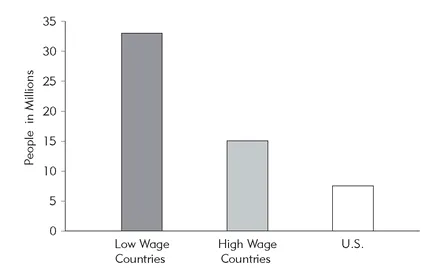
Workers in developed countries face increasing global competition for expertise. Uhalde and Strohl (2006) estimate as many as forty million American jobs, equivalent to nearly a third of the U.S. labor force are theoretically vulnerable to off shoring. The expanding global pool for the type of higher level skills that have historically been the province of developed nations comes from the BRIC (Brazil, Russia, India, and China) supply chain. Since the turn of the century, 1.5 billion people from China, India and countries from the former Soviet bloc have joined the global labor force. Data from a 2005 McKinsey report summarized in Figure 1.1 show young professionals from low-wage countries, including engineers, finance analysts and accountants, and
Figure 1.1. Young Professionals in the Global Talent Pool, 2005 From McKinsey, 2005
generalists with university degrees make up the largest segment in the global talent pool. And foreign skilled professionals will continue to be inexpensive for several decades to come making some forms of expertise in Western workforces less competitive.
An organization’s ability to innovate becomes the competitive edge in a global economy. “The need to innovate is growing stronger as innovation comes closer to being the sole means to survive and prosper in highly competitive and globalised economies” (David & Foray, 2003, p. 22). Therefore a recurrent theme in this book is the psychology of expertise—especially adaptive expertise that is the basis for creative and critical thinking.
What Is an Expert?
According to Wikipedia (2007), an expert is “someone widely recognized as a reliable source of technique or skill whose faculty for judging or deciding rightly, justly, or wisely is accorded authority and status by the public or their peers. An expert, more generally, is a person with extensive knowledge or ability in a particular area of study”. Wikipedia, one of a growing cadre of open-access software, did not exist at the writing of the second edition of this book and illustrates one way that expertise can be deployed through the Web 2.0.
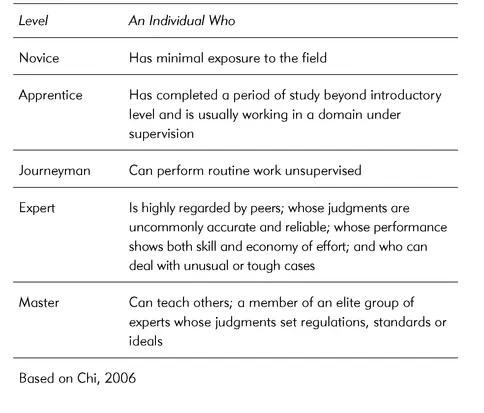
Of course, expertise is not all or nothing. As one begins to learn a new set of skills, one evolves from novice through various skill levels up to expert or master performer. Table 1.1 summarizes the common labels and attributes associated with stages of expertise. As training professionals we encounter diverse levels of expertise in the course of our work. We may interview subject-matter experts who are, as the name implies, experts or even
Table 1.1. Levels of Expertise
master performers. Our learners are often at the novice or apprentice stages. Our training goals are often relatively modest in scope, perhaps to bring a novice closer to an apprentice level, or perhaps to teach a journeyman a new set of specialized skills or knowledge. As instructional professionals however, we are collectively responsible for the investment of close to $60 billion a year in the United States alone devoted to the growth of the specialized expertise that makes our organizations competitive (Industry Report, 2007).
Seven Lessons Learned About Experts
Psychologists have studied experts in a variety of domains, including sports, medicine, programming, music, and chess to see how they are different from less-skilled individuals. Here are the main lessons learned from that research:
1. Expertise Requires Extensive Practice
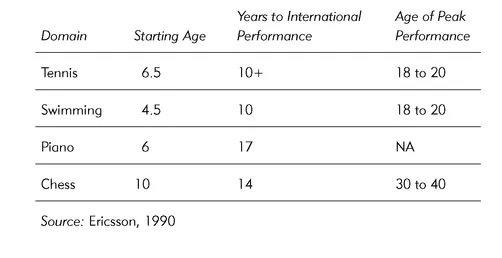
As you can see in Table 1.2 world-class experts start early in life and pursue their vocations through many years of prolonged and
Table 1.2. Years of Practice to Achieve World-Class Performance
concentrated practice. While an acceptable level of performance in many tasks such as typing or tennis can be reached in a matter of a few weeks or months, high levels of expertise demand years of practice. Some of the first research focused on master-level chess players. About ten years of sustained chess practice is needed to reach master levels. In fact, from sports to music to programmers, the ten-year rule has proved pretty consistent. “Until most individuals recognize that sustained training and effort is a prerequisite for reaching expert levels of performance, they will continue to misattribute lesser achievement to the lack of natural gifts, and will thus fail to reach their own potential” (Ericsson, 2006, p. 699). In other words, while innate ability is one factor that contributes to expertise, most of us do not invest the level of practice needed to fully exploit the talents we have.
While most practice takes place on the job, as a trainer or instructional designer, you can leverage what we have learned about accelerating expertise through appropriate practice during training. For example, after twenty-five hours of study with a computer training simulator called Sherlock, learners with about two years of experience achieved a level of expertise that matched technicians with ten years of experience (Gott & Lesgold, 2000)! Acceleration of expertise can be achieved when training is designed on the basis of human psychological learning processes.
2. Expertise Is Domain Specific
Because someone is an expert chess player, will he or she be better prepared to solve a problem in physics? In general, the answer is no! Fields of expertise are very narrow. That’s because expertise relies on a large body of specific knowledge accumulated over time in memory. Master-level chess players, for example, store over 50,000 chess plays in memory (Simon & Gilmartin, 1973). These play patterns were acquired gradually over a ten-year period. Successful programmers solve new programming problems by drawing on specific programming strategies that have worked for them in the past.
Studies of expert performers show that concrete and specific knowledge stored in memory is the basis for expertise. Each job domain will require a unique knowledge base and a specialized educational and developmental program to build it. When it comes to high levels of expertise, there are no generic or quick fixes!
3. Expertise Requires Deliberate Practice
Although a long period of practice is needed, not everyone who invests a great deal of practice time will achieve high proficiency levels. We are all familiar with the recreational golfer who spends many hours playing, but never really moves beyond a plateau of acceptable performance. Ericsson (2006) distinguishes between routine practice and deliberate practice. For example, he found that all expert violinists spent over fifty hours a week on music activities. But the best violinists spent more time per week on activities that had been specifically tailored to improve their performance. Typically, their teachers identified specific areas of need and set up practice sessions for them. “The core assumption of deliberate practice is that expert performance is acquired gradually and that effective improvement of performance requires the opportunity to find suitable training tasks that the performer can master sequentially. . . . typically monitored by a teacher or coach” (Ericsson, 2006, p. 692). Deliberate practice requires good performers to concentrate on specific skills that are just beyond their current proficiency levels.
4. Experts See with Different Eyes
A profession that relies on visual discrimination such as radiology provides a salient example of seeing with different eyes. Even experienced physicians rely on the unique expertise of the radiologist to review various forms of medical imagery and provide interpretations However, experts from all domains “see” the problems they face in their domains with different eyes than those with less experience. A programmer looking at code, a chess player viewing a mid-play board, or an orchestral conductor scanning the musical notation and hearing the symphony—all take in relevant data and represent it in ways that are unique to their expertise. As a result of their unique representations, they can choose the most appropriate strategies to solve problems or improve performance. Part of building expertise is to train the brain to “see” problems through the eyes of an expert; in other words, to build the ability to represent problems in ways that lead to effective solutions.
5. Experts Can Get Stuck
While expert performance is very powerful, expertise has its down sides. For example, based on their extensive experience, experts can be inflexible; they can have trouble adapting to new problems—problems that will not be solved by the expert’s well-formed mental models. Bias is a facet of inflexibility. In presenting hematology cases or cardiology cases to medical specialists such as hematologists, cardiologists, and infectious disease specialists, Chi (2006) reports that specialists tended to generate hypotheses that corresponded to their field of expertise whether warranted or not.“This tendency to generate diagnoses about which they have more kn...
Table of contents
About This Book
About Pfeiffer
Title Page
Copyright Page
Introduction
PART ONE - Foundations of Building Expertise
PART TWO - Basic Learning Events Proven to Build Expertise
PART THREE - Promoting Adaptive Expertise and Motivation
PART FOUR - Building Expertise in Action
REFERENCES
GLOSSARY
NAME INDEX
SUBJECT INDEX
ABOUT THE AUTHOR
Trusted by 375,005 students
Access to over 1.5 million titles for a fair monthly price.
Study more efficiently using our study tools.
Frequently asked questions
Yes, you can cancel anytime from the Subscription tab in your account settings on the Perlego website. Your subscription will stay active until the end of your current billing period. Learn how to cancel your subscription
No, books cannot be downloaded as external files, such as PDFs, for use outside of Perlego. However, you can download books within the Perlego app for offline reading on mobile or tablet. Learn how to download books offline
Perlego offers two plans: Essential and Complete
Essential is ideal for learners and professionals who enjoy exploring a wide range of subjects. Access the Essential Library with 800,000+ trusted titles and best-sellers across business, personal growth, and the humanities. Includes unlimited reading time and Standard Read Aloud voice.
Complete: Perfect for advanced learners and researchers needing full, unrestricted access. Unlock 1.5M+ books across hundreds of subjects, including academic and specialized titles. The Complete Plan also includes advanced features like Premium Read Aloud and Research Assistant.
Both plans are available with monthly, semester, or annual billing cycles.
We are an online textbook subscription service, where you can get access to an entire online library for less than the price of a single book per month. With over 1.5 million books across 990+ topics, we’ve got you covered! Learn about our mission
Look out for the read-aloud symbol on your next book to see if you can listen to it. The read-aloud tool reads text aloud for you, highlighting the text as it is being read. You can pause it, speed it up and slow it down. Learn more about Read Aloud
Yes! You can use the Perlego app on both iOS and Android devices to read anytime, anywhere — even offline. Perfect for commutes or when you’re on the go. Please note we cannot support devices running on iOS 13 and Android 7 or earlier. Learn more about using the app
Yes, you can access Building Expertise by Ruth C. Clark in PDF and/or ePUB format, as well as other popular books in Business & Human Resource Management. We have over 1.5 million books available in our catalogue for you to explore.