eBook - ePub
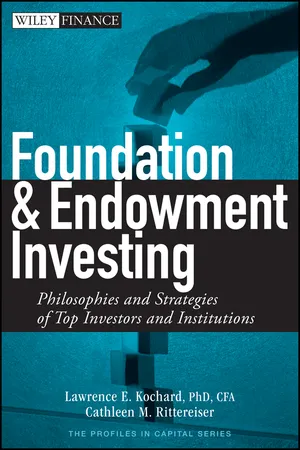
Foundation and Endowment Investing
Philosophies and Strategies of Top Investors and Institutions
- English
- ePUB (mobile friendly)
- Available on iOS & Android
eBook - ePub
Foundation and Endowment Investing
Philosophies and Strategies of Top Investors and Institutions
About this book
In Foundation and Endowment Investing, authors Lawrence Kochard and Cathleen Rittereiser offer you a detailed look at this fascinating world and the strategies used to achieve success within it. Filled with in-depth insights and expert advice, this reliable resource profiles twelve of the most accomplished Chief Investment Officers within today's foundation and endowment community—chronicling their experiences, investment philosophies, and the challenges they face—and shares important lessons that can be used as you go about your own investment endeavors.
PART ONE
Foundations and Endowments Rise as Powerful Institutional Investors
CHAPTER 1
The Evolution of Foundation and Endowment Investment Management
From Poorhouses to Powerhouses
Foundations and endowments have become investment powerhouses, managed by sophisticated investors using advanced investment techniques. Despite a smaller asset base than pension funds, they have become increasingly influential institutional investors because their long-term perspective gives them the latitude to take more investment risks and the impetus to adopt new asset classes and strategies long before other investors. While the number of foundations and endowments is not necessarily growing, the numbers that have chosen to dedicate professionals to their investments has grown. There are more organizations with in-house investment staffs or new chief investment officers (CIOs) than ever.
It could have turned out differently. Until 1969 most endowment funds had conservative portfolios, which underperformed other investors. If McGeorge Bundy at the Ford Foundation had not intervened, foundations and endowments might have become investment poorhouses today.
This chapter chronicles the evolution of foundation and endowment investment management from the first gifts to Harvard to the important changes set in motion by McGeorge Bundy and the Ford Foundation, the global economic and market conditions driving investment performance, and the rise to prominence of foundation and endowment CIOs.
It will give an overview of how these institutions became so powerful and a rationale for profiling the talented CIOs who got them there.
ORIGINS OF ENDOWMENT MANAGEMENT
Endowments can be traced back to the fifteenth century, when donors in England made gifts to churches, schools, and universities to support them in perpetuity. Usually, these gifts carried the restriction that the principal (the donated amount) needed to be preserved, although the income from the endowment could be spent. Donors frequently restrict the use of an endowment for a specific purpose, such as professorships or scholarships. Endowments are intended to be a permanent source of income for institutions that traditionally did not have income.1
The core pool of assets managed by either foundations or educational institutions is known as its endowment, although in the investing community, endowment has become shorthand for describing the investments of educational institutions. Throughout the text, endowment will generally be used to describe the assets of educational institutions or a specific institution. In this chapter and occasionally throughout the book, the word will refer to the assets of nonprofit organizations in general.
Harvard University traces its endowment back to 1649 when two members of the class of 1642 who also were the school’s first teaching fellows, John Bulkeley and George Downing, and two from the class of 1646, Samuel Winthrop and John Alcock, gave the college a real estate parcel. The one-time cow yard was planted with apple trees and became known as the “Fellow’s Orchard.” The land remains part of the Harvard campus; the school’s Widener Library occupies part of the site. In 1669, lumber merchants guaranteed the school a payment of 60 pounds per year for seven years and met the obligation by providing lumber products that the school then sold. Today, close to 11,000 separate funds constitute the Harvard endowment, the majority restricted to supporting specific programs such as scholarships, building maintenance, teaching, research and student activities and designated to support that purpose in perpetuity.2
In 1890, Trinity College, a Methodist institution in North Carolina, had chosen the city of Raleigh over Durham for its new location. Behind-the-scenes maneuvers by Durham community leaders and family members led Washington Duke to pledge $85,000 for an endowment to locate the school in Durham. With that pledge in hand, Trinity’s president, John F. Crowell, secured a donation of land on the western edge of the city. When Duke made the formal offer to the board of trustees on March 20, citizens of Durham had raised an additional $9,361 to support the school. Trinity College is now known as Duke University.3
Those anecdotes exemplify the origins of modern endowment funds and foreshadow how endowment assets have been acquired, managed, and manipulated for over three centuries. Harvard’s cow-yard gift displays several factors that have characterized endowment management, including the generosity and corresponding influence of powerful alumni, handling gifts of property or goods, and the “naming gift” and “matching gift.” The prospect of a large financial gift appears to have resulted in the trustees of Trinity College backing out of a commitment to Raleigh, although one could argue that they met their fiduciary responsibility and followed the “prudent man rule.” Traditionally, committees of wealthy, powerful men donated and managed the assets, volunteering their services even when lacking expertise, until 1969, 300 years after the lumber merchants donated their products to Harvard.
Powerful, wealthy alumni of institutions or benefactors of foundations can still exert enormous influence over an organization and its investments, but the shift to a more structured, modern, and professional form of investment management began to take shape in 1969. Academic research—namely, Markowitz’s modern portfolio theory—and evidence that excessively restrictive endowment management policies thwarted asset preservation came to the forefront with two groundbreaking and influential studies commissioned by the Ford Foundation. The changes in fiduciary law and investment policy changed endowment management, creating this formidable investor base.
Unbeknownst to John Bulkeley and George Downing, their cow-yard donation would form the cornerstone not only of the Widener Library, but also of a powerful, influential institutional investment community led by prestigious, professional, talented, and accomplished CIOs.
CATALYSTS OF CHANGE
Toward the end of the 1960s, McGeorge Bundy, then the head of the Ford Foundation (a leading donor to education), became concerned about the rising costs of higher education. He began to study the management of endowment assets to determine if they could be managed more productively and, if so, to assist in alleviating the problem.
At the time, these assets tended to be managed by wealthy trustees guided by personal trust law. Funds were not commingled in investment vehicles, trustees were forbidden to delegate investment decisions, and rules limited the endowments to spending only dividend and interest payments. The funds were managed to generate current yield and to maintain principal over time and invested in bonds and other fixed-income vehicles rather than equities. The use of cost accounting, recording the price of a security when purchased and adjusting the value only when sold, obscured the fact that bonds actually had been declining in value and that equities generally delivered superior returns over the long term.
A narrow interpretation of the famous original prudent man rule ruling of Harvard College v. Amory in 1830 also limited the investment approach. In the original case, Harvard and Massachusetts General Hospital would each receive half the estate of John McLean when his widow died. The executors, the Amories, had invested the assets in stocks. Fearing the loss of their eventual principal, the two institutions sued because they believed stocks were too risky. In ruling against Harvard and Mass General, and in favor of the Amories’ right to invest the assets, Justice J. Putnam wrote:
All that can be required of a trustee to invest, is, that he shall conduct himself faithfully and exercise a sound discretion. He is to observe how men of prudence, discretion and intelligence manage their own affairs, not in regard to speculation, but in regard to the permanent disposition of their funds, considering the probable income, as well as the probable safety of the capital to be invested.
Thus, the prudent man rule became the standard for managing trustlike assets. The rule became more narrowly interpreted over time, primarily due to the influential works of Professor Austin Wakeman Scott, “Restatements of Trusts” (1935) and “Scott on Trusts” (1939). He restated the rule in such a way that modern academics and legal scholars agree that it lost its flexibility and led fiduciaries to evaluate investments individually, rather than as part of a portfolio.4
Before Bundy addressed this issue, there had been signs that the approach to investing these assets needed to change. The birth of modern portfolio theory in Harry Markowitz’s 1952 paper, “Portfolio Selection,” reinvented investment thinking and eventually earned him the Nobel Prize in economics.5 In a less seismic, yet still important change, the College Retirement Equities Fund (CREF) had introduced total return and market value accounting to the community in 1952. In 1966, the book Pension Funds: Measuring Investment Performance (The Graduate School of Business) by Peter Dietz also made the case for measuring total return and implementing market value accounting. Since many trustees also had leadership roles in companies and familiarity with these concepts, they started to consider applying them to endowment management. Investment books and academic papers, including research by Yale University’s treasurer, John Ecklund, shifted thinking by persuasively advocating for investing in growth company equities.
But it took the leadership of McGeorge Bundy and the resources of the Ford Foundation to cause change. In the Ford Foundation annual report published in 1967, writing on endowments Bundy said:
We believe there may be room for great improvement here. It is far from clear that trustees have reason to be proud of their performance in making money for their colleges. We recognize the risks of unconventional investing, but the true test of performance in the handling of money is the record of achievement, not the opinion of the respectable. We have the impression that over the long run caution has cost our colleges and universities much more than imprudence or excessive risk taking. The Foundation intends to make a careful study of this whole field.
The Foundation commissioned two studies, released in 1969 as “Reports to the Ford Foundation.” The first, “The Law and Lore of Endowment Funds” by William L. Cary and Craig B. Bright, addressed legal principles that had governed endowment investing and recommended changes in thinking and policies. The second, “Managing Educational Endowments,” by Robert R. Barker, analyzed investment performance and recommended changes to investment processes and procedures.
The Law and Lore of Endowment Funds
Bundy realized the mistaken belief that personal trust laws applied to endowments impeded change. He charged William L. Cary and Craig B. Bright, lawyers with the firm Patterson, Belknap & Webb in New York City with reviewing and reporting on these legal constraints. Mr. Cary had been the chairman of the Securities and Exchange Commission and was the Dwight Professor of Law at Columbia University.
The report made several conclusions that essentially released trustees from their self-imposed investment prisons and cleared the path for permanent changes in managing endowment assets. They included the following:
• Endowments are corporations with one beneficiary and were not subject to the laws governing personal trusts with many beneficiaries.
• Trustees represent the institution and have responsibility for establishing spending and investment policy.
• Trustees could delegate the execution of investment policies to qualified, outside investment advisers but retained responsibility for supervising and monitoring advisers.
The authors also recommended establishing a new uniform state law that would allow trustees to consider the total returns of the portfolio from realized and unrealized gains along with dividend and interest income when determining the spending policy. This directly led to the formulation in 1972 of the Uniform Management of Institutional Funds Act.6
Managing Educational Endowments
Bundy was not just concerned about the management of educational endowments; he was also concerned about the Ford Foundation’s ability to manage its assets and meet its commitments to supporting higher education. In the 1966 Ford Foundation annual report, he noted that an incremental 1 percent improvement in performance of the Foundation’s assets would double the amount of money it could grant. The second report, also released in 1969, “Managing Educational Endowments,” by Robert R. Barker (not the famed television game show host, but an academic and member of the Smith College Investment Committee), studied the ossified investment techniques hindering endowment growth and performance.
The report compared the performance of the endowments at “fifteen important educational institutions” from 1959 to 1968 to balanced and growth-oriented mutual funds and the University of Rochester’s professional investment office. The 8.7 percent average annual performance of the endowments lagged all the others. The balanced funds beat endowments by only 0.5 percent, but the growth funds and Rochester delivered 14.6 percent and 14.4 percent, respectively, almost a 6 percent per year difference.
The report blamed the poor performance of endowments on the management of trustee committees, stating that their focus on avoiding losses and maximizing current income had led them to choose bonds at the expense of better-performing growth-oriented equities because the latter provided virtually no dividend yield. It predicted that this approach would result in “highly adverse consequences for long-term endowment values” and recommended that “endowment managers must be able to select securities on the basis of total return over the long term rather than on the basis of maximizing dividends and interest to help in balancing the operating budget.” The report also proclaimed that “delegation to an able professional portfolio manager who has a capable organization around him is essential for successful investment management.” The report advocated a spending rule based on a percentage of the three-year moving average of the assets’ market value.7 In fact, the Smith College board of trustees implemented the total return and market value accounting approach in 1969 as a result of the research.8
Also in 1969, Section 4944 of the Internal Revenue Code established the “no jeopardizing investment” rule for foundations and contained language that allowed an investment to be considered as part of a portfolio.
Many historians consider 1969 a seminal year in U.S. history. Neil Armstrong walked on the moon, Woodstock happened in upstate New York, and the New York Mets won the World Series. It also became a seminal year in investment history. Barker’s investment thinking, Cary and Bright’s legal thinking, and even the IRS’s policy thinking converged and enabled permanent, substantial changes in the app...
Table of contents
- Title Page
- Copyright Page
- Dedication
- Preface
- Acknowledgments
- About the Authors
- PART ONE - Foundations and Endowments Rise as Powerful Institutional Investors
- PART TWO - Profiles in Capital
- PART Three - Summary and Analysis
- Notes
- Index
Trusted by 375,005 students
Access to over 1.5 million titles for a fair monthly price.
Study more efficiently using our study tools.
Frequently asked questions
Yes, you can cancel anytime from the Subscription tab in your account settings on the Perlego website. Your subscription will stay active until the end of your current billing period. Learn how to cancel your subscription
No, books cannot be downloaded as external files, such as PDFs, for use outside of Perlego. However, you can download books within the Perlego app for offline reading on mobile or tablet. Learn how to download books offline
Perlego offers two plans: Essential and Complete
- Essential is ideal for learners and professionals who enjoy exploring a wide range of subjects. Access the Essential Library with 800,000+ trusted titles and best-sellers across business, personal growth, and the humanities. Includes unlimited reading time and Standard Read Aloud voice.
- Complete: Perfect for advanced learners and researchers needing full, unrestricted access. Unlock 1.5M+ books across hundreds of subjects, including academic and specialized titles. The Complete Plan also includes advanced features like Premium Read Aloud and Research Assistant.
We are an online textbook subscription service, where you can get access to an entire online library for less than the price of a single book per month. With over 1.5 million books across 990+ topics, we’ve got you covered! Learn about our mission
Look out for the read-aloud symbol on your next book to see if you can listen to it. The read-aloud tool reads text aloud for you, highlighting the text as it is being read. You can pause it, speed it up and slow it down. Learn more about Read Aloud
Yes! You can use the Perlego app on both iOS and Android devices to read anytime, anywhere — even offline. Perfect for commutes or when you’re on the go.
Please note we cannot support devices running on iOS 13 and Android 7 or earlier. Learn more about using the app
Please note we cannot support devices running on iOS 13 and Android 7 or earlier. Learn more about using the app
Yes, you can access Foundation and Endowment Investing by Lawrence E. Kochard,Cathleen M. Rittereiser in PDF and/or ePUB format, as well as other popular books in Business & Investments & Securities. We have over 1.5 million books available in our catalogue for you to explore.