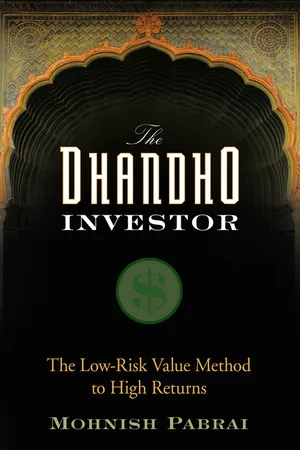
In a straightforward and accessible manner, The Dhandho Investor lays out the powerful framework of value investing. Written with the intelligent individual investor in mind, this comprehensive guide distills the Dhandho capital allocation framework of the business savvy Patels from India and presents how they can be applied successfully to the stock market. The Dhandho method expands on the groundbreaking principles of value investing expounded by Benjamin Graham, Warren Buffett, and Charlie Munger. Readers will be introduced to important value investing concepts such as "Heads, I win! Tails, I don't lose that much!," "Few Bets, Big Bets, Infrequent Bets," Abhimanyu's dilemma, and a detailed treatise on using the Kelly Formula to invest in undervalued stocks. Using a light, entertaining style, Pabrai lays out the Dhandho framework in an easy-to-use format. Any investor who adopts the framework is bound to improve on results and soundly beat the markets and most professionals.
- English
- ePUB (mobile friendly)
- Available on iOS & Android
eBook - ePub
Chapter 1
Patel Motel Dhandho
Asian Indians make up about 1 percent of the population of the United States—about three million people. Of these three million, a relatively small subsection is from the Indian state of Gujarat—the birthplace of Mahatma Gandhi. And a very small subsection of Gujaratis, the Patels, are from a tiny area in Southern Gujarat. Less than one in five hundred Americans is a Patel. It is thus amazing that over half of all the motels in the entire country are owned and operated by Patels. What is even more stunning is that there were virtually no Patels in the United States just 35 years ago. They started arriving as refugees in the early 1970s without much in the way of education or capital. Their heavily accented, broken-English speaking skills didn’t improve their prospects either. From that severely handicapped beginning, with all the odds stacked against them, the Patels triumphed. Patels, as a group, today own over $40 billion in motel assets in the United States, pay over $725 million a year in taxes, and employ nearly a million people. How did this small, impoverished ethnic group come out of nowhere and end up controlling such vast resources? There is a one word explanation: Dhandho.
Dhandho (pronounced dhun-doe) is a Gujarati word. Dhan comes from the Sanskrit root word Dhana meaning wealth. Dhan-dho, literally translated, means “endeavors that create wealth.” The street translation of Dhandho is simply “business.” What is business if not an endeavor to create wealth?
However, if we examine the low-risk, high-return approach to business taken by the Patels, Dhandho takes on a much narrower meaning. We have all been taught that earning high rates of return requires taking on greater risks. Dhandho flips this concept around. Dhandho is all about the minimization of risk while maximizing the reward. The stereotypical Patel naturally approaches all business endeavors with this deeply ingrained riskless Dhandho framework—for him it’s like breathing. Dhandho is thus best described as endeavors that create wealth while taking virtually no risk.
Not only should every entrepreneur seek to learn from the Patel Dhandho framework, but also the primary audience for this tome—investors and allocators of capital. Dhandho is capital allocation at its very finest. If an investor can make virtually risk-free bets with outsized rewards, and keep making the bets over and over, the results are stunning. Dhandho is how the Patels have exponentially compounded their net worths over the past 30-odd years.
I’m getting ahead of myself. Sit back, relax, grab a cool one, and mellow out. You’re about to begin a remarkable journey—one that I hope is as rewarding and profitable for you as it has been for me and generations of Patel businessmen.
Gujarat lies along the Arabian Sea with a large, desirable coastline and several natural harbors. The Tropic of Cancer cuts right through the state. Over the centuries, it has always been an ideal location for trade with neighboring Asian and African countries—it has served as a melting pot of many different cultures over its rich history. The Parsis, fleeing religious persecution in Iran, landed in Gujarat as refugees in the twelfth century and were warmly received. Similarly, the Ismailis arrived in the first half of the nineteenth century from Iran. For several centuries, Gujaratis were very used to traveling to, and trading with, their Asian and African neighbors.
Patels originally were known as patidars—loosely translated as landlords. Most villages in Gujarat had a patidar appointed by the ruler who was responsible for collecting land taxes, providing security, and running a streamlined farming operation. In medieval times, these patidars were chosen on the basis of their savvy management and farming skills. Patels usually had large families, and as the land was subdivided into smaller and smaller fragments for each son, farming became a tough way to make a buck. In the late nineteenth and early twentieth centuries, Ismailis and Patels from Gujarat migrated in significant numbers to countries like Uganda in East Africa. They went as traders or as indentured laborers to help build the railroads.
The Patels and the Ismailis have been a very entrepreneurial community for centuries, and, over the ensuing decades (with their soon-to-be-revealed Dhandho techniques), they came to control a large proportion of the businesses in Uganda. General Idi Amin came to power in Uganda as a dictator in 1972. He declared that “Africa was for Africans” and that non-Africans had to leave. Amin wasn’t a big fan of the Patels who controlled most of his economy. The fact that most of these “non-Africans” like the Patels and the Ismailis were born in Uganda, had been there for generations, had no other home, and had all their businesses and property in Uganda meant nothing to Amin. For him, it was simple: Africa was for Africans.
Amin revoked the residency permits of all Asians regardless of whether they had any natural homeland to return to. The Ugandan state seized all their businesses and nationalized them—with no compensation to the owners. A total of 70,000 Gujaratis were thus stripped of virtually all their assets and thrown out of the country toward the end of 1972.
The world had several hot spots in 1972 and 1973 that had a significant impact on the future destiny of these orphaned Patels. With the recent formation of Bangladesh in 1971 and the war with Pakistan over its independence, India was already reeling from a very severe refugee crisis. Millions of impoverished Bangladeshi refugees had poured into India. As a result, the Indian government refused to recognize the Indian-origin population being expelled from Uganda as having any right to enter India.
Amin’s Patel expulsion also coincided with the tail end of the Vietnam War and the United States was dealing with a large influx of Vietnamese refugees at the time. President Nixon and Secretary of State Kissinger were well briefed on the Ugandan situation and were sympathetic to the plight of the Patels, but were limited in the number of Indian-origin refugees they could accept. Being “members of the Commonwealth,” the vast majority of the Patels and Ismailis were allowed to settle in England and Canada. A few thousand families were also accepted by the United States as refugees.
The first few Patels who arrived in the United States went into the motel business. The thousands that arrived later followed the lead of the pioneers and also became motel operators. Why motels? And why did virtually all of them go into the same industry?
If we examine the history of ethnic groups migrating to alien lands, we notice a pattern: In Chicago, many of the early Irish immigrants became police officers while most housemaids were Polish. In New York City, Koreans dominate the deli and grocery business, Chinese run many of the city’s laundries, and Sikhs and Pakistanis drive most of the cabs. It’s a bizarre sight, but most of the rental car staff at California’s San Jose International Airport consists of older Sikhs—turbans and all. There is a large population of Eastern European cab drivers in Vegas, and most of the prostitutes in Dubai are of Eastern European or Russian origin.
The reason we end up with concentrations of ethnic groups in certain professions is because role models play a huge role in how humans pick their vocations. If someone looks like me, has had a similar upbringing, belongs to the same religious order, has attended a similar school, and is making a good living, it naturally has a huge impact when I’m trying to decide my calling in life. Tall inner-city African-American kids routinely see tall African-American males playing for the NBA and leading very enviable lives. They are also aware that the childhood of these NBA stars, in many cases, is pretty similar to their own present circumstance. It serves as a huge motivator to sharpen their basketball playing skills.
That still begs the question: Why did the first wave of Patels who entered the United States go into the motel business? Why not delis, Laundromats, or drug stores? Why motels? And why not just find a job? Part of the answer lies in another demographic shift that was underway in the early 1970s in the United States. After World War II, there was a huge buildout of suburbia and the interstate highway system. The automobile had become a middle-class staple, and American family-owned motels popped up all along the newly built interstates. The 1973 Arab oil embargo and misguided American economic policies (price and wage controls) led to a deep recession across the country.
Motels are heavily dependent on discretionary spending. The recession, coupled with rationed and sky-high gas prices, led to huge drops in occupancy. Many small, nondescript motels were foreclosed by banks or went on sale at distressed prices. At the same time, the kids of these old motel-owner families were coming of age and saw plenty of opportunity outside of the motel business and left in droves to seek their fortune elsewhere.
PAPA PATEL
It is 1973. Papa Patel has been kicked out of Kampala, Uganda, and has landed as a refugee in Anywheretown, USA, with his wife and three teenage kids. He has had about two months to plan his exit and has converted as much of his assets as he could into gold and other currencies and has smuggled it out of the country. It isn’t much—a few thousand dollars. With a family to feed, he is quickly trying to become oriented to his alien surroundings. He figures out that the best he can do with his strange accent and broken-English speaking skills will be a job bagging groceries at minimum wage.
Papa Patel sees this small 20-room motel on sale at what appears to be a very cheap price and starts thinking. If he buys it, the motivated seller or a bank will likely finance 80 percent to 90 percent of the purchase price. His family can live there as well, and their rent will go to zero. His cash requirement to buy the place is a few thousand dollars. Between himself and his close relatives, he raises about $5,000 in cash and buys the motel. A neighborhood bank and the seller agree to carry notes with the collateral being a lien on the motel. As one of the first Patels in the United States, Dahyabhai Patel succinctly put it, “It required only a small investment and it solved my accommodation problem because [my family and] I could live and work there.”1
Papa Patel figures the family can live in a couple of rooms, so they have no rent or mortgage to pay and minimal need for a car. Even the smallest motel needs a 24-hour front desk and someone to clean the rooms and do the laundry—at least four people working eight hours each. Papa Patel lets all the hired help go. Mama and Papa Patel work long hours on the various motel chores, and the kids help out during the evenings, weekends, and holidays. Dahyabhai Patel, reflecting on the modus operandi during the early days, said, “I was my own front-desk clerk, my own carpenter, my own plumber, maid, electrician, washerman, and what not.”2 With no hired help and a very tight rein on expenses, Papa Patel’s motel has the lowest operating cost of any motel in the vicinity. He can offer the lowest nightly rate and still maintain the same (or higher) profitability per room than his predecessor and competitors. As a result, he has higher occupancy and is making super-normal profits. His competitors start seeing occupancy drop off and experience severe pressure on rates. Their cost structures prohibit them from matching the rates offered by the Patel Motel—leading to a spiraling reduction in occupancy and profits.
The stereotypical Patel is a vegetarian and leads a ve...
Table of contents
- Title Page
- Copyright Page
- Dedication
- Acknowledgments
- Chapter 1 - Patel Motel Dhandho
- Chapter 2 - Manilal Dhandho
- Chapter 3 - Virgin Dhandho
- Chapter 4 - Mittal Dhandho
- Chapter 5 - The Dhandho Framework
- Chapter 6 - Dhandho 101: Invest in Existing Businesses
- Chapter 7 - Dhandho 102: Invest in Simple Businesses
- Chapter 8 - Dhandho 201: Invest in Distressed Businesses in Distressed Industries
- Chapter 9 - Dhandho 202: Invest in Businesses with Durable Moats
- Chapter 10 - Dhandho 301: Few Bets, Big Bets, Infrequent Bets
- Chapter 11 - Dhandho 302: Fixate on Arbitrage
- Chapter 12 - Dhandho 401: Margin of Safety—Always!
- Chapter 13 - Dhandho 402: Invest in Low-Risk, High-Uncertainty Businesses
- Chapter 14 - Dhandho 403: Invest in the Copycats rather than the Innovators
- Chapter 15 - Abhimanyu’s Dilemma—The Art of Selling
- Chapter 16 - To Index or Not to Index—That Is the Question
- Chapter 17 - Arjuna’s Focus: Investing Lessons from a Great Warrior
- NOTES
- INDEX
Trusted by 375,005 students
Access to over 1.5 million titles for a fair monthly price.
Study more efficiently using our study tools.
Frequently asked questions
Yes, you can cancel anytime from the Subscription tab in your account settings on the Perlego website. Your subscription will stay active until the end of your current billing period. Learn how to cancel your subscription
No, books cannot be downloaded as external files, such as PDFs, for use outside of Perlego. However, you can download books within the Perlego app for offline reading on mobile or tablet. Learn how to download books offline
Perlego offers two plans: Essential and Complete
- Essential is ideal for learners and professionals who enjoy exploring a wide range of subjects. Access the Essential Library with 800,000+ trusted titles and best-sellers across business, personal growth, and the humanities. Includes unlimited reading time and Standard Read Aloud voice.
- Complete: Perfect for advanced learners and researchers needing full, unrestricted access. Unlock 1.5M+ books across hundreds of subjects, including academic and specialized titles. The Complete Plan also includes advanced features like Premium Read Aloud and Research Assistant.
We are an online textbook subscription service, where you can get access to an entire online library for less than the price of a single book per month. With over 1.5 million books across 990+ topics, we’ve got you covered! Learn about our mission
Look out for the read-aloud symbol on your next book to see if you can listen to it. The read-aloud tool reads text aloud for you, highlighting the text as it is being read. You can pause it, speed it up and slow it down. Learn more about Read Aloud
Yes! You can use the Perlego app on both iOS and Android devices to read anytime, anywhere — even offline. Perfect for commutes or when you’re on the go.
Please note we cannot support devices running on iOS 13 and Android 7 or earlier. Learn more about using the app
Please note we cannot support devices running on iOS 13 and Android 7 or earlier. Learn more about using the app
Yes, you can access The Dhandho Investor by Mohnish Pabrai in PDF and/or ePUB format, as well as other popular books in Business & Investments & Securities. We have over 1.5 million books available in our catalogue for you to explore.