- English
- ePUB (mobile friendly)
- Available on iOS & Android
eBook - ePub
About this book
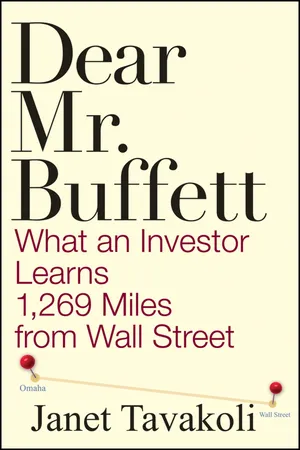
Janet Tavakoli takes you into the world of Warren Buffett by way of the recent mortgage meltdown. In correspondence and discussion with him over 2 years, they both saw the writing on the wall, made clear by the implosion of Bear Stearns. Tavakoli, in clear and engaging prose, explains how the credit mess happened beginning with the mortgage lending Ponzi schemes funded by investment banks, the Fed bailout and its impact on the dollar. Through her narrative, we hear from Warren Buffett and learn how his enduring principles caused him to see the mess that was coming well in advance and kept him and his investors well out of the way.
Chapter 1
An Unanswered Invitation
Be sure to stop by if you are ever in Omaha and want to talk credit derivatives . . .—Warren Buffett in a letter to Janet Tavakoli, June 6, 2005
It was August 1, 2005, and I was rereading a letter in my correspondence file dated June 6, 2005. The letter was from Warren Buffett, the CEO of the gargantuan Berkshire Hathaway conglomerate. I had not yet responded and had no explanation for the delay save for a little awe. For the several years prior, Fortune listed Warren Buffett as either the richest or second richest man on the planet. He and Bill Gates annually jousted for the top spot, with the outcome depending on the relative share prices of Berkshire Hathaway and Microsoft.
Several years earlier, I had sent Warren Buffett a copy of my book, Credit Derivatives & Synthetic Structures. In his letter Buffett wrote that he had been looking at the book again and had just found a letter I had tucked between the pages, “Please accept my apologies,” he continued, “for not replying to you when I first received it.”1 He invited me to stop by if I were ever in Omaha. I looked up. After all this time, I could not remember what I had written in that old letter. I did know that I had not expected a response. But certainly now a response was needed from me, a belated one. “Dear Mr. Buffett,” I began.

I am an investor in Berkshire Hathaway “A” shares, but Mr. Buffett would have no way of knowing that since I hold shares in brokerage accounts. Perhaps Mr. Buffett had a bone to pick with me, but I had warned about the risk of credit derivatives and the hidden leverage they created. I was so persistent in exposing the flaws in the financial system that BusinessWeek called me the “Cassandra of credit derivatives.”2 But most journalists overlooked a much more important derivatives quote in Mr. Buffett's 2002 shareholder letter. Berkshire Hathaway invests in multinational businesses with a variety of complex operations, and that means that investments have to be hedged or entered into in ways that create tax or accounting advantages. Mr. Buffett had also written: “I sometimes engage in large-scale derivatives transactions.”3 Yet I dithered and had not responded to his letter.
In 1998, Berkshire Hathaway acquired General Reinsurance. Warren Buffett initially called it his “problem child,”4 and its General Reinsurance (Gen Re) Securities unit was its problem sibling. Even before the acquisition, both Warren Buffett and Berkshire Hathaway vice-chairman Charlie Munger realized that the value of Gen Re Securities derivatives transactions was overstated and vainly tried to sell it. Some of the contracts were for 20-year maturities, and the operation would take years to wind down. Furthermore, the models valuing the derivatives give poor approximations of the true mark-to-market value—the price at which the derivative can be bought and sold in the market—of some of Gen Re Securities' esoteric derivatives contracts. There was no real market. Instead, the derivatives contracts were priced or marked based on model valuations known as mark to model. Buffett wrote that in extreme cases, it was a “mark to myth.”5
In his 2002 letter to Berkshire Hathaway shareholders, Buffett wrote that it sometimes seemed “madmen”6 imagined new derivatives contracts. His pique was prompted by the multiyear-long hangover of losses from derivatives, chiefly credit derivatives, in the GenRe Securities unit. It showed a loss of $173 million, partly due to restating faulty, but standard, derivatives accounting from earlier years. The loss inspired Buffett to call derivatives “financial weapons of mass destruction.”7 His viral sound bite quickly circled the globe. After reading Buffett's quote in the financial press, one investment banker joked that my book on credit derivatives is “the manual on how to blow up the world.”
Warren Buffett's letter to me arrived in June 2005, a hectic month. One of my clients was a law firm representing a large money center bank as plaintiff in a securities fraud case involving another large money center bank. The defendants' lawyers had hired a former chairman of the U.S. Securities and Exchange Commission (SEC) as their expert witness. Earlier, I had written both my expert opinion report and a report rebutting the former SEC chairman's point of view. I prepared to give a two-day-long deposition to discuss my opinion in the case in which hundreds of millions of dollars had been lost. The defendants had read my work, knew they faced serious trouble, and subsequently changed their strategy. In fact, they sent their most experienced litigator to depose me.
I put Buffett's letter in my purse to remind myself to respond to it. The morning of the deposition's first day, I saw the letter and felt a glow of confidence. I am not a superstitious person, but I couldn't help thinking of the letter as an auspicious sign. I put it in my pending correspondence file and forgot about it again.
The deposition came and went, and the plaintiff's lawyers were delighted. “Everyone gets bloody in a battle, but you slaughtered them.” The defendants' arguments fell apart in the face of the facts, and the case never went to trial. Shortly thereafter, the defendants came to a settlement agreement to the plaintiff's satisfaction.
At the end of June, I reviewed my correspondence file and read the letter again. Client business would not take me to Omaha, and I was fairly certain Warren Buffett did not need my help.
July 2005 was another busy month: I had focused so much on the securities fraud case that I had a backlog of business, so I took a much-needed week-long vacation to decompress. At the end of July, I reviewed my pending correspondence file, and it contained only one item: the letter.
After rereading the letter on August 1, I wrote a letter in reply and offered three dates, with August 25, five days before Warren Buffett's 75th birthday, being the earliest of the three:
It is my turn to apologize for being so late getting back to you. . . . . Business isn't taking me in that direction anytime soon, but I would be happy to fly in for the day—just because I would enjoy doing it . . .
On August 3, I received an e-mail from Warren Buffett through his assistant stating that August 25 would work:
If you can make it for lunch, I would be glad to take you to a place with no décor but good food.
Everyone in the global financial community knew Warren Buffett by reputation, and his name continually popped up in the financial press, but I operated in specialty niches of the industry, and he was just part of the background noise of my world. I hadn't read any of the books about him, and I hadn't read the many articles about Warren Buffett, the man. But I had read many of Berkshire Hathaway's annual reports including Mr. Buffett's shareholder letters, which I enjoyed very much.
Warren Buffett was already a billionaire at age 60. That in itself was an achievement beyond the reach of all but a miniscule percentage of humans, but his future success dwarfed that accomplishment. Due to the benefits of continued compounded growth off of a greater base of wealth, the bulk of Buffett's wealth accumulated after the age when most men retire to spend their money.
Throughout my career, I worked with people who eventually met or did business with Warren Buffett. It was as if we attended the same university and he were a popular senior and I a freshman. I was well respected in my field, and was a self-made woman; but Warren Buffett was a financial legend superlatively good at making money for himself and for his shareholders.
In 1987, Warren Buffett and Charlie Munger rode to the rescue of John Gutfreund, the CEO of Salomon Brothers. Their “white knight” investment of $700 million of Salomon Inc.'s convertible preferred stock enabled Gutfreund to fend off Ronald Perelman's hostile take-over. Perelman, a famous, colorful cigar-loving corporate raider with a reputation for ruthlessness, had already swallowed up Revlon, Sunbeam, Panasonic and other companies in the 1980s. In contrast, Buffett and Munger were not well known, and their lifestyles didn't provide salacious material for the media frenzy that surrounded corporate raiders.
Initially, Salomon's preferred stock was an ideal Berkshire Hathaway investment. Buffett never supplied management; he looked for good honest managers, and he thought he had found one in Gutfreund. Things changed in 1991. Paul Mozer, a trader on the Arbitrage Desk, pleaded guilty to felony charges after a government bond trading scandal. John Meriwether, the head of Salomon's Arbitrage trading desk, told Gutfreund that Mozer had confessed to him. Their failure to immediately come forward compounded the scandal, and neither of them survived the fallout. Buffett was compelled to protect Berkshire Hathaway's investment. In the summer of 1991, he became Salomon's reluctant CEO for 10 months. Mr. Buffett's leadership and reputation for integrity salvaged Salomon's business, which rapidly recovered. The convertible bonds outperformed the fixed income securities that Berkshire Hathaway had sold in their place, but by 1995, the option to convert to comm...
Table of contents
- Cover
- Titlepage
- Copyright
- Epigraph
- Preface
- Acknowledgments
- Chapter 1: An Unanswered Invitation
- Chapter 2: Lunch with Warren
- Chapter 3: The Prairie Princes versus the Princes of Darkness
- Chapter 4: The Insatiable Curiosity to Know Nothing Worth Knowing (Oscar Wilde Was Right)
- Chapter 5: MAD Mortgages—The “Great” Against the Powerless
- Chapter 6: Shell Games (Beware of Geeks Bearing Grifts)
- Chapter 7: Financial Astrology—AAA Falling Stars
- Chapter 8: Bear Market (I'd Like a Review of the Bidding)
- Chapter 9: Dead Man's Curve
- Chapter 10: Bazooka Hank and Dread Reckoning (AIG, Fannie, Freddie, Lehman, Merrill, and Other Fluid Situations)
- Chapter 11: Bond Insurance Burns Main Street
- Chapter 12: Money, Money, Money (Warren and Washington)
- Chapter 13: The Fogs of War, Religion, and Politics
- Chapter 14: Finding Value
- Bibliography
- Index
- EULA
Trusted by 375,005 students
Access to over 1.5 million titles for a fair monthly price.
Study more efficiently using our study tools.
Frequently asked questions
Yes, you can cancel anytime from the Subscription tab in your account settings on the Perlego website. Your subscription will stay active until the end of your current billing period. Learn how to cancel your subscription
No, books cannot be downloaded as external files, such as PDFs, for use outside of Perlego. However, you can download books within the Perlego app for offline reading on mobile or tablet. Learn how to download books offline
Perlego offers two plans: Essential and Complete
- Essential is ideal for learners and professionals who enjoy exploring a wide range of subjects. Access the Essential Library with 800,000+ trusted titles and best-sellers across business, personal growth, and the humanities. Includes unlimited reading time and Standard Read Aloud voice.
- Complete: Perfect for advanced learners and researchers needing full, unrestricted access. Unlock 1.5M+ books across hundreds of subjects, including academic and specialized titles. The Complete Plan also includes advanced features like Premium Read Aloud and Research Assistant.
We are an online textbook subscription service, where you can get access to an entire online library for less than the price of a single book per month. With over 1.5 million books across 990+ topics, we’ve got you covered! Learn about our mission
Look out for the read-aloud symbol on your next book to see if you can listen to it. The read-aloud tool reads text aloud for you, highlighting the text as it is being read. You can pause it, speed it up and slow it down. Learn more about Read Aloud
Yes! You can use the Perlego app on both iOS and Android devices to read anytime, anywhere — even offline. Perfect for commutes or when you’re on the go.
Please note we cannot support devices running on iOS 13 and Android 7 or earlier. Learn more about using the app
Please note we cannot support devices running on iOS 13 and Android 7 or earlier. Learn more about using the app
Yes, you can access Dear Mr. Buffett by Janet M. Tavakoli in PDF and/or ePUB format, as well as other popular books in Business & Investments & Securities. We have over 1.5 million books available in our catalogue for you to explore.