- English
- ePUB (mobile friendly)
- Available on iOS & Android
eBook - ePub
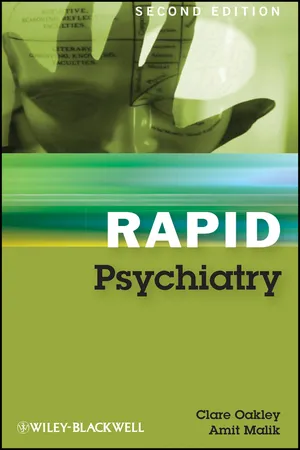
Rapid Psychiatry
About this book
This pocket guide is a must for all clinical medical students and junior doctors and provides an excellent revision tool in the run-up to exams. It is also perfect for when working on the psychiatric attachment, as it covers many of the conditions encountered on the wards, in clinics, and in general practice. Now thoroughly updated, it includes new sections on Neuropsychiatry, the Psychiatry of Learning Disability, Forensic Psychiatry, and Psychotherapy, as well as common disorders, their assessment and their treatment. Featuring the key points of the Mental Health Act, along with a glossary of terms, Rapid Psychiatry is the ideal refresher, covering just the basic relevant facts.
Information
General Adult Psychiatry
Anxiety disorders – agoraphobia
DEFINITION Anxiety associated with places or situations from which escape may be difficult, e.g. crowds and public places.
AETIOLOGY Family and twin studies suggest that genetic factors are relevant. Onset of agoraphobia often follows a precipitating event, which may be a panic attack, which leads to avoidance. It can occur following a major life event in someone with dependent personality traits.
ASSOCIATIONS/RISK FACTORS It is strongly associated with panic and ICD-10 classifies the disorder into agoraphobia either with or without panic disorder.
EPIDEMIOLOGY F > M. Average age of onset is late twenties.
HISTORY Consistent and marked fear of:
- crowds
- public places
- travelling alone
- being away from home
Anxiety symptoms occur in the feared environment or in anticipation of it:
- Palpitations
- Sweating
- Shaking
- Dry mouth
- Difficulty breathing
- Chest pain
- Nausea
- Dizziness
- Hot flushes
- Fear of losing control
- Fear of dying
Avoidance of these situations is the prominent feature. The patient may feel better if accompanied by someone else.
EXAMINATION Normal unless in that situation. May have a panic attack if exposed.
INVESTIGATIONS FBC, U + Es, LFTs, Ca, TFTs.
MANAGEMENT Exposure therapy, gradually increasing, e.g. walking increasing distances from home each day. CBT.
COMPLICATIONS Isolation. Secondary depression. May misuse alcohol or illicit substances to cope with feared environment.
PROGNOSIS Fluctuating course. Condition may be severe and the person housebound.
Anxiety disorders – generalised anxiety disorder
DEFINITION Generalised and persistent anxiety, not restricted to, or predominating in, any particular circumstances (free-floating).
AETIOLOGY
- Genetic predisposition
- Current stress
- Life events
ASSOCIATIONS/RISK FACTORS Childhood experiences characterised by separations, demands for high achievement and excessive conformity.
EPIDEMIOLOGY Lifetime prevalence is 5%. F > M. Onset is in adolescence to early adulthood.
HISTORY The symptoms should be present most days for at least several weeks at a time. These symptoms should involve elements of:
- apprehension (worries about future misfortunes, feeling on edge, difficulty concentrating)
- motor tension (restlessness, fidgeting, tension headaches, trembling)
- autonomic overactivity (lightheadedness, sweating, tachycardia or tachypnoea, dizziness, dry mouth, epigastric discomfort).
EXAMINATION Tachycardia and tachypnoea.
INVESTIGATIONS FBC, U + Es, LFTs, Ca, TFTs.
MANAGEMENT
- Anxiety management:
- psychoeducation
- distraction techniques
- cognitive control
- breathing/relaxation techniques
- Benzodiazepines may be useful in the short term.
- SSRIs or venlafaxine are useful.
COMPLICATIONS Half will develop a depressive illness. May misuse alcohol or illicit substances to cope with anxiety.
PROGNOSIS Course may be chronic, worse at times of stress. Poor prognosis is associated with longer duration of illness, co-morbid psychiatric disorder and poor premorbid personality.
Anxiety disorders – social phobia
DEFINITION Persistent fear of social situations that may lead to scrutiny, criticism or embarrassment (e.g. eating, drinking, speaking in public).
AETIOLOGY There is evidence from family studies of a genetic component.
ASSOCIATIONS/RISK FACTORS More likely in those with lifelong sensitivity to critiscism and avoidant personality disorder.
EPIDEMIOLOGY F > M. Onset gradual from late adolescence.
HISTORY Situational anxiety in social groups: parties, meetings, classrooms. There is marked avoidance of these situations. There will be anxiety symptoms and blushing, trembling, fear of vomiting and urgency/fear of micturition.
EXAMINATION Normal unless exposed to social situation. Then blushing, shaking, restless, avoids eye contact. Fear of scrutiny/humiliation. Fear of vomiting/fainting.
MANAGEMENT Graded exposure and desensitisation. CBT. SSRIs.
COMPLICATIONS Social phobia may be secondary to a depressive illness when social performance declines. Secondary alcohol and substance misuse is common.
PROGNOSIS Generally present for life.
Anxiety disorders – specific phobia
DEFINITION Persistent fear of a specific object or situation, out of proportion to the threat of the situation. The fear is recognised as excessive, but cannot be reasoned away.
AETIOLOGY There is evidence for a familial pattern of phobias. Classical conditioni...
Table of contents
- Cover
- Title
- Copyright
- Preface
- Acknowledgements
- List of Abbreviations
- Introduction to Psychiatry
- Differential Diagnosis
- General Adult Psychiatry
- Neuropsychiatry
- Child and Adolescent Psychiatry
- Old Age Psychiatry
- Psychiatry of Learning Disability
- Forensic Psychiatry
- Psychotherapy
- PsychopharmacoIogy
- Appendices
- Glossary
Trusted by 375,005 students
Access to over 1.5 million titles for a fair monthly price.
Study more efficiently using our study tools.
Frequently asked questions
Yes, you can cancel anytime from the Subscription tab in your account settings on the Perlego website. Your subscription will stay active until the end of your current billing period. Learn how to cancel your subscription
No, books cannot be downloaded as external files, such as PDFs, for use outside of Perlego. However, you can download books within the Perlego app for offline reading on mobile or tablet. Learn how to download books offline
We are an online textbook subscription service, where you can get access to an entire online library for less than the price of a single book per month. With over 1.5 million books across 990+ topics, we’ve got you covered! Learn about our mission
Look out for the read-aloud symbol on your next book to see if you can listen to it. The read-aloud tool reads text aloud for you, highlighting the text as it is being read. You can pause it, speed it up and slow it down. Learn more about Read Aloud
Yes! You can use the Perlego app on both iOS and Android devices to read anytime, anywhere — even offline. Perfect for commutes or when you’re on the go.
Please note we cannot support devices running on iOS 13 and Android 7 or earlier. Learn more about using the app
Please note we cannot support devices running on iOS 13 and Android 7 or earlier. Learn more about using the app
Yes, you can access Rapid Psychiatry by Clare Oakley,Amit Malik,Clare Oakley in PDF and/or ePUB format, as well as other popular books in Medicine & Psychiatry & Mental Health. We have over 1.5 million books available in our catalogue for you to explore.