- English
- ePUB (mobile friendly)
- Available on iOS & Android
eBook - ePub
About this book
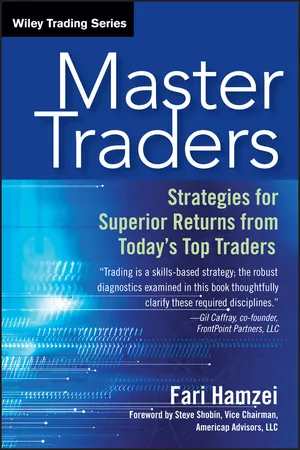
Master Traders introduces you to an outstanding group of financial experts—from seasoned hedge fund managers to top technical analysts—who discuss the methods they use to tame today's highly volatile and unpredictable markets. Composed of chapters contributed by leading financial professionals, Master Traders contains a variety of proven strategies and techniques that will give you an edge in the world of stocks, options, and futures.
PART I
Technical Analysis
CHAPTER 1
Playing with Fear and Arrogance
Jeff deGraaf
—Crash Davis, Bull Durham
In the market, arrogance without fear will eventually break you. Fear without arrogance will leave you paralyzed at the most inopportune time. The delicate balance of fear and arrogance fosters appropriate aggressiveness without the recklessness.
The combination may appear contradictory, but much like a seasoned sailor approaches the sea, a trader needs both to maximize returns while minimizing the risk of a debilitating blow. Arrogance fosters the killer instinct and the ability to dominate, to press while others show timidity. Fear is not only a sign of respect, but a deep understanding of the enormity and danger of the beast. To have fear is to understand that committed errors can be fatal, that markets are vast, and therefore unknowable, and that the unforeseen risk is usually the most dangerous and detrimental.
Contrary to what 99 percent of the investment population thinks, trading is not about being right. Being right is easy. Trading is about being wrong; and navigating this inevitable occurrence distinguishes the winners from the losers in the long run. History reveals a long list of financial disasters, a majority of which began and ended with the failure to proceed properly, fearfully, in the face of error. The road to riches is littered with the bodies of those who believed that being right required conviction and stamina. Conviction is viewed as a badge of honor among investors, traders, and portfolio managers—a sign of triumph and steadfast assured-ness over others’ pendulousness—but the line between conviction and stubbornness is at best vague. In most instances, conviction and stubbornness are indistinguishable characteristics differentiated only by their eventual outcome. To have conviction is to have the intestinal fortitude to see through the market’s action and stay the course, understanding that the market will eventually reward the view. Stubborn investors carry the same intestinal fortitude, but the position eventually becomes a hopeless cause, or worse, part of a class action bankruptcy ruling.
The difference in attitude between conviction and stubbornness is only well defined after the fact. Though the probability of disaster may be small, the consistency of the 100-year flood striking financial markets every five or six years should serve as notice to play with enough fear to keep the arrogance in check. To fear the market is not to cower in its presence, but to be in continued awareness of its unforgiving attitude and its continual ability to wreak devastation.
Economist John Maynard Keynes once quipped, “The market can remain irrational longer than you can remain solvent.” While these are about the only words from Keynes that I believe to be true, they are resoundingly so. What Keynes realized was that markets were powerful, and rational in the long run, but were influenced by a multitude of factors in the short run, some of which were inconsistent, illogical, and contradictory. By employing a combination of tactics, the short-term irrationality that often proves ruinous can be mitigated. Such tactics are not only unconventional, they are often the most controversial on Wall Street.
THE INVESTMENT PROCESS
Investors and traders both large and small share a similar objective: to earn a return on the capital employed. That return may be weighted against the risk taken (alpha), it may be in absolute terms (beta), or it may be measured against a benchmark for performance, such as the S&P 500, or the cost of borrowing the capital (leverage). In every instance, regardless of the methodology, investors are seeking a return on their capital.
Investors approach the market in several ways in an attempt to earn a return, but two primary schools of thought dominate: fundamental and technical analysis. By far the most popular of these disciplines is the use of fundamental analysis. The various elements of the discipline—finance, accounting, marketing, economics, and management—are rigorously taught throughout the country’s business schools, and roughly 95 percent of Wall Street’s analysts approach the market with a fundamental discipline. It stands to reason, as the approach is logical, methodical, and intuitive. The fundamental discipline uses company facts and specifics such as balance sheets and income statements as well as the study of industry and economic data to judge a company’s merits as an investment. By comparing the current selling price with the theoretical price as computed by the analyst’s assumptions, a buy or sell recommendation can be made. A market price above the analyst’s estimated value would be considered a sell candidate, while a market price below the analyst’s estimated value would be considered a buy candidate.
The technical analyst takes a different approach and uses data supplied from the market, such as price and volume, in an attempt to judge the dominant position of supply and demand (seller and buyer). In many ways the technical analyst is like a hunter tracking game, understanding that investors leave footprints, and those footprints are visible through the price patterns, volume flows, and other data presented in the charts. The technical analyst attempts to identify trends or turning points in the market or security using these inputs, and has little or no interest in the company specifics. Relying on the market to provide the message, the technician understands that if enough buyers or sellers are attracted to a security (for any reason) their actions will be noticeable through the price and volume displayed on the charts. The technical approach to investing is often skipped over at most business schools, and those classes where it is addressed tend to teach the discipline with snickers, snide comments, and the same incredulousness one may expect from a modern-day medical school teaching the merits of leeching their patients.
My initial exposure to technical analysis, as it was for most technicians , left me feeling skeptical. Being a quick learner, however, it became apparent to me that technical analysis provided a perspective much different from that of the fundamental process. It serves as a cold, hard reality check; the culmination of thousands of opinions backed by their capital. The devotees of technical analysis on Wall Street are rarely the young ivy-league MBAs with a hot hand; instead, they are the seasoned veterans, battle-hardened from years of experience. It is this rare breed who knows the true meaning of playing with fear and arrogance. They come to the work every day with admiration for the markets, and the technical discipline is an invaluable perspective into this world.
Proponents of both the fundamental and the technical disciplines have been engaged in a holy war of sorts for decades. It is a war that has wasted too much time and too much energy because it is a war that is unlikely to be won. As a Certified Financial Analyst (CFA) and Chartered Market Technician (CMT) charter holder, I will go so far as to say that both disciplines work and both disciplines fail at inopportune times. While each discipline has unique merits and attributes, neither deserves the religious fervor championed by its most ardent proponents, for both are fallible. In a business where the score is literally kept every day, it is surprising how often the means (forms of analysis) are held in higher regard than the ends (money being made). That is to say, the sequence and sophistication of arriving at the buy or sell decision is often looked upon with more prestige than the result of the recommendation. At the heart, there is an innate human desire to be able to account for and explain everything around us, from weather to bacteria. Fundamental analysis tends to fulfill this explanatory desire more adequately than technical analysis, which tends to be viewed as more of a faith-based discipline.
Importantly, neither discipline has been found to hold a clear or sustained advantage in generating excess returns from the market, most likely because both disciplines are as much an art as they are a science. The accuracy of linear mathematical tools will always be limited when nonlinear behaviors and emotions are present within the investment world. My allegiance has always been to the ends and not the means (within legal boundaries, of course), and if studying caribou migration patterns or lunar cycles improves the ends, the unorthodox means can be tolerated.
It is not a question as to whether fundamentals or technicals work. The question is, how and when do they work? The fundamentals are good at narrowing the pool of investable candidates and aligning ideas with a philosophical discipline or comfort level such as value or growth. Where the fundamentals tend to fail is in risk control, money management, and timing. In theory, buying a security based purely on the fundamental discipline will continually suggest buying or adding to a position as its price goes lower and lower and it becomes seemingly cheaper and cheaper. Using a purely fundamental approach, it is difficult if not impossible to know when the analysis is wrong, as at some point it will be. Continually buying at ever-lower prices represents what is known as the Martingale method in gaming situations. Essentially, it is a strategy that continually doubles down after each loss with the assurance that an eventual turn in the bad luck or string of losses will move the position to breakeven. Such a strategy requires unlimited resources and, less realistically, an extreme tolerance for pain since the position sizes and losses grow geometrically as the price moves against the position. It is a foolish strategy that reeks of arrogance and dances on a perilous edge of disaster. The flaw in the fundamentals is not in the rationale—it can provide an extremely useful guide—but in the timing and risk control.
The technical discipline acts instead as an unbiased arbiter providing risk control and checks and balances to the fundamental thinking. Technical systems are equal opportunity investors, with a willingness to buy or sell regardless of the securities’ characteristics (i.e., growth or value, large or small, cheap or expensive). This is both an advantage and a disadvantage. It is advantageous in that technical analysis, when properly used, will identify areas of emerging strength or weakness and can reverse-engineer the attributes being most aggressively rewarded, or in vogue in the current environment. The disadvantage is that by not distinguishing on some other basis, an unrealistic number of names are presented as opportunities which are unlikely to be utilized. Using technical analysis in isolation requires throwing a lot of spaghetti against the wall to see what sticks, and that implies transaction costs and levels of frustration that become impractical. We find technical analysis to be best at identifying emerging opportunities before the fundamentals become apparent and well discounted, and then base our decisions on the pervasiveness of strength on an individual level and within the context of the group.
Historically, purely fundamental managers tend to suffer from a few systematic errors in the management of portfolios. Value managers tend to enter positions too early, falling into the value trap where the cheap security gets continually cheaper. Once the value begins to be recognized and the price bid up by the market, the value manager tends to exit the positions too early and not extract the maximum profit from the position.
Growth managers ten...
Table of contents
- Title Page
- Copyright Page
- Dedication
- Foreword
- Preface
- Acknowledgments
- Introduction
- PART I - Technical Analysis
- PART II - Fundamental Analysis
- PART III - Sentiment
- PART IV - Derivatives
- PART V - Trading Size
- EPILOGUE
- About the Author
- About the Contributors
- Index
Trusted by 375,005 students
Access to over 1.5 million titles for a fair monthly price.
Study more efficiently using our study tools.
Frequently asked questions
Yes, you can cancel anytime from the Subscription tab in your account settings on the Perlego website. Your subscription will stay active until the end of your current billing period. Learn how to cancel your subscription
No, books cannot be downloaded as external files, such as PDFs, for use outside of Perlego. However, you can download books within the Perlego app for offline reading on mobile or tablet. Learn how to download books offline
Perlego offers two plans: Essential and Complete
- Essential is ideal for learners and professionals who enjoy exploring a wide range of subjects. Access the Essential Library with 800,000+ trusted titles and best-sellers across business, personal growth, and the humanities. Includes unlimited reading time and Standard Read Aloud voice.
- Complete: Perfect for advanced learners and researchers needing full, unrestricted access. Unlock 1.5M+ books across hundreds of subjects, including academic and specialized titles. The Complete Plan also includes advanced features like Premium Read Aloud and Research Assistant.
We are an online textbook subscription service, where you can get access to an entire online library for less than the price of a single book per month. With over 1.5 million books across 990+ topics, we’ve got you covered! Learn about our mission
Look out for the read-aloud symbol on your next book to see if you can listen to it. The read-aloud tool reads text aloud for you, highlighting the text as it is being read. You can pause it, speed it up and slow it down. Learn more about Read Aloud
Yes! You can use the Perlego app on both iOS and Android devices to read anytime, anywhere — even offline. Perfect for commutes or when you’re on the go.
Please note we cannot support devices running on iOS 13 and Android 7 or earlier. Learn more about using the app
Please note we cannot support devices running on iOS 13 and Android 7 or earlier. Learn more about using the app
Yes, you can access Master Traders by Fari Hamzei in PDF and/or ePUB format, as well as other popular books in Business & Finance. We have over 1.5 million books available in our catalogue for you to explore.