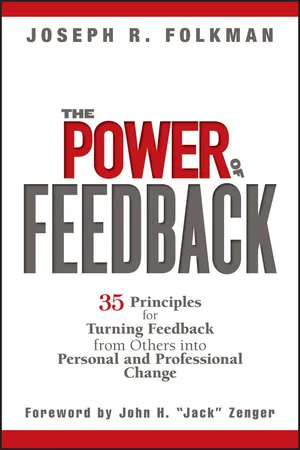
"Some books are worthy of being recommended simply because of their subject matter. . . . There is no greater force to improve the quality of human relationships or improve the way organizations function than to multiply the amount and improve the quality of feedback."
"Other books are worthy of being recommended . . . when an author takes an otherwise abstract, obtuse subject and turns it into an actionable, practical set of things to do. Joe Folkman has accomplished that task . . . helping individuals and organizations to develop feedback-rich environments . . . [and] change through the use of a variety of surveys and feed?-back instruments. He has made this topic highly engaging and accessible."
"So, here you have the best of everything--an important topic; a talented, entertaining, and highly qualified author; content that is practical; and a text written in an easily comprehended manner. Enjoy." --From the Foreword by John H. "Jack" Zenger
"Joe Folkman has years of experience and miles of wisdom from coaching and training high-performance organizations. He speaks truth: change is hard. But feedback can be very powerful if the receiver makes the commitment to lasting change. Folkman has scored a home run with The Power of Feedback." --Maria Nalywayko Senior Vice President, Human Resources, Fremont Investment & Loan
"Most of us are clueless when it comes to providing feedback. But now, thanks to Joe Folkman's The Power of Feedback, we have a road map for turning the feedback we receive into lasting and profound change." --Jeffrey Gill Director of Organization Capability, The Coca-Cola Company
The process of giving thousands of people feedback on their individual performance has uncovered several clear and defined principles of feedback that generally apply in most interactions involving feedback. We begin by discussing each of those principles.
PRINCIPLE 1
Asking others for input increases their expectation that you will change in a positive way.
Many who receive feedback turn that feedback into measurable change. However, others receiving feedback do not change. This frustrates not only those receiving the feedback, but also those providing the feedback. This leads to a second principle.
PRINCIPLE 2
If you receive feedback but do not change for the better, you will be perceived more negatively than if you had not received feedback.
You can compound your negative feedback by ignoring or rejecting it. When people receive feedback, they react. Their reactions may range from extremely negative to extremely positive, or there may be no visible reaction at all. Regardless of the reaction, a third principle emerges.
PRINCIPLE 3
You will not change what you do not believe needs to be changed.
A personal feedback experience is fundamentally different from looking at a production report or an accounting statement. Even though someone may provide feedback in a way that leaves no room for doubt or difficulty in understanding, this does not necessarily guarantee that people will believe the feedback, or that they will act on it. Those who receive feedback and then make changes or adjustments in their behavior become better people because of the feedback. But there may be a few obstacles along the way including denial.
PRINCIPLE 4
Rather than accept criticism, we tend to denounce not only what is said, but those who say it.
As people move from childhood to adulthood, the maturation process makes us more effective as adults than we were as children. However, because children have not had years of practice in denial, most of them are much more effective at accepting feedback than adults. The extent to which you have developed your denial skills determines the extent to which you accept feedback or question its accuracy.
Denial
To protect ourselves, each of us has developed a useful skill called denial. When we were children and our friends or siblings teased us, we developed the ability to say to ourselves, “They’re wrong! I’m not like that.”
When you receive feedback from others, if you are like most people, you will pass through some level of denial. If you feel your feedback does not point out any specific areas of change, you may be right, or you may be denying or ignoring some of the data. Likewise, if you think the feedback does not accurately reflect your true performance, again you may be right, or the feedback may be so threatening that you simply rationalize it away.
Minimal denial presents itself as rationalization. At this level, when people receive negative feedback, they either rationalize that it is not important to change, or perhaps they believe things are “not so bad.” People in minimal denial are generally more aware of their rationalizations, and often can be persuaded to accept the feedback.
Moderate denial is less conscious. In this situation, people react to feedback, but they usually do not know why they are reacting. Typically, people in moderate denial display either more emotion or almost no emotion. Some people in moderate denial confront those who provided negative feedback. Others have no emotional reaction to negative feedback, and try to minimize its importance.
Those who experience advanced denial are not at all conscious that they are in denial. They may act as experts and assertively deny that a problem exists, or they may totally ignore the problem. The difference is they are not consciously aware of their denial.
One key to understanding the feedback you receive is to work through your denial, and accept that the perceptions of others are, in fact, reality.
PRINCIPLE 5
All perceptions are real, at least to those who own them.
Experience suggests that the most productive approach to handle feedback is to assume they are real.
After reviewing his feedback on how well he gives instructions, and discovering the very low ratings given him by his direct reports, Steve commented, “They’re wrong; I give great instructions. Those guys are just too dense to understand. The problem is not with my instructions; it’s with the audience I give them to.”
Steve believed that his perceptions were real and others’ perceptions were wrong. Steve may be effective at giving instructions to highly trained personnel, but if his job requires that his direct reports understand his instructions, and if his instructions confuse those people, then he is not effective at giving instructions. Therefore, the perceptions of the people he manages are real.
Even when perceptions are completely inaccurate, they still represent reality. The following vignette illustrates this point:
Suppose I were to build a structurally sound and safe bridge that adheres to all laws and principles of engineering. But, because of the unique design of the bridge, most people perceive that my bridge is not safe or structurally sound.
Although it is clear to me that those perceptions are not true, to the people who believe the bridge is unsafe, their perceptions are real. If the bridge was built to help people cross a river, but people think the bridge is unsafe and therefore do not use the bridge, of what value would the bridge be?
Balance
When receiving feedback, some reactive behaviors are counterproductive. However, productive behaviors are not always the simple opposites of counterproductive behaviors. For example, one counterproductive behavior is rationalization. When people over rationalize the feedback they receive, they convince themselves that nothing is wrong. They discount the feedback or even reject it outright. Such actions are counterproductive. However, the opposite behavior, taking the feedback too literally, is also counterproductive. For example, some recipients accept feedback at face value without considering reasons why the feedback could be wrong, or they read more into the feedback than was originally intended.
PRINCIPLE 6
Balancing your normal but counterproductive reactions to feedback is essential in effectively dealing with feedback.
Balance is the key to effectively dealing with feedback. For example, you must be able to balance between rationalization and taking feedback too literally. Effectively dealing with feedback may require some rationalization, but it may also require you to take some results at face value.
Those who deal most effectively with feedback are those who maintain a proper balance between counterproductive behaviors. For most people, such balance is difficult to achieve. Most people want to be told to do one thing and not another, but balance requires that we do a little of one and a little of the other, and not carry any one behavior to an extreme.
The following are four extremes or common coping strategies used in processing feedback that require balance:
Rationalization versus literal acceptance
Fight versus flight
“That’s interesting” versus “that’s terrible”
Paralysis of analysis versus ignorance is bliss
Rationalization versus Literal Acceptance. When people rationalize the results of their feedback, they often are trying to justify their own behavior while avoiding the underlying sources of the problem. To accept feedback from others, you must balance rationalization with taking feedback too literally.
Jill’s feedback described her as an ineffective listener. When asked about the results, Jill said, “I know some of my associates don’t think I listen to them, but they’re wrong. I do listen. I just don’t show them how well I listen. Besides, in some positions, managers have to pay a lot of attention to the people who report to them, and hold their hands. But my job isn’t like that, and my people don’t need it. I listen to others the same way my boss listens to me.”
Jill rationalized her feedback. Some people have great rationalizing skills. Rationalizing typically involves making excuses, justifying behavior, or discrediting the feedback, and is a counterproductive behavior. We often respond to rationalization by encouraging people to accept their feedback at face value. However, some managers avoid having to think too deeply by accepting the results of their feedback surveys too literally.
As he reviewed his feedback, John showed the facilitator that his boss had rated him very highly in technical competence, but his peers and those who reported to him had rated him well below average in the same area. John had rated himself highly in technical competence. He asked the facilitator, “Who is right?”
The facilitator replied, “Both are right.”
In frustration John responded, “No, I’m either technically competent or incompetent. I can’t be both.”
People don’t always completely agree on the meaning of feedback results, because we all respond differently to the same experiences. For example, how many times have you gone to a movie with a friend and, walking away, remarked how great it was, only to have your friend remark that he or she had not liked it at all?
To accept feedback, we frequently need to balance what some people say against the differing opinions of others. John accepted the feedback from his peers and those who reported from him once he realized that his boss’s criteria for technical competence differed from theirs.
Fight versus Flight. Another common strategy for dealing with feedback is to fight. To accept feedback from others, you must balance the reaction to fight against feedback with the desire to run away from it.
In response to her feedback, Jennifer told the facilitator: “I think you gave me another person’s feedback. It’s a simple error; I know how easily it can happen.”
The facilitator told her the feedback had been checked and verified, but Jennifer still did not believe it. She reviewed the written comments to see if they applied to the situations in her department. And although she agreed that some of the written comments were about her, others did not sound right.
Over the next four days, the facilitator called the office six times, generated a computerized listing of all the results, and even calculated scores by hand to verify that it had been, in fact, Jennifer’s feedback. But, despite every new piece of evidence, Jennifer looked for other problems. After four days of evidence, phone calls, and computer printouts, Jennifer finally concluded that she had given the surveys to the wrong people.
Jennifer’s reaction to her feedback was to fight. Her rejection of the feedback prevented her from having to change, but it also kept her from improving. The issues she faced didn’t go away just because she refused to listen. Her case is similar to a case study used in many introductory psychology classes:1
A patient...
Table of contents
Title Page
Copyright Page
Dedication
Foreword
Acknowledgments
Introduction
CHAPTER 1 - Reacting to Feedback
CHAPTER 2 - Why Did I Get That Feedback?
CHAPTER 3 - Improving Your Ability to Accept Feedback
CHAPTER 4 - Why Change?
CHAPTER 5 - Deciding What to Change
CHAPTER 6 - Fixing Weaknesses or Building Strengths?
CHAPTER 7 - Making Change Happen
CHAPTER 8 - Making Change Stick
CHAPTER 9 - Working Harder or Working Smarter?
Afterword
Notes
Index
About the Author
Trusted by 375,005 students
Access to over 1.5 million titles for a fair monthly price.
Study more efficiently using our study tools.
Frequently asked questions
Yes, you can cancel anytime from the Subscription tab in your account settings on the Perlego website. Your subscription will stay active until the end of your current billing period. Learn how to cancel your subscription
No, books cannot be downloaded as external files, such as PDFs, for use outside of Perlego. However, you can download books within the Perlego app for offline reading on mobile or tablet. Learn how to download books offline
Perlego offers two plans: Essential and Complete
Essential is ideal for learners and professionals who enjoy exploring a wide range of subjects. Access the Essential Library with 800,000+ trusted titles and best-sellers across business, personal growth, and the humanities. Includes unlimited reading time and Standard Read Aloud voice.
Complete: Perfect for advanced learners and researchers needing full, unrestricted access. Unlock 1.5M+ books across hundreds of subjects, including academic and specialized titles. The Complete Plan also includes advanced features like Premium Read Aloud and Research Assistant.
Both plans are available with monthly, semester, or annual billing cycles.
We are an online textbook subscription service, where you can get access to an entire online library for less than the price of a single book per month. With over 1.5 million books across 990+ topics, we’ve got you covered! Learn about our mission
Look out for the read-aloud symbol on your next book to see if you can listen to it. The read-aloud tool reads text aloud for you, highlighting the text as it is being read. You can pause it, speed it up and slow it down. Learn more about Read Aloud
Yes! You can use the Perlego app on both iOS and Android devices to read anytime, anywhere — even offline. Perfect for commutes or when you’re on the go. Please note we cannot support devices running on iOS 13 and Android 7 or earlier. Learn more about using the app
Yes, you can access The Power of Feedback by Joseph R. Folkman in PDF and/or ePUB format, as well as other popular books in Business & Management. We have over 1.5 million books available in our catalogue for you to explore.