- Defines 'body work' to include the work by service sector employees on their own bodies and on the bodies of others
- Sets UK case studies in the context of global patterns of economic change
- Explores the consequences of growing polarization in the service sector
- Draws on geography, sociology, anthropology, labour market studies, and feminist scholarship
- English
- ePUB (mobile friendly)
- Available on iOS & Android
eBook - ePub
About this book
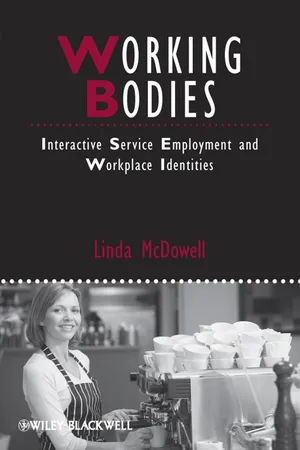
Through a series of case studies of low-status interactive and embodied servicing work, Working Bodies examines the theoretical and empirical nature of the shift to embodied work in service-dominated economies.
Information
1
Service Employment and the Commoditization of the Body
It is illiberal and servile to get the living with hand and sweat of the body.
William Alley, The Poore Man’s Library, 1571
Work is no less valuable for the opportunity it and the human relations connected with it provide for a very considerable discharge of libidinal component impulses, narcissistic, aggressive and even erotic, than because it is indispensable for subsistence and justifies existence in a society.
Sigmund Freud, Civilization and Its Discontents, 1930
Introduction: Narratives of Change
This is a book about bodies at work. It is about who does what sort of waged work in the contemporary service economies that dominate the western world. Its aim is to explore who does what, where, with whom, for whom and to whom, and with what consequences for the financial rewards and social status that accrue to different workers. Its focus is on the social division of labour, on the ways in which class, gender and ethnicity, as well as age, looks and weight, are key attributes in explaining who is employed in what sorts of work in the first decades of the new millennium. The types of work discussed are those where both the worker and the consumer are present and, in the main, where the service provided is used up at the time of the exchange. Through the lens of the workplace, the emphasis is on the sorts of embodied interactions that take place in everyday exchanges between the three sets of actors involved in these exchanges: workers, managers and clients/customers. As a consequence, the book is about a smaller and more local spatial scale than geographers are used to. Traditionally, economic geographers’ scale of analysis is local or regional labour markets, although there is also a strong geography of the firm. Sociologists are more typically analysts of workplace interactions, yet they too often ignore the significance of the local, neglecting to ask what is specific and different about the places they study. The aim here is to bring a geographical and sociological perspective together. Although the focus is the workplace – be it an individual home, the street, a shop or a hospital – through this lens, the changing national and international spatial divisions of labour that produce increasingly diverse workforces in the cities of western economies are also revealed. The examples are drawn in the main from UK workplaces, as well as from the USA, but the workers whose identities are at the heart of the book are extremely varied in their national origins.
In the new millennium in the economies of the western world, it may seem as if we have entered a new era or at least have been passing through a period of significant change since ‘around 1973’: the date that David Harvey (1989) identified as the start of the transformation from the old Fordist model of economic organization to a new condition of postmodernity. Since then, growing numbers of individuals have become part of the social relations of waged work, and many seem to be working in new types of work under different conditions compared to workers in a former era, especially those in manufacturing industries. Change is the key motif of contemporary discussions of waged work. In both the popular and academic literatures about waged work and the labour market titles that indicate a radical change with the past are common. The ‘new capitalism’ (Sennett 2006), the rise of ‘post-Fordism’ (Amin 1994), in a period of ‘liquid modernity’ (Bauman 2000) are all part of the titles of books purporting to describe the changes that are evident in what some have identified as a ‘new’ economy (Carnoy 2000; Jensen and Westenholz 2004). ‘One of the most striking things about much of contemporary theorizing about work and identity is the epochalist terms in which it is framed’, in which the ‘logic of dichotomization establishes the available terms in advance’ (Du Gay 2004: 147).
The statistical picture of labour market change seems to confirm these claims about transformation: from the Fordist manufacturing economy of the past, to a post-Fordist, post-modern or post-industrial service economy of the present. There has been a remarkable shift in the types of work most people in the UK perform (and in the USA, France, Germany and other western economies), as well as in the types of people who fill the expanding jobs. The most significant change has been the growing dominance of service employment: almost three quarters of all employees in the UK currently work in services. Half-way through the twentieth century, more than half of all workers were employed in the manufacture of goods; half a century later, the sons and daughters of these workers do quite different types of work. Less than 15 per cent of British workers are now employed in manufacturing. This shift has been captured in terms such as ‘deindustrialization’ (Gregory and Urry 1986), the ‘end of manufacturing’, even, for some commentators, ‘farewell to the working class’ (Gorz 1982), as it seemed to these analysts almost inconceivable that working in shops or cafés, providing massages, cleaning houses and teaching children was ‘work’ in the old sense of producing material products through the application of brute strength and heroic effort, typically by men. Other commentators have seen the rise of service employment in more optimistic terms, welcoming the introduction of less stressful or dangerous working conditions, improved pay and opportunities for social mobility for a better-educated population (Wright Mills 1953; Bell 1973; Gartner and Reissman 1974). By the new millennium the optimistic scenario had shifted into a different register as it became clear that the service sector includes poorly paid, as well as well paid, jobs and that for many the anticipated social mobility would never materialize. To narratives of loss and nostalgia for the golden age of manufacturing – a period from about the end of the Second World War until the 1970s – a new narrative of precarious and insecure work was added (Sennett 1998, 2006).
Associated with this apparent transformation of the labour market and adding to the claim of many that older forms of working-class solidarity are dead, there has been a marked feminization of the labour force in Western Europe and the USA. Rising numbers of women have entered the social relations of waged work over the last fifty years, many of them in the service sector and many on different terms and conditions than those that typified masculine forms of attachment to the labour market. Many women are employed on a part-time basis, especially in the UK, and tend to work in different sorts of workplaces than the factories, shipyards and car plants that typified male work in the Fordist era. Women are more likely, for example, to work in other people’s homes or in small, often unorganized, workplaces. And as well as growing numbers of women, economic migrants – people born outside the nation-state where they labour – are filling a growing number of jobs in service economies. Thus, labour forces are becoming increasingly diverse in their social characteristics.
At the same time as waged work is changing, and often becoming more precarious, it has become a more central part of more and more people’s everyday lives in almost all countries in the global economy, apart from the former communist countries where participation rates fell in the 1990s. Participation rates in the UK labour market, for example, are higher than at any previous period. In 2008, 75 per cent of all people of working age in the UK were employed: one of the highest participation rates in Europe. Two decades earlier, British sociologist Ray Pahl (1988) argued that employment – the nature, distribution and rewards for waged work – was one of the most significant and urgent issues for social scientists to address. He suggested then that a range of questions about work remained unresolved as ‘confusion and ambiguities about its meaning, nature and purpose in our lives are widespread’ (p. 1). His argument is even more relevant now, despite a huge expansion of academic analyses of waged work. As the economist Francis Green (2006: 1) argued, ‘almost everyone gets to do it. Work itself is a major and defining part of most people’s lives. It takes up a large proportion of their time on this earth and profoundly moulds their life experiences.’ Developing an understanding of how labour markets work, how people are divided between and segmented into particular jobs, and what this means for their self-identity and standard of living, is an even more significant task as the new millennium advances and the place of waged work in most people’s lives continues to expand.
Over the last two decades the expansion of employment has also become a central part of the reforming agenda of central and local governments. The British state, under New Labour governments since 1997, has endeavoured to increase the proportion of the national population that is economically active. In common with other western governments, albeit to different degrees, the adoption of a series of neoliberal employment policies has resulted in cuts in state provision and benefits for the workless and a correspondingly greater emphasis on the responsibilities of individuals to provide for themselves rather than rely on state support (Herod 2000; McDowell 2004; Peck 2000). Growing numbers of citizens in these countries – and in countries where systems of state support for the workless have never been well developed – are now expected to provide for themselves though labour market participation and are doing so by entering into the social relations of waged work in unprecedented numbers. The UK and the US are among the most ‘liberal’ economies, where the dependence on deregulated markets and workfare policies distinguish them from mainland Western European economies and from the Scandinavian countries (Esping Andersen 1990, 1999; Perrons et al. 2006), which provide greater protection for the majority of workers. In the UK and the USA ‘workfare’ programmes have replaced parts of older forms of welfare provision (Peck 2000; Sunley, Martin and Nativel 2001) which time-limit access to benefits as well as enrol the workless onto ‘job ready’ programmes. In the UK there is also a move to reduce the eligibility for benefits of long-term sick and incapacitated claimants: an issue that is particularly important in parts of the country where men previously worked in heavy primary or manufacturing occupations (Fothergill and Wilson 2007). Young unskilled men and women, not only in these regions but across the UK economy, are also ‘encouraged’ into work through schemes designed for their age group. Single parents – the majority of whom are women – are a further target group for raising participation rates which currently are well below those of other women workers.
For the more affluent and highly skilled groups in the population, apart from men over 50 whose participation rates are falling, employment participation rates have continued to rise in the last two decades. As they do, time becomes more precious for waged workers, exacerbating the transfer into the market of many of the services previously provided within the home. This is one of the most significant changes in the way in which consumer services are provided in advanced capitalist economies. Rather than the rise of a self-service economy, identified by Gershuny (1978), in which households serviced their own needs in the home through the purchase of consumer durables, more and more services have become part of the market. As well as rising attendances at cinemas and in other leisure spaces, dual-income middle-class families, for example, increasingly buy childcare, house cleaning, dog walking and a whole gamut of other services that enable their complex lives to function more smoothly. The demand for these low-waged jobs in turn draws less affluent individuals – typically, women – into the labour market (Sassen 2001), often re-cutting class and gender relations, as I shall illustrate in the case-study chapters. Working-class employees in these low-wage ‘servicing’ jobs increasingly work in intimate contact with the bodies of the middle class in ways that are more reminiscent of earlier periods of industrial history than the immediate Fordist past (Panitch and Leys 2000).
The initial response by labour economists, geographers and sociologists to manufacturing decline in the 1970s and 1980s was to focus on the causes and consequences of deindustrialization, rather than analyses of the causes and consequences of this growing commoditization of services. A range of studies addressing, for example, questions about declining wage rates and the loss of the middle of the income distribution (Bluestone and Harrison 1982), diminishing union membership (Martin, Sunley and Wills 1994, 1996), male job loss and regional inequalities (Gregory and Urry 1986; Massey 1984; Massey and Meegan 1982) dominated the agenda of labour market studies. Some argued that the decline of manufacturing heralded the ‘end of work’ (Rifkin 1995), whereas others suggested that the rise of a consumer economy was leading to a reduction of the significance of employment in the social construction of identity, as people increasingly constructed their sense of self-worth primarily through consumption rather than through work (Bauman 1998): perhaps surprising claims as governments pushed through workfare programmes.
More recent studies of economic change and its labour market correlates, however, have focused explicitly on service sector employment growth and its meaning for workplace identities as well as for national economic growth. The dominant emphasis in this literature has tended to be an optimistic one: a ‘new’ knowledge economy (Carnoy 2000; Rodrigues 2005) was identified based on the production of ‘weightless’ goods and services such as financial commodities, legal expertise and new forms of scientific innovations in an economy that is ‘living on air’ (Coyle 1997; Leadbetter 1999). In this weight-less economy, an increasingly specialist and well-educated workforce, employed in new clean environments, facilitates successful competition with newly industrializing countries in a globalized world, permanently connected by the internet (Castells 2001). National economies are linked into a global ‘space of flows’ connected by new technologies that facilitate the flows of information and capital (Castells 1996). But there is also another narrative of change that has not caught the attention of theorists or the media to the same extent. This story emphasizes the less successful and less glamorous side of service sector growth, recognizing the steady expansion of poorly paid, low-wage jobs, increasingly undertaken by women or by economic migrants but also by less-well educated or low-skilled men, especially young men. These are the workers who stepped into the gap to provide daily services to keep the households of work-rich but time-poor households running smoothly, as well as to care for the elderly and service the growing leisure demands of the majority. Here too a story of regret is evident, as commentators (Sennett 1998) mourned the loss of permanent, well-paid work for men, replaced by new forms of more precarious attachment (Vosko 2001) to the labour market in which employers have little loyalty to their workforce, which is both disposable and replaceable.
What unites these three narratives – of deindustrialization, the ‘new’ knowledge economy and the rise of precarious work – is the rhetoric of radical change or transformation. Western economies seemed to be being significantly restructured as new ways of working in new forms of employment replace the older certainties of full-time waged work, often for a single employer over a lifetime. I argue in the next chapter of this book, however, that the rise of service employment is neither new nor a significant transformation, or rather not a transformation that can be explained solely by studying the economy in isolation. Instead, I want to argue that what we are witnessing is the commodification of many of the types of work that were previously undertaken mainly in private homes and for ‘love’ – in the sense of not for wages. Because participants in these activities – the care of children, sexual relations, caring for elderly bodies, meeting leisure needs – were not financially recompensed, they were not recognized as work and so excluded from economic analyses. If they had been included, then not only would the definition of work have been widened but the attributes of both work and workers would have been different. Women performing caring labour in the home would have been included in this wider definition of work and so the apparently radical change captured in the dominant narratives would have seemed less remarkable. Here, instead of a narrative of transformation, I want to emphasize continuity. In part, I do this through the use of quotations at each chapter head from earlier eras in British labour market history which remain entirely relevant today. In this way the connections between the types of work and employment that dominated what are now regarded as past eras are connected to the continuing changes in the post-millennium labour market. Servicing the bodily needs of others has always taken up the time of large numbers of workers and typically it has been regarded as low-status work, and constructed as particularly suitable for women.
Servicing Work as Waged Employment
While I shall argue that continuity is the key defining characteristic of all those forms of service sector work that involve caring for the bodily needs of others, there undoubtedly has been a significant shift in the nature and location of these types of work. In the long decades of the postwar years of economic growth and relative prosperity, notwithstanding manufacturing decline, these forms of embodied work have moved from the private into the public arena (provided both by the market and the state) and into the cash nexus. The rise in women’s labour market participation rates and their increasing inability, or unwillingness, to provide the range of services in the home that other family members once took for granted has exacerbated this shift. In affluent societies, an increasing array of activities, including sex, food, healthcare, advice, exercise, childcare and music making, that was provided for ‘love’ (in the sense of financially unrewarded) within the family or local community, has become part of market exchange.
The movement of these services into the cash economy and women’s greater involvement in the social relations of employment, has had a significant impact on women’s sense of self-identity, as well as on the location of their key social relationships. For all workers, the workplace is an arena of social relations, a place in which peers, superiors, subordinates, managers and bosses interact. These sets of relations are not merely the rational exchange of labour power for wages, as economists argue, but also provide an outlet for emotions and the development of social relationships: aspects of the employment relation more typically analysed by sociologists and psychologists. People experience anger and frustration at work, as well as satisfaction in a job well done. People make friends at work, sometimes fall in love, and provide and receive emotional support, as the quotation from Freud at the head of this chapter makes clear. Work is about sociability. But what has changed in the twenty-first century is the growing significance of social relations in the workplace in women’s lives. Two generations ago, for most women, socializing took place in the home, among family, kin and neighbours, and in the local community, perhaps through participation in voluntary work or through membership of clubs and groups based on mutual interests. As the traditional saying made clear, ‘a woman’s place is in the home’. In 2008 the majority of women are in waged employment and so are able to construct an alternative set of social networks. Indeed, as the US sociologist Arlie Hochschild (1997) found in her study of a large Midwest workplace, women employees not only valued their workplace relationships but regarded them as more significant than their home lives for friendship and emotional support. As the subtitle of her study – when ‘work becomes home and home becomes work’ – indicates, for these women life had changed as emotional satisfaction was sought and found in the workplace rather than or as well as at home. This change affects others too, not only at home, but in communal and voluntary patterns of participation. As Robert Putnam (2000) noted, many Americans are now condemned to go ‘bowling alone’.
As well as social and emotional relationships with other workers, increasingly, participation in waged work in Britain, the USA and in other service-dominated economies involves the establishment of social relationships, albeit typically transitory, with customers. The most common forms of waged work now undertaken in the UK involve a service exchange between employees and customers – what Robin Leidner (1993) termed ‘interactive work’. In the service sector, the production of consumer services typically depends on the co-presence of workers and purchasers – waiters serve restaurant customers, the hairdresser is only able to cut and style hair when the client is there, teachers need an audience for their classes, doctors a body to practise on. Further, the service is used up at the moment of exchange: a meal is over when customers leave, a haircut completed, a lecture finished, an operation over.
The recognition that service employment involves social interactions in spaces where the service provider and service purchaser are co-present is connected to a second shift in the last half-century: that is the huge expansion in the range and patterns of consumption in modern economies as an increasingly wide range of goods and services are for sale. As well as the typical goods of an expanding consumer economy – cars, fridges, clothes, an ever-wider range of electronic gadgets – there has been a remarkable expansion in consumer services, from eating out, through travel, to all sorts of care for the body and the soul, from massage to counselling. The economy as a whole has become one in which the provision and sale of services is the key motor of development as well as one in which a great deal of that emotional solace as well as bodily care that was previously provided in the private arena is now for sale. In these consumer-driven, service-dominated economies, individuals’ bodies – as the producer and objects of exchange – have become absolutely central in a way that differs from the embodied labour power driving manufacturing industries. The physical attributes of the body providing a service are part of the exchange that occurs at the point of sale. A well-groomed, preferably slim body, produced through exercise, adornment and self-improvement, whether temporary through the application of cosmetics or more permanently through radical interventions such as surgery, is seen as an essential requirement of many, if not most, forms of employment. While this is not a new phenomenon – all types of work depend on a range of embodied attributes and visceral emotions ranging from physical strength through distaste and disgust to empathy and affection – it is significant in the extent to which it draws in ever-greater numbers of workers, including men, into forms of employment that depend on visible, interactive and embodied exchanges in which the physical shape of bodies, their adornment and workers’ emotions matter in workplace performances.
This sort of work is more personal, centred within a set of direct contacts and social relations between providers and purchasers, than work in the manufacturing sector, where workers – the producers of goods – rarely have any contact with the eventual purchasers of what they make. In the service sector, the personal embodied attributes of workers enter into the exchange process in a direct way. When we ask for a waiter’s advice about what to choose to eat, or consult a stylist about what might suit us, we evaluate their advice not just on the basis of the technical information that they might give us but also on the basis of what we think about them: whether we find them sympathetic or trustworthy, whether they are person-able, friendly, standoffish, even aggressive, whether we admire or resent their youthful good looks or their facial piercings and fashionable dress. And so transactions in the service sector depend not only on a cash exchange but also on a personal interaction in which the embodied attributes of both provider and clients enter into the relationship, however momentary or transitory it might be. The embodied attributes of workers are part of the service – their height, weight, looks, attitudes are part of the exchange, as well as part of the reason why some workers get hired and others do not for particular sorts of interactive work. The exchange is also an emotional one in which the tastes, predilections and attitudes of both parties to the exchange are part of what is going on in the workplace, which is more likely to be a shop or a café, a nursing home or a childminder’s house than a factory, shipyard or machine shop. These two concepts – embodiment and emotions – are central to understanding service employment.
Many of these expanding forms of interactive employment, for both women and men, increasingly involve working on the body. They involve servicing the bodies of consumers, clients and patients – in healthcare, in gyms, massage parlours and hair salons. As I have already noted, they also demand that employees work on their own bodies in self-improvement programmes to produce an idealized version of a slender, toned, deodorized, youthful-looking (and white) body – the type of body that is most highly valued in the new consumer-based economies of western cities. Images of these idealized bodies are ubiquitous. Where once representations of toned, white, often semi-clothed women were the typical images used to sell a range of products, in the twenty-first century there is greater gender equality in advertising. Men’s bodies are also now used to sell products. Images of muscled men hav...
Table of contents
- Cover
- Series page
- Title page
- Copyright
- List of Illustrations
- Series Editors’ Preface
- Preface and Acknowledgements
- 1: Service Employment and the Commoditization of the Body
- Part I: Locating Service Work
- Part II: High-Touch Servicing Work in Private and Public Spaces
- Part III: High-Touch Servicing Work in Specialist Spaces
- References
- Index
Trusted by 375,005 students
Access to over 1.5 million titles for a fair monthly price.
Study more efficiently using our study tools.
Frequently asked questions
Yes, you can cancel anytime from the Subscription tab in your account settings on the Perlego website. Your subscription will stay active until the end of your current billing period. Learn how to cancel your subscription
No, books cannot be downloaded as external files, such as PDFs, for use outside of Perlego. However, you can download books within the Perlego app for offline reading on mobile or tablet. Learn how to download books offline
Perlego offers two plans: Essential and Complete
- Essential is ideal for learners and professionals who enjoy exploring a wide range of subjects. Access the Essential Library with 800,000+ trusted titles and best-sellers across business, personal growth, and the humanities. Includes unlimited reading time and Standard Read Aloud voice.
- Complete: Perfect for advanced learners and researchers needing full, unrestricted access. Unlock 1.5M+ books across hundreds of subjects, including academic and specialized titles. The Complete Plan also includes advanced features like Premium Read Aloud and Research Assistant.
We are an online textbook subscription service, where you can get access to an entire online library for less than the price of a single book per month. With over 1.5 million books across 990+ topics, we’ve got you covered! Learn about our mission
Look out for the read-aloud symbol on your next book to see if you can listen to it. The read-aloud tool reads text aloud for you, highlighting the text as it is being read. You can pause it, speed it up and slow it down. Learn more about Read Aloud
Yes! You can use the Perlego app on both iOS and Android devices to read anytime, anywhere — even offline. Perfect for commutes or when you’re on the go.
Please note we cannot support devices running on iOS 13 and Android 7 or earlier. Learn more about using the app
Please note we cannot support devices running on iOS 13 and Android 7 or earlier. Learn more about using the app
Yes, you can access Working Bodies by Linda McDowell in PDF and/or ePUB format, as well as other popular books in Physical Sciences & Geography. We have over 1.5 million books available in our catalogue for you to explore.