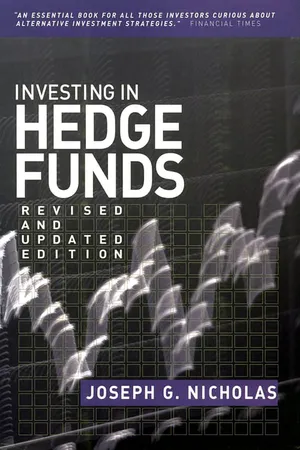
Until recently, much of what makes hedge funds tick has been closely guarded--the intellectual property of Wall Street's investment elite. In this updated and revised text, Joseph G. Nicholas, founder and chairman of the leading industry information provider Hedge Fund Research, Inc., travels inside the hedge fund marketplace to explain the alternative investment strategies of top fund managers, providing clear descriptions of how to access these funds and where they're headed. It's a complete guide that everyone investing in hedge funds should study closely.
- English
- ePUB (mobile friendly)
- Available on iOS & Android
eBook - ePub
Investing in Hedge Funds
About this book
Hedge funds are in the news and on the minds of sophisticated investors more than ever. Investors have questions about how the funds are structured, where the assets are allocated, and whether hedge funds can truly act as a hedge against market risk. The answers are all here in Investing in Hedge Funds.
Information
PART I
Keys to Understanding
CHAPTER 1
What Is a Hedge Fund?
The term hedge fund describes an investment structure for managing a private, unregistered investment pool. Typically, this structure charges an incentive-based fee that compensates the fund manager through a percentage of the profits that the fund earns. For most hedge funds, exemption from securities registration limits the number of participants, who must also be accredited investors, qualified investors, or institutional investors. All hedge funds are not alike; managers usually specialize in one of a diverse number of alternative investment strategies operated through the hedge fund structure.
THE TERM hedge fund has been used to describe both an investment structure—a commingled investment fund—and a strategy—a leveraged long portfolio “hedged” by stock short sales. However, because of the diverse range of investment approaches now employed, it more accurately describes the investment structure within which a hedge fund strategy is executed. For example, a convertible arbitrage hedge fund and a distressed securities hedge fund both operate in the same type of fund structure but follow two distinct strategies. Like the term mutual fund, which describes only the investment structure and does not indicate whether it invests in stocks or bonds or in the United States or abroad, the term hedge fund alone does not tell an investor anything about the underlying investment activities. A hedge fund acts as a vehicle, helping an investor get to the ultimate investment goal: to turn market opportunities into investment returns. In this respect, a hedge fund is no different from a mutual fund. Hedge funds differ from mutual funds in the range of allowable investment approaches, the goals of the strategies that they use, and in the breadth of tools and techniques available to investment managers to achieve those goals for investors. (It should be noted that this distinction is becoming blurred. Mutual fund regulatory changes have allowed certain hedge fund strategies to operate under the mutual fund structure.)
Since the term hedge fund describes an investment structure and is applied to a range of strategies, in order to understand particular hedge funds it is necessary to separate the structure of the investment (its legal form and method of operations) from its investment strategy (how it invests capital in the financial markets to achieve its goals).
The investment structure is the legal entity that allows investment assets to be pooled and permits the hedge fund manager to invest them. The investment approach that the manager takes is known as the hedge fund strategy or alternative investment strategy. The structure establishes such things as the method of manager compensation, the number and type of investors, and the rights and responsibilities of investors regarding profits, redemptions, taxes, and reports. The elements that make up the strategy include how the manager invests, which markets and instruments are used, and which opportunity and return source is targeted.
HEDGE FUND STRATEGIES
There is nothing mystical about the strategies that hedge fund managers use. These strategies can be described in the same terms as those for a traditional portfolio: return source, investment method, buy/sell process, market and instrument concentrations, and risk control. The alternative investment strategies that hedge fund managers tend to use produce returns by leveraging some kind of informational or strategic advantage. Essentially, although some hedge fund strategies are complex, hedge fund investing can be understood by anyone familiar with financial markets and instruments who also has a basic working knowledge of corporate structure and finance.
Although it is important to acknowledge that most money managers who operate private investment pools using the hedge fund structure have their own styles, most of these specialized investment approaches can be categorized within the list of general strategies described in this book. The hedge fund universe is composed of managers who use a broad range of variations of these strategies. They may have little or nothing in common except that they operate under the hedge fund structure and are considered to be alternatives to traditional investment approaches.
THE JONES NOBODY KEEPS UP WITH
THERE ARE REASONS to believe that the best professional manager of investors’ money these days is a quiet-spoken, seldom photographed man named Alfred Winslow Jones. Few businessmen have heard of him, although some with long memories may remember his articles in Fortune; he was a staff writer in the early 1940s. In any case, his performance in the stock market in recent years has made him one of the wonders of Wall Street—and made millionaires of several of his investors. On investments left with him during the five years ended last May 31 (when he closed his 1965 fiscal year), Jones made 325 percent. Fidelity Trend Fund, which had the best record of any mutual fund during those years, made “only” 225 percent. For the ten-year period ended in May, Jones made 670 percent; Dreyfuss Fund, the leader among mutual funds that were in business all during that decade, had a 358 percent gain.
The vehicle through which Jones operates is not a mutual fund but a limited partnership. Jones runs two such partnerships, and they have slightly different investment objectives. In each case, however, the underlying investment strategy is the same: the fund’s capital is both leveraged and “hedged.” The leverage arises from the fact that the fund margins itself to the hilt; the hedge is provided by short positions—there are always some in the fund’s portfolio.
Jones’s accomplishments have spawned a number of other “hedge funds.”
— Carol J. Loomis
Fortune1
Fortune1
Alternative investments differ from the traditional investment approaches used in mutual funds in many significant ways. Traditional investment strategies are exclusively long. Their practitioners seek stocks or bonds that they think will outperform the market. However, alternative investment strategies invest long, short, or both, combining two or more instruments to create one investment position. Traditional strategies normally do not take advantage of leverage. Many alternative strategies do.
Alternative strategies make use of hedging techniques. Unlike traditional strategies that lose money in a market decline, hedged strategies can generate profit on their hedges to offset some or all of the market losses. Hedging may take a number of forms. Some hedges seek to generate profit on an ongoing basis; others may be purely defensive or insurance against market crashes. In general, they are positions that will profit in a market decline by providing an offset, or hedge, to losses incurred on investments in the portfolio that are exposed to the market.
The returns generated by traditional long-only strategies are relative, or benchmarked, to market indexes. For example, if a traditional mutual fund invests in large-capitalization U.S. equities, its return is benchmarked to the performance of a large-capitalization stock index, and performance is judged relative to that index. Most alternative strategies, however, target absolute returns. Because the source of return for most of these strategies is not based on the directional moves of a simple market and does not relate to a particular market or index, it is not useful to compare returns with a traditional market index. Rather, returns are expected to fall within a certain range, regardless of what the markets do. The performance of these strategies will still be cyclical and subject to a variety of drivers. The recent availability of investable hedge fund indexes offered by HFR, S&P, and CSFB now provides real benchmarks for performance comparison.
The hedge fund strategies covered in this book are differentiated by the tools used and the profit opportunities targeted. The various strategies have very different risk-reward characteristics, so it is important that potential investors distinguish between them instead of lumping them together under the heading of “hedge funds.” Hedge funds are heterogeneous. To render them comparable, you must categorize them by the core strategy that the fund manager uses. Some hedge fund strategies, such as macro funds, use aggressive approaches, whereas others, such as nonleveraged market-neutral funds, are conservative. Many have significantly lower risk than a traditional portfolio of long stocks and bonds for the same levels of return.
HEDGE FUND MANAGERS
Hedge fund managers are more difficult to categorize than the various strategies of the funds they manage. Their diverse backgrounds often provide them with the specialized knowledge, expertise, and skills they use to implement unique variations of general strategies.
The typical hedge fund manager is an entrepreneur who organizes a money management company and investment fund to pool his assets (often a substantial portion of his net worth) with those of family, friends, and other investors. The manager’s primary efforts are directed toward the implementation of a hedge fund strategy and the management of a profitable investment portfolio. Often, the “business culture” of the manager and the money management company will reflect these primary efforts, with less emphasis on selling and investor relations when compared with traditional investment operations. Because hedge fund managers usually are investing their own assets along with those of the other investors, they are highly motivated to achieve investment returns and to reduce risk. This motivation has translated into success, as evidenced by the significant growth of the hedge fund industry and the proliferation of hedge funds and managers. Increasingly, institutions and traditional money management firms are organizing internal operations to pursue hedge fund strategies by converting traditional managers and training new ones.
HEDGE FUND INVESTORS
Hedge fund investors have traditionally been high-net-worth individuals. At times, more than half of these were from countries outside the United States. These non-U.S. investors sought to invest with the top investment talent, which in the early 1990s was almost exclusively based in the United States; today top hedge fund managers are located in financial centers around the globe. Recently, the increasing number of American and international high-net-worth individuals has been augmented by institutional investors, including pension funds, endowments, banks, and insurance companies. An infrastructure has emerged to process and make available information about hedge funds. In light of these developments, institutions have become more open to exploring allocations to alternative investment strategies. In response, many hedge funds have made changes, such as providing transparency, to accommodate the needs of institutional investors. It has been a self-reinforcing process: as funds make information about their operations available to institutions, infrastructure to support this body of information is created, and institutions are more likely to make allocations to hedge funds. These institutional investors represent a gr...
Table of contents
- Praise
- Title Page
- Copyright Page
- Dedication
- Acknowledgements
- Introduction
- PART I - Keys to Understanding
- PART II - Investing With Knowledge
- PART III - Making an Investment
- APPENDICES
- GLOSSARY
- NOTES
- INDEX
- ABOUT BLOOMBERG
- ABOUT THE AUTHOR
Trusted by 375,005 students
Access to over 1.5 million titles for a fair monthly price.
Study more efficiently using our study tools.
Frequently asked questions
Yes, you can cancel anytime from the Subscription tab in your account settings on the Perlego website. Your subscription will stay active until the end of your current billing period. Learn how to cancel your subscription
No, books cannot be downloaded as external files, such as PDFs, for use outside of Perlego. However, you can download books within the Perlego app for offline reading on mobile or tablet. Learn how to download books offline
Perlego offers two plans: Essential and Complete
- Essential is ideal for learners and professionals who enjoy exploring a wide range of subjects. Access the Essential Library with 800,000+ trusted titles and best-sellers across business, personal growth, and the humanities. Includes unlimited reading time and Standard Read Aloud voice.
- Complete: Perfect for advanced learners and researchers needing full, unrestricted access. Unlock 1.5M+ books across hundreds of subjects, including academic and specialized titles. The Complete Plan also includes advanced features like Premium Read Aloud and Research Assistant.
We are an online textbook subscription service, where you can get access to an entire online library for less than the price of a single book per month. With over 1.5 million books across 990+ topics, we’ve got you covered! Learn about our mission
Look out for the read-aloud symbol on your next book to see if you can listen to it. The read-aloud tool reads text aloud for you, highlighting the text as it is being read. You can pause it, speed it up and slow it down. Learn more about Read Aloud
Yes! You can use the Perlego app on both iOS and Android devices to read anytime, anywhere — even offline. Perfect for commutes or when you’re on the go.
Please note we cannot support devices running on iOS 13 and Android 7 or earlier. Learn more about using the app
Please note we cannot support devices running on iOS 13 and Android 7 or earlier. Learn more about using the app
Yes, you can access Investing in Hedge Funds by Joseph G. Nicholas in PDF and/or ePUB format, as well as other popular books in Business & Investments & Securities. We have over 1.5 million books available in our catalogue for you to explore.