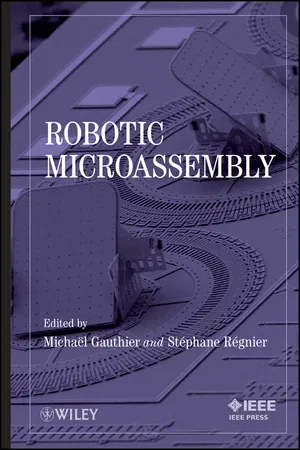
Robotic Microassembly
  1. English
  2. ePUB (mobile friendly)
  3. Available on iOS & Android
eBook - ePub

About this book

Discover the latest models and methods for robotic microassembly from around the world

This book presents and analyzes new and emerging models and methods developed around the world for robotic microassembly, a new and innovative way to produce better microsystems. By exploring everything from the physics of micromanipulation to microassembly to microhandling, it provides the first complete overview and review of this rapidly growing field. Robotic Microassembly is divided into three parts:

  • Part One: Modeling of the Microworld

  • Part Two: Handling Strategies

  • Part Three: Robotic and Microassembly

Together, these three parts feature eight chapters contributed by eight different authors. The authors, internationally recognized experts in the field of robotic microassembly, represent research laboratories in Asia, Europe, and North America. As a result, readers get a remarkable perspective on different approaches to robotic microassembly from around the world. Examples provided throughout the chapters help readers better understand how these different approaches work in practice. References at the end of each chapter lead to the primary literature for further investigation of individual topics.

Robotic microassembly offers a new, improved way to manufacture high-performance microelectro-mechanical systems (MEMS). Therefore, any professional or student involved in microrobotics, micromechatronics, self-assembly or MEMS will find plenty of novel ideas and methods in this book that set the stage for new approaches to design and build the next generation of MEMS and microproducts.

Frequently asked questions

Yes, you can cancel anytime from the Subscription tab in your account settings on the Perlego website. Your subscription will stay active until the end of your current billing period. Learn how to cancel your subscription.
At the moment all of our mobile-responsive ePub books are available to download via the app. Most of our PDFs are also available to download and we're working on making the final remaining ones downloadable now. Learn more here.
Perlego offers two plans: Essential and Complete
  • Essential is ideal for learners and professionals who enjoy exploring a wide range of subjects. Access the Essential Library with 800,000+ trusted titles and best-sellers across business, personal growth, and the humanities. Includes unlimited reading time and Standard Read Aloud voice.
  • Complete: Perfect for advanced learners and researchers needing full, unrestricted access. Unlock 1.4M+ books across hundreds of subjects, including academic and specialized titles. The Complete Plan also includes advanced features like Premium Read Aloud and Research Assistant.
Both plans are available with monthly, semester, or annual billing cycles.
We are an online textbook subscription service, where you can get access to an entire online library for less than the price of a single book per month. With over 1 million books across 1000+ topics, we’ve got you covered! Learn more here.
Look out for the read-aloud symbol on your next book to see if you can listen to it. The read-aloud tool reads text aloud for you, highlighting the text as it is being read. You can pause it, speed it up and slow it down. Learn more here.
Yes! You can use the Perlego app on both iOS or Android devices to read anytime, anywhere — even offline. Perfect for commutes or when you’re on the go.
Please note we cannot support devices running on iOS 13 and Android 7 or earlier. Learn more about using the app.
Yes, you can access Robotic Microassembly by Michael Gauthier, Stephane Regnier, Michael Gauthier,Stephane Regnier in PDF and/or ePUB format, as well as other popular books in Technology & Engineering & Robotics. We have over one million books available in our catalogue for you to explore.

Information

Table of contents

  1. Cover
  2. Series Page
  3. Title Page
  4. Copyright
  5. Foreword
  6. Preface
  7. Contributors
  8. Part I: Modeling of the Microworld
  9. Part II: Handling Strategies
  10. Part III: Robotic and Microassembly