Each chapter provides practical tips and easy to grasp models that will help new managers in China to be effective. In CHINA CEO, we deliver what other Western authors can't – first-hand reflections based on over 100 years' collective experience in China. The book presents this rich knowledge in a readable, conversational style suitable for time-constrained executives. Each chapter gives specific advice on how to manage Chinese employees, work with Chinese business partners, communicate with headquarters, face competitors, battle intellectual property rights infringers, win-over Chinese consumers, negotiate with the Chinese government, and adapt yourself (and your family) to life in China.
eBook - ePub
China CEO
Voices of Experience from 20 International Business Leaders
- English
- ePUB (mobile friendly)
- Available on iOS & Android
eBook - ePub
China CEO
Voices of Experience from 20 International Business Leaders
About this book
CHINA CEO: Voices of Experience From 20 International Business Leaders is based on interviews with 20 top executives and eight experienced consultants based in China. The book is packed with first-hand, front-line advice from veterans of the China market. Hear directly from the top executives heading up the China operations of Bayer, British Petroleum, Coca-Cola, General Electric, General Motors, Philips, Microsoft, Siemens, Sony and Unilever, plus expert China-based consultants at Boston Consulting Group, Korn/Ferry International, McKinsey & Company, and many more.
Chapter 1
Qualities of a Successful International Manager in China
“If I had to focus on any one message [for incoming managers], I would emphasize that relationships are very important. … It is really about people—relationships between people and the confidence they have in each other. China is even more that way than in Europe or in the States.”
Dr. Gary Dirks, President and CEO, British Petroleum China
INSIDE CHAPTER 1
Interviewee Credentials
The Right Stuff for China?
Conclusion
Introduction
One of our primary goals in researching this book was to identify the critical success qualities (CSQs) necessary in an international (non-Chinese citizen) manager who operates successfully in China. Our method for researching this was simple: we asked each of our 20 China-based top executive interviewees, “What qualities would you look for in finding a successor to your current position?” Their answers form the basis for this chapter.
Interviewee Credentials
Before we share our findings on the essential qualities for a successful international manager in China, we wish to share a word on our interviewees—the 20 top executives for China operations profiled in this book. We want you to be sure of their credentials for determining what kind of expatriate manager survives best in China. We set several strict criteria before seeking interviews. Each interviewee must represent the top level of management for his company in China, be based full-time in China (rather than commuting from Hong Kong, for example), and have been working in China for more than a year. Nearly all the interviewees far exceeded these requirements. The record for time spent abroad goes to Volkmar Ruebel, general manager of Hilton Hotels, Shanghai, who as this book goes to press boasts 41 years of international experience, 37 years in the same company, and 11 years in China. Also having a decade of China experience under their belts are Philip Murtaugh, chairman and CEO of General Motors China, Dr. Gary Dirks, group vice president and chief executive of British Petroleum China, and Paolo Gasparrini, president and managing director of L'Oréal China.
Our interviewees have witnessed tremendous changes during their time in China. Many describe the dramatic physical transformation in the urban centers. In the plush lounge of the 42-storey Hilton Shanghai—a building now surrounded by high-rises—general manager Volkmar Ruebel describes his first night in the city. “I arrived in Shanghai on New Year's Eve 1995. The city was dark. There were no lights. There were very few high buildings. … That changed very quickly.” Others describe the transformation in the business climate. When Dr. Ernst Behrens arrived in Bejiing for Siemens in 1981, he lived in a small room in a rundown domestic hotel near Tiananmen Square—one of the few hotels designated by the Chinese government for foreign visitors. Because Siemens policy restricted Behrens from bringing his family to China, he spent three years living for 10 weeks at a time in China, followed by 10 days in Hong Kong. Today, such restrictions—both governmental and corporate—have all but disappeared. At the time of writing this book, 63,000 expatriate professionals and their families live in Shanghai alone, served by 25 international schools.
Paolo Gasparrini (now L'Oréal president and managing director for China) describes arriving from Hong Kong in February 1996, carrying a briefcase of cosmetic products. Although he also brought with him seven years of experience as president of L'Oréal Brazil, the difference in China was that he had to launch the company on his own, virtually from scratch. “There was nothing here; it was starting from zero,” he recalls. Back then L'Oréal's presence in China consisted of a handful of makeup counters in Shanghai and Bejiing displaying Maybelline or Lancôme products. Initially, Gasparrini did not even have permission to rent office space. Instead, he and his sole employee, a communications director, traveled to Shanghai and Beijing each week from Hong Kong. Today, L'Oréal has invested US$150 million in its operations in China, which now include the manufacture, distribution, and sale of 12 international mega-brands and two local brands that the company acquired in 2003 and 2004. A large chunk of L'Oréal's production in China is exported to Japan, South Korea, and other markets in Asia.
Any international manager in China quickly realizes that this is a country in the midst of a transformation that is both fast-moving and far-reaching, a shift that is not only redirecting the economy but also changing social and cultural norms. Factors including ongoing economic reform, regulatory changes triggered by accession into the WTO, increased consumer wealth, and growing international exposure, even preparations for the 2008 Olympic Games, are all bringing about significant and sometimes surprising changes. It is from the perspective of having survived (and thrived) in this environment that the executives we interviewed offer advice on what it takes to lead a winning business operation in China now.
“When expatriates come to China, local people expect them to bring something—in terms of knowledge or skill—that they need but that is not available here. There is a strong expectation that the expatriate will do that.”
The Right Stuff for China?
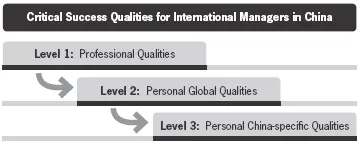
During our interviews, the question of what characteristics our executives would look for in a successor sparked a rich mixture of responses. We have organized these responses into three categories based loosely on the logical sequence followed in considering the qualifications of a potential manager:
- Level 1: Professional Qualities
- Level 2: Personal Global Qualities
- Level 3: Personal China-specific Qualities
This concept of levels conveys the idea that an international manager, especially one destined for China, must first demonstrate rock-solid professional qualifications, then show the ability to work in an international environment, and then prove able to handle specific challenges posed by China's business environment. We illustrate the progression of necessary qualifications in Figure 1.1.
FIGURE 1.1 Critical Success Qualities for International Managers in China
Level 1 CSQs: Professional Qualities
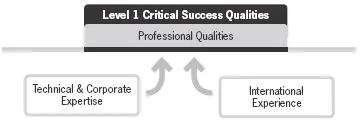
Not surprisingly, the first set of qualities our interviewees named as critical in selecting an international manager for China are professional prerequisites. Our interviewees identified two types of professional requirements they would insist upon for a candidate filling their current position of heading China operations for a multinational company:
- Technical and company expertise
- International experience
See Figure 1.2.
FIGURE 1.2 Level 1 Critical Success Qualities
Professional Quality #1: Technical and Corporate Expertise
A look at the careers of our 20 successful top executives in China themselves reinforces the idea that rock-solid technical expertise and rich management experience are a critical starting point for evaluating a candidate for an overseas senior management position. As a group, our interviewees have spent an average of 23 years working their way up in the same company. This gives them an extraordinarily broad and deep knowledge of their industries and of the company they are to represent abroad.
One of the first points made by our profiled consultants is that in today's China, expectations of expatriate managers are sky-high among the employees, business partners, and officials with whom they will be working. As China's own workforce rapidly gains ability in the international business arena, the demands on foreign nationals working in China are quickly rising. Human resources (HR) expert Simon Keeley of Hewi. Associates explains that the bar is rising for expatriate managers and technical experts. “When expatriates come to China, the local people expect them to bring something—in terms of knowledge or skill—that they need but that is not available here. There is a strong expectation that the expatriate will do that.” Keeley warns that foreign managers or specialists who fail to gain recognition for the expertise they bring to the China operations will likely quickly run into trouble.

As a result, Keeley says, foreign companies are increasingly raising the requirements for those being sent to China. “Now companies are paying more a.ention to [expat selection], probably because they take China as a very important part of their global strategy.” He adds that companies are much more selective today than in the 1990s. He points to a client company that recently transferred eight top-performing professionals from their home country to China. “This company knows China is an important part of its worldwide strategy and is sending its best people here. I think more companies will do this.”
The second type of professional skill our China hands deemed necessary in China is the ability to manage difficulty. Serving as president, CEO, or country manager in a foreign environment requires handling different levels of responsibility simultaneously First, they must oversee all the standard duties typically performed by a top-level manager back in the home country: managing relations externally (with officials, business partners, customers) and internally (with superiors, staff members). Second, when posted abroad, expatriates must manage these same relationships while facing significant obstacles separating them from each of these critical groups. For example, when interacting with the corporate headquarters, the China-based manager suddenly faces geographic distances, time differences, and vast gaps in knowledge caused by working on the other side of the planet from one's boss. The opportunity is ripe for misunderstandings, delays, and other forms of disconnect. Meanwhile, when the manager works with business partners and employees (who will mostly be Chinese nationals), he or she suddenly faces vast cultural differences a...
Table of contents
- Chapter 1: Qualities of a Successful International Manager in China
- Chapter 2: Managing Chinese Employees
- Chapter 3: Working With Business Partners
- Chapter 4: Communicating With Headquarters
- Chapter 5: Facing Competitors
- Chapter 6: Battling Intellectual Property Rights Infringers
- Chapter 7: Winning Over Chinese Consumers
- Chapter 8: Negotiating With the Chinese Government
- Chapter 9: Living in China
- Chapter 10: Conclusion
- Research Methodology
- Index
Trusted by 375,005 students
Access to over 1.5 million titles for a fair monthly price.
Study more efficiently using our study tools.
Frequently asked questions
Yes, you can cancel anytime from the Subscription tab in your account settings on the Perlego website. Your subscription will stay active until the end of your current billing period. Learn how to cancel your subscription
No, books cannot be downloaded as external files, such as PDFs, for use outside of Perlego. However, you can download books within the Perlego app for offline reading on mobile or tablet. Learn how to download books offline
Perlego offers two plans: Essential and Complete
- Essential is ideal for learners and professionals who enjoy exploring a wide range of subjects. Access the Essential Library with 800,000+ trusted titles and best-sellers across business, personal growth, and the humanities. Includes unlimited reading time and Standard Read Aloud voice.
- Complete: Perfect for advanced learners and researchers needing full, unrestricted access. Unlock 1.5M+ books across hundreds of subjects, including academic and specialized titles. The Complete Plan also includes advanced features like Premium Read Aloud and Research Assistant.
We are an online textbook subscription service, where you can get access to an entire online library for less than the price of a single book per month. With over 1.5 million books across 990+ topics, we’ve got you covered! Learn about our mission
Look out for the read-aloud symbol on your next book to see if you can listen to it. The read-aloud tool reads text aloud for you, highlighting the text as it is being read. You can pause it, speed it up and slow it down. Learn more about Read Aloud
Yes! You can use the Perlego app on both iOS and Android devices to read anytime, anywhere — even offline. Perfect for commutes or when you’re on the go.
Please note we cannot support devices running on iOS 13 and Android 7 or earlier. Learn more about using the app
Please note we cannot support devices running on iOS 13 and Android 7 or earlier. Learn more about using the app
Yes, you can access China CEO by Juan Antonio Fernandez,Laurie Underwood in PDF and/or ePUB format, as well as other popular books in Business & Leadership. We have over 1.5 million books available in our catalogue for you to explore.