eBook - ePub
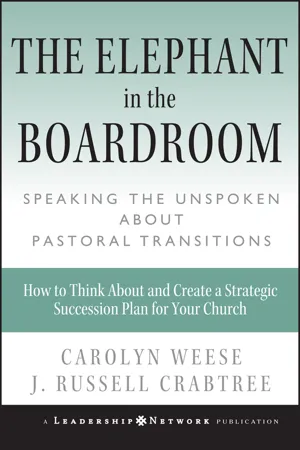
The Elephant in the Boardroom
Speaking the Unspoken about Pastoral Transitions
- English
- ePUB (mobile friendly)
- Available on iOS & Android
eBook - ePub
The Elephant in the Boardroom
Speaking the Unspoken about Pastoral Transitions
About this book
Carolyn Weese and J. Russell Crabtree—experts in the field of church leadership—have written a nuts-and-bolts guide to developing a succession plan for smoothing pastoral transitions. Filled with strategies and solid advice, this handy resource is based in solid research and the authors' many years of experience working with churches in a wide variety of denominations. Weese and Crabtree clearly show that leadership succession should be part of every church's planning process.
Information
Part One
The Principles, Cost, and Players in Health-Based Transition
Chapter One
Principles of Transition, Jesus Style
And this is my prayer: that your love may abound more and more in knowledge and depth of insight. . . .
—Philippians 1:9 (NIV)
We do not say it frequently in this book, but it is important to state emphatically that the personal and corporate spiritual work required in a successful pastoral transition is critical. It would be a mistake to interpret the organizational and managerial tone of this book as dismissive of that spiritual work. Linda Karlovec, a psychologist who specializes in organizational therapy, argues that almost all resistance to organizational change is emotional, though it is perceived to be rational. This implies that the entire pastoral-transition enterprise needs to include the spiritual components of prayer, Scripture reading, personal reflection, confession, and nurture of faith. The life, teaching, and prayers of Jesus constitute a particularly rich source of sustenance for this journey.
Transformation is not a function of information, but of exploration with trust. People must find enough strength in their relationship with God and their trust of one another to be able to talk openly, pray, confess, and seek grace and healing if they are to develop excellence in a leadership transition. The capacity of a leader, or a group of leaders, to face their own shadow side through the power of Jesus Christ is critical to effectiveness in succession planning.
It is difficult to imagine a man more insistent and articulate regarding His own leadership transitions than Jesus of Nazareth, as described in the record of the New Testament. At the beginning of His ministry, He is clear and unambiguous. In Luke 4:16 (NIV), He enters the synagogue in His home town, reads a passage from the prophet Isaiah, and unmistakably lays His hand to the reins of leadership: “Today these words are fulfilled in your hearing.” At the end of His ministry, He is equally clear and unambiguous; in John 16:16 (NIV) Jesus says, “A little while and you will see me no more.” Later, we delve into the spiritual principles that seemed to be guiding Jesus. For now, suffice it to say that Jesus was candid and forthright about His arrival on the scene and equally transparent regarding His departure. Although the people on both ends tried to deny this reality, Jesus was unrelenting in His focus.
In the church today, the situation is often reversed. Members try to face the reality of a leadership change, while the leader denies it. Members know that they are the ones who will be left to deal with the shock wave of a sudden departure, and all the aftershocks as well. But when they try to talk honestly about this, the leader often dismisses the concern with an ambiguous response concerning God’s will, God’s call, and God’s timing. Leaders who design worship services with an impulse of excellence driving every detail are willing to leave the impact of a major leadership transition to a curious silence. When it comes to pastoral transition, leaders often stop leading.
Why? The reasons certainly cannot be traced to the behavior or the teaching of Jesus. Instead of being grounded in spiritual principle, the reasons for silence seem to be rooted more in fear and low self-confidence. We are afraid that:
- If we talk about pastoral transition we might put the idea in someone’s head and make it more likely to happen.
- We will create a lame duck situation in which effective ministry becomes impossible.
- A discussion about pastoral transition will have unintended consequences that we do not know how to manage.
- We don’t have the resources to deal with transition planning and be successful.
- Our peers and colleagues won’t support us in doing it a different way, and we are not sure we want to be pioneers on the road of better pastoral transition if this means going it alone.
All these issues can be addressed given the right resources and spiritual resolve. At the present time, however, church culture in North America does not provide these resources. The end result is that the congregation is left with no alternative but to experience the triple whammy of emotional, “organic,” and organizational change all at the same time. As a whole, the church is a living, breathing organism and experiences all of the same emotions as an individual. At the same time, it is also an institution that experiences change at an organizational level as well. Thus, the triple whammy.
Jesus Did It Differently
Choose a number between one and twenty. There are that many reasons why the church must manage leadership transitions in a different way. But the most compelling reason is as simple as it is basic: Jesus did it differently. It is fundamentally an issue of discipleship. How can we claim to be following Jesus, when our practice of managing leadership transition runs directly counter to the model of His life?
Unfortunately, the people who genuinely sound like Jesus on this issue are not in the church, but in business. During his last years of service, the CEO of a large corporation said that putting in place a succession plan was what he spent most of his time thinking about. In an important work on succession planning, one author argued that a good plan is needed to avoid undermining the entire transition process and creating lingering casualties. How many church leaders understand that the failure to manage their transition to another ministry with clarity and wisdom creates lingering casualties among the members they have worked so hard to cultivate? One of the long-term needs that human beings have is to leave a legacy. It is small comfort for a pastor to look back over a lifetime of service and see three or four seasons of dynamic ministry punctuated by decline and retrenchment after his or her departure because inadequate attention was given to a transition plan. Jesus’ transition plan for His own disciples included a vision for long-term results: “You did not choose me, but I chose you and appointed you to go and bear fruit—fruit that will last” (John 15:16 NIV).
Jesus managed two major leadership transitions in His life. He managed His succession of His predecessor, and He managed His own departure. Today’s leader has to manage these same transitions as well. But the impetus to do so requires understanding management as an expression of discipleship. The example of Jesus is rich and illuminating. We cannot derive specific transition strategies that would fit the multiplicity of church governments today, but certain start-up principles emerge that apply across the spectrum of churches.
Principle One: Honor Thy Predecessor
Practically, honoring our predecessor means we should use TLC with members regarding a predecessor. That’s talk, listen, and confirm.
Leaders help the transition process if they simply talk about their predecessor. Jesus did. He talked about John the Baptist on multiple occasions in public settings. Here is a list of some things Jesus said about His predecessor in public:
Among those born of women, there has not arisen anyone greater than John . . . (Matthew 11:11 NIV)
For John came to show you the way of righteousness . . . (Matthew 21:32 NIV)
For John came neither eating bread nor drinking wine, and you say, he has a demon. (Luke 7:33 NIV)
The baptism of John—was it from heaven or from men? (Mark 11:30 NIV)
Jesus was not afraid to talk about His predecessor in public. Yet many church members experience an eerie silence on the part of their new pastor regarding the work of his or her predecessor. It would be refreshing and liberating for many members to hear their pastor speak, in positive terms, the name of the pastor who went before and was referred to as an instrument in God’s plan for building that church. In reality, the opposite is often the case. A pastor is sometimes so threatened by the esteem paid to a predecessor that he or she gives the signal to members that they are not to speak about the predecessor in the pastor’s presence.
This leads to listening. Members need leaders to listen to them talk about their affection for their predecessor. This enables them to integrate their past and present experiences rather than compartmentalize them. If the leader is unwilling to do this, it places an emotional burden on the members. In one church, members made an agreement with one another not to speak the name of a former pastor except in private for nearly twenty years after the pastor left the community and moved to another state!
Ken Blanchard, of One Minute Manager fame, said that “what we resist, persists.” The surest way to botch a leadership transition and lock people into the past is to send the message that they cannot talk about the previous leader. Again, in Blanchard’s words, this is an obstacle posed by the ego—and ego means Edging God Out.
An example that pastors could learn from comes from a choir director in a large church who described how her ministry began. When Leta realized she was following a popular and effective predecessor named Martha, she called her on the phone. This began regular communication. Whenever she had a conversation with Martha, Leta would share with the choir that she had talked with Martha and would convey Martha’s greeting to the choir. When Martha came to town, Leta would invite her to sing in the choir. When Leta was visiting in another city where Martha was the choir director, Leta was introduced to the congregation and invited to direct the choir.
As a result, members of the church were at ease with their past leader and their present one. They did not have to be anxious that conversation about their past leader would create a conflict with their new one, or vice versa. They were not placed in a position of making choices regarding loyalty. This was extremely effective as a transition strategy. Leta described this experience as uncommon among choir directors; however, it seems to follow the model of Jesus.
Finally, members need to have the leader confirm the importance of the past. As we develop, we generally are trying to find integrity in our lives. It is important to discover that a common thread has been running through our years, and that life is not merely a series of events that have no relationship to one another. Members and leaders need to confirm that past experiences, including those with a predecessor, made an important contribution to the drama of their lives even when a significant change has to be made. Taken together, talking, listening, and confirming help fulfill the spiritual principle introduced by Jesus: Honor thy predecessor.
Principle Two: Build on Health
Jesus said, “Therefore every teacher of the law who has been instructed about the kingdom of heaven is like the owner of a house who brings out of his storeroom new treasures as well as old” (Matthew 13:52 NIV).
Jesus reached into the treasure chest of the past and pulled out what was healthy and strong, thus fashioning the timbers of the new work He was building. Many of the stories Jesus told were not original to Him; neither were many of His ideas. Jesus knew where to find islands of health in His tradition, and that is where He planted His feet.
Jesus knew that the history of His people held pockets of disease and dysfunction. What we now call the Old Testament spoke of polygamy and concubines. Some Scripture seemed to permit a system of divorce that left women impoverished. Jesus did not allow Himself to get lost in an ocean of dysfunctional thinking and debate from the past. He went straight to the Scriptures that spoke about health in marriage—that a man should leave his father and mother, cleave unto his wife, and the two become one. Knowing that some Old Testament laws were less helpful than others, Jesus zeroed in on the greatest commandment, the one most visionary and grounded in health: “Love the Lord your God with all your heart, soul, strength, and mind” (Deuteronomy 6:5 NIV).
Today, one prevailing stream of thinking about leadership transitions tends to be illness-based. A pastoral departure is treated like a terminal diagnosis; just as no one plans for cancer, no one plans for a leadership transition either. Once the leader has moved, grief sets in. Organic change has taken place. A death has taken place. The congregation is wounded in all the ways an individual is wounded by a personal loss, and it responds in a similar pattern. Denial, anger, depression, guilt, bargaining, and finally acceptance are the stages of grief play...
Table of contents
- Cover
- Contents
- Title
- Copyright
- List of Exhibits
- Preface
- Dedication
- Acknowledgments
- Introduction
- Part One: The Principles, Cost, and Players in Health-Based Transition
- Part Two: The Four Church Cultures: Family, Icon, Archival, and Replication
- Part Three: Components of a Transition Plan
- Appendix: The Church Planning Questionnaire
- The Authors
- About Leadership Network
- Index
Trusted by 375,005 students
Access to over 1.5 million titles for a fair monthly price.
Study more efficiently using our study tools.
Frequently asked questions
Yes, you can cancel anytime from the Subscription tab in your account settings on the Perlego website. Your subscription will stay active until the end of your current billing period. Learn how to cancel your subscription
No, books cannot be downloaded as external files, such as PDFs, for use outside of Perlego. However, you can download books within the Perlego app for offline reading on mobile or tablet. Learn how to download books offline
Perlego offers two plans: Essential and Complete
- Essential is ideal for learners and professionals who enjoy exploring a wide range of subjects. Access the Essential Library with 800,000+ trusted titles and best-sellers across business, personal growth, and the humanities. Includes unlimited reading time and Standard Read Aloud voice.
- Complete: Perfect for advanced learners and researchers needing full, unrestricted access. Unlock 1.5M+ books across hundreds of subjects, including academic and specialized titles. The Complete Plan also includes advanced features like Premium Read Aloud and Research Assistant.
We are an online textbook subscription service, where you can get access to an entire online library for less than the price of a single book per month. With over 1.5 million books across 990+ topics, we’ve got you covered! Learn about our mission
Look out for the read-aloud symbol on your next book to see if you can listen to it. The read-aloud tool reads text aloud for you, highlighting the text as it is being read. You can pause it, speed it up and slow it down. Learn more about Read Aloud
Yes! You can use the Perlego app on both iOS and Android devices to read anytime, anywhere — even offline. Perfect for commutes or when you’re on the go.
Please note we cannot support devices running on iOS 13 and Android 7 or earlier. Learn more about using the app
Please note we cannot support devices running on iOS 13 and Android 7 or earlier. Learn more about using the app
Yes, you can access The Elephant in the Boardroom by Carolyn Weese,J. Russell Crabtree in PDF and/or ePUB format, as well as other popular books in Theology & Religion & Christian Ministry. We have over 1.5 million books available in our catalogue for you to explore.