- Represents a state-of-the-art assessment of current scholarship on FDR, the only president elected to four terms of office and the central figure in key events of the first half of the 20th century
- Covers all aspects of FDR's life and times, from his health, relationships, and Supreme Court packing, to New Deal policies, institutional issues, and international relations
- Features 35 essays by leading FDR scholars
- English
- ePUB (mobile friendly)
- Available on iOS & Android
eBook - ePub
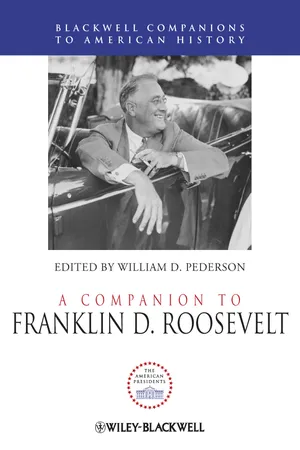
A Companion to Franklin D. Roosevelt
About this book
A Companion to Franklin D. Roosevelt presents a collection of historiographical essays by leading scholars that provides a comprehensive review of the scholarship on the president who led the United States through the tumultuous period from the Great Depression to the waning days of World War II.
Information
Chapter One
FDR BIOGRAPHIES
Historians have long debated whether history is a science or an art, and some have concluded that the question is moot because science and art are closely related. In History as Art and as Science: Twin Vistas of the Past (Hughes 1964: 2), E. K. Carr argued that, “Scientists … and historians are … engaged in different branches of the same study: the study of man and his environment … the object … is the same: to increase man’s understanding and mastery over his environment.”
While this assessment may seem logical and persuasive at first glance, it is, in fact unsustainable. True, there may be some similarities between the goals of historians and scientists, but the similarities are, at best, superficial and in no way tie the two disciplines together. There is nothing scientific about history. It is a form of literature; it is a highly sophisticated but utterly unscientific art. Unlike the scientific process where objectivity is the essential ingredient and all examinations of the same evidence must produce the same result, the historical process is inevitably subjective. All historians – sometimes by design, sometimes unintentionally, but nevertheless in all cases – impose themselves upon their subjects and the cumulative result is often chaos. That is, the outcomes produced by various historians dealing with the same topic are never the same and thus result in confusion. Put another way, if one examines all the historical literature on a given topic, the answers to the fundamental question of how human beings seek to understand and control their environment are never clear. Moreover, in no subdiscipline of history is this phenomenon more obvious than in biography, and no subject of biography has generated more literary chaos than Franklin Delano Roosevelt.
Roosevelt became the subject of historians and other writers long before his death, has continued to attract attention to the present time, and without doubt will be targeted by many writers with various agendas well into the future. The total number of books on Roosevelt is staggering. In addition to biographies, there are works dealing with topics such as the Great Depression, World War II, and general politics, and all of them, of course, include some biographical material. But this chapter, for the most part, deals only with those works intended to be biographical in the strictest sense of the word. Even this approach leads to more than 80 books, and not all of them are discussed. Instead, the most important biographies are selected and divided into four categories: those written by professional historians, journalists, close associates, and relatives. The discussion of them suggests the imperfect nature of Roosevelt biographical literature.
Historians
Emil Ludwig comes first in the discussion. A Pole who lived at various times in Poland, Switzerland, the United States, and Germany, he could be classified as either a historian or a journalist, but I have chosen to include him with the former because of the quantity and quality of his biographical and historical works. His biography, Roosevelt: A Study in Fortune and Power (Ludwig 1938 – English translation by Maurice Samuel), was released in the United States in 1938. Though he attempted to enshrine Roosevelt’s greatness as the savior of the capitalist system and democracy, the result is overly sentimental and not especially persuasive.
Nearly a decade and a half lapsed before another historian attempted a Roosevelt biography, but once Frank Freidel began, he maintained his interest in Roosevelt for the remainder of his life After spending most of his academic career at Harvard, he concluded it at the University of Washington. His four-volume biography appeared over the course of 20 years. First was Franklin D. Roosevelt: The Apprenticeship (1952), followed by Franklin Delano Roosevelt: The Ordeal (1954), Franklin Delano Roosevelt: The Triumph (1956), and FDR: Launching the New Deal (1973). The delay in the publication of the fourth volume was caused by the controversy that blazed about the New Deal during the Red Scare of the 1950s and the search for additional documents. While generally sympathetic to Roosevelt, Freidel’s work is also critical when the need is obvious, in such cases, for example, as the Supreme Court fiasco and his intervention in the congressional election of 1938. It is one of the best written and most comprehensive of all the FDR biographies and remains today an excellent example of biographical literature, although it is not definitive.
The next historian to publish a Roosevelt biography was James McGregor Burns. Professor Burns is a well-known presidential biographer and an authority on leadership studies, serving as the Woodrow Wilson Professor emeritus, of Political Science at Williams College. His two-volume biography is Roosevelt: The Lion and the Fox (1956) and Roosevelt: The Soldier of Freedom, 1940–45 (1970) The second volume won a Pulitzer Prize and the National Book Award in 1971. The former is a fine example of historical literature, in which Burns evaluates FDR as a leader and politician during the Great Depression. Finding both weakness and strength, many fans of the president did not like the book; nevertheless, it was for the most part well received by reviewers. In Roosevelt: The Soldier of Freedom, Burns once again exhibited his skill as a literary craftsman. More critical of FDR than in the first volume, he describes the president as a deeply divided man who provided inadequate leadership to a fragmented nation. He censures Roosevelt especially for his treatment of the Japanese Americans and his insensitivity to civil liberties.
Professor Dexter Perkins was known throughout the western world as a prominent authority on US history. During his long career, he taught at the University of Rochester, Cornell University, the University of London, and Cambridge. He was the official US historian at the San Francisco Security Conference that preceded the organization of the United Nations in 1945. His biography, entitled The New Age of Franklin Roosevelt, 1932–1945 (1956), is an account of FDR’s leadership through the Great Depression and World War II. Though only 193 pages, mostly anecdotal, not based on primary sources, and bereft of anything unknown up to its date of publication, it is a well-balanced, fair-minded summary of what many have styled the beginning of America’s modern era. It is also beautifully written and thus attracted many readers who were not likely to seek out the massive multi-volume works of other well-known authors.
One of those who, like Frank Freidel, successfully attempted a huge multi-volume biography was Kenneth S. Davis, who graduated from Kansas State University in 1934 with a degree in journalism and received a Master of Science degree from the University of Wisconsin in 1935. He taught journalism at New York University, was a war correspondent during World War II, and later taught history at both Kansas State and the University of Kansas. Though a biographer of Charles Lindbergh, Dwight D. Eisenhower, and Adlai Stevenson, his best known biography is on FDR.
Davis intended to produce five volumes, but the last was never completed due to his illness and death in 1999. Volume I, FDR: The Beckoning of Destiny, 1882–1928 (1972) is based largely on secondary sources, mainly from Burns and Freidel, but also includes some new information. The major thesis of this book is that character develops and persists; it does not appear full blown at birth, nor does it change to meet each new responsibility. He pictures Roosevelt not as a hero, but as a man whose character exhibited significant flaws. FDR: The New York Years, 1928–1932 (1985) features Roosevelt as governor of New York and as candidate for the Democratic presidential nomination. Again, the author is both sympathetic and critical. The best parts of this volume are the description of Roosevelt’s assembling of the Brains Trust and its persuasive argument that Roosevelt represented a significant political alternative in 1932. He entitled volume III FDR: The New Deal Years, 1933–1937 (1986). Here, he focused on the period known to historians as the First New Deal, considering issues such as currency reform, banking, agriculture, labor, the regulation of labor relations, welfare, and especially social security. Roosevelt, says Davis, was essentially conservative in his outlook and succeeded not because of any particular piece of legislation, but because of his grasp of his historic role. His approach to practically all problems was both pragmatic and erratic.
FDR: Into the Storm, 1937–1941 (1993), was Davis’s fourth and last volume. It covers the efforts to sustain the New Deal, the Supreme Court controversy, the failed purge of conservative Democrats, the successful battles over wages and hours, farm tenancy, housing bills, and the third-term struggle. With respect to the latter, Davis is at his best as an analyst. For example, he shows that Roosevelt knew Wendell Willkie represented a serious threat, but was mistaken in his belief that Willkie was a puppet of the far right. Davis is very critical of the president for his handling of events leading up to US entry into World War II. He pictures Roosevelt as a cautious and ineffective leader, who had an opportunity to deter Hitler and failed. How Davis would have interpreted Roosevelt’s wartime leadership will never be known, but it was obvious that as each volume appeared, Davis’s work became more critical and more controversial. At the same time it received significant recognition. Volume I won the Francis Parkman Prize in 1973 and was nominated for the National Book Award. The New York Times ranked volumes I and II among the 10 best books of the years when they appeared.
Gerald D. Nash, Distinguished Professor of History at the University of New Mexico, produced a biographical work entitled Franklin Delano Roosevelt (1967), not written by himself but consisting of excerpts from the works of other authors, including Richard Hofstadter, James McGregor Burns, Arthur M. Schlesinger, Jr, and Roosevelt himself. The president’s section, Part I, features comments about the first 50 years of his life and career. Part II consists of comments by people who knew Roosevelt, including his mother, American politicians, journalists, and world leaders. Part III includes well-known interpretations by Hofstadter, Burns, Schlesinger, and John Gunther. All the entries are very brief, running from a few paragraphs to five or six pages. Nash’s goal was to combine the intimacy of autobiography, the immediacy of eyewitness observations, and the “objectivity” of modern scholarship. Whether or not he was successful can be determined only by the reader.
John Morton Blum has long been regarded as one of the preeminent political historians in the United States. One of his best known works is a college textbook, The American Experience, still in use by many universities, but he also was the author of another important work, The Progressive Presidents: Roosevelt, Wilson, Roosevelt, and Johnson (1980). Blum, an outspoken liberal, argues that the progressive presidents, including FDR, successfully protected capitalism from both right and left wing extremists by pushing successfully for significant domestic reforms. Their achievements, he declares, far outweigh any of their activities that might be regarded as abuses of power. They performed well despite their imperfections.
One of the best one-volume Roosevelt biographies came from the pen of “Ted Morgan,” the pseudonym of a French-American writer whose real name is Comte St Charles Armand Gabriel de Gramont. In 1977, he became an American citizen and adopted the name “Ted Morgan,” which is an anagram of De Garmont. In addition to his biography of FDR, he has written much admired biographies of Winston Churchill and Somerset Maugham. In FDR: A Biography (1985), he covers Roosevelt’s entire life and career in 800 pages. He is neither a great admirer nor a hateful critic, but attempts to capture the character of a man he saw as at once judicious, rash, cunning, naive, mean, and generous. To do this, he reconstructs the atmosphere of Roosevelt’s day, recounts anecdotes, recreates events, and by implication asks readers to judge for themselves. This technique is interesting, but of course produces mixed results.
Geoffrey C. Ward is both an historian and a screenwriter. Early in his career he was an editor for American Heritage magazine, and he later collaborated with Ken Burns on the television mini-series The Civil War and several documentaries, including Jazz, Baseball, The War, and The West. His biography of FDR, Before the Trumpet: Young Franklin Roosevelt, 1882–1905 (1985), won the National Book Critics Award and the Francis Parkman Award. It begins with FDR’s birth and concludes with his marriage to Eleanor. He intended to add a second volume but never did, although he published several articles dealing with various aspects of Roosevelt’s life and career. Among the best parts of Before the Trumpet are Ward’s discussions of Roosevelt’s relationship with his mother, and his courtship of Eleanor. He also focuses on the source of certain aspects of Roosevelt’s character, especially his boldness, caution, deviousness, charm, and self-assurance.
Professor Patrick J. Maney contributed his Roosevelt biography in 1992. Maney received his PhD from the University of Maryland in 1976. He taught for several years at the University of South Carolina and Tulane, and later at Boston College. In The Roosevelt Presence: The Life and Legacy of FDR (1992), he pictures Roosevelt as a decisive figure in American history largely because, in one way or another, he influenced many of his successors – Truman, Eisenhower, Kennedy, Johnson, Clinton, and even Reagan. The Roosevelt administration contributed, among other things, social security, unemployment insurance, minimum wage law, public housing, bankruptcy insurance, farm subsidies, and regulation of the stock market. These became permanent fixtures in American society and have remained so whether supported, ignored, or opposed by those leaders who came after Roosevelt.
After a hiatus of a decade, historians once again turned their attention to Roosevelt and produced some interesting work. One of the first authors in this group was the Englishman, Roy Jenkins, the author of many books, including the prize-winning Winston Churchill. He was a politician, having served in the House of Commons as Minister of Aviation, Home Secretary, and Chancellor of the Exchequer, as well as Chancellor of the University of Oxford, and was raised to the House of Lords in 1987. His biography of FDR, Franklin Delano Roosevelt (2003), was unfinished at the time of his death, but was completed by Richard E. Neustadt. Although only 208 pages, it is insightful. In very stylish prose, Jenkins deals with the peculiarities of Roosevelt’s character, his skill and flexibility as a politician, and his ability to charm and dazzle both close associates and casual acquaintances, while at the same time keeping them at arms length. He gives Roosevelt high marks as commander-in-chief, arguing that he successfully oversaw the complex mobilization of the economy and the military during World War II. Emphasizing the importance of Roosevelt’s relationship with Eleanor – who, he reminds readers – was not only his wife but an important adviser, despite their peculiar relationship.
Two historians, Allan Winkler and Jeffery W. Coker, published Roosevelt biographies in 2005. Coker’s work, Franklin Delano Roosevelt: A Biography (2005), appeared in May, and Winkler’s Franklin Delano Roosevelt (2005) came out in July. Coker, an Assistant Professor of History at Belmont University, had two books to his credit before embarking on the Roosevelt project. His work is part of Greenwood’s Biographies Series and is brief. Nevertheless, he traces Roosevelt’s life from his childhood through the New Deal and the war, and concludes with a discussion of the various controversies concerning his legacy. Though critical of Roosevelt and not ranking him as one of the greatest presidents, at the same time he admits that Roosevelt was one of the most influential presidents; that influence being not ent...
Table of contents
- Cover
- Series page
- Title page
- Copyright page
- Dedication
- List of Figures
- Preface
- Notes on Contributors
- Chapter One: FDR BIOGRAPHIES
- Chapter Two: ELEANOR ROOSEVELT BIOGRAPHIES
- Chapter Three: PRE-PRESIDENTIAL CAREER
- Chapter Four: PHYSICAL AND PSYCHOLOGICAL HEALTH
- Chapter Five: THE ELECTION OF 1932
- Chapter Six: THE 1936–1944 CAMPAIGNS
- Chapter Seven: URBAN AND REGIONAL INTERESTS
- Chapter Eight: MINORITIES
- Chapter Nine: LABOR
- Chapter Ten: BUSINESS
- Chapter Eleven: OPPONENTS AT HOME AND ABROAD
- Chapter Twelve: FDR AS A COMMUNICATOR
- Chapter Thirteen: THE NEW DEAL
- Chapter Fourteen: THE BANKING CRISIS
- Chapter Fifteen: FDR AND AGRICULTURE
- Chapter Sixteen: CONSERVATION
- Chapter Seventeen: POLITICAL CULTURE
- Chapter Eighteen: HUMAN RIGHTS
- Chapter Ninteen: THE INSTITUTIONAL PRESIDENCY
- Chapter Twenty: POLITICAL AND ADMINISTRATIVE STYLE
- Chapter Twenty-One: THE CONGRESS
- Chapter Twenty-Two: THE SUPREME COURT
- Chapter Twenty-Three: THE AMERICAN MILITARY
- Chapter Twenty-Four: SCIENCE AND TECHNOLOGY
- Chapter Twenty-Five: INTELLIGENCE
- Chapter Twenty-Six: RELATIONS WITH THE BRITISH AND FRENCH
- Chapter Twenty-Seven: RELATIONS WITH CANADA
- Chapter Twenty-Eight: THE GOOD NEIGHBOR POLICY AND THE AMERICAS
- Chapter Twenty-Nine: RELATIONS WITH THE SOVIET UNION
- Chapter Thirty: RELATIONS WITH CHINA AND INDIA
- Chapter Thirty-One: RELATIONS WITH JAPAN
- Chapter Thirty-Two: RELATIONS WITH ITALY AND NAZI GERMANY
- Chapter Thirty-Three: RELATIONS WITH SPAIN AND EUROPEAN NEUTRALS
- Chapter Thirty-Four: INTERNATIONAL LEGACY
- Chapter Thirty-Five: POLITICAL REPUTATION
- Bibliography
- Index
Trusted by 375,005 students
Access to over 1.5 million titles for a fair monthly price.
Study more efficiently using our study tools.
Frequently asked questions
Yes, you can cancel anytime from the Subscription tab in your account settings on the Perlego website. Your subscription will stay active until the end of your current billing period. Learn how to cancel your subscription
No, books cannot be downloaded as external files, such as PDFs, for use outside of Perlego. However, you can download books within the Perlego app for offline reading on mobile or tablet. Learn how to download books offline
We are an online textbook subscription service, where you can get access to an entire online library for less than the price of a single book per month. With over 1.5 million books across 990+ topics, we’ve got you covered! Learn about our mission
Look out for the read-aloud symbol on your next book to see if you can listen to it. The read-aloud tool reads text aloud for you, highlighting the text as it is being read. You can pause it, speed it up and slow it down. Learn more about Read Aloud
Yes! You can use the Perlego app on both iOS and Android devices to read anytime, anywhere — even offline. Perfect for commutes or when you’re on the go.
Please note we cannot support devices running on iOS 13 and Android 7 or earlier. Learn more about using the app
Please note we cannot support devices running on iOS 13 and Android 7 or earlier. Learn more about using the app
Yes, you can access A Companion to Franklin D. Roosevelt by William D. Pederson in PDF and/or ePUB format, as well as other popular books in History & 20th Century History. We have over 1.5 million books available in our catalogue for you to explore.