- English
- ePUB (mobile friendly)
- Available on iOS & Android
eBook - ePub
About this book
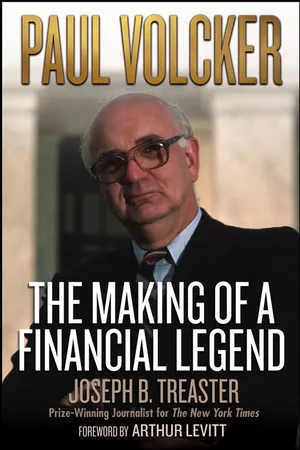
As the Chairman of the Federal Reserve from 1979 to 1982, Paul Volcker established himself as one of the most influential economic thinkers. Currently a major advocate for corporate governance and accounting reforms, Volcker's reputation as a great business leader with uncompromising ethics continues to this day. Written by award-winning New York Times journalist Joseph Treaster, Paul Volcker: The Making of a Financial Legend takes readers through the most compelling moments of this legend's life in private and public service. From his early days as a young Treasury Department official through his appointments to the New York Federal Reserve Bank, the Federal Reserve, and James D. Wolfensohn, Inc., this inspiring book captures the significant moments in Volcker life and explores the ethical, economic, and moral dilemmas he faced at every turn.
CHAPTER ONE
A FINANCE LEGEND
The lanky man in the rumpled suit puffed serenely on a cigar, and the members of the House Committee on Banking sputtered with rage. The lawmakers had been flooded by their constituents with heartbreaking stories of personal hardship as the nation slid ever deeper into the worst recession since the Great Depression. Interest rates had shot above 20 percent, millions of Americans had been thrown out of work, and consumer spending had plummeted. The vital industries that built and sold homes and cars were struggling, and thousands of businesses were heading into bankruptcy.
Yet, as the Congressmen questioned the one man most responsible for the hard times, Paul A. Volcker Jr., the chairman of the Federal Reserve Board, they drew no comfort. As bad as conditions were, Volcker said on that summer day in 1981, they were only going to get worse.1
Volcker knew, because he pulled the levers and pressed the buttons that largely determined the flow of money in America, whether it would be bountiful or scarce and how much it would cost to borrow. He had deliberately orchestrated a stratospheric rise in interest rates over the previous two years in a determined campaign to crush inflation. He had not expected interest rates to soar quite so high or the economy to fall quite so deeply into distress,2 but he was convinced that the constant escalation of prices—the essence of inflation—gravely threatened America’s economic stability and its status as a world leader, and that it had to be stopped.
Most Americans, however, did not see the danger. As troubled as they were by the uncertainties of ever rising prices, they had learned to live with inflation. They realized that the money in their pockets was losing value every month, so they bought homes and land that would rise in value as inflation rose and took out loans that would be paid back in inflated dollars. They demanded and received higher wages. Manufacturers marked up their goods. When Volcker slammed on the brakes and threw the economy into a dive, the country was stunned—and many Americans complained to their representatives in Washington.
Calm and seemingly detached in a wreath of wispy cigar smoke, Volcker told the Congressmen in their grand hearing room that summer day that while he saw signs that inflation was declining, he was cutting back further on the supply of money in the economy,3 knowing that almost certainly business failures would multiply and millions more would lose their jobs. He was doing this, he said, for the long-term good of the country.
The Congressmen literally shrieked. Frank Annunzio, a Democrat from Illinois, shouted and pounded his desk.4 “Your course of action is wrong,” he yelled, his voice breaking with emotion. “It must be wrong. There isn’t anybody who says you’re right.”5 Volcker’s high interest rates were “destroying the small businessman,” decried George Hansen, a Republican from Idaho.6 “We’re destroying Middle America,” Representative Hansen said. “We’re destroying the American Dream.” Representative Henry B. Gonzalez, a Democrat from Texas, called for Volcker’s impeachment, saying he had permitted big banks to be “predatory dinosaurs that suck up billions of dollars in resources” to support mergers while doing little to help neighborhood stores and workshops and the average American consumer.7
The outburst was a distillation of national sentiment—or resentment—that would only deepen as unemployment rose to a high of nearly 11 percent and interest rates, which peaked the following month in August 1981 at 20½ percent, remained close to 16 percent for the next year.
As the recession worsened, Americans beseeched Volcker to relent. Building contractors and carpenters inundated his offices in Washington with stubby lengths of two-by-fours, lumber they said they would not need since no one was buying houses. They slapped mailing labels on the wood and scrawled plaintive messages. On one block now sitting on a shelf at the Federal Reserve, Lloyd Fancett wrote, “I need my job, don’t stop housing.” L. D. Estes Jr., of Texarkana, Arkansas, sent in a block with a knothole. “Dear Mr. Volcker,” he wrote in black marker, “I am beginning to feel as useless as this knothole. Where will our children live?”
Car dealers sent Volcker mailbags full of ignition keys for sedans and coupes that had no buyers. Farmers brought their tractors to the capital and paraded gloomily around the Federal Reserve headquarters, along Constitution Avenue, up 21st Street, then back on C Street. Some of the protests were menacing. In Kentucky, a homebuilders’ association tacked up “Wanted” posters featuring Volcker and the six other Federal Reserve governors. In neighboring Tennessee, a building trades magazine accused Volcker and his colleagues of the “premeditated and cold-blooded murder of millions of small businesses” and of “kidnapping (and holding for ransom) the American dream of home ownership.”8 Shortly before Christmas, a man talked his way into the Federal Reserve, dashed up the interior marble stairs, and got as far as a closed-door meeting in the majestic Federal Reserve boardroom before he was tackled by a guard. The man, who told the police he was upset about high interest rates, was carrying a sawed-off shotgun, a pistol, a knife, and a satchel containing a fake bomb.9
Volcker’s fight against inflation had consequences even the Fed chairman could not have predicted, contributing strongly to the defeat of President Carter in 1980 and significantly hurting the popularity of his successor, Ronald Reagan. Both presidents chose not to quarrel openly with Volcker, but their aides felt less constrained, with some of the more pronounced hectoring coming from President Reagan’s Treasury secretaries, Donald T. Regan and James A. Baker III, who earlier had served as White House chief of staff. When Volcker told President Reagan in the summer of 1987 that he was resigning, Baker could not contain his glee. “We got the son of a bitch,” Baker told a friend in New York.10

Volcker ultimately defeated inflation, putting the country on the path to its greatest run of prosperity in history. In recognition of his success and his unyielding adherence to principles and tactics, his stature has risen to the level of demigod in the world of economics and finance. “If you play free association with the name Paul Volcker, two words come up, integrity and steadfastness,” says Alan S. Blinder, a Princeton University economics professor who served on President Bill Clinton’s Council of Economic Advisers and was Clinton’s appointee as vice chairman of the Federal Reserve Board in 1994.11
Alan Greenspan, the current chairman of the Fed, hails Volcker as the father of America’s economic vitality over most of the last two decades and says his own success in driving down inflation to historic lows has been largely an extension of “the basic policy that Volcker put in place.”12
Volcker’s approach to tackling inflation has its detractors, but even they acknowledge his historic achievement and admire his iron will. Nobel laureate in economics Joseph E. Stiglitz views him with “enormous respect,”13 even though he believes Volcker inflicted more pain than necessary on America.
Likewise, Professor Blinder would have preferred a slower pace in the inflation fight, but heralds the results. In the years since Volcker administered his shock therapy, Blinder points out, inflation has been “a very minor social and economic issue in this country.”14 As Volcker saw it, he had to strike hard to jolt Americans out of the expectation that prices would inevitably leapfrog higher and that the only way to stay ahead was to keep spending and demanding higher pay.15
In retrospect, Greenspan says, Volcker may not have needed to apply as much pressure as he did, but there was no way for Volcker or anyone else to know that. The inflation he faced was like a virulent cancer. In a situation like that, Greenspan says, one tends toward overdose. “You do not want to take the chance that you will underdose,” he says, “because you might not get a second chance.”16
Volcker was probably the best-prepared chairman ever to preside over the Federal Reserve, both in education and manner of thinking. But for all his brilliance in setting monetary policy and skill in navigating Washington politics, he often came across to ordinary Americans as a cold and arrogant numbers cruncher. The ever present cigar only reinforced the public’s perception of him as a hard-nosed banker’s banker. In a way, that’s what he was. But he was convinced that he had to act decisively to save his country from ruin. His predecessors had tried to dampen inflation, but had retreated as Americans began to feel the pain. The result had been an exceedingly long, rippling upward climb of inflation. Volcker, the son of a revered town manager dedicated to public service, felt a duty to stay the course. “If he would have walked away from it, it would have really endangered the United States...
Table of contents
- Cover
- Contents
- Title
- Copyright
- Dedication
- Foreword
- Chapter 1: A Finance Legend
- Chapter 2: Seventy-Six
- Chapter 3: The Power of the Fed
- Chapter 4: Chairman
- Chapter 5: Youth
- Chapter 6: School Days
- Chapter 7: Hardship
- Chapter 8: Difficult Choices
- Chapter 9: The Fallout
- Chapter 10: Fly-Fishing
- Epilogue
- Bibliography
- Acknowledgments
- Index
- Photo Insert
Trusted by 375,005 students
Access to over 1.5 million titles for a fair monthly price.
Study more efficiently using our study tools.
Frequently asked questions
Yes, you can cancel anytime from the Subscription tab in your account settings on the Perlego website. Your subscription will stay active until the end of your current billing period. Learn how to cancel your subscription
No, books cannot be downloaded as external files, such as PDFs, for use outside of Perlego. However, you can download books within the Perlego app for offline reading on mobile or tablet. Learn how to download books offline
Perlego offers two plans: Essential and Complete
- Essential is ideal for learners and professionals who enjoy exploring a wide range of subjects. Access the Essential Library with 800,000+ trusted titles and best-sellers across business, personal growth, and the humanities. Includes unlimited reading time and Standard Read Aloud voice.
- Complete: Perfect for advanced learners and researchers needing full, unrestricted access. Unlock 1.5M+ books across hundreds of subjects, including academic and specialized titles. The Complete Plan also includes advanced features like Premium Read Aloud and Research Assistant.
We are an online textbook subscription service, where you can get access to an entire online library for less than the price of a single book per month. With over 1.5 million books across 990+ topics, we’ve got you covered! Learn about our mission
Look out for the read-aloud symbol on your next book to see if you can listen to it. The read-aloud tool reads text aloud for you, highlighting the text as it is being read. You can pause it, speed it up and slow it down. Learn more about Read Aloud
Yes! You can use the Perlego app on both iOS and Android devices to read anytime, anywhere — even offline. Perfect for commutes or when you’re on the go.
Please note we cannot support devices running on iOS 13 and Android 7 or earlier. Learn more about using the app
Please note we cannot support devices running on iOS 13 and Android 7 or earlier. Learn more about using the app
Yes, you can access Paul Volcker by Joseph B. Treaster in PDF and/or ePUB format, as well as other popular books in Business & Finance. We have over 1.5 million books available in our catalogue for you to explore.