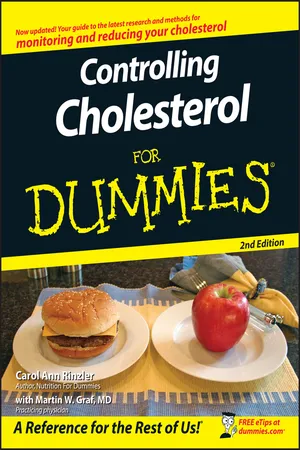
Controlling Cholesterol For Dummies
eBook - ePub

Controlling Cholesterol For Dummies

  1. English
  2. ePUB (mobile friendly)
  3. Available on iOS & Android
eBook - ePub

Controlling Cholesterol For Dummies

About this book

The latest ways to lower cholesterol and reduce the risk of heart disease Need to get your cholesterol in check? You'll find the latest information about cholesterol, including treatments, drug information, and dietary advice, in Controlling Cholesterol For Dummies, 2 nd Edition, an easy-to-understand guide to cholesterol control. You'll learn how to lower your numbers and maintain healthy cholesterol levels. You'll also find out how to eat and exercise properly, use vitamins and supplements, and quit unhealthy habits.

You'll find out cholesterol's positive functions and why too much can be a bad thing. You can also assess your cholesterol risk by taking your age, sex, ethnicity, and family history into consideration. Find out what you need to ask your doctor about stress tests, ECBT, and angiograms to check for plaque buildup. Design a cholesterol-crushing diet and understand which foods can help you lower your numbers. Find out how smoking, alcohol, exercise, excess weight, supplements, and prescription medications affect your cholesterol levels. Find out how to:

  • Assess your cholesterol risk
  • Understand the benefits and risks associated with cholesterol
  • Design and adhere to a cholesterol-lowering diet
  • Avoid dangerous drugs
  • Reduce your risk of heart attack
  • Choose fats and fibers correctly
  • Check for plaque buildup

Complete with lists of ten important cholesterol websites, ten nutrition websites, ten cholesterol myths, ten landmarks in cholesterol history, ten foods that raise your cholesterol, and ten foods that lower your cholesterol, Controlling Cholesterol For Dummies, 2 nd Edition will help keep your cholesterol levels under control for good!

Frequently asked questions

Yes, you can cancel anytime from the Subscription tab in your account settings on the Perlego website. Your subscription will stay active until the end of your current billing period. Learn how to cancel your subscription.
No, books cannot be downloaded as external files, such as PDFs, for use outside of Perlego. However, you can download books within the Perlego app for offline reading on mobile or tablet. Learn more here.
Perlego offers two plans: Essential and Complete
  • Essential is ideal for learners and professionals who enjoy exploring a wide range of subjects. Access the Essential Library with 800,000+ trusted titles and best-sellers across business, personal growth, and the humanities. Includes unlimited reading time and Standard Read Aloud voice.
  • Complete: Perfect for advanced learners and researchers needing full, unrestricted access. Unlock 1.4M+ books across hundreds of subjects, including academic and specialized titles. The Complete Plan also includes advanced features like Premium Read Aloud and Research Assistant.
Both plans are available with monthly, semester, or annual billing cycles.
We are an online textbook subscription service, where you can get access to an entire online library for less than the price of a single book per month. With over 1 million books across 1000+ topics, we’ve got you covered! Learn more here.
Look out for the read-aloud symbol on your next book to see if you can listen to it. The read-aloud tool reads text aloud for you, highlighting the text as it is being read. You can pause it, speed it up and slow it down. Learn more here.
Yes! You can use the Perlego app on both iOS or Android devices to read anytime, anywhere — even offline. Perfect for commutes or when you’re on the go.
Please note we cannot support devices running on iOS 13 and Android 7 or earlier. Learn more about using the app.
Yes, you can access Controlling Cholesterol For Dummies by Carol Ann Rinzler,Martin W. Graf in PDF and/or ePUB format, as well as other popular books in Medicine & Diseases & Allergies. We have over one million books available in our catalogue for you to explore.

Information

Publisher
For Dummies
Year
2011
Print ISBN
9780470227596
eBook ISBN
9781118052242
Edition
2
Part I

Getting Up Close and Personal with Cholesterol

In this part . . .
**IN a DROPCAP**
To do the best job of controlling your cholesterol, you need to have a handle on the basics — info such as what cholesterol is, where it comes from, what it does, and why some varieties are more threatening than others. And being a Serious Seeker of Knowledge, you probably want to be able to perform a realistic evaluation of your own risk of developing cholesterol-related problems. The info you need is right here in this part. Go for it.
Chapter 1

Mapping the Heart Land

In This Chapter

bullet
Picturing your heart
bullet
Quantifying heart disease and tracking the stats on heart attacks
bullet
Setting a sensible strategy to cut your personal risk
Heart disease is America’s number one health killer; it’s ahead of every type of cancer combined and every infectious and degenerative disease. Heart attack is the most common form of heart disease, and one significant risk factor for heart attack is high cholesterol or, more specifically, a high level of certain kinds of low-density lipoproteins (LDLs) — the “bad” fat and protein particles that ferry cholesterol into your arteries.
If you already know all this introductory stuff, feel free to skip Chapter 1 and head right into Chapter 2 where I describe cholesterol’s dual nature (yes, cholesterol has two sides).
But, then again, this chapter does lay out a statistical picture of heart disease and heart attack and explain the role cholesterol plays in placing you at risk. In fact, come to think of it, this chapter is a darn good intro to Controlling Cholesterol For Dummies, 2nd Edition.
No surprise there!

Ladies and Gentlemen, Meet Your Heart

Your heart is a pretty spectacular organ — a four-chambered, hollow muscle right smack in the middle of your chest. The heart’s job is to pump the blood that carries life-giving oxygen and other nutrients to every body tissue. To show how this works, the clever For Dummies artists have drawn a cross section of your heart in Figure 1-1 tracing the path of blood flowing in and out and in and out and in . . . you get the idea.
Figure 1-1: The heart: Looks nothing like what you drew in 4th grade, does it?
TechnicalStuff
Every second of every minute of every hour of every day, blood flows out from your heart to carry oxygen and other nutrients to every tissue and organ in your body, and then comes back to your heart to pick up more oxygen and nutrients. In other words, blood circulates, which is why your heart and the vessels through which blood travels are called the circulatory system.
The best way to explain this process is to begin at the beginning, the point at which blood flows back from your body, into your heart:
1. The blood enters your heart from the superior vena cava, a large vein that opens into the right atrium, the first chamber of your heart.
Tip
Yes, the vena cava and the right atrium are on the left side of the picture above. In this picture, you’re looking at the front of the heart as it sits in the chest of the person to whom it belongs. If he were to turn around so that you were looking at him from the back, the vena cava and the right atrium would be in the correct position, on the right side of his body. Got it? Good. Onward.

Naming the blood vessels

Blood vessels are grouped according to the job they perform in your body, which means they’re grouped in terms of whether they carry blood to your heart or away from your heart. This list explains how the groupings work:
bullet
Veins: Blood vessels that carry blood toward your heart. The word vein comes from vena, the Latin word for hollow.
bullet
Venules: Small veins.
bullet
Capillaries: Teensy, little veins that connect arteries to veins right under the skin. When blood flows into your capillaries, the red liquid under the skin gives you a rosy glow — a blush.
bullet
Arteries: Blood vessels that carry blood away from your heart. The word artery comes from arteria, the Latin word for windpipe.
bullet
Arterioles: Very small arteries.
I have no idea why the person who named the blood vessels picked a word that means hollow for veins and a word that means windpipe for arteries. If it were up to me, I would’ve used a word that means “bring to” for veins, and a word that means “go away from” for arteries.
In fact, the words afferent (from the Latin ad = toward and ferro = carry) and efferent (ferro plus the Latin ex = away) are used to describe, respectively, nerves that carry impulses to or away from the central nervous system. Maybe whoever named the blood vessels picked veins and arteries because afferent and efferent were already taken. Works for me.
2. From the right atrium, blood spills down through a one-way “trapdoor” called the tricuspid valve and into the right ventricle.
3. When the right ventricle contracts (squeezes together), the blood is sent out of your heart through the pulmonary artery and into your lungs where it picks up a plentiful supply of oxygen...

Table of contents

  1. Title
  2. Contents
  3. Introduction
  4. Part I : Getting Up Close and Personal with Cholesterol
  5. Chapter 1: Mapping the Heart Land
  6. Chapter 2: Comparing Cholesterol’s Risks and Benefits
  7. Chapter 3: Rating Your Cholesterol-Related Risk
  8. Part II : Eating Your Way to Lower Cholesterol
  9. Chapter 4: Writing Rules for a Cholesterol-Lowering Diet
  10. Chapter 5: Building a Cholesterol-Lowering Diet
  11. Chapter 6: Pinning Down the “How-To’s” for a Cholesterol-Lowering Diet
  12. Part III : Leading a Cholesterol-Lowering Lifestyle
  13. Chapter 7: Weighing Weight’s Weight on Cholesterol
  14. Chapter 8: Exercising Options to Control Your Cholesterol
  15. Chapter 9: Weeding Out Tobacco’s Role in High Cholesterol
  16. Chapter 10: The Grape, the Grains, and Your Cholesterol
  17. Part IV : Cutting Cholesterol with Nutrients and Medicine
  18. Chapter 11: Vitamins, Minerals, and Other Good Stuff
  19. Chapter 12: Prescribing Lower Cholesterol
  20. Chapter 13: Identifying Meds That Raise Cholesterol
  21. Chapter 14: Mouth-Watering Morsels for Special Occasions
  22. Part V: The Part of Tens
  23. Chapter 15: Ten Clicks to Reliable Cholesterol Information
  24. Chapter 16: Ten Nutrition Web Sites
  25. Chapter 17: Ten Cholesterol Myths
  26. Chapter 18: Ten (Okay, Eleven) “Eureka!” Cholesterol Moments
  27. Appendix: Calories and Other Nutrients in Food
  28. : Further Reading