Rotating Electrical Machines
eBook - ePub

Rotating Electrical Machines

  1. English
  2. ePUB (mobile friendly)
  3. Available on iOS & Android
eBook - ePub

Rotating Electrical Machines

About this book

In this book a general matrix-based approach to modeling electrical machines is promulgated. The model uses instantaneous quantities for key variables and enables the user to easily take into account associations between rotating machines and static converters (such as in variable speed drives). General equations of electromechanical energy conversion are established early in the treatment of the topic and then applied to synchronous, induction and DC machines. The primary characteristics of these machines are established for steady state behavior as well as for variable speed scenarios.

Important new applications for this technology (such as wind turbines, electric propulsion systems for large ships, etc.) are addressed and the book is illustrated with a large number of informative and detailed photographs, provided by various companies at the leading edge of research and applications in the field.

Frequently asked questions

Yes, you can cancel anytime from the Subscription tab in your account settings on the Perlego website. Your subscription will stay active until the end of your current billing period. Learn how to cancel your subscription.
No, books cannot be downloaded as external files, such as PDFs, for use outside of Perlego. However, you can download books within the Perlego app for offline reading on mobile or tablet. Learn more here.
Perlego offers two plans: Essential and Complete
  • Essential is ideal for learners and professionals who enjoy exploring a wide range of subjects. Access the Essential Library with 800,000+ trusted titles and best-sellers across business, personal growth, and the humanities. Includes unlimited reading time and Standard Read Aloud voice.
  • Complete: Perfect for advanced learners and researchers needing full, unrestricted access. Unlock 1.4M+ books across hundreds of subjects, including academic and specialized titles. The Complete Plan also includes advanced features like Premium Read Aloud and Research Assistant.
Both plans are available with monthly, semester, or annual billing cycles.
We are an online textbook subscription service, where you can get access to an entire online library for less than the price of a single book per month. With over 1 million books across 1000+ topics, we’ve got you covered! Learn more here.
Look out for the read-aloud symbol on your next book to see if you can listen to it. The read-aloud tool reads text aloud for you, highlighting the text as it is being read. You can pause it, speed it up and slow it down. Learn more here.
Yes! You can use the Perlego app on both iOS or Android devices to read anytime, anywhere — even offline. Perfect for commutes or when you’re on the go.
Please note we cannot support devices running on iOS 13 and Android 7 or earlier. Learn more about using the app.
Yes, you can access Rotating Electrical Machines by René Le Doeuff,Mohamed El Hadi Zaïm in PDF and/or ePUB format, as well as other popular books in Technology & Engineering & Electrical Engineering & Telecommunications. We have over one million books available in our catalogue for you to explore.

Chapter 1

Main Requirements

1.1. Introduction

The study of rotating electrical machines is a science which is linked with several other topics. In order to make this book easier to read, we are going to summarize the main results and concepts used later on in this introductory chapter:
– sinusoidal systems;
– electromagnetism;
– power electronics.

1.2. Sinusoidal variables

1.2.1. Single-phase variables

1.2.1.1. Timed expressions

An x variable, a timed-sinusoidal function, can be written as:
image
where X is the rms (root-mean-square) value and is the angular velocity.

1.2.1.2. Vector representation

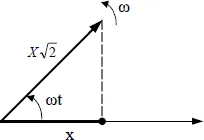
The x variable defined above can be considered to be the projection on an axis of a vector of length X
image
rotating anticlockwise at an angular velocity ω (Figure 1.1).
Figure 1.1. Vector representation of a sinusoidal variable
image

1.2.1.3. Single-phase currents and voltages

If a sinusoidal single-phase voltage v is applied at a Z impedance terminal, current i in this impedance, at steady state, is also sinusoidal, and can be written:
image
image
φ being the phase shift between the voltage often chosen as the origin and the current. Conventionally, φ is counted positively when the current is lagging behind the voltage. The instantaneous power supplied to impedance Z is:
image
[1.1]
image
is the active power and:
[1.2]
image
is the pulsating power. It must be noted that this variable, which characterizes the fact that the single-phase power supplied to a receiver is time varying, is cancelled with balanced polyphase systems.
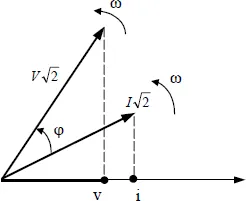
Figure 1.2 shows that voltage is changed into current through a similitude of ratio Z and angle φ.
Figure 1.2. Vector representation of sinusoidal current and voltage
image

1.2.1.4. Complex representation

Complex numbers are very useful to represent the previous similitude and vector
image
will thus be associated with complex number
image
as well as complex number Ī with vector
image
. They can then be written as follows:
image
image
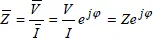
Complex impedance
image
is also defined by ratio:
image
It will be set down:
image
image
R and X respectively being the resistance and the reactance expressed in Ohms.
image
is also introduced :
[1.3]
image
image
is the apparent power expressed in volt-amperes (VA). Q is the reactive power expressed in volt-amperes reactives (VAr).

1.2.2. 2-phase voltages and currents

A 2-phase voltage system is defined by two voltages in quadrature:
image
image
if it is loaded onto a symmetr...

Table of contents

  1. Cover
  2. Title Page
  3. Copyright
  4. Preface
  5. Chapter 1: Main Requirements
  6. Chapter 2: Introduction to Rotating Electrical Machines
  7. Chapter 3: Synchronous Machines
  8. Chapter 4: Induction Machines
  9. Chapter 5: Direct Current Machines
  10. Bibliography
  11. Index