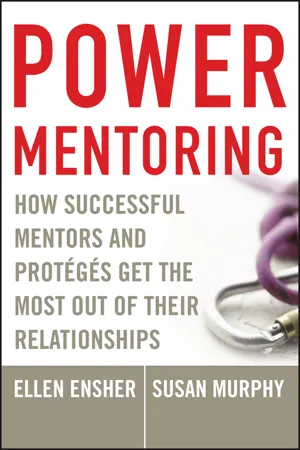
eBook - ePub
Power Mentoring
How Successful Mentors and Protégés Get the Most Out of Their Relationships
- English
- ePUB (mobile friendly)
- Available on iOS & Android
eBook - ePub
Power Mentoring
How Successful Mentors and Protégés Get the Most Out of Their Relationships
About this book
Written to reflect the realities of todays business environment, Power Mentoring is a nuts-and-bolts guide for anyone who wants to create a connection with a protg or mentor, or to improve a current mentoring relationship. Filled with illustrative examples and candid insights from fifty of America'smost successful mentors and protgs, Power Mentoring unlocks the secrets of great mentoring relationships and shows how anyone (including those who are well established in their careers, or those who are just starting out) can become a successful mentor or protg. Based on compelling interviews from Ellen Ensher and Susan Murphys own research, this important resource explains what it takes to develop a power mentoring network consisting of a variety of mentors across a range of organizations and industries. The authors provide strategies for establishing suchpower mentoring relationships, outline the best practices, and offer insights from mentors and protgs in a variety of fields including technology, politics, and the media.
Information
CHAPTER ONE
INTRODUCTION TO POWER MENTORING
And when the event, the big thing in your life, is simply
an insight—isn’t that a strange thing? That absolutely
nothing changes except you see things differently and
you’re less fearful and less anxious and generally stronger
as a result: Isn’t that amazing that a completely invisible
thing in your head can feel realer than anything you’ve
experienced before?
an insight—isn’t that a strange thing? That absolutely
nothing changes except you see things differently and
you’re less fearful and less anxious and generally stronger
as a result: Isn’t that amazing that a completely invisible
thing in your head can feel realer than anything you’ve
experienced before?
—JONATHAN FRANZEN, THE CORRECTIONS
As a child, what did you want to be when you grew up? Maybe it did not work out that you would be a movie star or an Olympic athlete, but have you found the level of joy in your work that you had hoped for? When you chose your major in college and then later changed it, or perhaps recently made a job or career switch, why did you do it? Maybe it was because you suddenly had the Great Career Insight—I will spend the majority of my waking hours for the rest of my life at work, so if I am not as happy at work as I want to be now, then I am wasting my life! We spend more time working than doing anything else we do in our lives. Those of us in the United States have the dubious distinction of working more hours and taking less vacation time per year than our counterparts in nearly any other industrialized nation.1 Nearly 40 percent of U.S. workers spend at least 50 hours on the job per week, and that number is even higher for the professional class.2
Why do we work so much? Maybe because in the United States we see work as central to who we are as individuals. An Associated Press survey showed that 91 percent of respondents said their jobs were important to their overall satisfaction in life.3 Given that we spend many hours at work, how we view it is important. Work can be a joy or drudgery, and an overwhelming amount of research conclusively shows that this often depends on our relationships with other people at work. Power Mentoring is about helping you gain more fulfillment at work by showing you how to actively develop and improve your relationships with others there, and in doing so gain all of the career outcomes that you have always imagined.
Consider the following situation: What would you do if you found out that your colleagues were corrupt and stealing money from one of Southern California’s poorest cities? Imagine you were a young public servant and felt as though you had no one to trust or turn to about this crisis. This is the situation that Araceli Gonzalez, former council member for the city of Cudahey, found herself in a few short years ago. She had no one to turn to, except, that is, for her mentor, Rosario Marin (41st U.S. Treasurer). What would you do if you were the mentor in this situation? Rosario Marin told Araceli to “do the right thing” and turn in her colleagues. Araceli did so and found that “everyone turned against her, except Rosario.” Marin stood by her young protégé and helped her get back on her feet politically and career-wise. Gonzalez has gone on to become a successful small business owner and received national recognition as an up-and-coming leader.
In this book, we share many stories like this and insights from interviews with 50 of America’s most successful mentors and protégés in leading industries. We reveal secrets from academia and present our own research that demonstrates how having a network of good mentoring relationships can make your work environment, your job, and your career better.
Power Mentoring is for professionals and managers who want to make the most of their careers. We have written this book for those of you who want to obtain a protégé or mentor, or who simply want to improve a current mentoring relationship. The book can also help you regardless of whether you are well established in your career or are just starting out. You might be a manager, a technical specialist, or even an entrepreneur. Our intention is that Power Mentoring will be helpful to people at all stages of their careers and in many types of positions. It is also for administrators of mentoring programs and anyone who teaches or conducts training about mentoring.
Regardless of whether you are thinking about finding a mentor, becoming a mentor, or extending your vast experience with mentoring, there is always much to learn. Some of our interviews provide examples of traditional mentoring relationships, in which an older, more experienced mentor takes a younger protégé under his or her wing and guides the protégé through career twists and turns. We found, however, that most of our interviewees did not rely on a single traditional mentor for support, but instead had a broad network consisting of a variety of mentors to support them. We call this network approach to mentoring power mentoring. We found that all those involved in power mentoring, both as mentors and as protégés, received mutually beneficial outcomes related to their personal career growth and development. In this book you’ll learn more about the various forms of power mentoring, how it differs from traditional mentoring, and the benefits associated with these relationships.
In this chapter, first we briefly introduce you to the power mentors and protégés in our research. Next we take you through a brief, compelling overview of what has changed in the career landscape, and of how power mentoring reflects the most contemporary approach to career development. Finally, we provide you with an overview of the book.
WHO ARE OUR POWER MENTORS AND PROTÉGÉS?
To learn about power mentoring, we had the great fortune to interview 50 top leaders in a variety of industries. To find these individuals, we culled through well-respected lists identifying leading executives, with an eye toward being especially inclusive of women and people of color. While our interviewees represent a variety of industries, there is a marked emphasis on entertainment, technology, and politics. These industries exert tremendous worldwide influence. They also have a high percentage of knowledge workers who represent the cutting edge in career management by moving from project to project, working in teams, and identifying with their profession or party more than with a particular organization. Next, we did extensive background research on each of these individuals and their experiences as mentors and protégés. We then created a target list of those we felt were not only exemplary leaders but were also highly skilled at developing others via mentoring. As a final step, we employed a network of industry experts to provide feedback on participant worthiness for inclusion in Power Mentoring.
Once we identified a top mentor, or in some cases a protégé, we then set out to learn as much as possible about that person’s network of mentoring relationships, including their past mentors and current protégés. Often we found that the power mentors had very strong one-on-one relationships with one or several protégés, so in those cases we interviewed mentor-protégé pairs such as Lisa Ling, television host and reporter, and her mentor, Mitch Koss, Channel One television news producer. Sometimes we found that power mentors had a one-on-one relationship that blossomed to include not only their relationship with a single protégé but also with the protégé’s other mentors and contacts. In those cases we interviewed mentoring groups such as Cisco’s CFO Larry Carter, his protégé Patty Archibeck, and Patty’s other mentor, Debra Martucci, vice president of Information Technology at Synopsys, in California’s Silicon Valley.
And finally, we were fascinated to find that mentors sometimes belong to an entire lineage of mentoring relationships. In a lineage, all of the mentors and protégés connect to each other through a relationship with a “founding” mentor, as in the Jack Welch lineage at General Electric (GE) or the Lou Gerstner lineage at IBM. Although the majority of our interviews represent pairs, groups, or lineages, in some cases, because of other time commitments or outside events (such as illness or war), we were able to interview the mentor only. In these cases, we relied solely on their reflections about their relationships.
Often when we pick up a book filled with fascinating career details, many of us assume that those experiences have little to do with our own lives, because the people portrayed are at the height of their success. Please do not make that assumption with this book! The individuals we profile in Power Mentoring often come from humble beginnings and have compelling mentoring stories with which many people can identify. These people got to where they are not by luck, but because of their superior technical and relationship talents and their ability to persevere. The difference between them and other people with talent is that they were not hesitant to ask for help. They were very eager to learn from others. While some had all the advantages one could wish for, others had very modest starts and overcame many obstacles to reach their current levels of success.
Our interviewees have other unique characteristics. First, rather than interviewing a majority of men or of women, our sample included roughly equal numbers. We also looked at mentoring through diverse eyes. Our interviews represented men and women of various ethnicities, ages, sexual orientations, and childhood economic backgrounds, each difference providing us with some unique ideas about mentoring. Let’s start by giving you a preview of some of our very interesting power mentors. Of course, later in the book, you will also get a chance to meet at least one of their protégés as well. To give you an introduction to some of our individuals, we describe three with compelling stories.
First, we have the inspiring story of Dixie Garr, vice president of Cisco’s Customer Success Engineering. As the youngest of eight children, Dixie grew up in a small town in Louisiana and graduated from her high school class with a National Merit Scholarship. In her role at Cisco, relationship building is her forte, because she leads teams responsible for world-class customer service. When you meet Dixie, you notice her radiant self-confidence, which comes from knowing that she has worked hard to get where she is and that she has much to share with others. She does so often—for example, in addition to her responsibilities at Cisco, she is a sought-after motivational speaker. Her mentoring relationships have been characterized by candor and honesty. As far as her success goes, Dixie says that “there was never a time that I didn’t expect to ... be all that I could be. My parents helped me to understand that I could not be passive, but proactive.” Dixie is a glass-ceiling breaker as a black woman in a white male-dominated field. She is also living proof of her belief that technology is a great leveler for women and minorities—she sometimes paraphrases James Brown’s lyrics, “Don’t give me anything, just open the door and I’ll get it myself.”
We also had the good fortune to interview a master mentor, Bob Wright, vice-chair of GE and chair and chief executive officer (CEO) of NBC Universal. Bob joined GE in 1969 and has been an influential mentor for many talented business leaders—you’ll meet two of his superstar protégés, Pamela Thomas-Graham, chair of CNBC, and Paula Madison, president and general manager of KNBC, in subsequent chapters. As a protégé of the legendary Jack Welch and thus part of his lineage, Bob’s career reads like a primer on how to be successful in American business. Bob enjoys a sterling professional and personal reputation, and under his leadership GE/NBC has made significant inroads in recruiting, retaining, and promoting diverse men and women. In a Columbia Business School lecture in 2003, he shared this observation with his audience: “I’ve learned that one of the main differentiators between good leaders and great leaders is not necessarily intelligence or experience or personal charisma. It is passion—intense passion for your work and for the success—not of the self—but of the larger enterprise.”4 In future chapters you’ll learn a lot more about how Bob brings these words to life through his mentoring relationships.
Now we introduce you to another fascinating and very different power mentor, Rosario Marin, who at the time of our interview was serving as the U.S. Treasurer and was the highest-ranking Latina in the administration of President George W. Bush. Rosario emigrated to the United States from Mexico when she was 14 years old. She spoke no English. A few years later she graduated from Harvard, and judging from her career success since, you might assume that she has led a charmed life. Not so. As a result of having a son with Down syndrome she became frustrated with the available state and federal services for the disabled, and her passion to help her son galvanized her to get involved in politics. Initially she was drawn to work for former California Governor Pete Wilson, because when she heard him speak on behalf of people with disabilities she knew “he was a man of compassion.” Wilson became a mentor for her, and she served as deputy director of the Governor’s Office of Community Relations. Years later, even in her very busy and highly visible role as U.S. Treasurer, Rosario stayed active in her Latino community and the world of Southern California politics by mentoring several young, aspiring politicians in state government.
These are just three of our extraordinary interviewees. We provide a complete list of ...
Table of contents
- Title Page
- Copyright Page
- Dedication
- CHAPTER ONE - INTRODUCTION TO POWER MENTORING
- CHAPTER TWO - THE MANY FACES OF POWER MENTORING
- CHAPTER THREE - MENTORING AS A TWO-WAY STREET Benefits of Giving and Receiving
- CHAPTER FOUR - THE MIND OF THE MENTOR
- CHAPTER FIVE - THE PROTÉGÉ’S PERSPECTIVE
- CHAPTER SIX - UNLOCKING THE SECRETS OF GREAT POWER MENTORING RELATIONSHIPS
- CHAPTER SEVEN - POWER MENTORING AND YOU
- CHAPTER EIGHT - CONCLUSION
- APPENDIX A - THE INTERVIEWEES
- APPENDIX B - STUDYING POWER MENTORING RELATIONSHIPS
- NOTES
- Acknowledgments
- THE AUTHORS
- INDEX
Trusted by 375,005 students
Access to over 1.5 million titles for a fair monthly price.
Study more efficiently using our study tools.
Frequently asked questions
Yes, you can cancel anytime from the Subscription tab in your account settings on the Perlego website. Your subscription will stay active until the end of your current billing period. Learn how to cancel your subscription
No, books cannot be downloaded as external files, such as PDFs, for use outside of Perlego. However, you can download books within the Perlego app for offline reading on mobile or tablet. Learn how to download books offline
Perlego offers two plans: Essential and Complete
- Essential is ideal for learners and professionals who enjoy exploring a wide range of subjects. Access the Essential Library with 800,000+ trusted titles and best-sellers across business, personal growth, and the humanities. Includes unlimited reading time and Standard Read Aloud voice.
- Complete: Perfect for advanced learners and researchers needing full, unrestricted access. Unlock 1.5M+ books across hundreds of subjects, including academic and specialized titles. The Complete Plan also includes advanced features like Premium Read Aloud and Research Assistant.
We are an online textbook subscription service, where you can get access to an entire online library for less than the price of a single book per month. With over 1.5 million books across 990+ topics, we’ve got you covered! Learn about our mission
Look out for the read-aloud symbol on your next book to see if you can listen to it. The read-aloud tool reads text aloud for you, highlighting the text as it is being read. You can pause it, speed it up and slow it down. Learn more about Read Aloud
Yes! You can use the Perlego app on both iOS and Android devices to read anytime, anywhere — even offline. Perfect for commutes or when you’re on the go.
Please note we cannot support devices running on iOS 13 and Android 7 or earlier. Learn more about using the app
Please note we cannot support devices running on iOS 13 and Android 7 or earlier. Learn more about using the app
Yes, you can access Power Mentoring by Ellen A. Ensher,Susan E. Murphy,Susan Murphy in PDF and/or ePUB format, as well as other popular books in Business & Management. We have over 1.5 million books available in our catalogue for you to explore.