- Current knowledge and trends in effective practice of nonprofit organization leadership and management.
- A thoroughly revised edition based on the most up-to-date research, theory, and experience.
- Practical advice on: board development, strategic planning, lobbying marketing, government contracting, volunteer programs, fund-raising, financial accounting, compensation and benefits programs, and risk management.
- An examination of emerging topics of interest such as strategic alliances and finding and keeping the right employees.
- Contributions from luminaries such as John Bryson, Nancy Axelrod, and Peter Dobkin Hall, and the best of the new generation of leaders like Cynthia Massarsky.
- English
- ePUB (mobile friendly)
- Available on iOS & Android
eBook - ePub
About this book
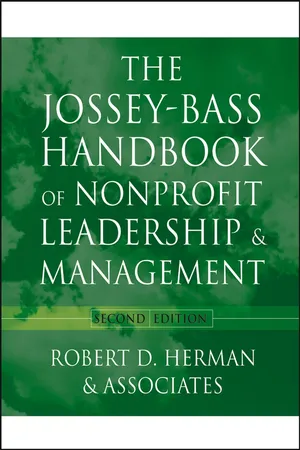
The Jossey-Bass Handbook of Nonprofit Leadership and Management offers a comprehensive and in-depth description of the most effective leadership and management practices that can be applied throughout a nonprofit organization. This second edition of the best-selling handbook brings you:
Information
PART ONE
CONTEXT AND INSTITUTIONS
While people have probably always engaged in informal voluntary efforts, the establishment and character of formal nonprofit organizations are greatly affected by social, political, legal, and economic institutions. The United States and Canada have, by international standards, large nonprofit sectors of long standing. To fully understand current (and evolving) nonprofit management and leadership practices and issues, we need to understand how institutions have shaped and influenced nonprofit organizations.
This part of the book contains five chapters that describe and analyze the historical evolution of the U.S. nonprofit sector; how nonprofit organizations are affected and affect our society’s major institutions; the legal and regulatory environment within which U.S. nonprofit organizations, particularly charities, must operate; how nonprofit organizations have responded to changes in the recent relationship of governments to nonprofit organizations and in the political economy more generally; and how the increasingly international and global character of philanthropy affects the leadership and management of nonprofit organizations that operate internationally.
CHAPTER ONE
Historical Perspectives on Nonprofit Organizations in the United States
Peter Dobkin Hall
Although charitable, educational, and religious organizations (such as the Roman Catholic Church) are thousands of years old and some in the United States (such as Harvard College) were founded in colonial times, the concept of “nonprofit organizations” as a unified and coherent “sector” dates back only to the 1970s.
In fact, over 90 percent of nonprofit organizations currently in existence were created since 1950. Worldwide, most nongovernmental organizations (NGOs) have come into being in the past thirty years. Nonprofits and NGOs are the most rapidly growing types of organizations in the world.
It is difficult to generalize about what nonprofit organizations are, what they do, and how they do it. They vary enormously in scope and scale, ranging from informal grassroots organizations with no assets and no employees through multibillion-dollar foundations, universities, religious bodies, and health care complexes with thousands of employees or members. While some provide traditional charitable, educational, and religious services, the law in many countries, including the United States, permits them to provide almost any kind of good or service on a not-for-profit basis. Sources of revenue vary: some nonprofits are supported by donations, others depend on income from sales of goods and services, and many receive most or all of their revenues from government. Modes of governance range from the autocracy of sole trustees selected from among the descendants of charitable donors through broadly representative boards composed of ex officio elected officials or directors elected by members of the organization.
Because of the complexity and diversity of nonprofit organizations, the term nonprofit itself has a variety of meanings. It can refer to entities classified by the Internal Revenue Code as 501 (c) (3) charitable tax-exempts or to a more inclusive universe of 501 (c) (4) civic organizations, which are themselves exempt from taxation but do not allow deductibility of donations. Good arguments can be made for including other noncharitable nonprofits such as cemeteries; veterans’ and fraternal and sororal organizations (such as the Masons and the Elks); political parties; and other organizations covered by section 501 (c). However inclusive, restricting the term to organizations accorded nonprofit status by the tax code remains problematic, since it does not include churches and other religious organizations that enjoy the privileges of 501 (c) (3)s but are not legally required to incorporate or seek exempt status. There is also a vast realm of unincorporated associations (such as Alcoholics Anonymous and other selfhelp groups) that perform many of the functions of incorporated nonprofits as providers of charitable, educational, and religious services but whose assets do not merit—or that ideology does not permit—formal institutionalization.
Because their numbers have grown so rapidly, because they are so diverse, and because their impact is so far-reaching—touching on every aspect of our lives and every level of institutions—nonprofits have been the focus of intense controversy as legislators, the courts, and the public have struggled to come to terms with this organizational revolution. At the same time, because the non-profit universe has been in a process of emergence, everyone within it had to struggle to define and legitimate it.
For all these reasons—diversity, complexity, and disagreement about how to define them—nonprofits pose particular difficulties for scholars trying to explain their history. While elements of the “nonprofit sector” date back to biblical and classical times (religious bodies, for example), other important aspects of it are entirely new (hospitals and universities, for instance). At best, in trying to understand the history of nonprofits, we can identify the various ideas and institutions that make up today’s nonprofit domain and show how they have evolved over time.
ASSOCIATIONS IN EARLY AMERICA
The basic legal vehicles of today’s nonprofits—the corporation and the trust—were known to colonial Americans. Philanthropy and volunteer service—giving money and time—were also features of early American life. But because the colonists understood the role of government and the rights and responsibilities of citizenship so differently, these vehicles and practices little resembled the forms they take in modern America.
To begin with, there was no clear demarcation between the public and the private realm. All corporations, to the extent that they were permitted to exist, were considered public agencies (Davis, 1918; Dodd, 1960; Hurst, 1970; Seavoy, 1982). Most common were municipal corporations: townships (Hartog, 1983). In most colonies, religious congregations were public corporations supported by taxation and enjoying monopoly powers. The early colleges, Harvard (founded in 1638), William and Mary (1689), and Yale (1701), were sustained by government grants and governed by clergymen who, as officials of the government-supported (“established”) churches, were public actors (Whitehead 1976). No private corporation as we understand the term today existed in America before the 1780s. Many of these institutions—churches, townships, and colleges—accepted gifts and bequests from donors and held them in trust as endowments, though it would be decades before American courts would have the power to enforce or adjudicate trusts.
Citizens often pitched in to maintain roads, to build meetinghouses, to fight with militias, and to assist with other public tasks (McKinney, 1995). While superficially resembling modern volunteers, these citizens were usually compelled by law to labor on behalf of the public. Service of this kind was a common way of paying taxes in a primitive colonial economy in which barter usually took the place of money. Militia duty and service in public office were often required by law—and those who failed to “volunteer” to serve were often punished by fines.
Despite obvious differences, these colonial institutions resembled modern nonprofits in important ways (Zollmann, 1924). They were self-governing, with decisions made by members who often delegated power to governing boards. More important, they had no owners or stockholders. As public bodies, they were exempt from taxation. And like modern nonprofits, they could accept donations and bequests for charitable purposes, such as supporting education and poor relief.
During the eighteenth century, population growth, economic development, and closer contact with England and other European countries changed American institutions. More people and the founding of new towns made it harder to maintain social and political unity. Artisans, merchants, and laborers living in seaports, dependent on trade and exposed to new ideas from Europe, developed different ways of thinking and living from subsistence farmers living in isolated landlocked villages. Even in the backcountry, conflict developed between farmers who began to grow crops for sale to urban merchants—tying themselves to the emerging market economy—and those who continued to produce largely to satisfy their own needs. To complicate matters, England’s efforts to integrate the colonies into its growing commercial empire brought political changes. In many colonies, elected officials were replaced by royal appointees, and the Congregationalist religious monopoly was broken by the establishment of Anglican churches.
New ideas accompanied these social, economic, and political changes. Out of a century of religious warfare and political strife in Europe came philosophies that asserted the “natural rights” of citizens, including freedom of speech, assembly, and worship, and questioned the authority of arbitrary and oppressive government (Bailyn, 1992). New ideas also included more sophisticated understandings of law, particularly as it affected economic rights (Katz, 1971; Katz, Sullivan, and Beach, 1985; Nelson, 1975; Horowitz, 1977).
Closer ties to Europe brought not only new ideas but also new institutions. After an apprenticeship as a printer in London, young Benjamin Franklin returned with firsthand knowledge of the various kinds of voluntary associations being formed by English tradesmen (Morgan, 2003). Freemasonry, a fraternal order whose members were committed to a variety of radical political and religious ideas, spread rapidly through the colonies in the mid-1700s. Masonry provided a model for other forms of private voluntary associations, most notably Franklin’s Junto, a club of young Philadelphia tradesmen who pooled their books, trained one another in debating and writing, and supported one another’s political and economic ambitions.
Closer ties with Europe also transformed American religious life as evangelists associated with dissenting sects crossed the ocean to spread their doctrines (Ahlstrom, 1972; Finke and Stark, 1992; Hatch, 1989; Butler, 1990). Soon American cities and towns were filled with competing churches, with Methodists, Baptists, and other religious enthusiasts crowding out the older Congregationalists and Methodists. Although Pennsylvanians and Rhode Islanders had long enjoyed religious toleration, the notion that people could freely choose how to worship and were free to form and support their own congregations, free of government interference, was a novel idea to most Americans. In many places, religious dissenters demanded and succeeded in obtaining many of the same rights as members of established churches, including exemption of their congregations from taxation. This set an important precedent for the secular associations that would proliferate in the nineteenth century.
The American Revolution drew on all these intellectual and organizational developments: religious revivals and political theories that affirmed the importance of individual rights, experience in organizing voluntary associations, and the use of associations in politics. Groups like the Sons of Liberty and the Committees of Correspondence helped mobilize citizens to fight for American independence.
VOLUNTARY ASSOCIATIONS IN THE NEW REPUBLIC, 1780-1860
Despite their importance during the Revolution, many Americans distrusted voluntary associations and feared the power of wealthy private institutions. These feelings were fueled by popular uprisings like Shays’s Rebellion, in which Revolutionary War veterans led armed resistance to tax collectors, and the establishment of the Society of the Cincinnati, an association of army officers that critics believed sought the creation of a titled aristocracy. This fueled resistance to efforts to charter corporations and to enact legal reforms that would make it easier to set up and enforce charitable trusts.
Led by Virginia, many states actively discouraged private charity (Wyllie, 1959; Miller, 1961). In 1792, the Commonwealth of Virginia annulled the British laws that authorized the establishment of charitable trusts and confiscated endowments administered by the Anglican Church. Favoring public over private institutions, Virginia established the first state university in 1818 (Dabney, 1981). This would become a common pattern in many southern and western states.
The South was not alone in its suspicion of private charitable enterprise. In 1784, New York established the Regents of the University of the State of New York, a regulatory body that oversaw all charitable, education, religious, and professional organizations. In the 1820s, the state enacted laws limiting the size of institutional endowments and the size of bequests that testators could leave to charity.
In contrast, the New England states actively encouraged private initiatives of all sorts. By 1800, Massachusetts and Connecticut had chartered more corporations than all the other states combined. Voluntary associations—formal and informal; religious and secular—flourished. By the 1820s, legal reforms gave further encouragement to private charities by protecting trustees from liability and liberalizing the kinds of investments they could make. As a result, the New England states became national centers for education, culture, and science as the wealth from the region’s industrializing economy poured into the coffers of its colleges, hospitals, libraries, and museums (Hall, 1982).
These growing differences in the treatment of private associations, charity, and philanthropy inevitably had political consequences. With the rise of popular politics and the intensification of efforts to disestablish churches in states where some religious groups still enjoyed monopoly privileges and tax support, conservative elites went on the defensive, using colleges and other private institutions to protect their power. These struggles came to a head in the Dartmouth College Case (Trustees of Dartmouth College v. Woodward, 17 U.S. 518, 1819; Tobias, 1982). In 1819, the U.S. Supreme Court was asked to decide whether the state of New Hampshire had exceeded its powers in taking over a privately endowed educational institution and turning it into a public institution. The court, in ruling that a corporation was a private contract and hence protected by the contracts clause of the United States Constitution, gave assurance to donors that the institutions they founded and supported would be safe from government interference. Later, in the Girard Will Case (Vidal v. Executors of Girard, 43 U.S. 127, 1844), the Court would affirm the legal basis for private philanthropy, even in states like Pennsylvania, which had annulled British charity statutes.
Because the Constitution granted significant power to the states, these federal court decisions had limited impact. Every state had its own laws governing corporations, associations, and charities. Some, like the states of New England, encouraged private philanthropy and protected charitable corpora...
Table of contents
- Title Page
- Copyright Page
- List of Tables
- Table of Figures
- Table of Exhibits
- PREFACE
- THE EDITOR
- THE CONTRIBUTORS
- PART ONE - CONTEXT AND INSTITUTIONS
- PART TWO - KEY LEADERSHIP ISSUES
- PART THREE - MANAGING OPERATIONS
- PART FOUR - DEVELOPING AND MANAGING FINANCIAL RESOURCES
- PART FIVE - MANAGING PEOPLE
- CONCLUSION: THE FUTURE OF NONPROFIT MANAGEMENT
- NAME INDEX
- SUBJECT INDEX
Trusted by 375,005 students
Access to over 1.5 million titles for a fair monthly price.
Study more efficiently using our study tools.
Frequently asked questions
Yes, you can cancel anytime from the Subscription tab in your account settings on the Perlego website. Your subscription will stay active until the end of your current billing period. Learn how to cancel your subscription
No, books cannot be downloaded as external files, such as PDFs, for use outside of Perlego. However, you can download books within the Perlego app for offline reading on mobile or tablet. Learn how to download books offline
Perlego offers two plans: Essential and Complete
- Essential is ideal for learners and professionals who enjoy exploring a wide range of subjects. Access the Essential Library with 800,000+ trusted titles and best-sellers across business, personal growth, and the humanities. Includes unlimited reading time and Standard Read Aloud voice.
- Complete: Perfect for advanced learners and researchers needing full, unrestricted access. Unlock 1.5M+ books across hundreds of subjects, including academic and specialized titles. The Complete Plan also includes advanced features like Premium Read Aloud and Research Assistant.
We are an online textbook subscription service, where you can get access to an entire online library for less than the price of a single book per month. With over 1.5 million books across 990+ topics, we’ve got you covered! Learn about our mission
Look out for the read-aloud symbol on your next book to see if you can listen to it. The read-aloud tool reads text aloud for you, highlighting the text as it is being read. You can pause it, speed it up and slow it down. Learn more about Read Aloud
Yes! You can use the Perlego app on both iOS and Android devices to read anytime, anywhere — even offline. Perfect for commutes or when you’re on the go.
Please note we cannot support devices running on iOS 13 and Android 7 or earlier. Learn more about using the app
Please note we cannot support devices running on iOS 13 and Android 7 or earlier. Learn more about using the app
Yes, you can access The Jossey-Bass Handbook of Nonprofit Leadership and Management by in PDF and/or ePUB format, as well as other popular books in Business & Nonprofit Organizations & Charities. We have over 1.5 million books available in our catalogue for you to explore.