eBook - ePub
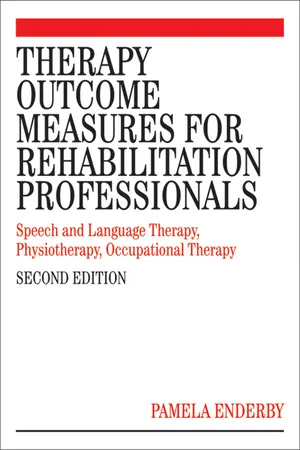
Therapy Outcome Measures for Rehabilitation Professionals
Speech and Language Therapy, Physiotherapy, Occupational Therapy
- English
- ePUB (mobile friendly)
- Available on iOS & Android
eBook - ePub
Therapy Outcome Measures for Rehabilitation Professionals
Speech and Language Therapy, Physiotherapy, Occupational Therapy
About this book
Previously published as two separate books for Speech and Language Therapists and for Physiotherapists, Occupational Therapists and Rehabilitation Nursing, this book has now been updated and expanded and combines the two first editions into one. This fits in with the increased amount of team working in rehabilitation, both in hospital and community settings. The book assists with the practical implementation of gathering outcome data on patient/clients receiving treatment. Over the last decade there has been a growing awareness of the importance of being able to gather information that could assist in identifying specific gains related to treatment programmes. This should not only help to identify areas for resource change, but also enable health care professionals to monitor the effectiveness of their treatments with individual clients.
Information
SECTION 1
Theoretical Underpinning and Testing
INTRODUCTION
This manual is intended to assist with the practical implementation of gathering outcome data on patients/clients receiving treatment.
The data related to the development of this approach, the reliability and validity trials, the development of the scales, and the pilot study results are reported in the accompanying technical report. It is essential that, prior to implementing this method of measuring outcome, a thorough understanding of the philosophical and technical underpinning is achieved.
Over the last decade, there has been a growing awareness of the importance of being able to gather information that could assist in identifying specific gains related to treatment programmes. This should not only help to identify areas for resource change but also enable health care professionals to monitor the effectiveness of their treatments with individual clients.
One of the essential components of this approach is the acknowledgement that therapy endeavours to have an impact on many areas of the client’s life. Traditionally, most assessments of patients/clients have concentrated on changes in the deficit/disorder, whereas goals of therapy might also aim to alter the functional components of communication, mobility, activities of daily living (ADL), autonomy, coping skills and adaptation. In order to determine if we are being effective with different client groups, it is necessary that we have a good understanding of the patient’s/client’s situation prior to, during and following the treatment.
Outcomes have been defined as results or visible effects of interventions. In healthcare, outcomes form part of the quality cycle which can be improved through evaluation. Outcome data can provide information on the impact of interventions, to identify the effectiveness of practices (care pathways, costs of care, resources), and facilitate the design of guidelines (Shaw and Miller, 2000; The College of Speech and Language Therapists, 1991). Information from a number of sources is required in order to build a picture of the outcome of current practice, and to identify the evidence for best practice. By understanding discrepancies between the two, issues for change can be identified, changes effected, and quality of care improved.
Quality assurance requires the health worker to provide a high standard of practice, yet definitions of quality in respect of its application to the provision of healthcare remain ambiguous. The UK Government White Paper (1999) defined quality as providing an equitable, efficient and responsive service, as follows:
- Equity: to reduce variation in health by targeting need;
- Efficiency: effective care for best use of money; and
- Responsiveness: to meet individual needs while responsive to changes in circumstances and knowledge.
Clinical governance has been introduced to the National Health Service in the United Kingdom as a means of ensuring quality (White Paper Department of Health, 1999). As a concept, clinical governance provides a framework to ensure quality of clinical care, so that service users benefit through continued endeavours for improvement (Buetow and Roland, 1999). The five areas needed to be addressed in order to achieve this quality improvement are: good use of information (with education, patient/client liaison and multi-disciplinary involvement); reduction of inequity and variations in care; involvement of individuals in service and care plans; sharing good practice (learning by comparison, benchmarking); and detecting and dealing with poor performance (Swage, 2000 pp. 48–49).
The evaluation of outcomes is an important part of clinical governance. Outcome data can provide a baseline of current practice, against which comparisons over time or with other similar services can be made in order to identify useful information on practice. If the data is to inform change, it is essential that it is seen to be relevant as well as being accessible to stakeholders. The use of any outcome indicators requires those using the method to be trained to use it reliably as well as appreciating its clinical relevance.
Recent radical changes in health service delivery have increased the pressure on all service providers to examine their methods for reporting results relating to the impact of health services (Wilkin et al. 1992). There is greater awareness of the disparity of health care, widely differing costs and concerns about demonstrable effectiveness. Information reflecting the effects of treatment is essential in order to modify methods of provision, influence purchasing patterns and assist in monitoring contracts along with harnessing efforts to improve care (Ware, 1991; Ware and Sherbourne, 1992). Hence, professionals are becoming more conscious of their social as well as clinical responsibility to account for the value and benefits of interventions.
The importance of basing health care on a firm knowledge base to improve cost-effectiveness and efficiency is highly laudable. However, moving towards gathering information in a formal and reliable way that will clarify health gain is a complex process. There has been a tendency in collecting data to focus on input, throughput and output, to equate the outcome of an activity with the rate at which patients/clients are being referred or discharged rather than determining the impact of particular care packages on an individual’s health (Hopkins, 1993).
“Purchasers are not indifferent to the question of quality but they are stymied by the ‘current state of the art’ in quality measurement” (Health Care Advisory Board, 1994, p. 32); this is due both to clinical and technological limitations and different views regarding what constitutes quality. Replicable and meaningful data are hard to find and even harder to decipher.
Outcome measurement is complex because it is difficult to define the effects of care, and frequently there is little agreement regarding what health programs are endeavouring to achieve with different client groups. For example, with a patients/client with progressive neurological disease, it may be more appropriate for a clinician to be concerned with appropriate pain management and the assurance that death is going to be handled appropriately rather than with a “cure”.
Most outcome measures have concentrated on negative outcomes, such as the reduction of morbidity and mortality, and have failed to reflect the quality of care received by the majority of patients/clients who are influenced positively by their treatment. Further difficulties arise when one examines the complexity of what health services try to deliver. Health care programmes frequently include aspects such as prevention of disease, information for patients/clients and relatives and supporting, counselling and managing secondary complications. Thus, the measures of outcome that are used currently may be seen as reflecting a simplistic view of the aims of the health intervention.
Informing investment for health care on objective evidence has led to a greater reliance on published research. In most medical and rehabilitation fields, there is a limited amount of conclusive research that can be used alone to inform practice. Frequently, research attracts specific cohorts of patients/clients that do not reflect the range of difficulties requiring health service involvement in a wide range of settings. Furthermore, although research is essential, purchasers and managers have difficulty using research as a benchmark for their own practices if there are no methods to continually monitor the performance of patients/clients within localities on a regular basis for comparative purposes. The Cochrane Systematic Reviews, Evidence Based Medicine Reviews, Database of Abstracts of Reviews of Effects and the OT Seeker – Occupational Therapy Systematic Review of Evidence – have been developed to provide a ready source of quality research applicable to effectiveness of care.
Many health status/outcome and assessment scales purport to provide objective data on populations and specific subgroups. Donovan et al. (1993) gave an overview of health status measures divided into six categories:
1. General health measures. These provide global profiles of health, including well-being, function and social and emotional health (e.g. General Health Questionnaire (Goldberg, 1992), Nottingham Health Profile (Hunt and McEven, 1980), Medical Outcomes Study Instrument SF36 (Reisenberg and Glass, 1989)).
2. Measures of physical function. These reflect the level of physical impairment and disability within general populations (e.g. Lambeth Disability Screening Questionnaire (Patrick et al. 1981)), or for specific groups (e.g. a unified ADL evaluation form (Donaldson et al. 1973)). These assess functions such as dressing, mobility and self-care.
3. Pain measures. These are instruments that are generally used with specific client groups and reflect the intensity/duration of pain (e.g. MeGill Pain Questionnaire (MeIzack, 1983), the Visual Analogue Scale (Scott and Huskisson, 1979)).
4. Social health measures. The Social Health Battery (Williams et al. 1981) and similar batteries assess the strength of people’s social support mechanisms and networks.
5. Quality of life measures. The Four Single Items of Well-being (Andrews and Crandall, 1976) and the Quality of Life Index (Spitzer et al. 1981) measure the elusive “satisfaction of individuals with life”.
6. Specific disease measures. These measures assess issues relevant to particular client groups in order to establish the impact and/or severity of conditions (e.g. the Arthritis Impact Measurement Scale (Meenan et al. 1980), The Frenchay Dysarthria Assessment (Enderby, 1981)).
These are a few of the plethora of different tools and approaches used to monitor the performance of patients/clients who have different diseases/health difficulties and who are receiving input from numerous health professionals. However, collecting, pooling and comparing these data are difficult and end up being less than informative for those who wish to make decisions. Traditional clinical indicators used in health research and outcome measurement have several major shortcomings: they tend to focus on rare negative outcomes and omit the degrees of benefit of certain treatments. Furthermore, other traditional measures focus on biological outcomes, for example, reductions in spasticity, infections or amputations. It is well known that health is considerably more to an individual than the reduction of disease alone. “Health is a slippery concept (...
Table of contents
- Cover
- Contents
- Title Page
- Copyright
- Preface
- SECTION 1: THEORETICAL UNDERPINNING AND TESTING
- SECTION 2: USING THE TOM
- SECTION 3: SCALES AND DATA FORMS
- INDEX
Trusted by 375,005 students
Access to over 1.5 million titles for a fair monthly price.
Study more efficiently using our study tools.
Frequently asked questions
Yes, you can cancel anytime from the Subscription tab in your account settings on the Perlego website. Your subscription will stay active until the end of your current billing period. Learn how to cancel your subscription
No, books cannot be downloaded as external files, such as PDFs, for use outside of Perlego. However, you can download books within the Perlego app for offline reading on mobile or tablet. Learn how to download books offline
Perlego offers two plans: Essential and Complete
- Essential is ideal for learners and professionals who enjoy exploring a wide range of subjects. Access the Essential Library with 800,000+ trusted titles and best-sellers across business, personal growth, and the humanities. Includes unlimited reading time and Standard Read Aloud voice.
- Complete: Perfect for advanced learners and researchers needing full, unrestricted access. Unlock 1.5M+ books across hundreds of subjects, including academic and specialized titles. The Complete Plan also includes advanced features like Premium Read Aloud and Research Assistant.
We are an online textbook subscription service, where you can get access to an entire online library for less than the price of a single book per month. With over 1.5 million books across 990+ topics, we’ve got you covered! Learn about our mission
Look out for the read-aloud symbol on your next book to see if you can listen to it. The read-aloud tool reads text aloud for you, highlighting the text as it is being read. You can pause it, speed it up and slow it down. Learn more about Read Aloud
Yes! You can use the Perlego app on both iOS and Android devices to read anytime, anywhere — even offline. Perfect for commutes or when you’re on the go.
Please note we cannot support devices running on iOS 13 and Android 7 or earlier. Learn more about using the app
Please note we cannot support devices running on iOS 13 and Android 7 or earlier. Learn more about using the app
Yes, you can access Therapy Outcome Measures for Rehabilitation Professionals by Pamela Enderby,Alexandra John,Brian Petheram in PDF and/or ePUB format, as well as other popular books in Psychology & Psychotherapy. We have over 1.5 million books available in our catalogue for you to explore.