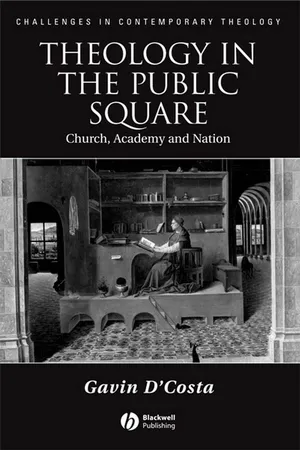
- The author sketches out a fascinating project using examples from US and UK institutions, whereby theology becomes a transformative force within universities.
- Imagines what a Christian university, in which all disciplines have been theologized, would look like.
- Feeds into discussions about the religious identity of denominationally-linked colleges and universities.
- Forms part of a wider attempt to imagine a vital public role for theology that enables it to serve both the Church and the wider community.
- English
- ePUB (mobile friendly)
- Available on iOS & Android
eBook - ePub
About this book
This imaginative study rethinks the nature of theology and its role in universities.
Information
Chapter One
Theology’s Babylonian Captivity in the Modern University
I Should “Theology” and “Religious Studies” Be Terminated?
Since this book is concerned with the health of theology and the Church’s engagement with cultures, it might seem rather odd to begin with a question that intimates the termination of theology within the university, the very place that is central to the future of Anglo-American theology. But as the Israelites found out, living in Babylon can have the effect of purifying the faith as well as destroying it. In what follows I shall be suggesting that theology’s location within the modern western secular liberal university is not unlike the Israelite captivity within Babylon. Theology, properly understood, cannot be taught and practiced within the modern university. This is not a view shared by all Christians, but is held by a number of post-liberal theologians and philosophers, such as Stanley Hauerwas, John Milbank, and Alasdair MacIntyre.1
One way of noticing this Babylonian captivity is in the arguments that are conducted in the modern university about the role of theology. The view expressed by some scientific atheists (Richard Dawkins, for example) is that theology has no place in the modern university. It is a vestige of a religious world and society which has long since crumbled and been discredited. It is a disservice to a modern research university to include such a subject in the curriculum.2 A similar voice is heard from some who teach in departments of religious studies. Donald Wiebe, for example, argues that a scientific, objective, rational study of “religion,” without any privilege being granted to any one religion, is the only intellectually respectable practice in the modern university.3 Dawkins and Wiebe have one presupposition in common, which I shall be calling into question: that there is such a thing as neutral objectivity in any mode of research, either science, Dawkins’s own area, or religious studies, Wiebe’s specialism. However, in another sense I agree with Dawkins’s and Wiebe’s conclusions, but for very different reasons. What are these reasons? In the next section of this chapter I want to look at the process of secularization, as it has affected both the university and the discipline of theology. Secularization is a much debated topic, and I use the word to connote two specific historical processes.4 The foundation of the universities took place in a universe with a sacred canopy, whereby people understood their practices to relate to an organic and cosmic pattern participating in the nature of reality. This reality was divinely created for the good of men and women, for the flourishing of human society, and for participation in truth and love. The modern university, with some exceptions, in contrast, develops its programs and practices without any reference to a sacred canopy. Often finance is the chief criterion, without any organic vision of the relation of the different disciplines, without any shared values regarding the good of men and women, or concerning what truth might possibly be. Augustine, well before the universities were founded, carried out a scathing critique of pagan institutions of learning: their main purpose being vanity in so far as they served purely to gain better employment, and self-promotion.5
This removal of the sacred canopy in institutional terms is one definition of secularism and it is one reason why I believe Dawkins and Wiebe are correct. The attendant sense denotes the way in which the process of secularization both creates and is created by various intellectual presuppositions embedded in our intellectual institutions. Of course, institutions do not have ideas, people do. But, through their organization and processes, institutions always reflect ideas about the good, the true, and the worthwhile. By briefly examining the secularizing of the university and the discipline called theology, I hope at least to indicate why Dawkins is correct: theology cannot flourish in the modern university. However, I think Dawkins is also wrong for two reasons. The modern university, like modern secular societies in England and the United States, has a strong commitment to liberal pluralism: cultural, intellectual, and religious diversity. In principle, it should be committed to facilitating real diversity, as opposed to Dawkins’s impulse to be rid of it. Further, if theology can argue that it is a real intellectual discipline and requires a different sort of university for its health, and, if it were healthy, would be a contributor to the common good, then in principle, liberals should be willing to entertain funding this alternative university for the common good, and the flourishing of real pluralism. In chapter three I shall be pursuing this argument in some depth, facing a number of serious objections to such a “sectarian” proposal, not least the question of funding, and the problem of the authority under which such a university is finally accountable. In much of this I draw on the experience of Roman Catholic universities in the United States. Every country is different and internally diverse.6 However, because I happen to be a Roman Catholic Christian, I have focussed more on Catholic universities. This is not intended as an un-ecumenical gesture, and I do believe that in England there is more chance of a Christian university than a Catholic university, but it is necessary to work out ideas and practice with some sensible focus. I very much hope that Christians of all denominations can find something in this exploration and bring their rich heritage to bear on the question and further the discussion.
But what of Wiebe’s proposals? At least, unlike Dawkins, he wishes to retain the place of religion in the university. In the third section of this chapter, I shall be arguing that his type of position is called into question because of its methodological assumptions, shared by Dawkins: that a neutral, objective, rational study is the only method permissible in the university. In fact, I would wish to go further and argue that the discipline of “religious studies,” as conceived by some of its major theoreticians, is intellectually flawed, such that it, not theology, has a contestable place in the modern research university. I want to argue that the legitimate place for the study of religions is within a theological religious studies, such that world religions are part of a theological curriculum. As it exists under Wiebe’s model, it is a secular study of religions, privileging secularism, over against the objects of study. Wiebe’s desire to escape from ideology is utterly ideological. I should make it very clear that I am not contesting religious studies’ role in the modern university; rather, I contest some forms of it, regarding their self-description.
Two further clarifications before proceeding with my argument. In this first chapter I shall be making apparently sweeping comments about the modern university. I beg the reader’s patience, as in chapter two I attempt to check these comments against empirical studies of universities in the United States and England. For certain readers, it may be worth reading chapter two first if they are unconvinced that there is a problem with the health of theology. Such a reader might say two things: there are Christian universities in the United States, so what is all the fuss about? They may add: Christians, like yourself, argue that it is impossible to do in the modern university precisely what you are doing. Does that not show that the modern university encourages pluralism far more than is admitted in the arguments of this book? To the first question, I respond in chapter two that American Christian research universities have already lost their salt, or are in the process of doing so. They retain their Christian character primarily by having a Mass on holy days, having well-resourced chaplaincies, and being actively involved in social work to the poor and less privileged. These features are very important, and I think they are a vital element of a Christian university, but they are not enough to constitute a Christian university. Many secular universities might boast all three of these features. Further, the deeper question is, how does the Mass, or prayer meeting, affect the curriculum, the interrelationship of the disciplines, or the research methodologies utilized not only in theology but other disciplines? Very few universities, hardly any among those studied, can answer these questions in any form of thick description. I argue, with a number of significant American scholars, that Christian universities are dying or dead in the United States. The second question is admittedly uncomfortable. Yes, I write this book with research leave from my own secular liberal university, Bristol, and my colleagues generously tolerate my writing suggesting that our department be closed down. I also enjoy good rigorous conversation with colleagues within the university who come at issues from very different angles. I am not arguing that the modern liberal university be closed, but rather that alternative universities be encouraged alongside it, to facilitate long-term serious intellectual pluralism. Such universities can train new generations in alternative intellectual traditions of theory and practice, rathe...
Table of contents
- Cover
- Table of Contents
- Challenges in Contemporary Theology
- Title
- Copyright
- Dedication
- Preface
- Chapter One: Theology’s Babylonian Captivity in the Modern University
- Chapter Two: Babylon in the Church: The United States and England
- Chapter Three: Cyrus Returns: Rebuilding the Temple in Babylon
- Chapter Four: Why Theologians Must Pray for Release from Exile
- Chapter Five: The Engagement of Virtue: A Theological Religious Studies
- Chapter Six: The Marriage of the Disciplines: Explorations on the Frontier
- Epilogue: Theology: The Church at the Heart of the Christian University Proclaiming the Word to the World
- Bibliography
- Index
- End User License Agreement
Trusted by 375,005 students
Access to over 1.5 million titles for a fair monthly price.
Study more efficiently using our study tools.
Frequently asked questions
Yes, you can cancel anytime from the Subscription tab in your account settings on the Perlego website. Your subscription will stay active until the end of your current billing period. Learn how to cancel your subscription
No, books cannot be downloaded as external files, such as PDFs, for use outside of Perlego. However, you can download books within the Perlego app for offline reading on mobile or tablet. Learn how to download books offline
Perlego offers two plans: Essential and Complete
- Essential is ideal for learners and professionals who enjoy exploring a wide range of subjects. Access the Essential Library with 800,000+ trusted titles and best-sellers across business, personal growth, and the humanities. Includes unlimited reading time and Standard Read Aloud voice.
- Complete: Perfect for advanced learners and researchers needing full, unrestricted access. Unlock 1.5M+ books across hundreds of subjects, including academic and specialized titles. The Complete Plan also includes advanced features like Premium Read Aloud and Research Assistant.
We are an online textbook subscription service, where you can get access to an entire online library for less than the price of a single book per month. With over 1.5 million books across 990+ topics, we’ve got you covered! Learn about our mission
Look out for the read-aloud symbol on your next book to see if you can listen to it. The read-aloud tool reads text aloud for you, highlighting the text as it is being read. You can pause it, speed it up and slow it down. Learn more about Read Aloud
Yes! You can use the Perlego app on both iOS and Android devices to read anytime, anywhere — even offline. Perfect for commutes or when you’re on the go.
Please note we cannot support devices running on iOS 13 and Android 7 or earlier. Learn more about using the app
Please note we cannot support devices running on iOS 13 and Android 7 or earlier. Learn more about using the app
Yes, you can access Theology in the Public Square by Gavin D'Costa in PDF and/or ePUB format, as well as other popular books in Theology & Religion & Christian Theology. We have over 1.5 million books available in our catalogue for you to explore.