- Illustrates new methodological directions in analyzing human social and biological variation
- Offers a wide array of research on past populations around the globe
- Explains the central features of bioarchaeological research by key researchers and established experts around the world
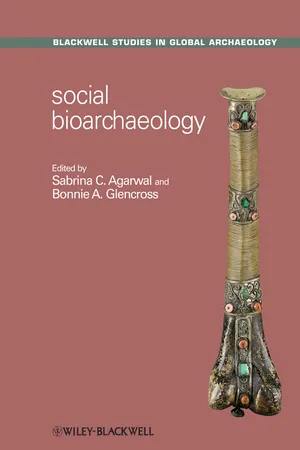
eBook - ePub
Social Bioarchaeology
- English
- ePUB (mobile friendly)
- Available on iOS & Android
eBook - ePub
Social Bioarchaeology
About this book
Information
1
Building a Social Bioarchaeology
“Every man is the builder of a temple, called his body, to the god he worships, after a style purely his own, nor can he get off by hammering marble instead. We are all sculptors and painters, and our material is our own flesh and blood and bones”
(Henry David Thoreau).
Perhaps nothing so easily invokes the mind to reflect on life and death as the human skeleton. While often regarded as the dry and inanimate remainder of the corpse, during life the skeleton forms the building blocks of our personal and social experience with the world. As such, for the archaeologist, human skeletal remains provide an assemblage like no other. Skeletal remains offer not only corporeal evidence of human existence, but also a biological material that has been crafted and shaped through the cultural experiences of life and death.
The duality of skeletal remains as both a biological and cultural entity has formed the basis of bioarchaeological theoretical inquiry. Bioarchaeology has developed and long used various biocultural models that emphasize the synergistic relationship of social, cultural, and physical forces in shaping the skeletal body (Armelagos et al. 1982; Armelagos and Van Gerven 2003; Schutkowski 2008). The use of biocultural approaches are best exemplified in population-based bioarchaeological studies that strive to interpret indicators of health and disease as adaptive responses of the skeleton to large-scale change, such as shifts in subsistence (Cohen and Armelagos 1984; Cohen and Crane-Kramer 2007), political or economic change (Goodman et al. 1992), or periods of contact (Larsen and Milner 1993). This population-based perspective and emphasis on the adaptive response of the skeleton to environmental (cultural) forces can be considered the founding and first wave of theoretical engagement in bioarchaeology. The commitment of the field to move away from the historical legacy of typological classification in skeletal biology, and more recently to also go beyond mere paleopathological description (Armelagos 2003), has continued to fuel studies of skeletal stress and adaptation in past populations in a growing number of areas such as the examination of growth and development (Cardosa 2007; Hoppa and Fitzgerald 1999; Saunders 2008), metabolic stress (Brickley and Ives 2008), postcranial biomechanical adaptation (Ruff 2008; Ruff and Larsen 2001; Stock 2006), activity-related markers and degeneration (Kennedy et al. 1999; Weiss 2007; Weiss and Jurmain 2007), and trauma (Grauer and Roberts 1996, Milner et al. 1991; Torres-Rouff and Costa Junqueria 2006; Walker 2001) (For comprehensive overviews of the field at large see Cox and Mays 2000; Larsen 1997.)
The second wave of engagement in the field of bioarchaeology has focused on two somewhat divergent areas of research. First, in recent decades there has been a growing interest in the application of state-of-the-art technologies to investigate health and lifestyle in past populations (Iscan and Kennedy 1989; Katzenberg and Saunders 2008; Saunders and Katzenberg 1992). For example, there has been ongoing advancement in the field in the use of isotopic methods for reconstructing diet and migration patterns (see, for example, Dupras and Tocheri 2007; Eckhardt et al. 2009; Katzenberg 2008; Sealy 2001; White et al. 2004), ancient DNA analysis of pathological conditions (Roberts and Ingram 2008), and the use of noninvasive micro-imaging technologies (Cooper et al. 2004; Rühli et al. 2002). While the use of state-of-the-art technologies to examine archaeological material is considered groundbreaking, this work has been criticized as primarily descriptive and lacking in the analytical and population-based focus of the field at large (Armelagos and Van Gerven 2003, Hens and Godde 2008). However, these studies have been instrumental in advancing the scientific arsenal of methods available to bioarchaeologists and opening new avenues of inquiry to be pursued in studies with larger-scale questions. The second area of research in recent decades has been the critical examination of the nature of archaeological skeletal samples themselves. While the early work of 20th-century skeletal biologists and even modern popular representations of the field, particularly in relation to forensic anthropology, give the impression of skeletal remains as unbiased and unambiguous sources of clear biological evidence, bioarchaeologists have long known the reality and challenges of their data set. The publication of the seminal paper by Wood et al. (1992), entitled “The Osteological Paradox,” brought to the forefront the nature of the skeletal record, specifically the role of selective mortality and hidden heterogeneity in susceptibility to illness (or frailty), their influence on the formation of skeletal samples, and how these affect our interpretation of health and disease in past populations. The challenges first outlined by Wood et al. (1992) are now expected and routine considerations in all bioarchaeological investigations of health in the past, and in fact have served to push our understanding of the biological and cultural component of individual and population frailty in disease processes further (Byers 1994; Cohen et al. 1994; Goodman 1993; Jackes 1993; Milner et al. 2008; Wright and Yoder 2003). Similarly, although early assessments of the challenges in the construction of demographic profiles in past populations were considered to be insurmountable roadblocks (Bocquet-Appel and Masset 1982), there has been much research on ways to better estimate and deal with the effects of demographic change on the composition of archaeological samples (Hoppa and Vaupel 1992; Jackes 1992; Konigsberg and Frankenberg 2002; Milner et al. 2008; Paine 2000).
The third wave of engagement within the field of bioarchaeology is anchored in the greater contextualization of archaeological skeletal remains. While the incorporation of archaeological contextual information has been central in the study of mortuary practice for some time (for example, see Beck 1995; Chapman et al. 2009; Parker Pearson 2001), only recent studies have emphasized the deeper understanding of past life ways gained through the close and simultaneous consideration of archaeological, historical, and ethnographic sources of data along with skeletal analyses (Blakey and Rankin-Hill 2004; Buikstra and Beck 2006). Attention to the biocultural adaptation of the skeleton and the use of state-of-the-art methodology is still maintained in the field; however, current research seeks to integrate elements from biological, behavioral, ecological, and social research. The goal of this new bioarchaeological practice is to transcend the skeletal body into the realm of lived experience and to make a significant contribution to our understanding of social processes and life in the past. Simultaneously, contemporary bioarchaeologists are more keenly aware of the present social world in which their work is practiced, and in which the skeletal remains they study are still situated in. Careful thought and attention is now paid to ethical considerations and the role of multiple stakeholders in bioarchaeological research. While early studies in human osteology emphasized biological and evolutionary change, contemporary bioarchaeology is now clearly a discipline poised to engage with social theory. In building a social bioarchaeology, scientists are engaged in the construction of the biological and social essence of individuals from the ground, or if you will skeleton up. Ultimately the interest is in reconstructing the biological footings of the skeletal body and cultural framework that has together created the social spaces and the social creatures that inhabit them. The collection of papers here considers the constituent parts in the construction of social bioarchaeological analyses; an emphasis is placed on skeletons and skeletal samples as basic building materials that are contextually situated, engaged in a biocultural framework, and that support and reflect social representations of identity in health and disease.
The opening chapters in Part I, Materials and Meaning: The Nature of Skeletal Samples, present the potential interpretive meaning and practical nature of skeletal samples. The focus in these chapters is on how the skeletal materials we study came to be, and how people in the past can affect and transform people today. In Chapter 2, Zuckerman and Armelagos begin with a recount of the origins of bioarchaeology in North America, from its initial focus on racial typology in the 19th and early 20th centuries, toward the population- and evolutionary-based research of the “New Physical Anthropology.” Building from earlier critiques of the field (Armelagos 2003, Armelagos and Van Gerven 2003; Armelagos et al. 1982; Goodman 1998), the authors also expound the practical challenges in recent decades in grounding the field in a biocultural-oriented anthropology. They go beyond, to further outline how theoretical sophistication in the field has led to the greater historical and archaeological contextualization of skeletal samples, and growing concern for uncovering aspects of the social past. Most importantly, Zuckerman and Armelagos emphasize how the strength of the biocultural approach lies in its power to keep bioarchaeology socially relevant with the exploration of the links between biology and sociopolitical processes affecting identity, health, and disease.
In Chapter 3, Turner and Andrushko explore the meaning and importance of human remains to both archaeologists and culturally affiliated descent groups. In recent years there has been much written on the ethical practice of excavation, curation, and study of indigenous human skeletal remains by bioarchaeologists (Turner et al. 2004; Walker 2008; Walker and Larsen 2004), and particularly in regards to the U.S. federal NAGPRA law (Bowman 1989; Rose et al. 1996; Thomas 2000; Watkins 2004). However, there has been little discussion of the role of descendent populations and the ethical practice of bioarchaeology internationally. With their presentation of the practical and ethical concerns of studying human skeletal remains in Peru, Turner and Andrushko begin the dialogue on how bioarchaeologists trained in the post-NAGPRA age can carry out ethical bioarchaeology outside North America. They describe the very different ethical landscapes in researching indigenous Peruvian remains in comparison to those in North America, which are created by the unique relationships between indigenous Peruvians and the central government, tourism, and foreign archaeologists. In doing so the authors are able to delineate the potential pitfalls and successes possible in the practice of ethical bioarchaeology internationally. The emphasis in their paper is one of how descent groups form different views and agendas for research involving human remains, and the critical importance of developing a deep understanding of the contextual influences of descendant perspectives and beliefs that is widely applicable to bioarchaeological research in any geographical area.
The remaining two chapters in Part I deal with the realities of the skeletal record itself, specifically the processes of taphonomy that create the burial record and the biased construction of skeletal populations. Although there has been much recent discussion in mortuary archaeology on the social formation of burials (Beck 1995; Rakita et al. 2005), there have been few systematic and detailed bioarchaeological studies on the formation of prehistoric skeletal samples. In Chapter 4, Weiss-Krejci provides a detailed discussion of the formation processes of mortuary skeletal samples using a graphic model exemplified with historic and ethnographic examples. She then goes on to provide a retrospective analysis of the formation of mortuary deposits from the prehistoric Mayan site of Tikal. She illustrates how preconceived notions of “burials” and what constitutes a grave, can color our perceptions of mortuary behavior in the past. Further, this work reminds us that we must remain vigilant of the fact that the data we collect and how we categorize it is in fact part of our interpretation, and to use our own cultural norms as the basis for these categorizations can render the results removed from the social realities of the past. In Chapter 5, Jackes critically examines human skeletal samples as the underpinnings of social bioarchaeological analyses. She prudently crafts the groundwork noting inherent properties of skeletal samples and their implications for reconstructing the social past. This work begins with a demonstration of the influence of changing social and historical context from immigration, emigration, and war to religious affiliation, occupation, social status, and personal choice, on the composition of the historic cemetery of St. John’s Anglican Church in Sydney, Australia. Jackes correctly reminds us that even the basic materials of bioarchaeology are designed through the influence of numerous social and physical factors, and that this has far-reaching implications for our interpretations of the past. Above all, this paper emphasizes the need to view both the skeleton and its context as integrated and inseparable, requiring the incorporation of both for the effect of a stronger foundation to social bioarchaeology.
In Part II, Social Identity: Bioarchaeology of Sex, Gender, Ethnicity, and Disability, chapter authors address the complex structure of social identity. Identities are composed of multiple features that are connected together in an edifice of individual personhood. While this includes sex and gender, constructs of identity also include aspects such as age, religion, ethnicity, and disability. Hollimon (Chapter 6) begins with the universal variable of biological sex, which underlies not only socially constructed gendered identities but research of any type involving human remains. She starts with an examination of theoretical issues relating to the sex/gender duality touching upon discussions of embodiment and nonbinary genders in bioarchaeology. Hollimon then goes on to discuss the study of gender identity through various sources in bioarchaeology including mortuary analysis, activity reconstruction, body modification, health and disease, diet, violence and warfare. She points out that since bioarchaeologists investigate human biocultural interactions framed within their historical and cultural context, they are well equipped to supply a comprehensive picture of sex and gender in the archaeological record. In outlining future avenues of research in the field, Hollimon points to the use of queer theory and life course perspectives to better understand the construction of gender identity in the past.
In Chapter 7, Zakrzewski emphasizes the need to address complexity and fluidity of identity through holistic analyses. In her chapter, she builds up evidence for the often intangible feature of ethnicity as expressed in a medieval skeletal assemblage from Iberia. Metric and nonmetric skeletal traits have long been considered important in the application of biological distance studies of inter-group variation among large temporal or geographically separated groups (for reviews see Pietrusewsky 2008; Saunders and Rainey 2008). Using these traits, Zakrzewski demonstrates how observed bioarchaeological identity within the Islamic Écija is composed of a variety of divergent yet superimposed aspects, including religion and ethnicity, and even age and gender. This work enables new insights on interpretation of intra-group variation and the identification of small subgroups of individuals with unique social and ethnic identities. Most importantly, Zakrzewski illustrates how ethnic identity is formed within a dynamic system constructed of social processes and personal choices, and how in the Iberian example migration and religious conversion are driving forces.
The chapter by Barrett and Blakey (Chapter 8) is also concerned with the reconstruction of identity, along with social inequality, as articulated through the skeletal and historical life histories of enslaved Africans in colonial New York. Employing multiple lines of evidence, including the skeletal, archaeological, and documentary records, the authors reconstruct the lives of the men and women of the New York African Burial Ground. Contextualizing the New York African Burial Ground project within the greater field of African American bioarchaeology, Barrett and Blakey utilize skeletal stress markers to make distinctions between the quality of life and health shared by enslaved individuals born free in Africa...
Table of contents
- Cover
- Half title page
- Series page
- Title page
- Copyright page
- List of Tables and Figures
- Notes on Contributors
- Series Editors’ Preface
- 1 Building a Social Bioarchaeology
- Part I: Materials and Meaning: The Nature of Skeletal Samples
- Part II: Social Identity: Bioarchaeology of Sex, Gender, Ethnicity, and Disability
- Part III: Growth and Aging: The Life Course of Health and Disease
- Index
Trusted by 375,005 students
Access to over 1.5 million titles for a fair monthly price.
Study more efficiently using our study tools.
Frequently asked questions
Yes, you can cancel anytime from the Subscription tab in your account settings on the Perlego website. Your subscription will stay active until the end of your current billing period. Learn how to cancel your subscription
No, books cannot be downloaded as external files, such as PDFs, for use outside of Perlego. However, you can download books within the Perlego app for offline reading on mobile or tablet. Learn how to download books offline
We are an online textbook subscription service, where you can get access to an entire online library for less than the price of a single book per month. With over 1.5 million books across 990+ topics, we’ve got you covered! Learn about our mission
Look out for the read-aloud symbol on your next book to see if you can listen to it. The read-aloud tool reads text aloud for you, highlighting the text as it is being read. You can pause it, speed it up and slow it down. Learn more about Read Aloud
Yes! You can use the Perlego app on both iOS and Android devices to read anytime, anywhere — even offline. Perfect for commutes or when you’re on the go.
Please note we cannot support devices running on iOS 13 and Android 7 or earlier. Learn more about using the app
Please note we cannot support devices running on iOS 13 and Android 7 or earlier. Learn more about using the app
Yes, you can access Social Bioarchaeology by Sabrina C. Agarwal, Bonnie A. Glencross, Sabrina C. Agarwal,Bonnie A. Glencross in PDF and/or ePUB format, as well as other popular books in Social Sciences & Archaeology. We have over 1.5 million books available in our catalogue for you to explore.